

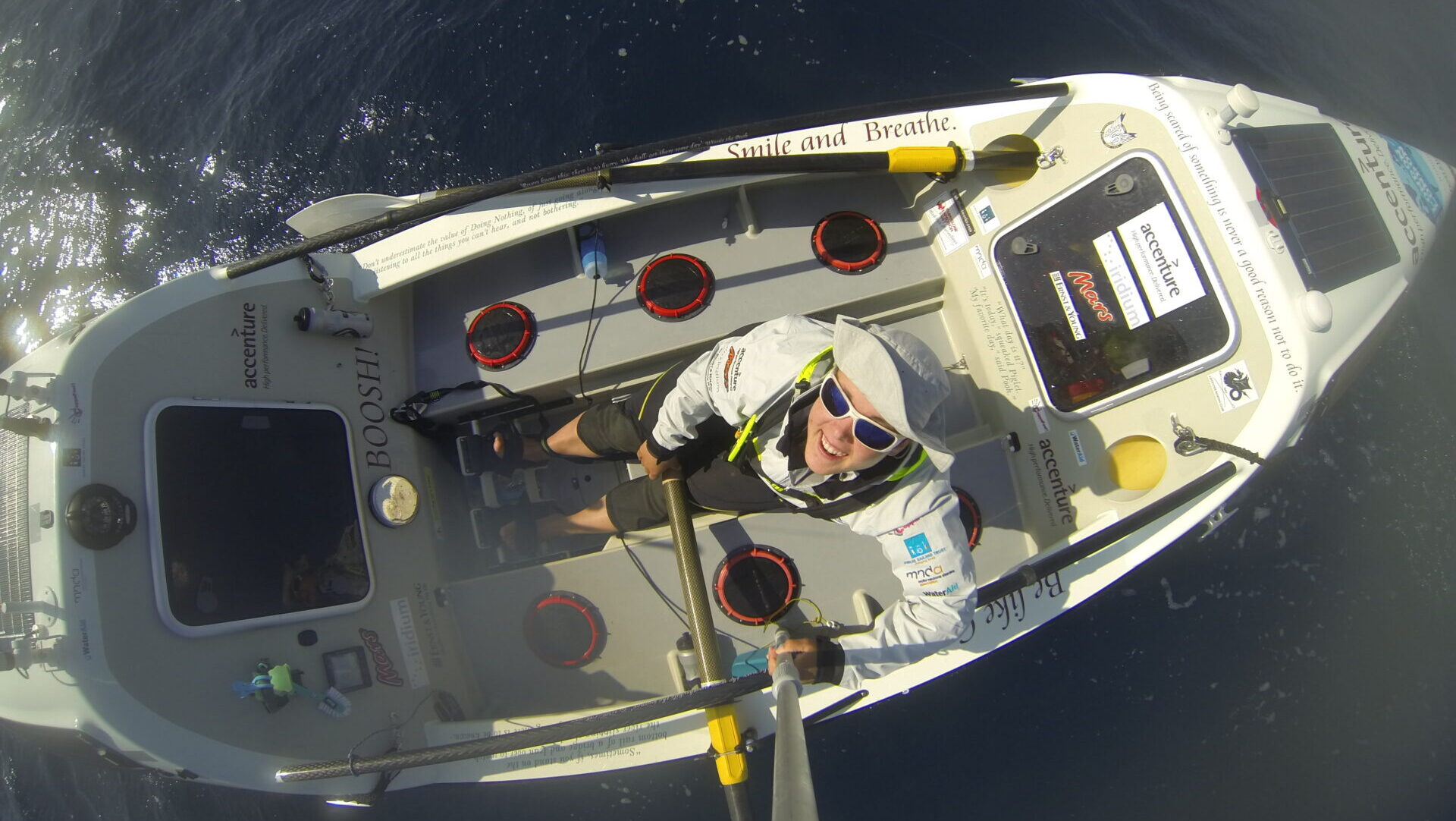
Sarah Outen was seventeen when curious seals surfaced beside her kayak off the coast of Scotland: “I remember very clearly having seals follow the boat and try and nibble at the toggles on the boat, and I just love that interaction,” she says. “It was as close to the water as you’re going to be. You’re never going to be off the water, but it was a way to be in that world.”
The desire to immerse herself in the natural world without trying to conquer it has shaped almost every chapter of her life. Outen is one of Britain’s most accomplished endurance adventurers: the youngest person and first woman to row solo across the Indian Ocean, later the first woman to row solo across the Pacific from Japan to Alaska, before completing a 20,000-mile, mostly human-powered journey around the world by rowing boat, bicycle, and kayak. The expeditions earned her an MBE, a Fellowship of the Royal Geographical Society and several Guinness World Records, yet when she talks about adventure, records barely feature. Instead, she returns to the sea itself: its unpredictability, its wildlife, and the quiet relationship it demands.
“I was very active, doing lots of sports at school,” she says. “I was very lucky. I had lots of opportunities through school for different sports and the Duke of Edinburgh’s Award, and then through a local kayaking club.” She first learnt to kayak at around eleven or twelve, before discovering Ellen MacArthur’s account of sailing solo around the world as a teenager. “These different things kind of just led me to a sense that one day I would like to do a big journey somewhere, somehow, but I didn’t know what it would be.”
At home, “there was a lot of encouragement for trying new things. I don’t feel there was ever anything that we were told: we don’t want you to do that, don’t have a go.” The greater influence, however, came from watching her father live with rheumatoid arthritis: “I saw him not be able to do lots of things that he used to love doing. I saw him not be able to walk as much and become wheelchair bound.”
For years, she interpreted that experience in the only way she knew how. “I’ve got to go and make the most of it, and at all costs will push through,” she says. Looking back, she sees something more complicated: “I’ve got one go in this body, and I need to really honour it, value it. Yes, push myself, and do things that I want to do, but I’ve got to really look after it. Because actually, I’ve experienced a lot of health challenges, in part driven by how I’ve pushed myself in the past, and sort of just ignored all the signals from my body.”
The University of Oxford arrived almost by accident. She had applied to Worcester College without really understanding the admissions process and instead received an offer from St Hugh’s. This became one of the happier accidents of her life: “Just the idea of not being able to walk on the grass felt really formal,” she says of Worcester. St Hugh’s, by contrast, felt immediately welcoming: “There was something really relaxed about the atmosphere… it’s got these lovely big gardens that you can walk all over.” She still describes ending up there as “a total gift.”
But Oxford was also harder than she had anticipated. During her gap year, she had been diagnosed with hypothyroidism. Only in retrospect did she realise how much it shaped her experience: “Some patterns that were playing out whilst I was at Oxford, they actually just weren’t being managed properly.”
What kept her grounded was the water: “I loved being a part of the boat club, especially, and the fact that that, for me, was a way to get out and about pretty much every day of the week on the water.” She still laughs about one race against the men’s crew. “We won, we beat the boys… One of our crew members made us some T-shirts afterwards, saying: ‘Making boys cry since 2006′, because it was alleged that there were some tears in the boys’ crew.”
However, a ruptured cruciate ligament during her first term ended previous hopes of an army scholarship: “I couldn’t do that anymore and I didn’t really have a plan at that stage. So I thought in my head, oh, okay, I’m going to row across an ocean.” Then, during her second year, the idea began to crystallise. An email advertising an Atlantic rowing race arrived just as Ben Fogle and James Cracknell’s crossing was being shown on television: “I was just blown away by the idea of it. I thought, wow, this is a really cool equation. I love oceans and I love rowing. Put these together.”
Just before her second-year exams, her father died suddenly: “It was a real shock, and very quickly again, I knew that I still wanted to go and row across an ocean, but that actually I did want to do it solo,” she says. “Nobody knew my dad. Like, as in the people that I was chatting to that might become the team, didn’t know him. It felt like a very personal mission. The ocean was this big, unknown, sometimes scary place that I had to cross. And grief was also this big, unknown, sometimes scary place that I needed to find a way through and to sort of live with.”
Turning that decision into reality took another three years: “To graduate, fundraise, build a boat, learn what to do with the boat, get sponsors, raise money, train, figure it out.” She describes it as solving a giant jigsaw puzzle: “Starting out with a mind map… okay, I’m here, I need to get to here, what are these different bits that I’m going to need?” What made it feel achievable was its ordinariness: “I had a real sense in that first journey that this isn’t rocket science. Other people have done it, so therefore I’ve got a good chance of doing it.”
She puts a lot of emphasis on the beginning: “We all have things we would like to do. And also, we can sometimes get a bit caught up in all the reasons why we can’t, why we shouldn’t. So, often, I think even just getting to the start of any project, be it an ocean or a degree or whatever it might be, it’s a big deal.”
Training for the row was surprisingly simple compared with organising it: “I focused on building an endurance base, so I borrowed a rowing machine and put it in my mum’s greenhouse, and I would go and row for a few hours at a time,” she says. First aid, radios, navigation, “how to fix bits of the boat,” took priority, on the theory that fitness would build itself at sea. What she hadn’t anticipated was the relentless mental load of being entirely responsible for herself: “The boat’s moving in some way, all of the time… you always need to be switched on, because you need to make sure you’ve closed the door so that if you were to capsize, suddenly you’re not flooded with water. It was a big adjustment, and I think that took me by surprise a little bit, was just how much of an adjustment that was.”
To survive months alone at sea, she learnt not to think in terms of the ocean: “I was reminding myself that I was as prepared as possible, and just taking it a little bit at a time, cutting down the overall journey… What about the next couple of days? What about the next hour? Sometimes, just what about the next minute?” It is a philosophy that now extends far beyond her expeditions: “We can get really overwhelmed when we look at everything that we’re trying to manage. There’s something going: okay, what can we control? I can’t control the weather. But I can control the thoughts that I’m having, or how I’m relating to those thoughts. I can control how I’m looking after my body, what I’m eating, and when I am sleeping. Bit by bit, then we can find a way through the stormiest of times, or the biggest of obstacles, when we kind of break it down into little bits.”
The ocean tested that outlook almost immediately. Her first attempt lasted just eleven days before deteriorating weather forced her back. “I looked at it as a warm-up lap,” she says. “Yes, I had failed. I had not made it across the ocean, but I was looking at it as: great, I’ve just survived eleven days at sea. I looked after myself. I still want to go back and have another go.”
The second crossing took 130 days. It made her the first woman to row solo across the Indian Ocean and only the fourth person ever to do so, although she dismisses the records almost as quickly as they’re mentioned. “It was more about what the journey meant to me than it did about any statistic or record,” she says. “For me, it’s more about the experiences… certainly with that first journey, it was about honouring my dad and honouring my grief and my healing, really.” Her emphasis is on sincere gratitude: “I just feel extraordinarily privileged and lucky, fortunate to have had the support of so many people… whether it’s a big sponsor putting in money, or Joe Bloggs at the end of the road encouraging me.”
She expected to miss the water when she landed, yet “about a month before I was due to land, I didn’t want to go back to land,” she says. “I was so comfortable in my boat world that I was a bit scared about what it would be like to transition back to being on land.” The landing itself, in Mauritius, was dangerous. “I ended up crashing onto a coral reef, essentially,” she says. Once she was safe, the adjustment turned out to be its own ordeal. “It was quite mind-boggling. It was quite stressful to try and keep tabs on things,” she says, remembering watching other people move her belongings around.
“At sea, I had very limited battery supplies that were charged by the sun. It was a real matter of life and death that I managed that battery supply… whereas on land, I had people who haven’t had those experiences, and they are leaving lights on, they’re wasting some food.” Confronted by a supermarket shelf of ten kinds of orange juice, she says it “was really stressful in new ways”. Alongside all that, there was real pleasure too. “It’s lovely to see friends and family. It was great to be able to walk on land and appreciate all the different foods… It was great to get a massage, my muscles were happy. I got to see my mum’s dog again.”
That heightened sensitivity has never quite left. On her later round-the-world journey, she watched wind patterns shift: “seeing disruption to that, which was having a direct impact on what I was doing and plastic pollution, which was really worrying”. What troubles her most is the distance most people keep from it: “There’s still quite a lot of blind spots for a lot of people. It feels like there’s this kind of ‘Oh, it’s out there somewhere, my activities don’t matter, or it’s not impacting me yet.’ That feels bothersome and is really worrying to me.”
The pace of human-powered travel transformed the way she experienced the world: “You feel a mountain range very differently when you’re chugging up it slowly on a bike… you would have felt the changing of the seasons, the changing of the landscapes.” The bicycle, she discovered, was also a universal conversation starter: “Even if I didn’t have the same language, we would see bikes, and there would be this sort of shared sense of ‘Hi, yeah, we’re on this thing together.’”
The biggest challenge came in the North Pacific: a typhoon, subsided to a tropical storm by the time it reached her, which she chose to ride out: “Knowing what I know now, in that wonderful thing of hindsight, I wouldn’t have stayed. But that was who I was at that time. I kind of looked through all the information that we had, and I thought that we had a good chance of getting through it.”
What followed was chaos: “It was so violent and so chaotic and so frightening to be a part of that.” Three days strapped into her bunk in a racing harness, watching through the cabin door: “All of these waves, these huge waves, topping out at fifteen metres, just looked like the Alps. Everything was white, and there was spray going everywhere, and I saw an albatross just soaring over the top of it. And I just thought, wow, I wish I were the albatross. I have never been so frightened in my life, certainly not for a sustained period. It was horrible and very uncomfortable.”
The Japan Coast Guard rescued her, but her boat, Gulliver, could not be brought with her and was cast adrift. “To me, it felt like I had sort of let my boat down somehow,” she says. “When you’re solo with a boat, you’re a little team, you look after each other.”
The sheer weight of emotional aftermath came after: “My way of coping was to sort of almost get on with it, and kind of put it to one side, what had happened, and just focus on moving forward, because I wanted to go back to sea.” Months later, the reckoning was almost forced: “I was having nightmares, I was crying all the time. I was scared all the time. I was really struggling.” When Gulliver herself turned up years later in the Philippines, during the making of a documentary about the journey, it started again. “Lots was being stirred up, and around that time, Gulliver turned up in the Philippines, which brought up lots of memories and emotions. It was like, okay, there’s another layer of healing to do here. We need to deal with this in a more proactive way.”
By the time she finally came home for good, something had to change: “So much of the journey had been about pushing forwards, going, keeping moving, going, getting to the next bit, going,” she says. “And actually, what I came to understand with hindsight, a few years later, was that it took quite a few years to process, to settle, to unwind some of the energy that was in my body from those journeys… now I needed to learn this whole new way of being that was more about softness and yielding and gentleness.”
She laughs gently at who she used to be: “I laugh at my younger self that she was so audacious to put together something as complex as that and as massive. I definitely didn’t fully comprehend just what it would take, emotionally, physically, financially, logistically, energetically.” Asked what she would tell her eighteen-year-old self, she says: “I wish I had known more about the impact of stress and food on my health, and on my autoimmunity and had more softness, and that I paid more attention to things like stretching.” Then she lets herself off the hook: “Some things you have to go through stuff to learn the lessons, I think. You’re not ready to know them until the point at which you’ve learnt them for yourself.”
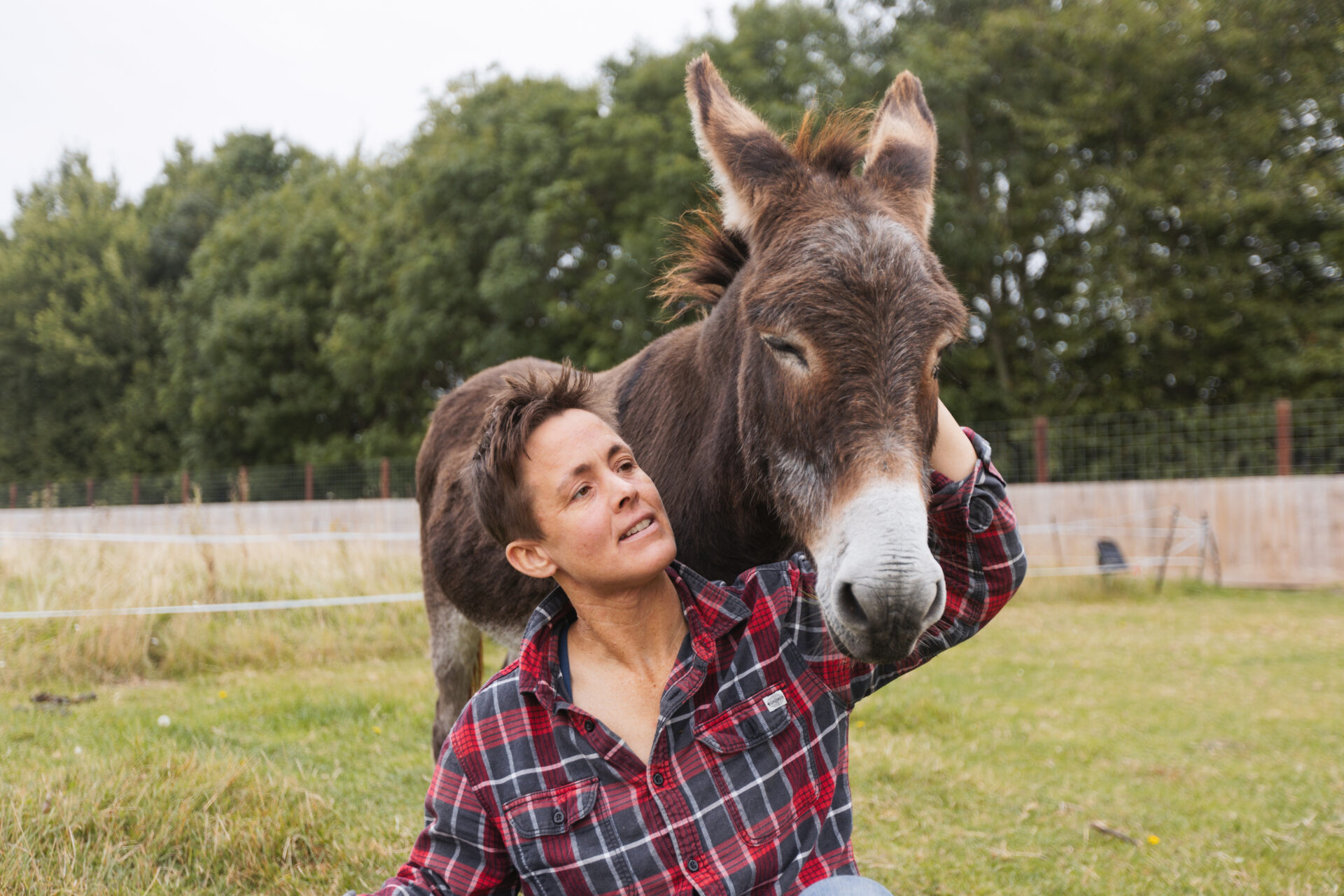
That difficult year, 2018, is also what led her to psychotherapy. She had been advised, coming off the journey, to take her time before deciding what came next. Working with a couple of different therapists, one of them an equine therapist, something became clear: “I thought, I want to be alongside people as they explore their worlds.” Indeed, the parallel with her old life feels obvious to her now: “It does feel like it’s an adventure to sit alongside somebody exploring their world. We don’t know what’s going to come next. We don’t know what’s going to happen. I feel similar senses of awe at the tenacity of the human spirit. What humans can navigate, and how we can find meaning and healing out of some of the darkest times, blows my mind.” Some of her sessions happen outdoors now: “I love that nature becomes my teammate, and the donkeys are my teammates.”
Listening to Outen now, it’s striking that the oceans themselves almost fade into the background. The crossings were extraordinary, but they were never really the destination. They became the landscape through which she learnt to live with grief, embrace uncertainty and, eventually, exchange relentless endurance for the courage to meet both the world and herself with softness.


