

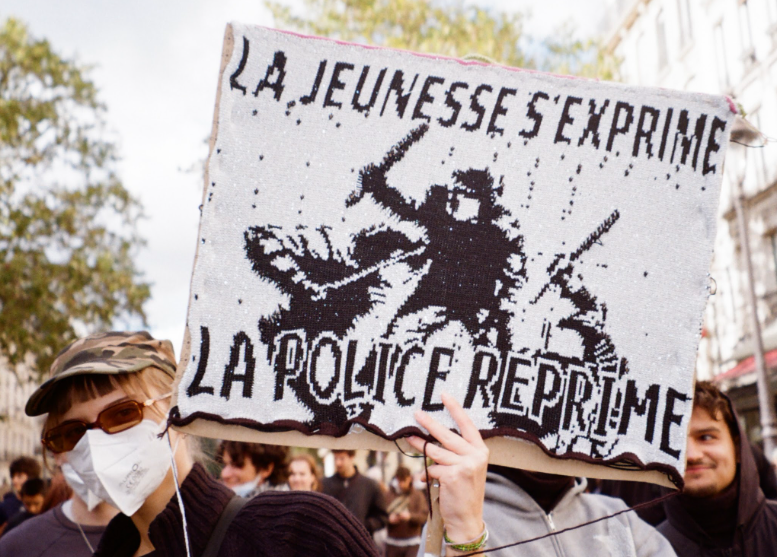
Kiera O’Carroll: the Student Spring
Books, not saline solution against tear gas, are what you’d expect to find in a schoolbag. This isn’t the case for most of my friends back home right now. Since September in France, a wave of protests against failing education, austerity, and the far-right have swept the country. Many talk of a new May 1968, the glorified student movement and nationwide strike. But the failed promises of a revolution are no longer echoed in the halls of Sorbonne University. High schoolers as young as 13 have shown us that political action requires less intellectualism and more strategy, using Snapchat to mobilise because it is their only social media. It’s different from the movement at the end of the sixties because it’s reverberating all across the globe with the speed of the internet; a Student Spring is rising.
From school to university lectures, I have always found it difficult to learn about social justice and the merits of advocacy while being violently repressed for expressing these values. I feel anger, like most students do. When we were told that fascism never shows up as itself but instead as aestheticised popular trends, I had to practice cognitive dissonance to not notice it everywhere. At a university like Oxford, this discord didn’t get any better. I was directed toward Google Forms about collective grievances because “protesting inconveniences others”.
On a FlixBus back from Paris, I heard someone in the next seat criticising the protests. It felt alienating to hear someone misconstrue a struggle you so deeply care about in ten seconds. I thank this person, however, for calling the movement part of a wider Student Spring. Taking its name from the Arab Spring of 2011, those protests fundamentally changed how youth social movements interact with political power in a digital age, with platforms like Facebook helping millions to mobilise against dictatorship. The current Student Spring testifies to the resilience of our generation and the convergence among social struggles.
As I watch unarmed and peaceful students choke on chemical irritants in the water cannons aimed at them, I recall my own experiences of getting tear gas grenades thrown at my feet. Tear gas has recently been scrutinised for its long-term effects like miscarriages or total blindness. The illegality of all of these violent methods is what strikes me; most of the weapons used in France are classified as wartime artillery. UN experts have expressed their concern about the crackdown on these student protests, as France recently deployed the army as reinforcement. Medical reinforcement does not seem to be coming through; in October, my friends and I, along with a volunteer student medic, were the only ones available to help a man struck to the bone by a grenade.
As disproportionate as these measures may seem, they prove just how powerful students are. In under two years of daily protest across the country, students in Serbia achieved the resignation of their populist leader who had been in various positions of power for 14 years. I remember visiting my cousins during the holidays, and nothing had paused. We chanted through the streets of Novi Sad every single evening. In Albania, students are also taking the matter into their own hands, many of whom are playing an active role in their ongoing ‘Flamingo Revolution’. The ‘Cockroach Janta’ student party in India, as in France, called for the resignation of their education secretary. Repressed by lathi baton charges, a colonial-era tactic where police use batons to scatter crowds, reports from Reuters have shown that pellet guns and Varifocal bullet cameras are not territorially confined.
Back in the UK, there is currently less of a culture centred around protest. I believe this disadvantages students. When university fees in the UK tripled to £9,000 in 2010, the protests were vilified in the same way as those in France. The government hoped students would drown in specialised research and ignore their unemployability, recently exemplified by funding cuts to the humanities.
At times, my university feels like a self-contained universe, a playground for ideas, not action. Our moral and communal responsibilities are delayed by learning their history or debating their justifications. My tutorials on utilitarianism and contractualism have taught me this. Universities are both the machines and the victims of the ideology we are taught about. But fear not, a Student Spring is blooming.
Caterina Azzara: If democracy listens, why are the streets full?
I was always told to study. Education, the story went, was the price of a voice: learn enough, and one day people would have to listen. But what happens when the state forgets its side of that promise?
The first answer came from France. Students at Lycée Saint-Exupéry in Créteil, a suburb just south-east of Paris, joined a strike called by their teachers on 21st September and blocked the school, which had gone months without enough teachers or support staff. Within around ten days, the vacancies had been filled, and the blockade in Créteil came to an end. By then, however, the discontent had travelled via social media to other high schools around Paris, and by early October more than 1,000 schools across France had been disrupted. The main pupils’ union set out its demands: more teachers, safe buildings, smaller classes, and the abolition of Parcoursup, the platform that has controlled access to French universities since 2018. By 17th October, joined by teachers and trade unions, the movement had merged with a national protest against the cost of living, which brought nearly 800,000 people onto the streets according to the unions, while the Interior Minister put the figure at 550,000.
Inspired by the French, Italian students took to the streets on 16th October, marching through Milan, Turin, Rome, Naples, Bologna, and Genoa under the banner of “No Meloni Day”, in reference to Prime Minister Giorgia Meloni. They were protesting against crumbling school buildings, a decree imposing a 30% cap per class on students with non-Italian citizenship, and an inadequate education budget. The timing gave their protest particular force as it coincided with the government’s spending plans for next year: while Cittadinanzattiva recorded 68 structural collapses in Italian schools over the past year, the draft budget for 2027, approved by the cabinet on 13th October, makes room for roughly €7 billion in additional defence spending. Hence the central demand of the student collective Osa: that the €13 billion earmarked for new weapons be converted immediately into funds for school buildings.
As the marches grew, so did the violence. In France, 24 schools were burned or ransacked, while protests in Milan and Turin ended in clashes with police. I will not justify it for two simple reasons. The first is that it does nothing to help the cause. In Why Civil Resistance Works (2011), a study of 323 campaigns between 1900 and 2006, political scientists Erica Chenoweth and Maria Stephan found that nonviolent movements succeeded twice as often as violent ones, because they attract far more participants and because repressing peaceful crowds tends to cost a government support. Omar Wasow’s 2020 study of the 1960s American civil rights movement reached a similar conclusion: peaceful marches won public sympathy, whereas riots frightened voters into backing candidates who promised ‘law and order’, tougher policing rather than the reforms protesters demanded. The second reason is that violence buries the cause it claims to serve. Media scholars call this the protest paradigm, in which cameras linger on the burning bin rather than the classroom without a teacher. In France, the Education Minister called the movement “taken hostage by ultra-violent groups”, and the debate shifted from missing teachers to public order.
Yet to dwell on the violence is to miss the more pressing question: why do so many young people feel that protest is the only way to be heard? The question matters because being heard is what democracy promises, and both the French and Italian constitutions place power in the hands of the people. Political theorist Robert Dahl argued that a democracy is judged not only by its elections but by how well it listens to its citizens in between. By that standard, a 16-year-old who barricades her school in order to get a teacher is not attacking democracy; she is exposing its failure.