

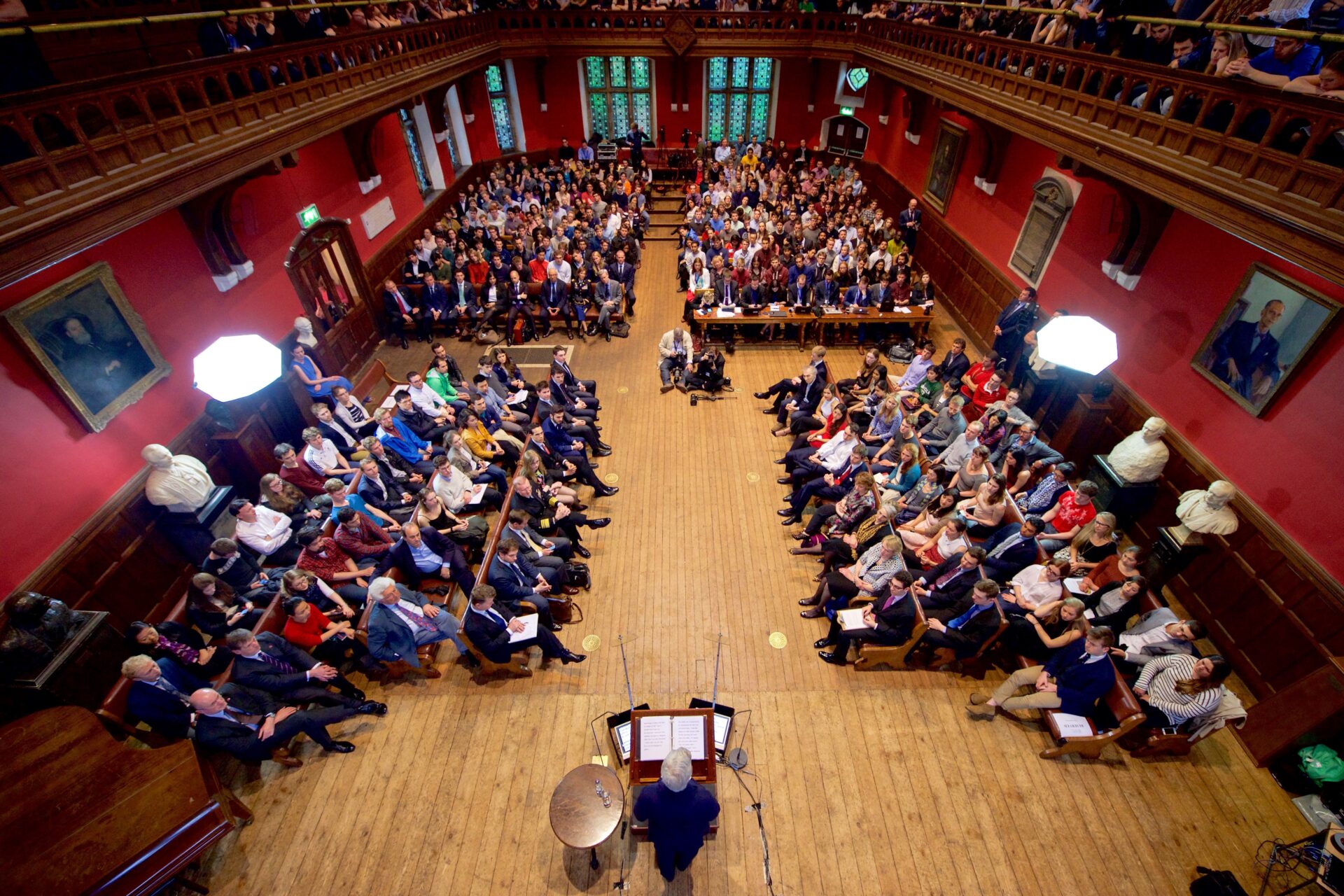
There is a familiar moment during an Oxford Union debate. One speaker finishes, the chamber applauds, and the next speaker approaches the despatch box, likely prepared with several pages of remarks. They thank the President, perhaps make a joke, and begin their speech.
There is nothing inherently wrong with this. If one is stepping into a chamber that has a 200-year history of hosting monumental debates, it would be foolish not to have come prepared. Nevertheless, after attending several Union debates, I started to get the sense that nothing anyone said could substantially affect what came next.
The speeches were sometimes interesting. The speakers (obviously) disagreed. Sometimes, they even directly challenged one another. But I increasingly found myself wondering whether I was watching an actual debate or simply listening to several people deliver their individual arguments on the same subject.
This is not an entirely new complaint. During the Union’s debate on youth activism, Oliver Carter criticised audience members who left after hearing the particular speech they came to see. His objection was straightforward: members were supposed to be discussing a motion, and leaving halfway through meant missing the entire argument.
While his point is certainly well taken, it invites another question: if every speaker had filmed and submitted their contribution the previous afternoon, how much would the debate actually change?
What is a Union debate supposed to do?
The Oxford Union was founded in 1823 and developed as a forum for discussion independent of the University’s constraints. Its establishment provided students an independent space to debate subjects they could not otherwise discuss freely. Two centuries later, the Union continues to place freedom of expression at the centre of its institutional identity.
That history still shapes how people inside the institution understand its purpose. Arwa Elrayess, a former Union President, described a gap between what the wider Oxford student body rewards and what she believes the office of the President demands. A President could organise a term around relatively ‘safe’ debates and probably receive less criticism. But, she argued, this would miss the point of running a “historic debating society, whose entire purpose is to be able to have those discussions, have those debates, that you would otherwise never be able to have”.
Controversy, therefore, is not an end in itself. However, it can be the consequence of taking disagreement between viewpoints seriously. “If a motion leaves everyone in the room in agreement,” she says, “then nobody held a view strong enough to argue”.
Antonio Reis, President-Elect of the Oxford Students Liberal Association (OSLA) and a member of the Union’s Secretary’s Committee, offered a useful distinction. Inviting Einstein to give an individual address would be justified by his expertise alone. Inviting him to a debate would promise something else: an argument tested against opposition.
As Reis put it: “If they’re coming to a debate, it’s because we want to hear an argument.”
A Union debate need not consist mainly of rebuttal. Invited speakers have perspectives that deserve to be heard in their own right. Nevertheless, the opposing case should be capable of imposing demands on their speech. At some point, a debate should make what one speaker says consequential for what the next speaker has to say.
I wanted to know how often that happened. To determine whether speeches actually ‘debated’, I spent 30 hours (of my life that I will never get back) watching 133 speeches across 17 Oxford Union debates from the 2025-26 academic year. I examined whether speakers responded to arguments previously advanced by their opponents, introduced new arguments, repeated material already presented by their own side, and received points of information (POIs).
I rated each speech on a four-point scale, from no engagement with earlier opposing arguments to extensive engagement with several. Contrary to my initial impression, of the 116 speeches capable of responding to a previous opponent, 82 (or around 70%) were coded as containing at least one substantive response. That hardly suggests that speakers universally ignore one another.
But a headline that reads “seven in ten Oxford Union speakers substantively respond to other speakers” would be misleading. A speech qualified if it substantively addressed just one opposing argument, even briefly, with few speeches consistently engaging with previous speakers’ points. Further, I could not reliably distinguish an improvised response from a rebuttal anticipated before the debate.
This revealed a problem with the question I had initially asked. Counting rebuttals could tell me whether a speaker had responded to an opponent. It could not establish whether anything the previous speaker said had materially changed the direction of the discussion.
A debate can contain rebuttals without its arguments meaningfully developing.
The problem with points of information
Ideally, this is where POIs would come in. Unlike a prepared rebuttal, a POI allows an opponent to challenge a speaker while they are speaking. It lets the argument develop in real time rather than waiting for the next scheduled contribution.
Reis described POIs as “super important”, explaining that they force speakers to think on their feet. Akheel Kale, another member of the Union’s Secretary’s Committee, similarly identified them as an important means of facilitating direct interaction between speakers.
The figures, however, complicate this picture. Across the 133 speeches, I identified 216 POI offers. Yet 74 speeches received none at all. In more than half of the speeches I watched, there was no identifiable attempt to interrupt with a question. The Union’s most concrete way of forcing a confrontation of views was alarmingly absent.
Furthermore, the distribution was highly uneven. The debate on whether the West was right to be suspicious of Islam accounted for 110 of the 216 identifiable POI offers across the entire sample. At first glance, this might suggest an exceptionally interactive debate. Yet Kale, recalling the event, described people speaking over one another and an extraordinary number of declined interruptions. His recollection highlights another distinction: confrontation is not necessarily deliberation.
An evening in which opponents repeatedly attempt to interrupt one another might be considerably more confrontational than an evening of uninterrupted speeches. But if speakers consistently refuse those interventions, or if interruptions produce little substantive exchange, the additional confrontation does not necessarily improve the discussion. The findings say something about the purpose of POIs. Their existence cannot guarantee genuine engagement. Their effectiveness depends on whether speakers are willing to allow their opponents to interfere with the arguments they came to deliver.
Responding without really debating
Perhaps an even more revealing question is whether the two sides are addressing the same disagreement in the first place.
Consider the Union’s debate on whether politics should be kept out of sport. The proposition initially approached the motion relatively narrowly, concentrating on the institutional and geopolitical use of sport for political purposes. The opposition, meanwhile, repeatedly invoked a broader understanding of politics, encompassing athlete activism, national identity, and political expression. The distinction matters. The opposition’s use of Tommie Smith and John Carlos, who famously raised their fists at the 1968 Olympics, illustrated the importance of political expression in sport. But defending their protest does not necessarily rebut the argument that governments exploit international sporting competitions for geopolitical purposes.
The two sides could appear to be rebutting one another while operating under different definitions of the motion. Of course, arguing over what counts as ‘politics’ can be productive. The problem arises when speakers use those different meanings without confronting the distinction. As Jacob Rees-Mogg put it: “That is often a problem with the Oxford Union Society. That when a motion says one thing and a speaker thinks something else, he tries and talks around the subject.”
Elrayess identifies a structural reason as to why this can happen. Union motions, she explained, have to be “snappy and quick to the punchline”. Nuance is inevitably lost. Sometimes, she said, “the core idea of the debate gets lost on the speakers who get caught up in the technicalities of the wording”. She also sees value in provocative wording: pushing a proposition towards its limits can force members to discover where their own views lie. But a motion that creates disagreement is not necessarily one that helps speakers locate the precise point of disagreement.
The paradox of the excellent speaker
There is a more fundamental obstacle to making speeches responsive: the Union’s greatest attraction may also discourage improvisation.
The Union certainly possesses an extraordinary ability to attract prominent politicians, academics, journalists, and other public figures. Its members can hear from people with years of experience in subjects they might otherwise encounter only through newspapers, books or television. It would be unreasonable to suggest that these speakers should abandon their prepared arguments simply to respond to whatever the previous speaker happened to say.
Elrayess described the difficulty of assembling opposing benches when invitees object to a motion or to sharing a platform with another speaker, highlighting a fundamental constraint on any attempt to construct a debate: a President cannot create opposing benches if potential participants refuse to sit on them. Her defence of controversial invitations follows from the same principle. “Speakers are invited because their views are influential enough, are listened to enough, that they deserve to be scrutinised,” she told me, “not because we wish to give them a badge of honour”.
That defence depends, in part, on what happens once the speaker arrives. A debate can scrutinise a controversial argument in a way that an individual address cannot, but only if the speaker engages with the arguments made in front of them. Yet the qualities that make somebody worth inviting can also make their contribution more self-contained. An eminent guest might have spent years developing a particular argument. They arrive with a prepared speech, knowing that their performance may be recorded and scrutinised by an audience far larger than the one sitting in the chamber.
Reis suggested that these pressures can discourage spontaneous interaction. With so much riding on a Union appearance, speakers may be reluctant to depart from prepared material or accept challenges that could take their speech somewhere unexpected. Contrast that with a debate night at one of Oxford’s many political societies, like OSLA’s Liquor and Liberalism. There, Reis explains, the lower-stakes environment allows more back-and-forth, even if the ensuing debate may be less polished.
The answer, then, cannot simply be to replace speeches with conversation. The Union should preserve the expertise and preparation that make its guests worth hearing, while ensuring that their arguments face meaningful scrutiny.
Importantly, these ambitions are not mutually exclusive. Prepared speeches and spontaneous responses can coexist. Kale recalled an India-Pakistan debate in which a speaker delivered an effective prepared speech while also responding substantively to challenging POIs. For him, the combination illustrated what the Union’s format can achieve: the benefits of preparation without sacrificing direct engagement.
Debate by design
Asked what she would change if she had unilateral power over the Union, Elrayess suggested experimenting with “different debate structures that allow for more fluid back-and-forths, rather than the speeches we often see”. A more fluid format, she argues, “prevents monologuing that does not serve the instrumental purpose of debate”.
An instructive historical comparison can be made. The famous 1858 debates between Abraham Lincoln and Stephen Douglas were political spectacles, attracting enormous audiences and considerable press attention. Nevertheless, their structure protected something that the Union’s format does not always guarantee: time specifically allocated to responding to an opponent. Each encounter began with a sixty-minute speech, followed by a ninety-minute response from the opposing candidate. The opening speaker then received thirty minutes to reply.
The Union need not reproduce a nineteenth-century two-person contest. It could experiment with a short, protected response period after opening speeches, or a moderated exchange between opposing speakers before the floor debate. Neither would require abandoning prepared remarks. Both would make it harder for speakers to avoid the strongest argument against their position.
Such changes would carry risks. More interruptions could reward theatrical confrontation; rigid rebuttal periods could crowd out expert explanation. But the Union already experiments with whom it invites and which motions it chooses. There is no reason for its format to be beyond experimentation.
A platform for free speech or a forum for debate?
Ultimately, the Oxford Union’s Thursday nights bring two of its institutional ambitions into tension.
The Union claims to be “the last bastion of free speech in the Western world”, as former Librarian of the Union Harold Macmillan put it. It also, however, claims to be the “world’s most prestigious debating society”. These two aims need not be inherently contradictory, but one does not automatically fulfil the other.
Allowing somebody to express an argument fulfils an important free-expression function. Inviting somebody else to express the opposite argument creates ideological diversity. Choosing a sufficiently contentious motion ensures they have something meaningful to disagree about. A debate adds one final requirement: those arguments should meet.
The Union is remarkably good at creating the conditions for disagreement. It chooses contentious motions. It invites people from opposing political traditions. It tolerates views that other institutions might refuse to host. It puts those people on opposite sides of the same chamber.
The prepared pages in a speaker’s hands are not the problem. Nor are prominent guests, provocative motions, rhetoric, or preparation. The question is whether anything that happens in the chamber can force the person holding those pages to depart from them.
Elrayess argues that the Union possesses a rare freedom to host conversations that otherwise might not happen. But creating the conditions for a conversation is not the same as ensuring one takes place. The Union has proved exceptionally good at getting opposing arguments into the same room.
A better debating society would make them collide.
Elrayess also argues that Union debates can change minds, although not necessarily on subjects bound closely to somebody’s identity. More commonly, members arrive uncertain, poorly informed or holding an opinion they have “never once had to defend”. In those circumstances, she says, a debate can genuinely shift their position.
The value of a debate need not be measured by whether somebody walks into the chamber supporting side Proposition and leaves supporting side Opposition. Making people articulate, defend and reconsider their arguments against serious opposition is in itself valuable.