

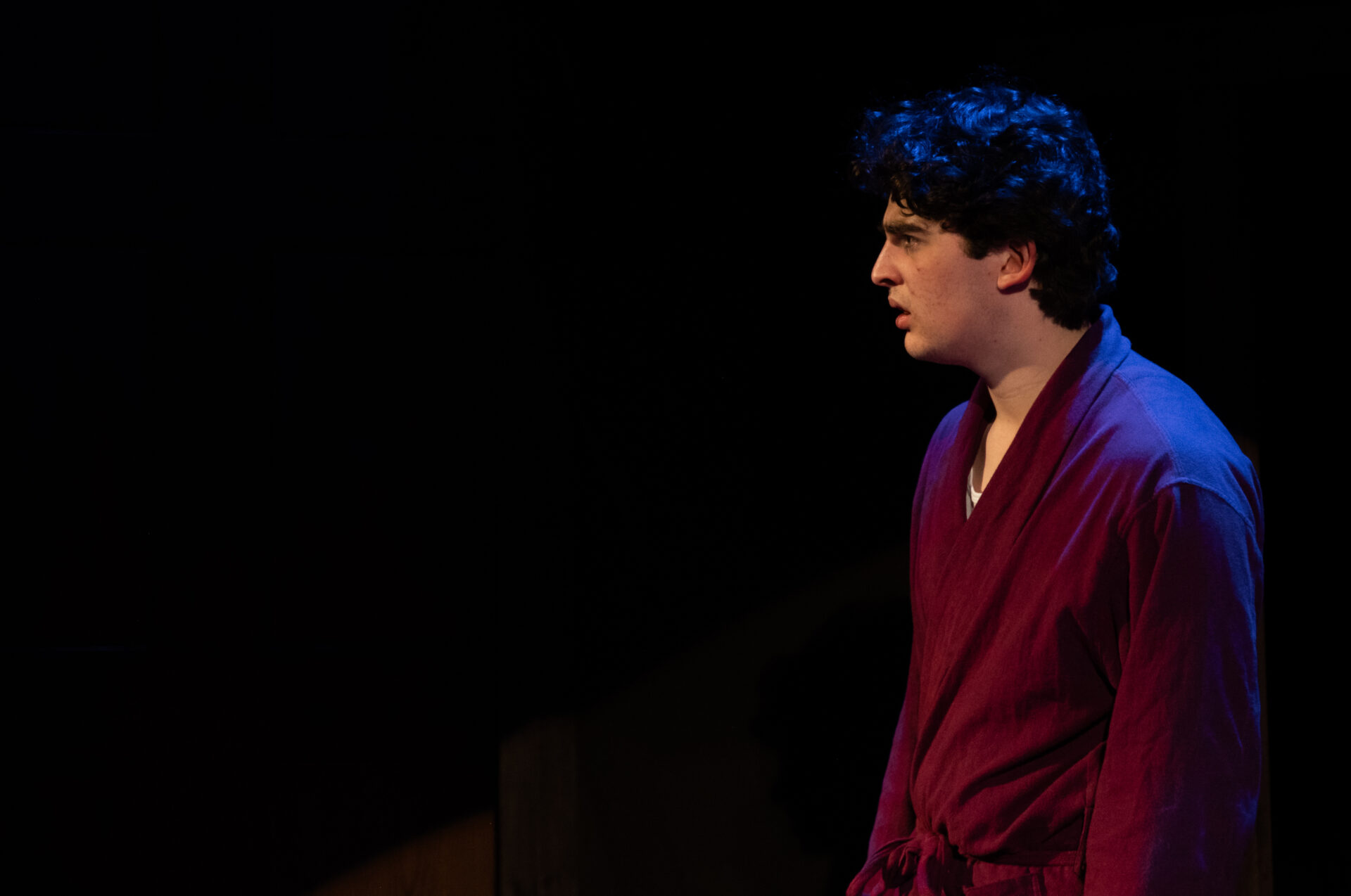
Lighthouse Productions’ Things I Know To Be True achieved the rare feat of combining stellar acting with artful set design. Things I Know To Be True addresses the cracks that exist below the surface of any family, and the conflict between maternal obligation and independence. It’s set in a suburb of Adelaide, Australia and writer Andrew Bovell’s vision was to draw attention to “the dreams we’re sold”, romantically and economically. Its few Australianisms do not detract from its ability to address universal family tensions. The action revolves around elderly married couple Bob (Sam Gosmore) and Fran (Lucía Mayorga)’s attempts, with humorously opposite parenting styles, to prevent their children – now embarking on their adult lives – from losing the ideals they’d been brought up with. As in any family (although this one seems a crazily intense parental challenge) each child presents a different set of concerns: Rosie (Hope Healy) the youngest, gets her heart broken on a gap year; Pip (Gabriella Ofo) leaves her husband; Mark (Alexis Wood) comes out as transgender and to top it all off, Ben (Ediz Ozer) steals £250,000.
This production had lots to live up to. Lighthouse’s marketing (by Magdalena Lacey-Hughes, George Robson and Ben Adams) covered all bases: tickets hidden around Oxford, a partnership with the Magdalen College Instagram, and a preview at a Lincoln College cabaret. Adding to this, physical theatre company Frantic Assembly’s Things I Know To Be True was pushed down my throat near-daily by a school drama teacher, making me even more hopeful that this show would live up to the hype. Luckily, they nailed it, and managed to exceed expectations.
Lighthouse’s interpretation was seeped in nostalgia and did a fantastic job of showing the unsteadiness of ‘family love’. In Cherwell’s preview, the directors mentioned their intent to make the audience recall a “state of growing up”, and to make theatre which “makes you feel something”. Both were certainly achieved.
The script itself presents challenges, as dramatic turning points follow quickly after another. Moments of high tension are so frequent that it would be possible for the acting to come across as overly melodramatic. Lighthouse was sensitive to the extreme anger that the production carried, describing Fran on their Instagram as someone who “picks favourites and traumatises her children”. Since the text of the play is so dramatic, opting to portray it in a stripped back naturalistic style would have been exhausting for the audience. Lighthouse Productions do a fantastic job of reminding the audience that while the script touches on real emotions, it is not quite real, and the characters are comedic archetypes of real life phenomena which the audience will recognise.
Monologues were accompanied by musical underscores, and changes of location represented by different coloured lights. One example of the show’s ability to make the audience feel emotion without aiming for total naturalism was the scene in which Mark is driven to the airport to start her new life as Mia in Sydney. A car was created out of wooden chairs, and soft blue lighting created a sense of serene nostalgia as Mark leaves home for the final time. This enabled what could have been a monotonous chunk of speech to carry emotional weight.
Another effective set device was the gauze screens at the back of the stage, used to highlight the person each character is thinking of as they speak to the audience. This accompanied with a stereotypical wooden door frame structure to connote the home allowed the set to deliver both literal and metaphorical representations of family love. The doorway was a well-chosen focal point: when each family member rushed through it, it indicated that something was about to go awry.
The productions’ success at carrying both humour and tension can be largely credited to Sam Gosmore’s portrayal of Bob. He was ridiculously believable as a tired father who loves his kids, but can’t bring himself to understand their generation’s ‘woke’ attitudes. Highlights were the opening scene where he is defeated by the new-fangled coffee machine, and his later extremely high tension confrontation with Ben: his utter rage that Ben would use his working-class background as a justification for stealing (“how dare you”, he screams) reveals a wounded pride. The actors’ focus in this particular scene was commendable: the audience could not help but fixate on the clenched fists of Ben and his father as they raced through a series of emotions. Ozer as Ben convincingly revealed the fragility of his ‘cool guy’ facáde as his fury turns to desperation and he tries to hug his father, who shakes with rage.
Also fantastically acted was the relationship between Fran and eldest daughter Pip. Ofo as Pip was captivating as a woman desperate to change the mundanity of her life. In a monologue reflecting on childhood – “this garden is the world” – she conveyed a real sense of childish joy, contrasting with her later monologue embracing a more romantically liberated version of herself. She exuded a level of maturity unusual in student theatre.
Lucía Mayorga’s Fran’s physicality gave a convincing sense of a tired mother in a relentless cycle of stress that is largely self-imposed. The harshness of the way she speaks to her eldest daughter compared to the kindness with which she addresses Ben makes the audience reflect on the fact that parents are themselves people, with flaws. A sheer opposite to her stress is Rosie’s total innocence. I found their relationship the most touching – the idea that Rosie had stubborn dreams of independence, but needs her mother’s guidance to execute them really resonated.
The only thing I questioned was the choice to die half of Fran and Bob’s hair grey given that the fact they are quite elderly is heavily implied. Otherwise, the acting and set combined to deliver a fantastic show. As the characters collapsed in grief at the play’s end, I had literal tears in my eyes, something student drama can rarely boast.


