

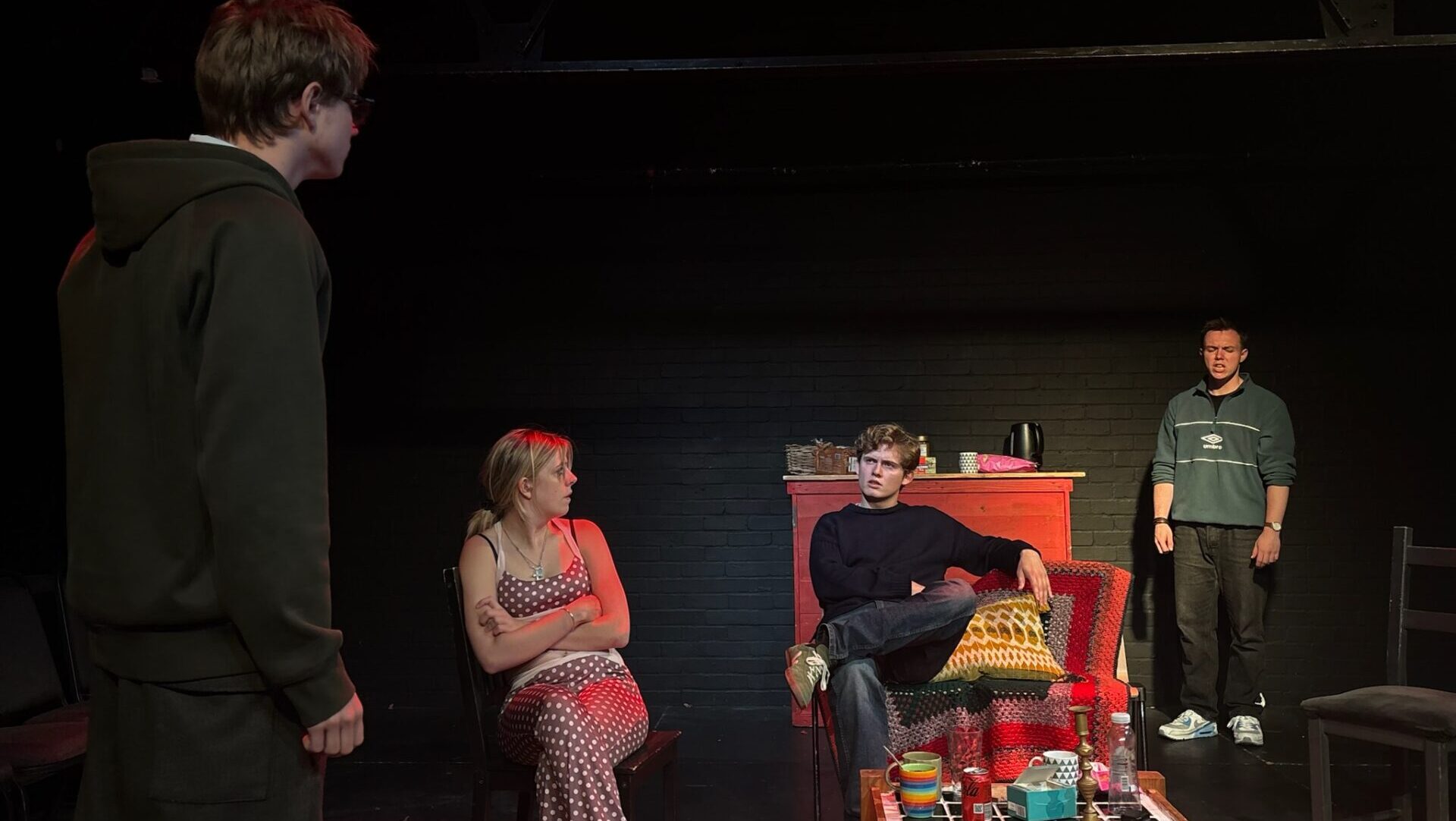
I wasn’t too sure what to expect when I went to see Wide Eyes Productions’ The Slip in Week 7 (written and directed by Orla Wyatt and produced by Milo Ghiandai). In two years at Oxford, I had somehow never made it to a piece of original student writing, and I arrived armed with all the usual, slightly cynical expectations: clunky, over-earnest monologues, low-budget visuals straining under ambition, and an audience politely disengaged.
However, opening night of The Slip immediately dispelled all those assumptions. From the moment I entered the Burton Taylor Studio, I was gripped. It is not a large space, but its intimacy only heightened the emotional stakes of Wyatt’s story, bringing the audience uncomfortably close to every revelation, accusation, and fracture in the group’s relationships.
Based on a true story once heard by the writer-director, The Slip centres around a fatal car accident on a country road. The premise is deceptively simple: Archie (Callum Beardmore) is driving friends Christina (Maisie Lambert), Billy (Sam Drury), and Daniel (Alex Smith) back from a house party during the early hours, when they hit a woman walking by the side of the road. As police questioning unfolds under the scrutiny of Inspector (Cait Kremenstein), the truth emerges piece by piece. What initially appears to be a tragic accident is gradually revealed to be something darker: Billy, drunk and reckless in the passenger seat, had grabbed the wheel and swerved towards a pedestrian with the chilling joke: “ten points for a pedestrian”.
The strength of Wyatt’s script lies not in this final revelation, but in the moral fallout that follows. Rather than constructing a conventional whodunnit, The Slip asks what happens when a group of friends become bound together by a secret. That a fox crossing the road had caused the car to suddenly swerve. The tension comes not from discovering who is responsible, but from watching each character negotiate guilt, loyalty, and self-preservation, all complicated by alcohol-fuelled uncertainty and a tangled web of personal relationships.
Callum Beardmore’s Archie carries much of this emotional burden. While the police investigation provides the play’s structural framework, Archie’s simmering resentment towards Billy provides its emotional core. As layers of their shared history are stripped away, we learn that Billy has long occupied the role of the charismatic golden boy: more popular, more confident, always seemingly one step ahead. Archie, by contrast, is left wondering why he has remained in Billy’s orbit for so many years, even after leaving university. Beardmore impressively navigated this transition from controlled anxiety to explosive anger, culminating in a final act that felt genuinely unsettling.
Sam Drury’s performance was equally compelling. While it would be easy to play Billy as a straightforward villain, the performance avoided this generalising caricature. Billy’s recklessness is undeniable, yet the play also exposes his insecurity and self-destructive tendencies. Drury excels at capturing the contradictions at the heart of the character: the effortless charisma that draws others into his orbit, alongside a deep immaturity that ultimately proves destructive both to himself and those around him. As his confidence is gradually stripped away, moments of vulnerability begin to emerge, complicating the audience’s response to him without ever excusing his actions. The result is a character who remains frustratingly human even as the audience’s sympathy evaporates, embodying the play’s wider exploration of toxic friendship, masculine insecurity, and the devastating consequences of thoughtless cruelty.
Caught at the centre of these tangled loyalties is Christina (Maisie Lambert), perhaps Wyatt’s most tragic figure. Blackout drunk at the time of the accident, she is kept in the dark by the others for much of the narrative. As a result, she becomes a focal point for the group’s collective dishonesty. Chrstina’s complicated relationships with both Billy (her ex-boyfriend) and Archie (who she has been sleeping with) contribute to this, adding another layer of messiness to the group’s dynamic. Whether her involvement with Archie is genuine affection or an unconscious attempt by him to wound Billy remains unresolved, and the play is stronger in its refusal to provide a definitive answer. Lambert brought real depth to the role, conveying Christina’s mounting moral unease as she gradually realises that those closest to her may be concealing the truth about the accident.
Meanwhile, Alex Smith’s Daniel functioned as the uneasy mediator of the group, caught between competing loyalties and increasingly aware of the moral cost of silence. His constant back and forth between truth and lies provides an important counterpoint to Archie and Billy’s increasingly volatile rivalry, grounding the play’s larger questions of guilt and accountability. As an ensemble, the cast succeeded in creating a web of friendships that felt genuinely lived-in long before the audience’s arrival. Their interactions carried the easy familiarity, private jokes, and unspoken tensions of relationships forged over years, making the gradual disintegration of those bonds all the more compelling to watch. By the play’s conclusion, not only the mystery had been unravelled, but also the friendships themselves.
The technical elements of the production deserve equal praise. Juliet Taub’s lighting design made particularly effective use of the Burton Taylor’s intimate space, helping to delineate shifts between police interviews the night before and the present moment. At key points in plot, changes in lighting and colour subtly heightened the sense of unease without ever becoming distracting. Ice Dob’s sound design complimented the production’s visuals, building tension and underscoring the emotional weight of the play’s most dramatic revelations. Together, these elements elevated the play from an Agatha Christie-like whodunnit to a psychologically-charged thriller.
Opening night of The Slip demonstrated an impressive confidence from Wyatt, who serves as both writer and director. The play as a whole had a remarkable command of both character and atmosphere. The result was a tense and morally complex drama that explores not only the consequences of a moment’s recklessness, but also the fragility of friendship, the corrosive effects of guilt, and the stories we tell ourselves to avoid confronting the truth.
Wyatt’s script handled the pacing of these weighty themes and gradual revelations with remarkable assurance. This was no mean feat given the play’s fragmented structure, which moves fluidly between interrogations on night of the accident, its aftermath, while also shifting between competing perspectives and imperfect recollections.
As the lights came up, I found myself still turning over the production’s questions – perhaps the strongest endorsement a piece of theatre can receive. The Slip is proof of the calibre of Oxford’s original student writing and theatre, as what could have been a simple mystery became a compelling study of guilt, friendship, and the consequences of a single reckless decision. Sharp, unsettling, and emotionally intelligent, The Slip is a striking showcase of the ambition and talent behind Wide Eyes Productions, while establishing Wyatt as a writer-director to watch.