

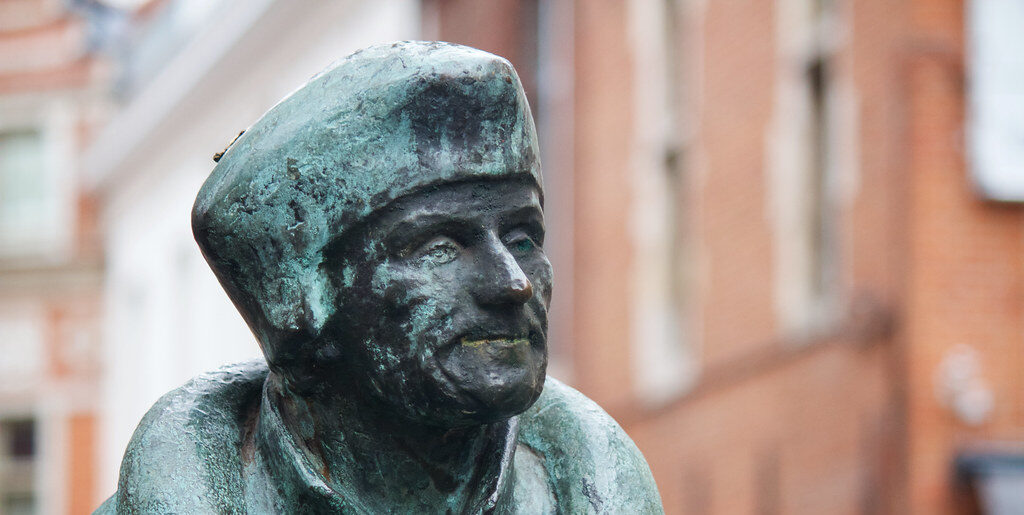
Erasmus had a content problem.
By 1525, Europe’s most famous humanist was being pirated, misquoted and buried beneath unreliable editions. “Is there anywhere on earth exempt from these swarms of new books?” he demanded in the preface to his 1508 Adagia. Print had made ideas wonderfully democratic. Unfortunately, it had done the same for bad ideas, plagiarism and errors. Mangled editions of Erasmus’s own letters travelled under his name faster than he could disown them. “The sheer multitude of books creates a glut”, he complained.
His quarrel was not really with Johannes Gutenberg’s printing press. It was with what happened once Gutenberg’s innovation met the market: printers, chasing speed and profit, flooded the Republic of Letters with texts of wildly varying quality. The problem was no longer access to information, but how to judge an abundance of it.
Five centuries later, the glut has acquired a familiar interface. Open a search engine and ‘Ask Gemini’ hovers nearby; Google search results arrive pre-digested into an ‘AI Overview’; Microsoft Copilot offers to summarise your email before you have to suffer the inconvenience of reading it. More telling is how hard it is to say no. Google says AI Overviews “can’t be turned off”, directing users to its separate ‘Web’ filter, while the more committed refusenik can append ‘-AI’ to a query, or the ‘udm=14’ URL parameter. What began as an experiment is now the default. Opting out is the specialist manoeuvre.
The appeal is obvious. Once a neatly sourced AI Overview can answer your most obscure question in seconds, the old ritual of opening six blue links and piecing together an answer yourself begins to feel wilfully inefficient. But that convenience is also the temptation: implicit in each click is the invitation – you needn’t read this yourself. Erasmus’s “swarms” of books still sat on shelves one could choose not to visit; AI now stands between us and the shelf, offering to read it first. James Marriott’s newly published The New Dark Ages calls this wider retreat from cognitive effort the “Great Simplification”: leisure reading declines; attention fractures; even television plots repeat themselves for viewers presumed to be checking WhatsApp. AI pushes the argument further: we are outsourcing not only our attention, but the first act of interpretation itself.
Erasmus offers a less gloomy sequel to information overload. Faced with his own glut, he did not read less; he learned to read more carefully. His 1516 Novum Instrumentum, produced by comparing Greek New Testament manuscripts against one another, became a landmark of textual criticism. The abundance of unreliable print generated new methods for tracing provenance and separating the authentic from the plausible. The technology that made error cheaper also made discernment more valuable. Renaissance Europe had, in effect, invented the fact-checker. What if AI produces the same counter-swing?
Photography offers a useful precedent. When Louis Daguerre unveiled his process in 1839, painting lost its monopoly on one of its oldest jobs: faithfully fixing a face, landscape, or moment. Accurate representation suddenly had a mechanical competitor – and worse, a progressively cheap one. Painters did not respond by trying to ‘out-photograph’ the camera. At the famous 1874 exhibition that critic Louis Leroy mockingly christened as ‘Impressionist’, Monet, Renoir and Degas made conspicuous what the camera could not. Through subjective brushwork and improbable colour, they rendered what was felt rather than what could be reproduced mechanically. Monet’s 1890-91 Haystacks series, 25 canvases of the same subject, painted across different hours, seasons and weather, makes the point. The brushwork makes no attempt to hide their creator’s human touch. Where the photograph seemed to efface the labour of representation, the Impressionist canvas flaunted it.
History often appears to be a constant pendulum. Romanticism answered Industrialisation’s cultural flattening with Wordsworth’s “spontaneous overflow of powerful feelings”. An excess of Romanticism, in turn, provoked Realism, the return to ordinary life and close observation. Culture develops an appetite for whatever the previous age has made scarce.
AI has renewed the old scarcity of trust. It counterfeits the appearance of knowledge almost frictionlessly, at a scale and fluency that Erasmus’s Europe could not have imagined. A citation can be hallucinated in seconds but, once exposed, the suspicion it leaves lasts much longer. Trust in a brand or source takes years to accumulate and one search bar to puncture.
But accuracy cannot be the whole story. Humans are perfectly capable of getting things wrong, yet we still seem to prefer human work even when the work itself is identical. In a 2023 experiment, researchers showed participants the same AI-generated artworks, labelled either “Human-created” or “AI-created”. The human label alone made people like and value them more. Perceived effort and the sense that there was a story behind the work helped explain why. Art itself is defined, to a degree, by its context. We value not only the finished object but the person we imagine behind it. Artificiality therefore unsettles something beyond accuracy; the inefficient things, such as handwriting, marginalia, drafts, print newspapers and visible edits, consequently acquire a peculiar new luxury. As with Monet, proof of labour becomes proof of life.
Advertising may be the clearest place to watch this mechanism operate in real time, precisely because brands are attentive to shifting audience values. Commercial director Ash Xu noticed brands increasingly spotlighting the creative process itself, hiring her not just to shoot the advert but to shoot a companion film documenting how it was made. Similarly, at New York Comic Con in 2025, DC president and publisher Jim Lee pledged that the company would not support AI-generated storytelling or artwork: “not now, not ever.” Vince Gilligan’s Apple TV series Pluribus puts “This show was made by humans” in its end credits. Heineken answered the rise of AI companionship with its “Real Friends Aren’t Artificial” campaign, turning the AI wearable into an argument for the considerably older ritual of having a beer with a mate.
Crucially, this new premium on human provenance is acquiring market value. Gartner predicts that by 2027, 20% of brands will deliberately position themselves by the absence of AI in their businesses and products. The prediction rests partly on mistrust: 72% of consumers Gartner surveyed believed AI-generated content could spread false or misleading information, prompting Senior Principal Researcher Emily Weiss to foresee an “acoustic” turn towards brands perceived as less “impersonal and homogenous”. Mirroring the rise in ‘organic’ labelling for food produce, once production becomes cheap and abundant, knowing who made something, and how, becomes as valuable as the product itself. Provenance shifts from footnote to selling point, as Gutenberg’s flood of print raised the value of scholars who could tell the authentic text from the corrupted one.
Employment gives this human premium rather higher stakes. Stanford researchers have found no economy-wide AI jobs apocalypse, but something more selective: among 22-25-year-olds in highly AI-exposed occupations (software development and customer service among them) employment is now 19% below that of peers in less-AI-exposed industries. Stanford says the gap is driven largely by reduced hiring rather than redundancies, and concentrated where AI automates human tasks rather than complementing them. It is widening fast, increasing from 15% when Stanford first documented it in July 2025 to 19% by June 2026. The familiar anxiety that AI might take our jobs is beginning, at least at the bottom of some career ladders, to acquire numbers.
Yet the counter-movement is visible too. PwC’s analysis of more than a billion job adverts finds AI-exposed junior roles seven times more likely to demand traditionally senior skills such as leadership and strategic thinking; as routine work becomes automatable, judgment and creativity become more valuable. The appetite for the human, then, need not be sentimental. When a machine can supply competent output, proving what remains distinctively yours acquires economic value. AI may be squeezing the bottom of the career ladder while raising the price of the qualities hardest to automate.
Admittedly, there is something suspiciously convenient about all this optimism. Pendulums do not always swing back because sometimes the new technology simply wins. Nobody mounted a revival of horse-drawn travel once the car arrived, and letter-writing has quietly become a niche hobby for the sentimental few. AI may behave the same way in some fields: routine writing and translation could simply disappear into automation, while elsewhere the glut grows without ever producing its glorious counter-swing.
There is also a difference in what, exactly, is being displaced. The car mechanised physical locomotion and email made correspondence considerably faster. AI arrives on more intimate grounds, replacing cognitive and creative labour, the very activities Western culture has spent centuries treating as markers of selfhood, authorship, and intelligence. Threats to identity provoke a different register of anxiety than threats to convenience. And the compressed timeline sharpens the unease: adoption that once unfolded over generations now happens between software updates.
And even where a genuine ‘renaissance’ does occur, it’s worth asking who gets to have it. We remember Monet, but not Ernest Meissonier, once the darling of the Salon, nor the hundreds who failed, or could not afford, to make the same turn. Erasmus’s philology was a pursuit for an educated few in a mostly illiterate Europe. If ‘verified human content’ becomes a premium option, the ‘renaissance’ risks being less a cultural rebirth than a luxury good: a small, well-lit room of authenticity for those who can afford to escape an ocean of automated content that everyone else remains submerged in.
None of this scepticism cancels hope; it just means the pendulum requires some pushing. Discernment seems more useful than resistance. With the recent addition of AI-generated prompts in ChatGPT, where even your own requests are being automated, it becomes increasingly pivotal to notice which habits we surrender to it. Thinking has always involved a certain amount of wasted time: the bad first argument, the paragraph abandoned after an hour of muddled sentences. The polished thought usually owes something to the half-formed, incoherent one that came before it. Friction is not always inefficiency; sometimes it is where judgment is made.
So, read a print newspaper some mornings. Not from nostalgia or because print possesses some inherent virtue, but for the minor inconvenience or small pleasure of deciding what you think before a chatbot decides what deserves your attention. Get to the source before the algorithm digests it. Let a thought remain awkward, unfinished, even wrong, before it is optimised or gently flattered into agreement.
This is an AI age. Whether we will get a renaissance is harder to know: retrospect supplies the capital R. The people living through the last one had no such luxury. They had a glut of new information, unreliable technology and rather a lot of reading to do.
So do we.