

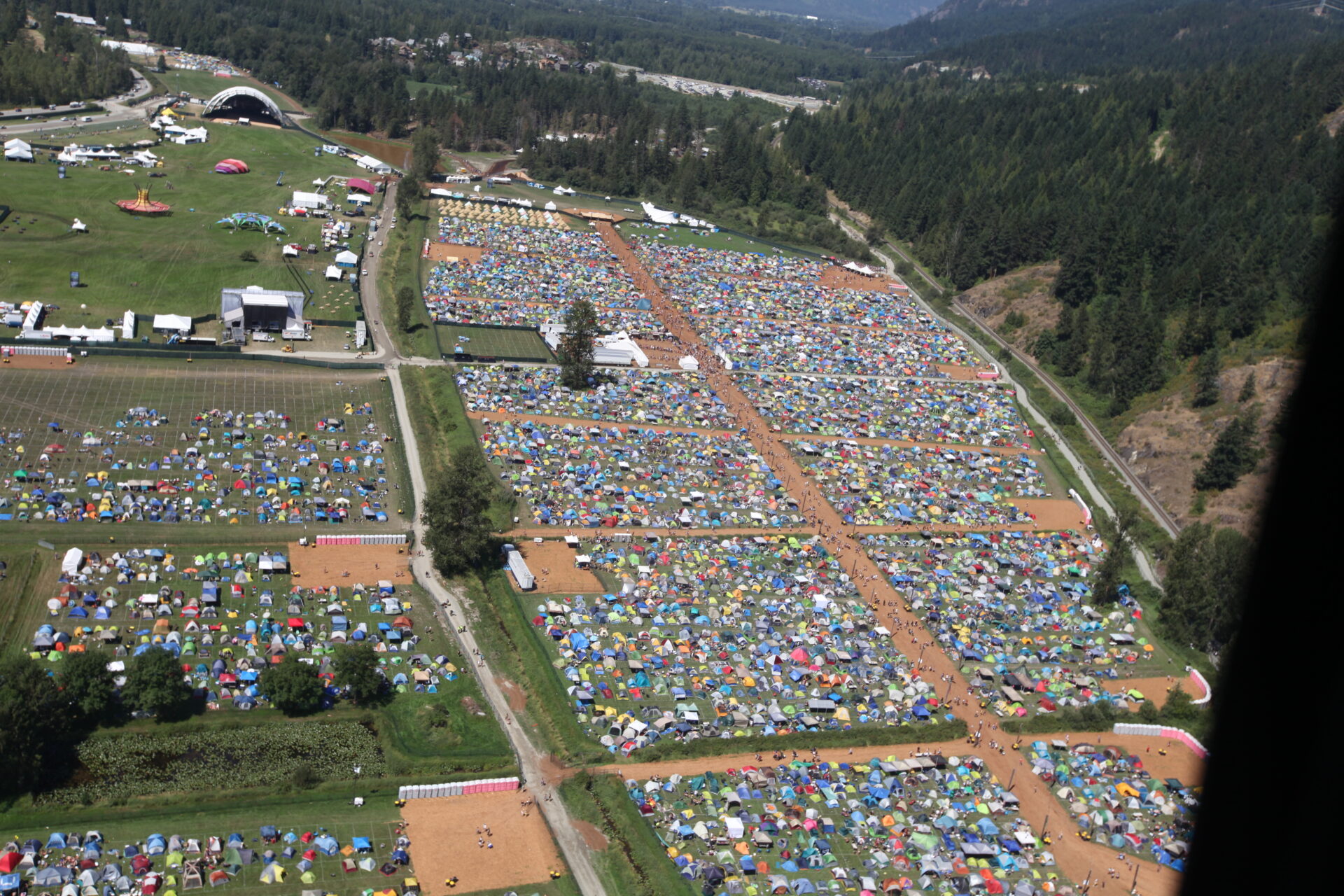
The music festivals of the summer have packed up and moved on. Stages and sound systems have been dismantled, litter cleared, and land reseeded. While little now remains to suggest that thousands of festivalgoers descended on the outdoor spaces that host open-air festivals, a less obvious question lingers: what impact did all the noise have?
Many of the environmental costs of festivals are already widely acknowledged. With audiences travelling from afar and large sound systems and lighting requiring significant energy, festivals emit substantial amounts of greenhouse gases that contribute to global warming. They also produce and send tonnes of non-recyclable waste to landfill. Similarly, camping equipment is often treated as single-use – for example, at last year’s Reading Festival, over 55 tonnes of tents were abandoned.
The venues themselves can also suffer due to the pressures of music festivals. Heavy equipment and large crowds compact soil, reducing the water and oxygen that can reach roots. In fact, campaigners in Finsbury Park argued that the two hazardous trees Haringey Council felled in advance of the electronic-music festival Krankbrother in 2025 had reached such a state of ill health due to excessive trampling from previous festivals.
Yet there is a rarely discussed type of pollution without which music festivals simply could not function: loud sound. Though we can see speaker cones vibrating and metal fencing rattling, loud sound is sometimes overlooked as a pollutant since it is more or less invisible. However, as acoustic ecologists often point out, sound is an important part of our environments and can actively shape relationships between organisms, rather than simply being background noise. This, in turn, means that sound itself may disrupt ecosystems.
Of course, open-air festival sites are also habitats, and the organisms that inhabit them reside not only in the landscape, but in the soundscape too. In fact, scientific research suggests that the drastic changes to the acoustic environment that music festivals cause can be harmful to nearby organisms. For example, loud low-frequency sound has been associated with stress responses in some organisms, including those in aquatic habitats. Further, loud music can significantly reduce bat activity, potentially fragmenting important habitats. Similarly, loud sound may reduce nestling survival rates, while one study suggests that the resulting reduction in biodiversity may persist even after an event finishes.
The tricky trade-off is that what drives wildlife away is part of what festivalgoers come for: the visceral thrill of loud music pulsing through the body. Indeed, festival sound systems are designed to enhance this very experience, comprising massive subwoofers capable of producing loud low-frequency sound. The challenge, then, is to preserve this experience while reducing its ecological impact.
Festivals have already begun reducing waste, improving public transport, and switching to cleaner energy. Noise should become part of that sustainability effort too. Moving forward, more research is required to identify which species are the most vulnerable and at what times of the year, which frequency ranges cause the greatest disturbance, how long effects last, and whether events of shorter duration are safer. With this information, festival organisers would be better equipped to stage acoustically sustainable festivals.
The solution, then, is not to cancel music festivals nor to strip away the powerful sound that makes them exciting. Instead, we must understand the effects of loud sound well enough to reduce unnecessary environmental harm, a particularly important objective since festivals take place in vulnerable ecosystems that are already under increasing stress due to climate change.