

Who gets to make art, who gets to see it, and whose art history gets told? Oxford’s artistic identity may seem firmly established: the Ashmolean’s collections, the portraits and sculptures tucked away in university colleges, and the dreaming spires that have made the city famous. This is only part of the picture, look closer and a more varied artistic landscape begins to emerge.
This Michaelmas, the city offers new ways of thinking about art and its place in the world. From Mike Nelson’s unsettling installation at Modern Art Oxford and Rhodes House’s exhibition exploring the meaning of home, to the Ashmolean’s exhibition on Aphrodite’s artistic legacy and display of work by contemporary Bangladeshi artist Soma Surovi Jannat, a city is revealed whose artistic heritage is as much about asking new questions as preserving old answers.
Mike Nelson: The past is never past
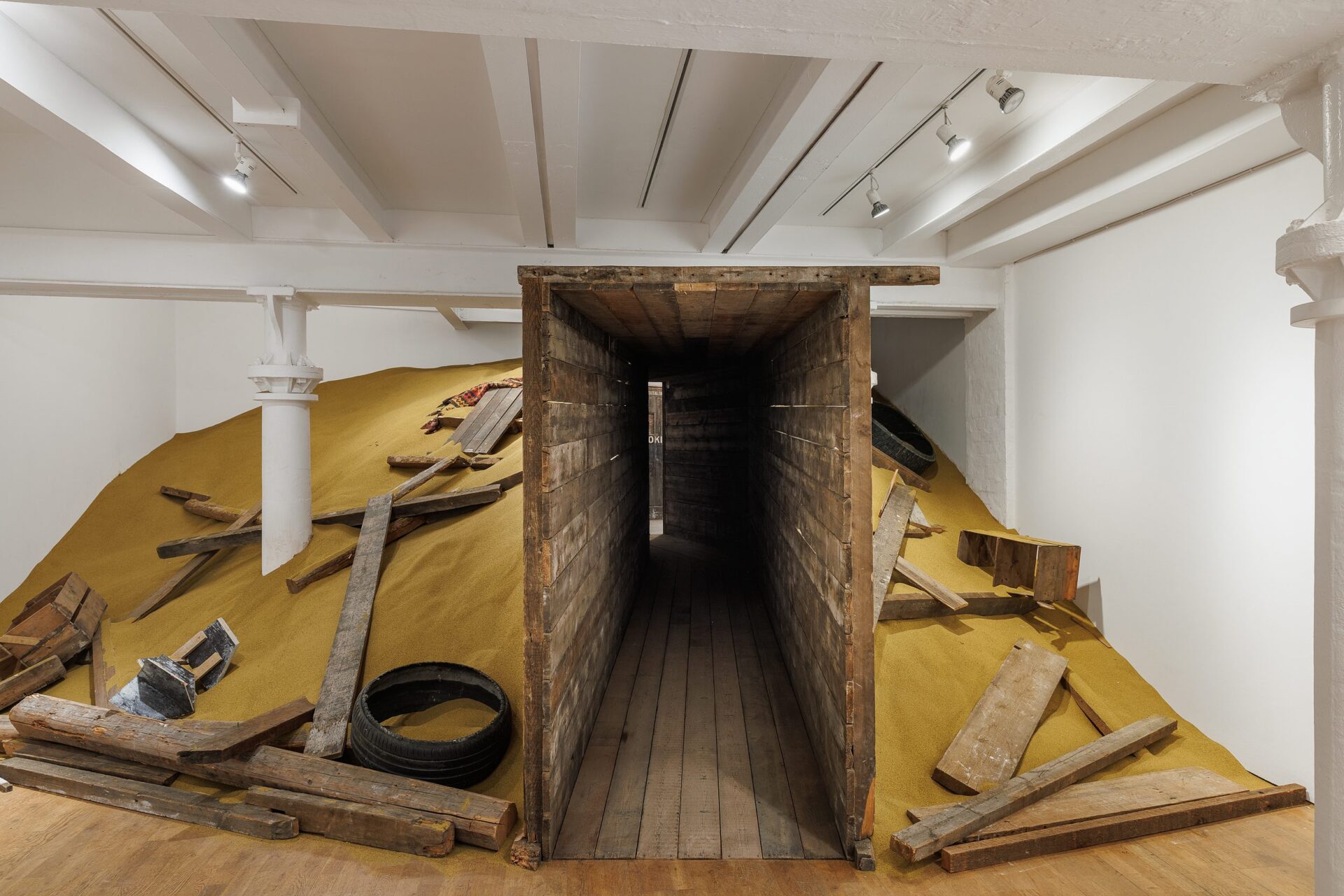
At Modern Art Oxford, the past acts as a starting point for new perspectives. Mike Nelson’s Double Negative (The Clown), on display from 3rd October 2026 to 11th April 2027, revisits an installation he created at the gallery 22 years ago. His dilapidated desert shack, once evocative of the turmoil of the Iraq War, returns more weathered and broken than before, its exposed foundations laying bare a disillusionment that continues to haunt the present. Visitors must navigate the fragmented structures and objects, from left-wing pamphlets and travel books to a projector flipping through self-portraits, piecing together their significance for themselves.
Constructed on-site from remnants of the original exhibition and newly created sculptures, the installation collapses together two moments in time into one unsettling environment. Nelson forces us to ask ourselves what has changed in the decades between – and what, more troublingly, has not.
Rhodes House: A home of one’s one
While Nelson asks how we reckon with the past and cope with the present, Show Me Why You Love Home at Rhodes House explores how memory and cultural traditions shape our sense of belonging. The exhibition brings together work by Rhodes Scholars and fellows from across the world. Lana Alabbasi’s mixed-media piece Carrying a Starry Home reimagines Van Gogh’s The Starry Night through Saudi memory and heritage, while Palestinian embroidery and Nadine Pinede’s poetic exploration of Haiti, diaspora, and remembrance illustrate how artistic expression allows us to preserve shared histories across generations and borders.
In a city that prides itself on international exchange and communication, these works reveal how Oxford’s artistic life is shaped by the people who come here and the stories and traditions they bring with them. Home, after all, is not a fixed place, but something we continue to build.
Aphrodite: Beauty through the ages
Just as home can mean different things to different people, so too can beauty take many forms. Yet, for thousands of years, artists have turned to Aphrodite as its enduring symbol. At the Ashmolean, Aphrodite: The Making of a Goddess (8th October 2026 – 11th April 2027) traces her evolution across more than 5,000 years through over 150 objects, spanning ancient Cyprus, the Greek and Roman worlds, Renaissance Europe, and contemporary culture.
As successive societies have reshaped Aphrodite in their own image, the goddess has come to embody shifting ideals of beauty, femininity, love and desire. Yet, beneath these changing interpretations lies a figure whose image remains remarkably recognisable across the millennia. With free admission for University of Oxford students, the exhibition brings ancient and contemporary art together into one space, encouraging us to reflect on how our ideals of beauty have evolved, and what has remained unchanged.
The Ashmolean: Beyond the colonial gaze
However, the Ashmolean’s engagement with art extends far beyond simply preserving historic works. In its Ashmolean NOW series, contemporary artists are invited to create new artwork in response to the museum’s collections. In Climate Culture Care, the fifth exhibition in the series, Bangladeshi artist Soma Surovi Jannat draws inspiration from the Sundarbans, the world’s largest mangrove forest, to explore the intersection between climate change and social inequality. On display until 1st November, her work, including a thirty-foot-long scroll and imagined landscapes, places art in conversation with urgent environmental concerns. As the first solo exhibition by a Bangladesh-based artist in a UK museum, it also broadens the range of voices represented within these institutions.
A different perspective emerges in Colonial Views of India, on display until 13th December. The exhibition presents photographs taken by nineteenth-century British colonial officer Eugene Clutterbuck Impey, documenting people, landscapes and religious sites across India. Taken during, and by a proponent of, British colonial rule, the images are far from neutral records and were often used to reinforce cultural distinctions that underpinned imperial power. Displaying them today raises questions not only about what they show, but whose perspectives they privilege, and how their colonial context informs our understanding of them.
While Jannat uses the museum’s historical objects as a starting point for imagining environmental futures, revising Impey’s photographs invites us to question how British colonial rule shaped the images of India that have survived. Neither exhibition requires us to abandon the past; rather, both ask us to look at it more critically.
Oxford’s art scene is not simply a compendium of what past generations have valued, but an ongoing conversation about what matters to us now. By stepping beyond our usual galleries and seeking out unfamiliar perspectives, we may discover just how many stories the city’s art still has to tell.