

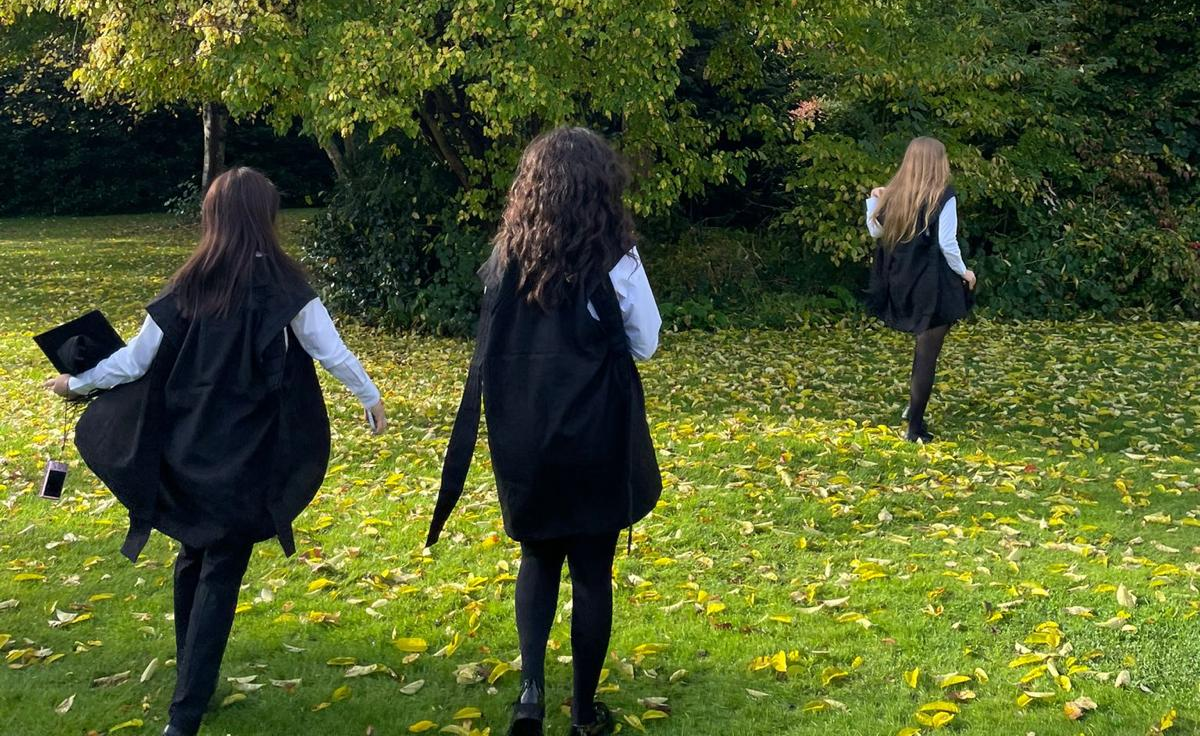
Walking to chapel on a mid-winter Wednesday morning, you could almost be certain to hear a teacher’s anguished cry: “Take those hoop earrings out!” Until two years ago, my sixth-form had only admitted boys for nearly six and a half centuries. There was still a strange ring of uncertainty in the voice of authority that pursued us with moral outrage, insisting we favour studs. Somehow, I always found myself wearing the wrong thing. The attention fell on the clothes, but inadvertently, the body beneath them too. Ours was a peculiar kind of uniform: no formally prescribed list beyond vague terms like ‘smart’ and ‘sober colours’, yet we were endlessly policed. I learned what was acceptable and what was not mostly through a series of raised eyebrows and disapproving looks. It left me wondering: what exactly made one outfit acceptable and another an offence?
Most schools in the UK have a uniform. While it is not mandated, the government advises that a uniform provides ‘a sense of belonging and identity’. The logic is persuasive: if we think of uniform as something beyond just a logo or a colour, it offers a visible affiliation between an individual and the collective. Leaving school ostensibly offers an escape from such scrutiny. At Oxford University, there is no everyday uniform, but students quickly become recognisable by what they wear. Whether your friend religiously favours their rowing jacket, designer gear, Lamb and Flag merch, college puffer, or rejects these altogether, they seem to offer a shorthand about the self. The college puffer is particularly interesting because it occupies the space between anonymity and personal identification. Despite being the ubiquitous symbol of the Oxford student, a black winter coat conceals much of the outfit beneath it, allowing the wearer to blend into the visual landscape of the city. Yet the college crest and embroidered initials invoke community and are a declaration of identity. I still feel a surprising sense of camaraderie when I spot a stranger wearing a Lady Margaret Hall jacket. The distance between two people who have never met can be narrowed; the coat makes us alike. We are accustomed to reading garments as statements about their wearers, their tastes, and the connections they have. Whether those readings are accurate is another matter. Clothes can tell us something about a person, but they can also tell us what we have been taught to expect.
Adolescence is already a period of sartorial experimentation, moving between styles and trends as you try to discover who you are. However, dressing under the scrutiny of others acquires a different dimension. You begin to anticipate what might attract comment, becoming conscious of the gap between how you want to look and how you are permitted to appear. When judgement falls on a skirt, a neckline, or a pair of earrings, it is difficult to separate criticism of the garment itself from criticism of the person wearing it. Yet, being judged for my uniform made me conscious of my own emerging style. Personally, I am drawn towards exaggerated, masculine tailoring in blazers and coats that seems to parody the patriarchal authority that sought to impose its judgement on me. Whilst now there is rarely a day that I am not in heels of some description, my principal criteria for shoes is that they must make a noise before they are seen. I would knock Blakeys into the bottom of my loafers to achieve this effect at school. Perhaps even the most individual expressions of style bear the imprint of the expectations they seek to escape.
The uniform has an afterlife. Its influence can persist long after we have left the school, sporting club, or institution that first imposed it. For some, that is embedded in the ardent desire to escape from it and for others, a pleasure in the community it invokes. Both are equally valid reactions to its influence. I still find myself glancing behind me, expecting to hear a shout about the length of my skirt. For many, coming to Oxford is the first time living away from home and being surrounded by a set of new peers – and also the first time we have total reign over our own clothes without judgement. So how we choose to exercise that freedom carries a degree of interpretative value. And no, I almost never wear studs.