
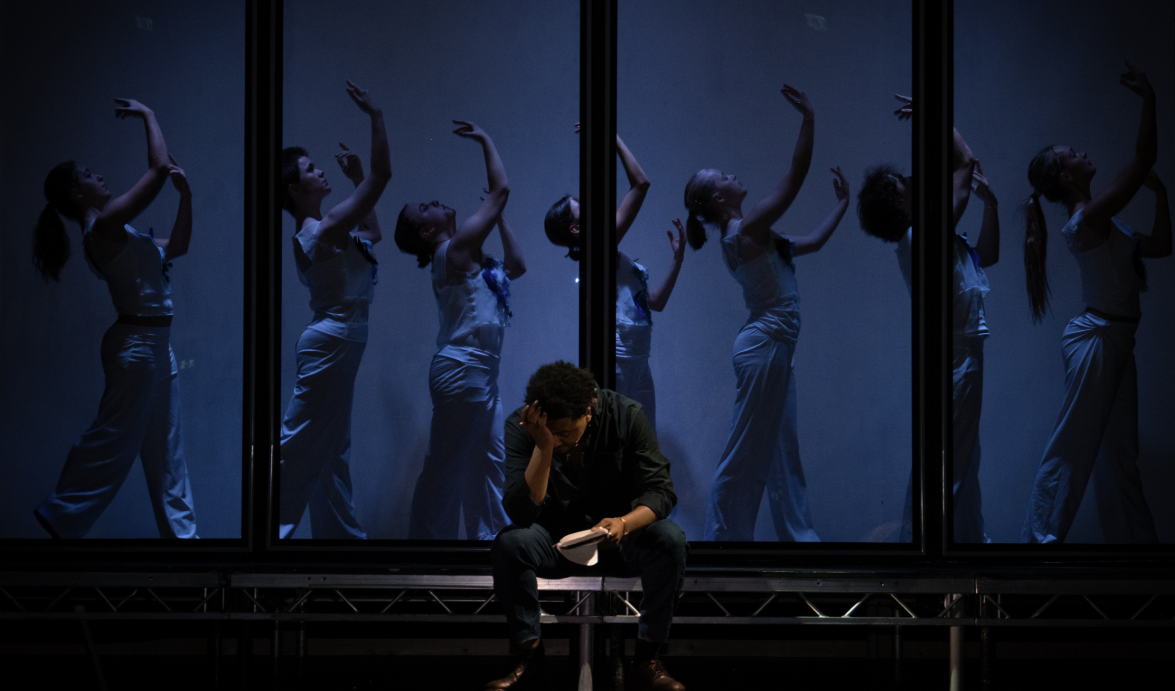
I want to tell you how this play ends, but I think you should watch it yourself. The thematic potency and the overall success of Lighthouse Productions’ iteration of Anton Chekhov’s The Seagull all came together in a great and terrible revelation. I say this not to diminish the preceding three hours in favour of a single line, but to compliment how masterfully and intentionally they were crafted, for the final sentence to have the power it had.
The Seagull is a simmering, slow play, written to subvert the theatrical conventions common in Chekhov’s time. It’s theatre laid bare, which is why the choice of a minimalist set works so well for this production. Beauty still flickers incandescently across the austere, almost empty, stage in the form of a talented dance crew choreographed by Anya Fuller, showing that the symbolist techniques derided within the story still have their uses. With their changing clothes, all evoking birds, they act as a sharp contrast to the monotonous blue costumes of the characters in the story. Clara Woodhead and Sophia Harris have both done well as costume designers for such an extensively large cast, and the symbolism in their clothing comes across clearly without being gaudy. Lucian Ng’s original score, which evokes the glacial minimalism of a Hildur Guðnadóttir film soundtrack, adds further depth to the interplay of sterile calm and quick bursts of movement we have already seen with the costumes and staging, the string quartet expertly evoking horror when it was needed. I did find that the score could be overbearing for my tastes at some times, though that was more an issue of volume, exacerbated by microphone issues on stage on the night I attended.
Much of what I have talked about with the play’s minimalism focuses on how it changes the experience of theatre through what it omits. But what makes this staging unique is what it does show, through a plexiglass box designed by Max Antoniou.
Chekhov intended for the play’s principal actions to take place off-stage. Here, these key moments, including that ending, take place inside the glass box. This is an audacious move for a play that relies on subtlety for its subversive effect, and it would certainly have failed if not for the cast’s tactful performances. This is an audacious move for a play that relies on subtlety for its subversive effect. It would certainly have failed if not for the cast’s tactful performances. The cast handled the comic and tragic aspects of this polytonal play exceptionally well. I cannot commend all of them, as this ensemble is absolutely massive, but that none of the characters felt two-dimensional is a testament to both the play’s enduring greatness and the cast’s ability. Ezana Betru and Rufus Shutter, Chekhov veterans from Fennec Fox’s Uncle Vanya (Michaelmas 2025), continue to impress. Danya Griver makes a welcome debut on the Oxford stage as Nina: it takes an exceptionally talented actress to play a rather mediocre one. I have particular praise, though, for Rowan Brown as Irina, a self-absorbed matriarch who could have easily become a shrill caricature of an ageing, vain woman, but whom she plays with exceptional life and sympathy. Because of these sublime performances, this production adds a darkly ironic and almost voyeuristic dimension to Chekhov’s script, rather than reducing emotional complexity and subtlety. It changes the purpose of the story, from a revolution in theatre to an indictment of its audience. There is the excitement that comes with seeing, with being in on the secrets of these characters, followed by a sense of guilt: it almost implicates you for watching. Chekhov’s Trigorin looks at a dead seagull and sees only material for a short story, and the glass invites us to do something not too different with someone else’s suffering.
Lighthouse Productions’ The Seagull is not a play to be missed. In her Director’s Note, Alys Young writes that she hopes to leave us “feeling more sure of the power of theatre than ever before”. By this metric, she is surely successful. Staging a lengthy, character-driven and understated play like The Seagull — so poorly received in Chekhov’s own day that he almost resolved to never write again — for an audience with a beleaguered attention span is no easy task. This production indicts our world’s lurid appetite for other people’s tragedies from TMZ to LiveLeak. Three hours long and unhurried, it still kept me perched on the edge of my seat, complicit and captivated in equal measure. A conventional part of me, however, wishes the play retained some of Chekhov’s tendency to hide the action, in defiance of our demand to know and to see. It would’ve surely strengthened the great, explosive ending all this work built toward, that final line I cannot yet tell you about.