


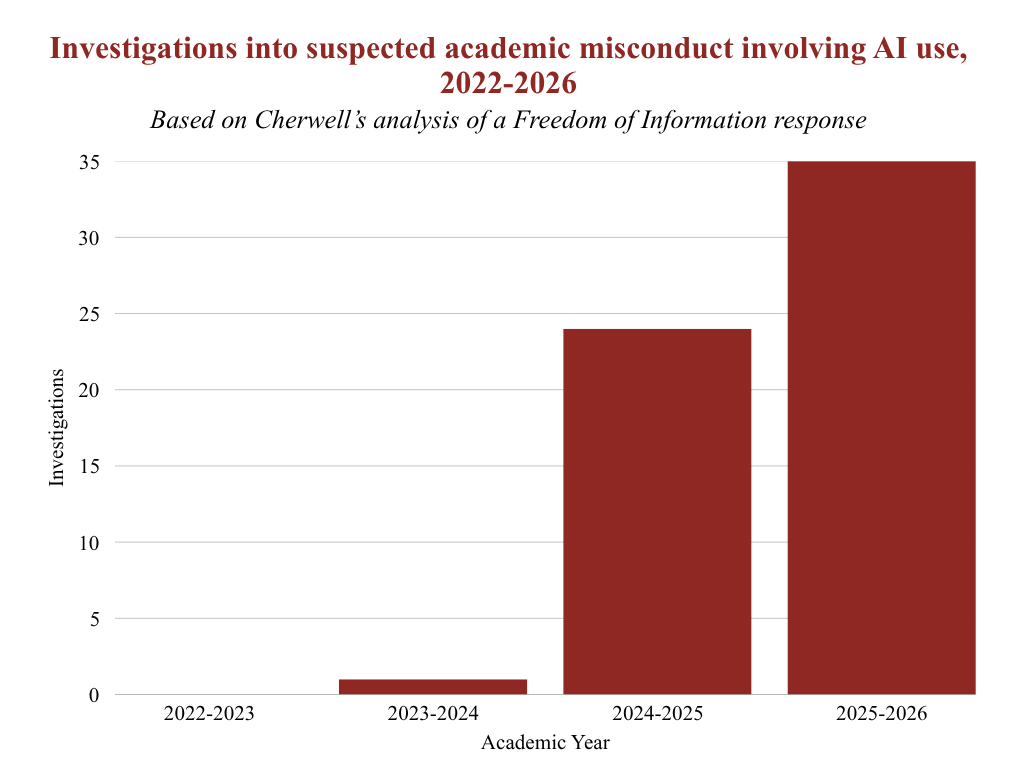
Oxford University’s investigations into suspected academic misconduct involving artificial intelligence (AI) have risen 46% in a year, Cherwell can reveal, with most investigations in the last three years occurring in the Social Sciences Division.
Data obtained by Cherwell through a Freedom of Information (FOI) request shows 35 investigations into unauthorised AI use in university assessments in the 2025-2026 academic year, a rise from 24 in 2024-2025. Only one such investigation occurred in 2023-2024, the first recorded since the emergence of large language models (LLMs) and generative AI in 2022.
The data comes from records held by the Proctors’ Office, which is the central University body responsible for handling cases of academic misconduct. Investigations by the Proctors’ Office only involve summative assessments by central university faculties and departments, and do not involve college-administered assessments such as collections. Unauthorised AI use is recorded as plagiarism.
Responding to the figures, a spokesperson for the University told Cherwell: “Oxford takes academic integrity extremely seriously, and the number of recorded academic misconduct cases remains low.” The university added that there were 1.3 such investigations for every 1,000 Oxford students, telling Cherwell that “comparable published data suggests that such offences are relatively rare at Oxford compared to UK universities more widely”.
Graph Credit: Ned Remington
Social Sciences responsible for majority of cases
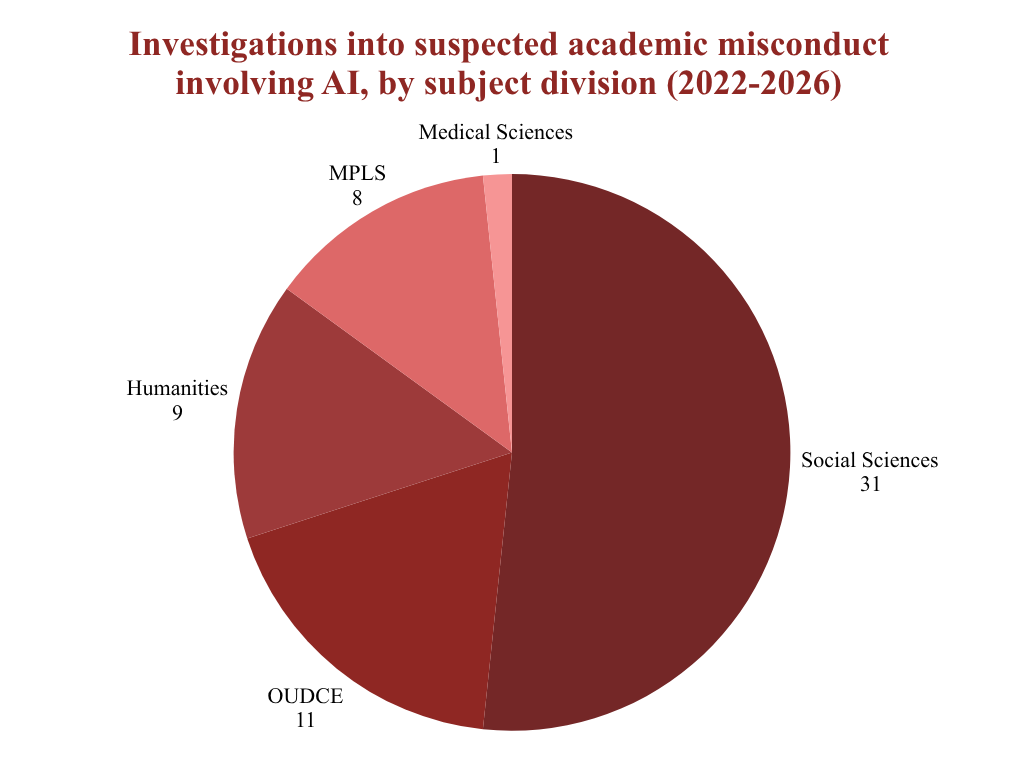
Out of 60 investigations into suspected plagiarism involving AI from September 2023 to the end of the last academic year, 31 (52%) were from the Social Sciences subject division. An average of 27% of Oxford students across the same period took social science subjects, and the division is home to the Faculty of Law, the Department of Economics, the Saïd Business School, and the Blatavnik School of Government, among others.
Another FOI obtained by Cherwell revealed that of 20 completed and ongoing investigations into suspected plagiarism in the Social Sciences division in the 2025-2026 academic year, 19 involved suspected AI use. In the humanities division, six out of ten completed and ongoing plagiarism investigations in the same period involved suspected AI use. An expanded definition of plagiarism in the 2025-2026 Academic Disciplinary Procedure included “use of material generated wholly or in part through use of artificial intelligence” without prior authorisation. Whilst Cherwell has not seen similar data for previous academic years, the high prevalence of AI in suspected plagiarism suggests advancements in artificial intelligence have placed a significant burden on the Proctors’ Office’s academic misconduct procedures.
According to data received through Cherwell’s original FOI, the Department for Continuing Education conducted eleven investigations in the past three academic years, with nine in the Humanities and eight in the Mathematical, Physical, Engineering and Life Sciences (MPLS) division. Only one such investigation occurred in Medical Sciences, which includes Medicine, Psychology, Biomedical Sciences, and Biochemistry, despite the division accounting for an average of 16.7% of the university’s students across the same period. Twelve investigations (20%) were into research-based assessments, whilst the remaining forty-eight (80%) were into non-research-based assessments.
The prevalence of social sciences reflects broader trends spotted in the misuse of AI in university-level assessment. A 2024 UC Berkeley survey of over 95,000 US university students found that 9% admitted to cheating on exams using AI, with the figure rising to 13% for business and management students and 17% for economics or journalism students.
The Social Sciences Division was contacted for comment.
Capped exam re-sits most common punishment for AI use
Of the concluded investigations into suspected AI-related academic misconduct from September 2023 to the end of the last academic year, three led to students’ permanent expulsion. No temporary suspensions from the University were issued.
By far the most common result was a capped re-sit, which was enforced on 28 occasions, where a student was required to resit an examination but with a limit on the grade they could achieve. According to the University’s Academic Disciplinary Procedure 2025-2026, for a “Category 4” instance of “gross plagiarism”, it is not usually possible to receive a grade higher than a pass in a resit examination. On two occasions, students were required to take an uncapped resit, whilst on three occasions students received mark reductions to work without undertaking a resit.
On 13 occasions, investigations resulted in cases being returned to the examination board with no further action taken. No students were given written warnings in place of other penalties. Three appeals to the results of investigations into academic misconduct involving AI were received over the same time period, with one resulting in a lower penalty being given whilst the other two were dismissed.
Graph Credit: Ned Remington
Oxford continues use of Turnitin
Once a report of plagiarism is received against a student, evidence is submitted before a Proctors’ Office caseworker decides whether to investigate. Oxford confirmed to Cherwell that reports from the plagiarism detection software Turnitin are still used to decide whether to investigate, under the latest Academic Disciplinary Procedures which came into force on 1st September 2026.
This is despite several UK Universities, including Newcastle, Westminster, and Southampton, announcing an end to their use of Turnitin over an updated End-User License Agreement (EULA) that could potentially allow Turnitin to use student work to train AI models. In a statement published a week after Oxford’s latest Disciplinary Procedures came into force, Turnitin announced a year-long postponement and re-drafting of the EULA, and confirmed that “no student or staff data has been used to develop generative artificial intelligence (AI) models or large language models (LLM)”.
Oxford noted that not every report into suspected plagiarism involves use of Turnitin. Under Oxford’s 2025-2026 Disciplinary Procedures, any investigation into suspected plagiarism is presented in a report to the Proctors, before an appropriate penalty is decided, with the student given opportunities throughout to admit wrongdoing or accept an agreed penalty. The University “aims to conclude its consideration of any Report (sic) within 90 calendar days” of the report being made, with 20 of those days usually left for the evaluation of appeals to any penalties imposed. This timeline can prevent students from continuing into more advanced education programmes or graduate jobs that depend on receiving a final degree grade.
The wider picture
The rise in investigations at Oxford into academic misconduct involving AI comes as more UK students report using artificial intelligence in assessments and examinations. The UK’s Higher Education Policy Institute (HEPI)’s 2026 Student Generative AI Survey revealed that 12% of students at UK Universities “included AI-generated text directly in a piece of assessed work”, up from 8% in 2025, whilst 15% believe such use of AI is acceptable. The report also revealed that 25% “used AI to generate text, which is then edited before incorporating into assessed work”. The report also found that “being accused of cheating by my institution” was the most commonly given reason that would make a student less likely to use AI for their studies, with 42% of respondents fearing accusations of misconduct.
The figures also come a year after The Guardian revealed that almost 7,000 instances of cheating using AI had been recorded by UK universities in 2023-2024. This was equivalent to 5.1 cases per 1000 students, at a time when Oxford University investigated only one similar instance for a student body of over 27,000.
However, the rise to 35 such investigations at Oxford in the last academic year comes after the University’s rollout of access to ChatGPT Edu for all Oxford University students last September, amongst a “range of enterprise-level GenAI tools… with agreements in place so that data is not used to train external AI models.”
The University spokesperson told Cherwell: “We are committed to helping students use AI safely and responsibly while upholding rigorous academic standards… The University offers a variety of AI training and academic skills support to students. We offer guidance on the safe and responsible use of AI tools, set out clear policy on our expectations on their use, and our AI Competency Centre offers a range of dedicated student workshops. Critical thinking and independent learning remain at the heart of an Oxford education.”
The University also pointed to Oxford’s tutorial system, which it described as “particularly valuable in the age of AI… through regular, small-group teaching and focused academic discussion, students are challenged to explain their ideas, defend their arguments and demonstrate their own understanding”.
Additional reporting from Timothy Blackburn.


