

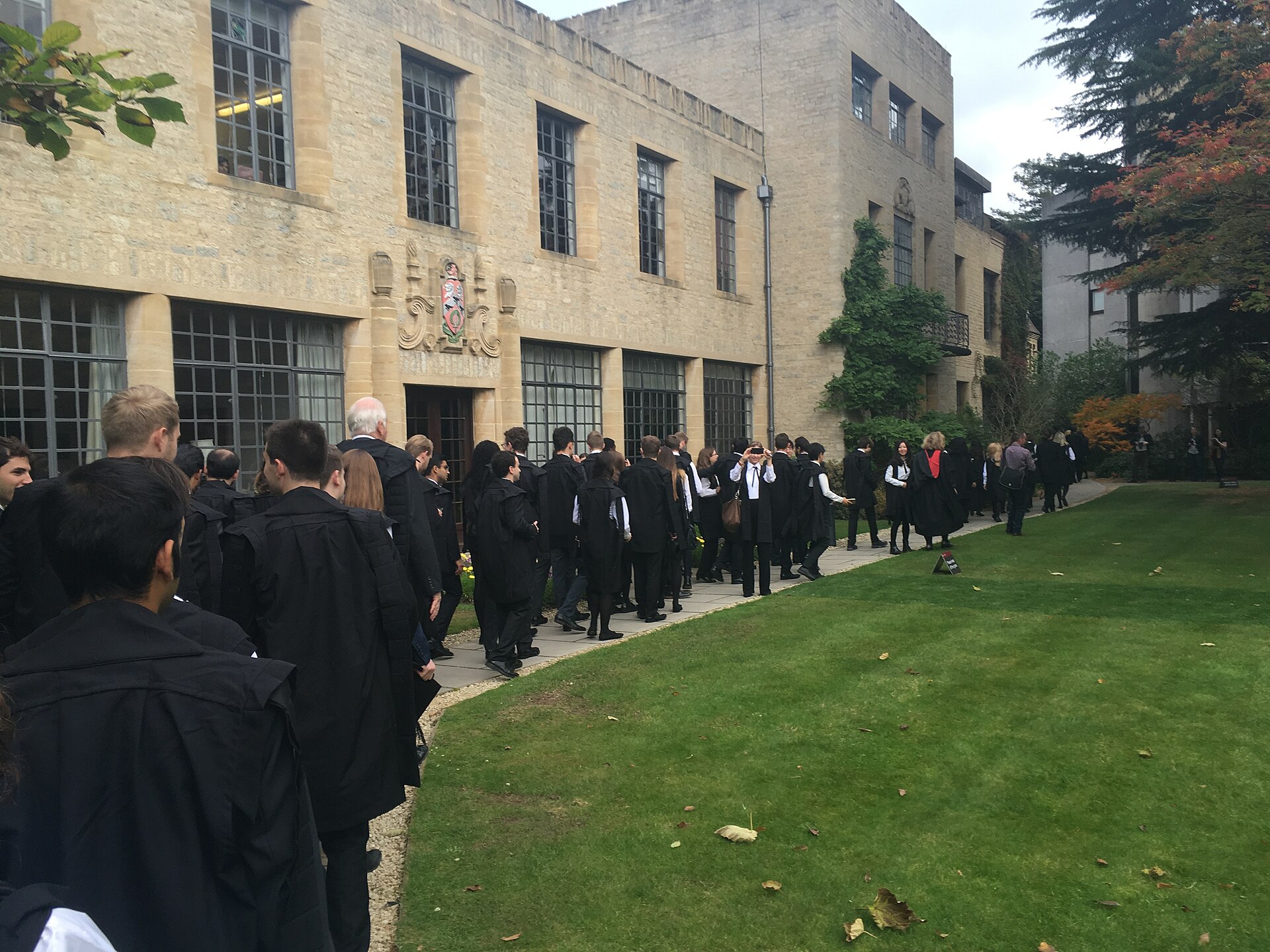
On the day I arrived in Oxford, my college mother gave me one piece of advice: “Oh, don’t worry, Prelims don’t matter at all”. Of course, on paper, she was right: for most students at Oxford (provided you pass), Prelims or Mods don’t affect your degree classification nor what you can pick in second year. In theory, for the humanities, they are a chance to practise the art of essay writing under time pressure. But, as an ancient academic institution, Oxford risks forcing division between students by encouraging rivalry between the best of the best. Thus is the philosophy behind the scholar’s gown: a “black gown of Russell cord or synthetic material in full style with a gathered stiffened yoke behind and short open sleeves” (according to the University guide to academic dress), bulkier than the modest commoner’s gown, and given to those who achieve a distinction in their first set of Oxford examinations.
I am no scholar. I made the humble mistake of merely passing my Prelims. It therefore came as a surprise when I received an email saying that I’d been given an exhibition – an award given by certain colleges for reasons ranging from good Collections results to simply being in the favour of your tutors (which one I fall into remains, as yet, a mystery). Both awards entitle recipients at my college to wear the scholar’s gown as part of our sub fusc, alongside a host of other rewards that vary between colleges. Yet I refuse to subscribe to this privileged and elitist attitude towards academic achievement.
All of us worked hard to get into this university: we endured months of prep for the personal statement, put together written work, and faced the intensity of the interview season. Behind that are good GCSE results and likely years of seeking academic validation from teachers. Every person at this university deserves their place; we do not need to prove ourselves further. Some, naturally, work harder than others, and that is reflected in the variety of degree classifications handed out alongside academic prizes. But we must remember that academic reward is not the end goal, and that Prelims are just that: preliminary examinations. When simply settling into the rhythm and social circles of university life is hard enough in first year, must we pile on the pressure even further?
I do not, and cannot, consider myself above my academic peers. Neither the English cohort at my college, all of whom worked hard during exam season and both struggled and shone throughout the year, nor anyone else in other faculties, where marking criteria and the number of Distinctions handed out vary massively. So why would I draw attention to this with a billowing gown? During Finals, as you gaze around the marquee full of hundreds of students in sub fusc, I imagine the last thing you want to be fearing is your own academic inferiority.
The way some colleges reward scholars seems disproportionate to how most are won. At my own, St Hugh’s, I have been invited to “make a short Declaration” at the Governing Body meeting, as well as to attend a free formal and drinks reception with my tutors. All for only one week’s worth of exams! I am only thankful that, unlike central colleges, gowns are discouraged at our formal halls, so there is no obligation to parade around your luck in first-year exams for the next few years. The scholar’s gown is an overt sign of academic comparison, fostering jealousy and rivalry between friends and coursemates – it has no place in what should be friendly, encouraging communities.
Another major issue is the disparity between scholarships across courses and colleges. This is apparent in the criteria for a Distinction: in English and History, candidates must achieve an average mark of 67 with two papers above 70. In Modern Languages, an average of 70 is required, although History and Modern Languages need one mark above 70 and no mark below 64. The boundaries for the sciences are far more vague, since marks are scaled depending on the difficulty of each paper. Meanwhile, in Medicine, tutors at each college decide scholarships. The prevalence of certain subjects amongst lists of scholars speaks to an inconsistent approach to Distinctions, and so it is hardly fair for their reward to have such a large financial and material benefit for students.
Between colleges, there are all sorts of discrepancies: Pembroke displays a list of scholars and exhibitioners near the porters’ lodge whilst subtracting £1000 from scholars’ battels and inviting them to a scholars’ lecture and dinner. At St Hugh’s, the sum is £300 a year for the rest of their course, whilst at Somerville it is £500 and at Hertford it is £250. Such large monetary gifts as incentives for good academic performance are surprising but also out of proportion. My tutors informed me in Freshers’ week that they valued the growth of my academic voice and development through tutorial essays far more than exam performance, yet the rewards for the latter speak volumes as to what the University values: prestige for the institution.
Of course, it is important to recognise and celebrate academic achievement, and this article ignores the not inconsiderable number of choral and organ scholarships given for talent and dedication to the colleges’ music scenes. And yet it is perfectly possible to skip most lectures and not bother with class or tutorial work, and come out with a Distinction in Prelims and a shiny scholarship to go with it. The way scholarships and exhibitions are awarded at Oxford is an out-of-date system, not recognising true academic talent outside the limited examination system.
The fact that I am here at Oxford, the place I spent so much time and effort to get into, the university I both desired and feared, should be good enough for me. Wearing a fancier gown in front of my friends does not make me cleverer, nor does it make me feel superior to the coursemates who have taught me more than many lecturers could. The friendships I have made at university, the experiences I have had, the joy (and tears) in tutorials, the love and human connection – all these mean so much more than a piece of fabric. No one here should ever feel inferior because they didn’t excel at a set of, quite frankly, mocks. And so, if you see me in the marquee during Finals, I will be wearing my commoners’ gown proudly. I have nothing to prove to others: simply being at this university is reward enough for me.


