An Oxford PhD student is through to the final four of this year’s MasterChef.
Nawamin Pinpathomrat, who studies at the Jenner Institute, will compete in the last four after a strong performance on the first night of the show’s ‘Finals Week’ where his dishes impressed judges John Torode and Greg Wallace.
He told Cherwell: “It means a lot to me being a MasterChef final four. Honestly, I didn’t expect to make it this far but I enjoyed every single moment in the competition.
“Of course, I’m excited to be in the final but also nervous at the same time. The standard is getting higher and higher. I have to cook to perfection while I have to finish my experiments and write my DPhil thesis – no pressure!”
Torode said that the 27-year-old had “absolutely smashed it”, while Wallace labelled his trout and rice, presented as a lotus flower, “the dish of the day”.
The student, who trained as a doctor in his native Thailand, said that cooking and medicine have some similarities.
He said: “Being a doctor, basically, the patients come to see you, they’re ill and then you treat them to make them like happy and that’s so rewarding.
“It’s exactly the same thing with cooking, when people come to my place, I cook for them and then, ‘It’s so lovely, I haven’t had this food before in my life!’
“It’s like that’s good, that’s rewarding so actually the same thing.”
Last week, Michelin-starred chef Nathan Outlaw described a mousse than Pinpathomran had prepared as “a new thing for me”.
“I’ve come here today, I can learn from you – no problem,” he said.
A PPE student has thanked “legends” for coming to her aid after her notes and laptop were stolen six weeks before her finals.
Anne-Marie Downes’ notes and laptop were taken from a car in Durham.
Downes tweeted an appeal in the hope that the notes could be found. The tweet has now been retweeted more than 12,000 times with many sending in their own notes to help the 21-year-old.
1/: Hi Twitter – I'd be very grateful if people could share this thread! TL;DR: A bag was stolen from me in Durham yesterday and it contained nearly all my notes and work for my finals, which are in six weeks. I'm hoping they dumped the bag/contents and someone may find them.
She told Cherwell: “I guess just that this has all been a bit of a nightmare and whoever nicked my bag has not helped with the pre-finals tension, and if anyone is in Durham please keep a lookout.
“Also though there is something pretty special about trying to work out how to explain all this to my Study Skills mentor at the DAS only to have him preempt me with ‘I know all about what’s happened because I saw Frankie Boyle’s retweet of your message.’
“Also, the philosophy and politics students who have been sending me their notes are legends and I’m incredibly grateful.”
I'm so so grateful to everyone sharing this and giving advice, especially to those who have said they live in the area and can have a look around! You are all such wonderful people, thank you so much <3
She tweeted: “I’m so so grateful to everyone sharing this and giving advice, especially to those who have said they live in the area and can have a look around!”
She added: “It’s such a testament to the power of twitter that so many people are helping me – my friend has joked that we should be tagging tweets with #SaveAMsDegree”.
She told the BBC her plan was to “cobble together” the notes she has been sent. She said: “People have rallied around and I am beginning to hope I might pass this degree after all.”
Downes also posted a plea for help on Facebook. Her post received 57 reacts and was shared 64 times.
Yesterday (Saturday 7th April) between 12 and 3pm our car was broken into in Durham in the car park in Pimlico, just off…
Durham Police said: “Due to the nature of the items taken, they are likely of little value to the culprit, but their loss has caused significant distress to the victim.”
Who would have thought that spending a Tuesday evening under the arches of Waterloo Station would turn out to be so enjoyable? Strictly speaking, The Vaults Theatre isn’t directly under the arches. More importantly though, the venue succeeds in evoking the post-Blitz London of Tristan Bernays’ award-winning musical TEDDY, a rock ’n’ roll piece set in 1956 Elephant and Castle. Set designer Max Dorey has transformed the versatile space, entrance included, into a derelict, bombed-out building.
The two-level stage appears fairly simple, but, with its huge advertisements for Brillo pads and Camp Coffee, it more than manages to conjure up the consumerist ideal of the American Dream which seeped into England after the Second World War. As we take our seats, the mist onstage seems slightly distracting. However, a sign from the council that warns against the teens gathering in the space is soon visible, subtly symbolising a generational divide. The sign becomes representative of an opposition to self-expression, against which the youngsters of this musical fight. The teens are frustrated by their lack of money, prospects and culture. They idolise their rock ’n’ roll hero: the American import Johnny Valentine. As we take our seats, the four-piece band, including lead singer Johnny Valentine (energetically played by Dylan Wood), strikes up 1950s melodies in what promises to be an immersive and dynamic production.
The narrative focuses on two teenagers, Josie and Teddy (Molly Chesworth and George Parker), who, bored with the monotony of their lives, dream of escaping to America and travelling in an American convertible. Seeing himself as the next Johnny Valentine, Teddy plans to take America by storm. Chesworth and Parker are completely compelling as the bored, deprived teenagers who live solely for all things American, and Johnny Valentine in particular.
Bernays’ script is partly written in rhyme, and uses the two leads to narrate the events of their Saturday night. Such an approach is particularly ingenious, allowing the protagonists to seamlessly morph into the different characters they encounter: from the grotesque and leeringly lecherous Tully making passes at Josie, to the elderly, aggressive pawnbroker. Chesworth and Parker carry this demanding script most effectively. In fact, the performances of the whole cast are convincing and energetic, whilst carefully drawing out the nuances of the script and the period.
Whilst beginning by narrating a seemingly banal, typical Saturday evening, tension quickly builds when a gun is produced by Teddy in a show of fearlessness, with the aim of finding money to pay for a concert ticket. As Josie procures the gun and points it at Teddy’s chest, the menacing music, paired with Parker’s highly convincing terror, culminate in creating one (of several) crescendos of tension in this musical.
The athleticism of the two actors as they dance and dash around the stage is particularly noticeable. The choreography is at times very demanding, but these two actors step up to the challenge admirably.
Speaking to Tristan Bernays about his influences for the play, he astutely cites the 2011 riots. Clearly, the idea of teenage rebellion is something which resounds as much today as it did back then. Music is also a point of connection between then and now, linking rebellious youngsters from different generations. Every generation has their own genre of music, and both then and now, such music may be recreated in a teenage bedroom. Anger at rejection, and the need to escape the monotony of everyday life remain pertinent, just as the good looking teen idol with a guitar remains the romantic rebel.
TEDDY is a fantastic piece of theatre which immerses the audience in 1950s culture and the issues of the time, whilst remaining highly engaging.
TEDDY runs at The Vaults Theatre until Sunday 3rd June 2018.
America is in the grips of a cultural revolution. While the general trends of TV tend towards a bright future of streaming, critically acclaimed mini-series, and a wealth of big-name talent on the smaller screen, the vice of nostalgia is beginning to grip America’s airwaves. That idea might make you jump automatically to Stranger Things, but a broader trend of decades-old shows being brought back for a new generation is gathering momentum.
Much like the worst of Hollywood’s continuing fascination with remakes and reboots, the current trend of TV shows being revived and the stale, unchanged nature of the revived shows are enough to make any TV lover weep with frustration. But that doesn’t mean they’re not worth examining. If the ratings for the Roseanne revival are anything to go by, the past may well be the future.
Its resurrection in today’s political climate is genuinely fascinating. It says a lot about the predominant creative mindset on ABC that they would rather resurrect a show about blue-collar, middle-American Conservatives than create a new show with similar ideals.
But it is nice to see a major network reviving a show that is at least conceptually noteworthy by virtue of being aired in a completely different pop cultural landscape than it initially aired in. Netflix haven’t yet managed to complete that same trick despite many more attempts, having ordered continuations of Arrested Development, Gilmore Girls and Fuller House, to name but a few.
Every new season Netflix has ordered seems to demonstrate the pitfalls of rebooting an old show. Arrested Development tried to redo an ensemble comedy where all the members of the ensemble were too famous and busy to sync up their schedules, resulting in a fractured, pale imitation of a once-great show. Revisiting Gilmore Girls seemed only to throw a spotlight on the very worst parts of the original series in the eyes of many fans, and Fuller House seemed only to fare well because Full House was never a show that set the bar very high to begin with.
But to Netflix, none of that really matters. They have a near-bottomless pit of cash to make content with, and as long as they’re creating original content that’s growing their subscriber base, they’re perfectly happy reviving old shows, even if the revivals aren’t particularly good. The revivals are still original, exclusive content, but with an inbuilt audience who are much more likely to revisit a show they remember than to flock to something brand new. Using an existing show as a springboard is also likely to make the creative process significantly easier.
The big question at the end of all if this is: which show will be revived next? Is it too soon to resurrect Parks and Recreation, How I Met Your Mother, or The US Office? Would Friends be able to weather another storm of Buzzfeed articles about how horrendously outdated many of its storylines now are? Has Curb Your Enthusiasm given you hope for a Seinfeld reunion? Make no mistake, folks: whether or not you’re happy with it being a controlling factor in what airs on your tellybox, nostalgia is a cultural force that’s here to stay.
Kacey Musgraves’ new album has been a long time coming. Last year’s Christmas album aside, Golden Hour is the first original material the American country star has released for almost three years. It seems apt, then, that the first track is titled ‘Slow Burn’.
Musgraves (always Kacey to her fans) burst onto the country scene in 2013 with Grammy award-winning Same Trailer Different Park, which positioned her as a challenge to the Nashville establishment from the beginning. Deemed by producers to be “too slow” and “too sad”, her first single, “Merry Go ’Round”, went on to become a modern country classic; this was followed by gay-positive anthem “Follow Your Arrow”, which ruffled feathers among the genre’s traditionally conservative fanbase.
Two years later, Musgraves followed up with Pageant Material, a tongue-in-cheek dissection of Southern small-town life, that speared Nashville’s ‘good ol’ boys club’ even more explicitly. Her music has overcome noticeably lukewarm support from country radio, been heartily received by critics and sold reasonably, although not spectacularly, well.
Her much-anticipated third album, however, would have to wait, because in October 2017, Musgraves got married. Her marriage to fellow country singer Ruston Kelly was not just a source of personal happiness—but of emotional inspiration and expression. In a recent interview, Musgraves described having “a kind of personal metamorphosis… I feel like I kind of came out of a shell that I didn’t really even know that I was in”. And in “Butterflies”, the first song she wrote after meeting Kelly, she admits “I was hiding in doubt till you brought me out of my chrysalis”.
This feeling is immediately obvious in the album’s sound – Golden Hour blurs the boundaries of country to incorporate a range of other influences. The piano ballads and lush instrumentation recall 70s-era Elton John and Fleetwood Mac, while there’s a hint of Daft Punk in the vocoder on “Oh, What a World”. “High Horse”, the climax of the album and one of its best songs, uses synths and disco beats to joyful effect.
But, for me, it is the lyrical transformation that stands out. Musgraves’ trademark witty wordplay is still sprinkled in places – “you’ll ride the high horse/and I’ll take the high road” – but the tone has changed. No longer an external observer of the idiosyncrasies of small-town America, Musgraves becomes much more introspective. The album leaf explains how each song loosely describes the “different masks” that represent “different sides of ourselves”. Arguably, Golden Hour shows Musgraves deconstructing her former façade of the sarcastic misfit, to reveal the contradictions and complexities beneath.
“Happy & Sad” reaches exquisite poignancy in the contrast between Musgraves’ veil of self-confidence and the admission that actually she’s “the kind of person/who gets kinda nervous/when I’m having the time of my life”. Another song sees her addressing the impossible standards of a ‘good wife’, with the confession that “I ain’t Wonder Woman” because “I’m only human”. It’s a love song to any perfectly imperfect marriage.
Golden Hour’s personal turn was perhaps unexpected after the recent tumults in American politics. Admittedly, I would still love Kacey to turn her acerbic wit to a more explicitly political album, along the lines of Margo Price’s gritty All American Made. But personal doesn’t equal apolitical. Hope courses through Golden Hour – in “Love is a Wild Thing”, Musgraves sings “there’s no way to stop [love], but they’ll try to”. It’s ‘love Trumps hate’ in a country-rock nutshell. And as the album fades out with Rainbow, Musgraves’ voice rises above the soft piano chords with the quiet conviction that “it’ll all be alright”.
Protesters from animal rights organisations are far from a rare occurrence at London Fashion Week, and this year’s event was no different. Protesters came out in force to take a stand against the fashion industry’s use of a variety of animal products, and their main target: fur. It would be no stretch to say that much of the public no longer supports the killing of animals for use of their fur to produce aesthetically pleasing products, and it is unsurprising that fur has been a target from protesters for many years.
But why are some designers so reluctant to listen to protesters’ voices? Granted, over 90% of the designers showing at London Fashion Week did not use fur in this collection, but some brands (such as Mary Katrantzou)refuse to renounce the use of fur altogether. This did not go unnoticed by protesters, and many individuals came out to stand up for the rights of animals.
Activists from PETA often make an appearance at Fashion Week. PETA, a well-known animal rights organisation, founded in the 1980s in the U.S., has been criticised by some for its tactics, but praised by others for their vehement defence of animals’ rights. They proudly claim on their website how this year a group of topless protesters attended London Fashion Week with the words “Wear Your Own Skin” written on their bodies. A protester from another animal rights organisation, SURGE, managed to get onto Mary Katrantzou’s catwalk; her chants of “Shame on you!” were caught on camera by many members of the audience. Though Katrantzou stated that only faux fur was used in this particular show, her past use of fox and mink fur makes her a natural target.
With brands such as Armani, Gucci and Vivienne Westwood completely renouncing the use of fur across their brands, it would seem that the protesters are having an effect. Indeed, the change in opinion amongst the general public would support this. The controversy surrounding Canada Goose jackets in the past few years highlights the outrage amongst the public, as unverified pictures of the alleged violent production of such jackets went viral. Pictures of coyotes in metal traps, coyotes being shot in the head: Canada Goose has a policy on its website highlighting that it uses ethically sourced fur, but it is now held by many people that there is no such thing as ‘ethically sourced fur’.
All fur used in fashion is, due to the deaths it causes, inherently immoral. Killing an animal simply for the use of its fur, when faux fur options are just as accessible and affordable, seems undeniably unethical: something that many brands have seemingly now accepted.
Yet, the protesters feel that their work to combat the use of fur in the fashion industry is not yet over, as some brands, such as Burberry and Mary Katrantzouare reluctant to completely renounce fur. This is hardly surprising when celebrities like the Kardashians are intent on wearing it.
Kim Kardashian and her sisters have consistently met criticism for their fur-wearing, even from fans. Indeed, in 2012, Kim Kardashian had flour thrown on her by someone claiming to support PETA. Simply reading the comments on the Instagram posts picturing the sisters wearing fur is sufficient to see the condemnation from the public. A case in point would be Khloe Kardashian’s post last April, which includes Kourtney, Kim, and herself, all wearing fur coats.
Likewise, more recently, on a post from January, Kim was criticised both for cultural appropriation due to her braids, as well as the fact that she was wearing what appears to be a real fur coat. The immense influence of the Kardashians amongst the public is not something that can be easily dismissed, and it is not surprising that when individuals like them consistently choose to wear fur, major brands such as Burberry will not renounce it completely. The Kardashians have undoubtedly become a brand, and shouldn’t they be help up to the same expected standards of ethical practice that other brands are? Perhaps certain supporters and members of the fashion industry do not feel that they have any reason to be ethical for the sake of its consumers as it could be argued that it is up to consumers to choose to buy ethically, and not up to the designers or celebrities to support ethical methods of clothes production.
It is clear that the work of the protesters is not over, but will they really affect the opinions of the Kardashians, or indeed the major brands? It is likely that they have had some influence on the matter, or else why would so many brands have already renounced it? Even if the protesters simply have changed public opinion, which has in turn changed the opinion of major brands, their influence was key. The videos and photos distributed by organisations such as PETA are powerful, but they do not seem to be touching the emotions of certain celebrities.Here, PETA’s reputation as extreme or fanatic may play a role, as protesters are sometimes seen, even amongst the public, as some form of fanatics, not representing the popular view.
So the work of the protesters can only be commended, when it is peaceful, and honest, but it does not seem to be enough for some of the high fashion brands. It is more than evident that the fact that major figures such as the Kardashians refusing to face up to their responsibility and influence as a vehicle for change is undoubtedly a principal barrier to creating a fashion industry that is completely fur free.
We knew Daniel Caesar grew up on gospel music. We knew Daniel Caesar sings with a Canadian sensibility. We knew that Daniel Caesar channels his religious values and experiences into the lyrical themes of his songs.
What we didn’t know, however, is just what Daniel Caesar’s debut album would sound like.
Having released two EPs, Praise Break and Pilgrim’s Paradise in 2014 and 2015 respectively, Caesar has amassed a steadily growing body of devotees who are drawn to his ecclesiastical sentimentality and emphasis on tender intimacy. So when Freudian was released late last year, Caesar certainly delivered to the fans precisely what they wanted.
Caesar called the album Freudian after learning of Sigmund Freud’s Oedipus complex, finding inspiration in the theory’s proposition that a child has an unconscious desire for the opposite-sex parent, in order to make sense of his own previous relationships. However, Caesar also draws from his pious experiences growing up with parents and a community unwavering in their fidelity to their faith. For Caesar, a child growing up in a tight-knit community of Seventh Day Adventists, a mainstream or secularist music culture was simply not a part of his upbringing.
Yet the sounds of R&B and neo-soul were too alluring for a youngster who was exhausting the gospel music on which he was raised. The polarity between those devotional and secular styles was mirrored in Caesar’s life by his growing disillusionment with his Christian upbringing. So with Freudian, Caesar sought to reconcile the dichotomies that fraught his life.
Freudian is a ten-track anthology centred upon sacred elements and secular sentiments, which are packaged in velvety, sensitive songs. Lyrics, mood, vocal capability, cohesiveness, presence, and guest features all fit nicely within the 45-minute runtime. While Caesar draws from elements of R&B and neo-soul, Freudian is grounded in black gospel in both music and subject matter. So whilst Caesar may have left the church behind him, it pervades Freudian. Gospel roots in the form of choral harmonies can be heard on ‘Neu Roses (Transgressor’s Song)’ and ‘We Find Love’, whilst gospel instrumentation is strewn across the tracks. The Hammond organ is generous applied as gloss paint over the majority of Freudian, which provides a devotional sheen to a familiar R&B sound.
The album’s sonic spectrum plants it firmly in the services, concerts and conventions that Caesar would have undoubtedly grown up attending. Yet that R&B feel is omnipresent throughout the album. The muffled synths and snare-accenting guitars hark back to both neo-soul jams and 70s soul records.
Whether by creative volition or out of circumstance, Caesar has mostly operated independently on his two previous EPs. With Freudian, Caesar enlisted the artistic forces of Kali Uchis, H.E.R., Syd and Charlotte Day Wilson, with many of the collaborations producing the finest material on the album. ‘Best Part’ and ‘Get You’ (featuring H.E.R. and Kali Uchis respectively) both stand apart from the other joint ventures for their plush, tight arrangements and vocal performances. ‘Best Part’, the opening song on the album, is a saccharine ditty that flows through themes of vulnerability and openness, and evokes images of gentle, morning moments between lovers who are in blind infatuation. ‘Get You’ is equally sentimental, with the chorus hook (“Who could’ve thought I’d get you”) explicitly regaling true adoration and unworthiness, and portraying a romance that is perpetually anchored in the honeymoon phase.
Indeed, Freudian is full of lyrics that, on paper, appear mawkish (“You’re the coffee that I need in the morning / You’re my sunshine in the rain when it’s pouring”), but this Canadian imbues them with such warm benevolence and sincerity that they reverberate with truth. What is apparent after listening through the entirety of Freudian is that the devotion in Christian faith that Caesar chastises and rejects is, perversely, the album’s basis, with the artist using devoutness as a symbol for his unconditional, unrequited love.
Ultimately, Caesar’s first full-length creative output is an audible representation of his spiritual and emotional odyssey from boy to man. Freudian plays like a beautifully-tracked voyage into the depths of both romantic and self-love, and the adoration of the sacred that finds its way into both. Whether Daniel Caesar still believes in a higher power or not, Freudian binds the disparate sacred elements and secular sentiments convincingly.
It was recently revealed that only 2.8% of Oxford’s intake for 2018 will come from areas defined as the most difficult to engage in higher education.
In a tweet responding to these figures, David Lammy MP offered the indictment: “Shame on them. Oxbridge take £700m a year in taxpayers’ money yet are not tackling entrenched privilege”. However, I fail to see how this helps the situation, with his remark suggesting that disappointing figures for access are entirely the fault of the University.
Oxford cannot and should not force students to apply, and the application process starts at the level of secondary education. Oxford can improve the way it engages with these schools and their respective pupils, but fundamentally the application process will always begin in school.
It’s woefully short-sighted to believe that the University is solely responsible. The long-term goal of improving access to those from the most socially and economically marginalised backgrounds can be met, but only through consistent collaboration between Oxford and secondary schools, a reality which is often ignored in media coverage of Oxbridge.
These latest statistics also revealed the disparity in the proportion of state-educated students at Oxford and Cambridge: 58% of students at Oxford are from state schools, compared to 62.6% at Cambridge.
From my own experience, I didn’t apply to Oxford the first time I applied to university in 2014, in part because no one from the University had ever visited my school. Having only 1 A, 4 Bs and 3 Cs at GCSE, I felt admission to Oxford, which emphasised the importance of having multiple A*s at GCSE just to attend the UNIQ summer school, was well outside of the realm of possibility.
I believe colleges should encourage current students to take part in outreach programmes and activities such as school visits, or even just engaging with potential applicants on forums like The Student Room – something I try and do whenever I can. Indubitably, it’s far easier to relate to a 19 or 20-year-old student than it is to an academic tutor whose life experience may seem irreconcilably removed from your own.
Whilst the current generation of Oxford students is probably the most representative it has ever been in the university’s 900-year history, Oxford cannot improve upon this alone: schools must see their critical role in the process. For example, when I was first applying to university, I was told unequivocally that one needed 8 A*s at GCSE to even attend an open day.
Rather than attacking Oxford for “taking £700m of taxpayer’s money” or for “entrenched privilege”, the way forward is surely to focus on how the current generation of Oxford students can harness their own experience to enable capable students to apply to Oxbridge.
Greater transparency is also needed: the figures for state sector admissions should be divided into comprehensives and grammar schools, so that the university is open and honest with regards to what proportion of its intake comes from just 150 or so grammar schools. Only through greater transparency, and collaboration with a variety of academies and free schools, can the potential of Oxford’s access programme be reached.
Should Oxford take the blame for its access problem?
To a British onlooker, South Africa is both reassuringly familiar and unsettlingly alien. Both demographically and democratically our junior, it could perhaps be conceived as our more fractious, more febrile younger sibling. Despite the recent election of supposed reformer Cyril Ramaphosa, in popular understanding, South Africa is still a place of dichotomies, ruled by a party, the ANC, that is simultaneously associated with the idealistic liberation party of Nelson Mandela and the corrupt and nepotistic machinations of former president Jacob Zuma. In this country of extremes, its politics is closer to our consumer fiction than to the pages of our newspapers. Yet at the same time, South Africa’s principle uncanniness is in the reflection it gives of our own home nation. Whilst for most British, the consequences of the imperial past upon which our society is based are reassuringly remote, but for South Africa the bubblegum façade of Western culture is openly and revoltingly juxtaposed with the undisguisable aftermath of colonial exploitation. In South Africa, we see, perhaps, most clearly the hypocrisies that ferment just below the surface of our own country. Yet even in a more general sense, such as the creeping tendency towards populism and the rule of soundbite politics, South Africa is less an anomaly than, as my uncle and resident of Johannesburg deems it, “a microcosm of the world.”
Recently elected president, Cyril Ramaphosa, in 2017.
What perhaps links the two countries most closely from my perspective is the issue of representation. The UK, since the last election, has become effectively bipartisan, leaving those of us with views outside that of the dominant Conservative or Labour narrative essentially unrepresented on the political stage. The problem is only exacerbated by Brexit, that has not only left the 48 per cent who voted Remain without a political voice in this respect, as both parties, currently, refuse to offer an alternative to leaving the EU, but also left little room for parties to think about anything else. Sapped by Brexit, neither party appears to have the bandwidth to develop new, modern policies on issues that voters feel strongly about.
In South Africa, the issue is increased a hundredfold. The ANC holds a one-party stranglehold on government, achieving 62 percent of the vote in the last election despite the numerous allegations of corruption and illegitimacy against it. Voting against the ANC is thus seen as essentially a waste of time and any form of opposition to the party is tainted with this sense of futility.
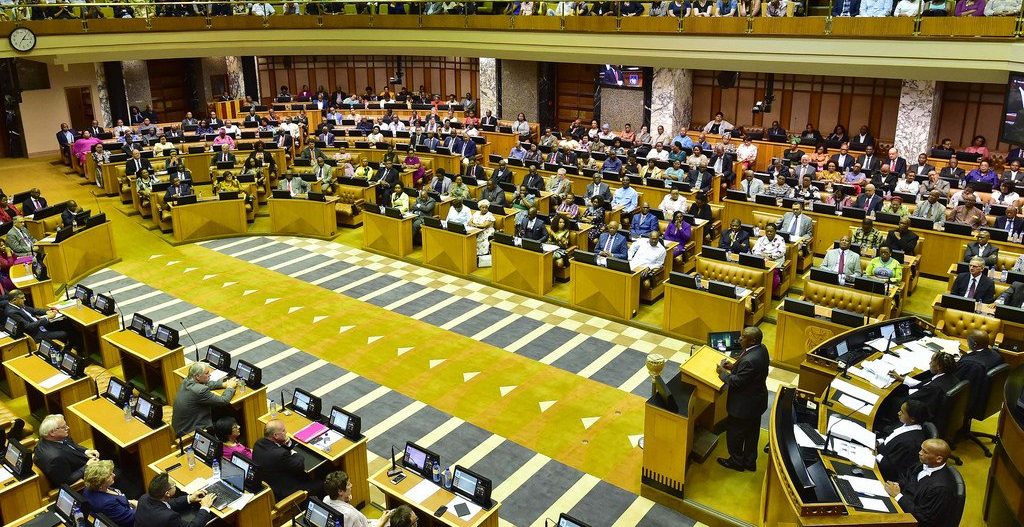
National Assembly of South Africa (2018)
One person who is particularly frustrated by the whole problem is Nick Farrell. Aged just 17, Farrell had run for the leadership of the Democratic Alliance, the country’s principal opposition party. A champion of liberal ideals since apartheid, the DA can perhaps be seen as the South African equivalent of typical European centrist party. Yet Farrell dismisses them as “irrelevant”. They achieved just 22 per cent of the vote at the last election, and appear unable to connect with voters beyond their traditional white and middle-class base.
For despite Farrell’s involvement in the DA since 2012 as a youth leader, and then chairperson of Morningside ward, his run for leadership was not based on a desire to become a career politician. Indeed, it was born out of frustration with the DA’s “increasingly autocratic” behaviour under the then leader Helen de Zille, who had bene unchallenged in leadership contest since 2007. Fed up with the inertia of his party, Farrell, against the wishes of his parents, announced his intention to run against her.
“People weren’t giving us (dissidents) a voice in the party. So, running was a legal way of saying look, you can’t shut me down…it was the best way of expressing my views in an open way,” he said.
Although Farrell never actually got to run against Zille in the contest, standing down shortly after making his statement, it was still enough for him to gather uncomfortable scrutiny from the press and even from the DA’s own MPs. One, Dan MacPherson, condemned his leadership run as a “stunt” and implicitly threatened to weaken Farrell’s chances of getting into university if he did not stand down.
“Young people often have slightly different views to the political establishment within the party, so when a young person speaks its often assumed that they are going to say something that isn’t in line – and often it is! But it’s easier to silence young people, to make sure they don’t have a place in the party,” said Farrell when considering MacPherson’s behaviour.
“But if you don’t have young people in the party, how are you going to attract young voters that are occupying a greater and greater percentage of the demographic, of the voting population?”
And of course, the DA’s inability to connect with voters is not just destructive for their own party. Without a powerful opposition movement, the ANC have been allowed in recent years to engage in corrupt political activity with effective impunity, relying on the memory of liberation to ensure success at the ballot box. The moral purity and ideological consistency of Mandela’s ANC was hijacked and replaced by Zuma’s own brand of personality politics. Prior to his recent expulsion, Zuma had used his individual power to enrich his own family and connections at the expense of his electorate, demonstrating himself to be more a kleptomaniac despot than a saviour of the people.
This lack of scrutiny from mainstream opposition, oh-so-familiar in our current political clime, has led to the creation of new parties in the South African system. Although often openly populist, nationalist. radical and still relatively fringe in terms of voter support, the Economic Freedom Fighters have begun to attract attention from disillusioned voters.
Indeed, despite his own centre-right political leanings, Farrell expressed admiration for the party. Perhaps in their “charismatic and powerful” young leader, he sees more than a little of himself. Julius Malema established the party in 2013, after being sacked as the leader of the ANC’s youth organisation under charges of “bringing the party into disrepute”. Echoing Farrell’s own criticisms of the DA, Malema has called the ANC, “directionless, possibly the most corrupt, and openly neo-liberal, right-wing political formation that will never solve South Africa’s socio-political problems”.
For Farrell, Malema has “a way of doing politics that I like.”
“You know I watched a press conference with him the other day, and you know – he’s a communist! – but I listened to this press conference and I thought he was actually speaking for me. It was bizarre. He was talking about a constitutional court judgement and he was talking about that in a way that connected with me.”
When I suggest that this is nothing more than the fatal attraction of unresearched populist rhetoric, he disagrees.
“I think everyone goes Julius Malema is a communist, he must be a populist and I think they are populist and they speak in a populist way. But if I look at EFF policies, they are definitely more substantial than the DA’s. They have a better grasp of the complex issues.”
For Farrell, the DA’s shying away from more controversial politics and their reluctance to engage with views that challenge party policy comes from a certain brand of “pragmatic politics” and “political correctness”. In his eyes, this political correctness that acts to place inflammatory and difficult beliefs outside the realm of usual political discourse is less a process of effective condemnation than a form of political cowardice.
Although the party elected its first black leader, Mmusi Maimane, in 2015, it has struggled to dispel accusations of institutional racism – attempts to silence the sometimes flagrantly racist remarks of party members have been unsuccessful in changing public opinion. Indeed, Farrell believes that this tactic of silencing is itself flawed.
“These people aren’t talking about it (race) out of malicious intent, they’re talking about it because it’s their belief, their view, and it’s not overtly racist but it’s subtle racism. We should embrace them rather than reject them, bring them in and include them, and say this is a problem, this is why you can’t say that, this is the empirical evidence that says that this isn’t true. Simply silencing people and saying, ‘No you can’t be involved, you can’t talk about this issue’ – it’s a superficial fix to a sophisticated problem.
“You can’t just say ‘sign this piece of paper and you won’t be a racist anymore’, ‘sign this piece of paper and you won’t say anything racist,’” he explains, referring to the ‘Pledge Against Racism’ that is now obligatory for all party members to sign.
“The essence of evolution is that we keep getting better. But we aren’t challenging the status quo, those views are going to get more and more entrenched and prejudiced. If people are overly pragmatic and politically correct it will not help progress, it will slow down, slow down, slow down [sic].”
Instead of coming out and challenging these problems, Farrell characterises the party’s policy as negative.
“What the DA have done over the last 5 years has just been anti-Zuma, and that is very, very simplistic. When Zuma goes, possibly in the next few weeks or months, what’s their argument going to be?”
Of course, since this interview, Zuma has gone. His successor, Cyril Ramaphosa, with his promises to fix corruption and restore a ‘business-friendly’ South Africa, seems to have signed the effective death warrant for the DA as the sole representative of transparent centrist politics.
Nick Farrell
Although the expulsion of Zuma is undoubtedly a good thing, paradoxically, of course, the re-ignition of support for the ANC through the appointment of Ramaphosa will only mean a further entrenching of South Africa’s position as an effective one-party-state. The vast spectrum of political parties that is so often put forward as the ideal of parliamentary democracy and that encompasses a continuum of political opinion, could perhaps slip even further out of reach.
But, as someone who isn’t a member of any political party, what Farrell gets most audibly excited about is a different vision of political heterogeneity. This heterogeneity comes not from established parties, but from individual members of the electorate themselves.
“If you look at our constitution, voting is one right, you know, [but you also] have the right to freedom of expression, you have the right to protest, you have the right to create a political party, you have the right to fund a political party, you have the right to free media. The right to vote is one aspect that a democracy needs to succeed, [but you need] to be participating in a variety of different areas that the constitution has set out for you to do…the constitution is a toolkit for all of us to use, for us to hold our leaders to account, to engage in the political process and to get the best outcome.”
For Farrell, young people are perfectly poised to initiate this new form of democracy. He admits that most of the publicity he got during his leadership campaign down to his age and his ability to exploit technology. Whilst social media is often demonised by the press as the root of extremist politics, echo-chambers and trolls, Farrell has a more idealist vision.
“We know everyone can tweet something and retweet to hundreds of people automatically. There is something inherently powerful in that that people aren’t making use of.”
Launching a political revolution on a medium most commonly used for exchanging memes and selfies may seem a little far-fetched. But we have already seen the power of social media as a means of breaking up and questioning the discourse of the mainstream press, as not only ordinary people but otherwise anonymous experts in their field have harnessed the democratizing nature of social media to highlight traditional journalists’ mistakes. Flick through any Twitter feed, and you can see responses to politicians and pundits being corrected and questioned by lawyers, doctors, nurses, nuclear physicists. Whilst its potential for spreading lies and vitriol is ceaselessly examined, social media’s ability to give further nuance to tricky topics is just as clear. Social media can be claustrophobic, but it also allows us to take more specific and unique viewpoints.
When it comes to his own future in politics, Farrell remains undecided.
“I definitely wouldn’t close the door in getting back into major involvement in the party and going up the ranks, but I definitely would need to finish my degree first and hopefully have a successful career before getting involved with politics in a major way again.
But I definitely want to stay involved, stay active, stay engaged.”
This final point seems particularly poignant in the wake of the Cambridge Analytica scandal. In an online world that is increasingly becoming characterised by the psychological warfare of unseen political entities ready to manipulate and exploit our own prejudices, isn’t it time to reclaim the Internet as our own? If we’re so bothered about the dissemination of fake news online, isn’t it right that we should be challenging those opinions and creating our own narrative? Now, more than ever before, it seems appropriate for us to take up Farrell’s gauntlet of individual political activism.
I’m the awkward person in Room 9 who panics at the sound of your Hoover outside on the day I know you’re coming to clean my room. I’m the one you see peering out of my door at you when you’re going about your business because I’m trying to work out when to time my tactical exit to the kitchen, because I find it too uncomfortable to sit in silence fake-typing at my laptop while you work in my room. I’m also the one that has to chase you down afterwards because I accidentally left my key in my room when I was tactically exiting.
We also seem to see each other ten times each day because, in the few hours you’re working in my building, I’ll leave for a lecture, come back (probably early), head to the kitchen to make a second breakfast, take it to my room, go back to wash up, return to my room, then maybe go briefly across the hall again. At first we’ll smile at each other and say hello when we pass each other, but on the fourth or fifth time it’s just awkward. My tendency to wander around doing not much and eating multiple meals before lunch is exposed.
You’ve been here a lot longer than I have and I realise you’re probably used to all different kinds of students, even ones as awkward as me (I’m also sorry about the breadcrumbs on my floor). I’ve recently been reminded how privileged we are to have Scouts in our buildings. You treat us better than I would expect to be treated by my own parents. You bring us fresh laundry every week, you empty our bins without commenting on how many Twirl wrappers there are in there, you clean up the disaster that is our kitchen on a Monday morning, and sometimes you even end up doing the washing up (which I’m pretty sure isn’t part of your job). Compared with ‘normal’ student life, living with a Scout is like living in a hotel. Maybe the reason I feel so uncomfortable with it (apart from the embarrassment of my domestic habits) is that I know how fortunate and undeserving we are to be spared the responsibility of even having to refill our own toilet paper.
I’m sorry for being weird and vaguely creepy – thanks for everything you do.