

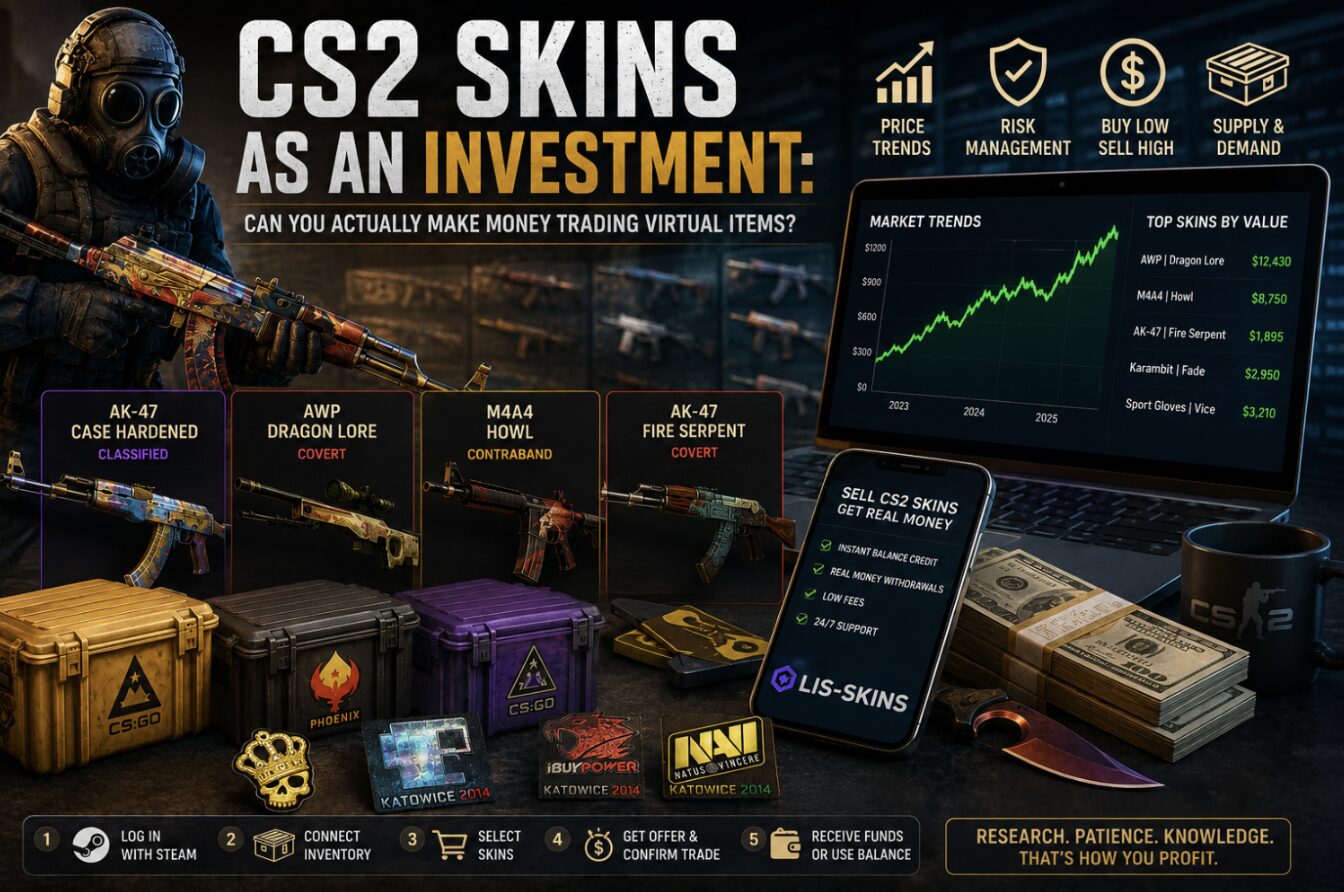
CS2 skins are cosmetic items, but the market around them behaves like a real digital economy. Players buy, sell, collect, trade, and track weapon finishes whose prices can range from a few cents to hundreds of thousands of dollars. That has created growing interest in CS2 skins as an investment.
The idea is simple: buy a skin, case, sticker, or other item at one price and sell it later for more. In practice, however, making money is much harder. Players who want to sell CS2 skins for profit need to consider supply, demand, rarity, weapon popularity, float, pattern, stickers, market liquidity, Valve updates, and the platform used to sell.
A successful CS2 skin investment requires research, patience, and risk control. Skins can increase in value, but they are not regulated financial products and do not guarantee returns.
Can you actually make money trading CS2 skins?
Yes, some players make money through virtual item trading, but profit is never automatic.
A trader can earn money by:
- Buying items below their usual market value;
- Holding discontinued or limited-supply items;
- Identifying skins with growing demand;
- Trading rare floats or patterns;
- Buying older cases before supply becomes more limited;
- Selling after a price increase;
- Finding undervalued sticker crafts;
- Using price differences between marketplaces.
The difficult part is that every transaction includes risk. A skin can increase in value, remain unchanged for years, or lose demand. Even when the visible price rises, fees and cash-out discounts can reduce the real profit.
For example, buying a skin for $100 and later seeing listings at $130 does not automatically mean a $30 profit. The item still needs a buyer, and the seller may pay marketplace fees or accept a lower cash price.
Why do CS2 skins have value?
Skins do not increase damage, accuracy, movement speed, or recoil control. Their value comes from scarcity, appearance, demand, and collectibility.
The main price factors are:
- Rarity grade;
- Weapon popularity;
- Case or collection supply;
- Exterior condition;
- Float value;
- StatTrak availability;
- Pattern index;
- Stickers;
- Professional esports exposure;
- Collector demand;
- Trading volume.
A popular AK-47 skin can have stronger demand than a similarly rare skin for a weapon that few players use. This is why rarity alone does not determine price.
The CS2 skin market values both scarcity and visibility. Players are often willing to pay more for items they will see frequently during matches.
Rarity does not always mean profitability
Counter-Strike uses rarity tiers such as Consumer, Industrial, Mil-Spec, Restricted, Classified, and Covert. Knives and gloves belong to special rare item categories.
Higher rarity usually means lower supply, but it does not guarantee higher returns. A Covert skin can perform poorly if demand is weak, while an older Restricted skin can rise because its collection becomes difficult to obtain.
Investors should study:
- How many items are available;
- Whether the case still drops;
- How often the skin sells;
- Whether demand is increasing;
- Whether the current price reflects real sales.
A rare item with no buyers can be difficult to sell. Liquidity matters as much as scarcity.
CS2 skin liquidity: why it matters
Liquidity describes how easily an item can be sold without reducing the price heavily.
Popular skins for AK-47, AWP, M4A1-S, M4A4, USP-S, Glock-18, knives, and gloves usually attract more buyers. That can make pricing easier and reduce the time needed to sell.
Less popular skins may show high listing prices but have low sales volume. In that situation, the seller may need to wait or lower the price.
Before investing in CS2 skins, check:
- Recent sales;
- Number of active listings;
- Buy orders;
- Price spread;
- Sales frequency;
- Cash-out value.
A liquid skin can sometimes be a safer choice than an extremely rare item with very few potential buyers.
Float and exterior condition
Every weapon skin has a float value within a defined range. Float affects the exterior condition:
- Factory New;
- Minimal Wear;
- Field-Tested;
- Well-Worn;
- Battle-Scarred.
Lower float often means less visible wear, but the effect depends on the skin. Some designs remain attractive in Field-Tested condition, while others lose important details.
Special float values can receive collector premiums. An extremely low Factory New float or unusually high Battle-Scarred float may be worth more than a standard item.
However, rare float does not guarantee profit. The seller still needs to find a buyer who understands why the item is special.
Pattern index and rare variations
Some finishes change significantly depending on pattern index.
AK-47 | Case Hardened is one of the best-known examples. Its surface can show different combinations of blue, gold, and purple. Blue-heavy patterns, known as Blue Gems, can sell for much more than ordinary versions, so players who plan to buy CS2 skins from this category should always check the pattern index, float, and recent comparable sales before making a purchase.
Pattern investing requires specialist knowledge. Two skins with the same name, exterior, and rarity can have completely different values because of pattern placement.
Before buying a pattern-based skin, check:
- Exact pattern index;
- Visible pattern placement;
- Comparable sales;
- Collector demand;
- Specialist price references.
Do not assume that every Case Hardened item is a valuable Blue Gem.
Stickers and crafts
Stickers can increase the value of a skin, especially rare tournament stickers such as Katowice 2014 Holos. But sticker value is complicated.
A sticker applied to a weapon usually does not add its full unapplied value. The premium depends on:
- Sticker rarity;
- Placement;
- Number of matching stickers;
- Visual combination;
- Weapon popularity;
- Collector interest.
A four-sticker craft may attract a large premium, but a random collection of expensive stickers can be difficult to price.
Conclusion
CS2 skins as an investment can generate profit, but success depends on knowledge, timing, liquidity, fees, and risk management. The CS2 skin market rewards players who understand rarity, float, patterns, stickers, collection supply, and real transaction prices.


