

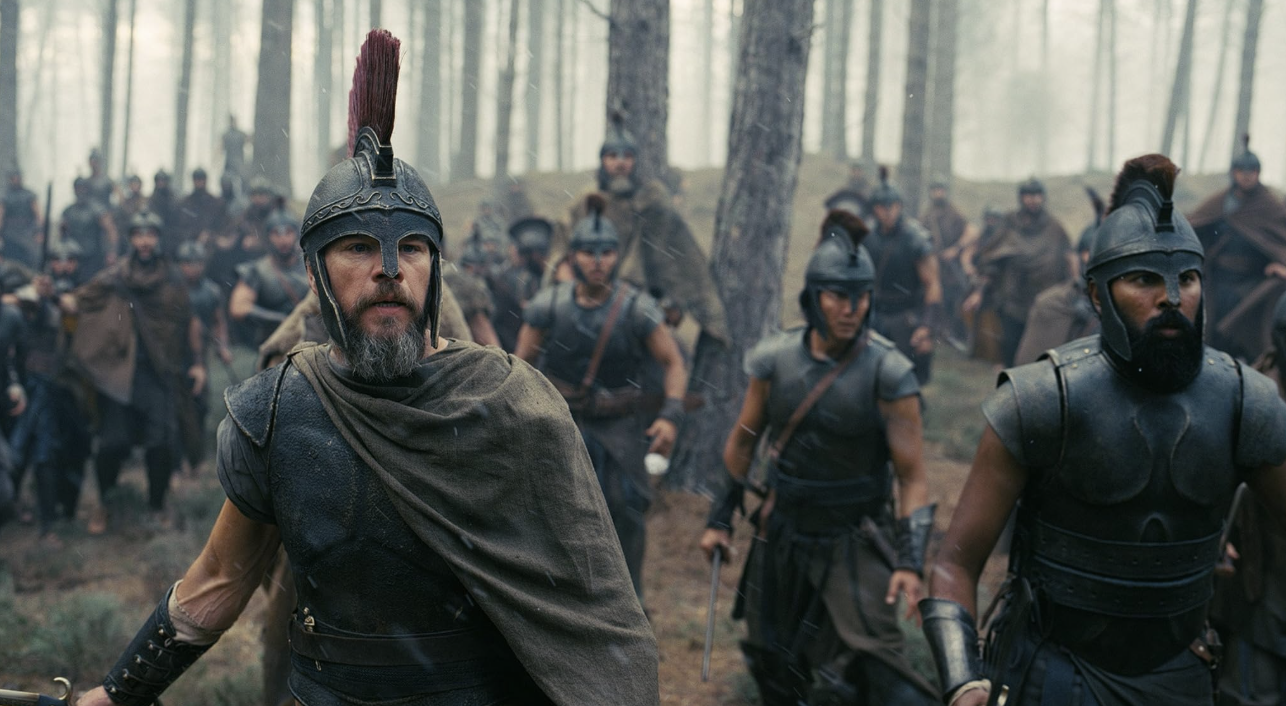
Anyone who has been within earshot of me whenever the terms ‘The Odyssey‘ and ‘Christopher Nolan’ have been mentioned during the past few months would know my strong opinions about the costuming, colour grading, casting, and language choices dominant in the trailer. In the run-up to the film, Classicists I have spoken to at Oxford seem to be divided into two camps: those who are like me, cynical and decrying the modern depreciation of the Classics. Then there are those who call us purists and snobs, and say that Nolan is merely participating in the long-standing oral tradition that has always interpreted and adapted forms of storytelling, as Homer intended. So what’s the verdict?
Despite the trailers, I was surprised at the full extent to which Nolan leaned into the set design. Stark and devoid of colour, Troy has white pillars, statues, and temples. All of this looks like it was built in a lab – the set looks like a set. It is incongruent with the ancient Greece that has long been established by researchers, where people wore vibrant, patterned peploi, and the statues were painted in bright colours. Instead, Nolan’s Greek cities and kingdoms resemble the inaccurate remnants seen under the sterile lens of a curated museum collection. This feels thematically deliberate, and therefore brilliant. Moments of magic are downplayed – ironic, since the film’s opening card sets it “in a time of apparent magic”. Lacking the “glimmer” of magic, the transformation of Odysseus’ men into pigs becomes one of the most grotesque and viscerally disturbing sequences in the film.
This also makes pops of colour, what we regard as “signs of life”, perversely memorable – Agamemnon’s stark black helmet plume with its mechanical golden vertebrae becomes recognisable from a distance, and terrifying against the bright white of the city he is about to destroy. The opening shot of the Trojan horse half-buried in sand, cutting a bronze diagonal across the too-white beach and the too-dim sea is emblematic of Nolan’s choice of set and costume design, almost Backrooms-like in its struggle to reconstruct memory. The visual language of the film translates itself to something on the verge of collapse, which ties in neatly with the overarching theme.
Memory is important here. The film’s episodic structure reflects how Odysseus’ memories gradually come back to him on Calypso’s island, having long repressed them due to trauma. This is, in my opinion, one of the bigger points of reinvention that I actually don’t mind. Through the bard figure, hilariously performed by Travis Scott, Nolan shows an awareness of the weight this story carries within a long-standing oral tradition. The original text is itself already highly meta: a story that focuses on storytelling as an active act of remembrance, and attempts to translate the story as ‘live performance’ of stories within stories.
The film’s treatment of gods also relates to memory, specifically through Athena, the only ‘goddess’ who appears in physical form and stays constantly by Odysseus’ side. The reveal that she takes the face of the priestess beheaded at the Temple of Athena during the sack of Troy is haunting, while simultaneously making me insane with joy, because Nolan has managed to visualise the very human way the mortals relate to the divine. Athena shows up as the only god Odysseus can put a face to because her face is a manifestation of his guilt and grief. Despite the multiple invocations of the other gods in turning points of life and death by Odysseus’ men, most prominently Poseidon and Zeus, they remain silent. Is this representative of the perversion of the divine-human relationship, broken forever due to the Trojan War?
However, the film’s semi-atheistic outlook translates to something confusing and inconsistent. It cannot decide how much moral responsibility its characters actually have. The film’s tagline is ‘defy the gods’, and through the film this is framed as a condemnation – the defiance of the laws between men is a defiance of the gods. Yet a line from Athena at the start of the film, when Odysseus is still on Calypso’s island, throws a spanner into this moral, where Athena disparages Odysseus for taking full responsibility for what is already fated and inevitable. The implication here is that she condemns him for being almost hubristic in his urge to constantly assume full responsibility for the loss of other lives, when the gods have already decreed that they were bound to die. Such a bold statement never really gets resolved, and the scene in the Underworld, where Teiresias once again emphasises that there is nothing Odysseus can do to prevent his entire crew dying because he “cannot save them from themselves”, deepens this problem.
In Homeric epic, the gods, Fate, and free will toe a very fine line. The gods do intervene, but human motivation and human choice always come first in narrative terms. There are many moments where mortals blame the gods within the poem, and none of these positions are justified in Homeric theology. So when Odysseus laments that Zeus made him fall asleep while his men ate Helios’ cattle, the audience is not meant to sympathise with his argument that this therefore makes him blameless – it can be an expression of frustration that the god has not helped him, or the confusing incomprehensibility of the gods (which Nolan also emphasises), but it does not mean Odysseus is free of the responsibility of his choice. Characters’ freedom to make choices is integral to driving the plot and characterisation forward, and yet Nolan fails to make clear the explicit chain of human cause and effect between the plunder and massacre Odysseus and his men conducted at Troy and the disastrous journey home. This leads to interpretations that the whole action of the film is simply the gods’ decree, and Nolan risks diluting his moral message.
This confusion ultimately boils down to where the film suffers the most – the overt sanitisation of Odysseus’ character. Throughout the film, Odysseus’ eyes are those we look through to judge the events of the Trojan War, the journey, and most of the narrative – the audience is inclined to sympathise with him, and having suffered the repercussions of his actions in the Trojan War, he becomes the plausible mouthpiece for Nolan’s message, the righteous avenger against the suitors who violated Zeus’ law first. But as the film repeats the shot of Odysseus staring out as he leans against the marble staircase at Troy, watching the priestess’ head get cut off, I cannot help but wonder – why is Odysseus so special? What makes Odysseus so much better that he is singled out by the gods to return home, and the rest of his men do not, when their actions have been so similar? If that moment where he watches the destruction of Athena’s temple is meant to be his epiphany, why does he carry on to burn down the first island he sees? Nolan has simplified Odysseus so much throughout the film that any straying away from virtue lands oddly instead of adding nuance. Emily Wilson is right: Nolan has written a very uncomplicated man indeed.
Homer, however, never hides how Odysseus is, in many ways, an incompetent leader, and most of the disastrous journey can be attributed to Odysseus’ bad judgement or arrogance. One famous example is the Cyclops episode, where after he and his remaining men successfully leave, Odysseus shouts back into the cave his name, his father’s name, and the destination he is heading to, entirely unnecessary apart from establishing glory for himself. Essentially, Homer establishes clear cause and effect (how Odysseus’ poor choices lead to the downfall of his men), and this elevates narrative significance when he does make the correct choices. Odysseus is not a character who can become a noble, simple character while retaining the same story beats. He is polutropos, a man of many ways – the complexity of his journey home reflects the complexity of the man. Dropping his incriminating story beats makes Odysseus more likeable, but the result is inconsistent characterisation, as well as a lack of character depth. Nolan’s version of Odysseus is unrecognisable when compared to Homer’s, who is cunning, flawed, and subtle.
The other issue with Nolan’s insistence on Odysseus’ nobility: it comes at a cost to the depth of other characters too, especially the women around him, and this is most evident in Penelope. Homer’s Penelope is Odysseus’ narrative parallel, and Book 23 is, in epic terms, Penelope’s aristea, her big ‘heroic’ moment, where she tests the reality of Odysseus’ identity by asking her handmaiden to move her bed, and waits for Odysseus to refute it because only her husband should know that it is immovable. Only then does she relent and greet Odysseus. There is much scholarly debate that Penelope had recognised him much earlier than Book 23, adding to the complexity that she may have been planning the exact type of contest that would benefit Odysseus ever since she saw him in disguise. The bed scene is left out entirely in Nolan’s film, and there is also no nuance as to when Penelope finally does recognise Odysseus.
Nolan also makes the mistake of telling rather than showing when Penelope screams at Telemachus that she has been ruling Ithaca for years and that it is about to be taken away from her male heir. Yet from an audience’s perspective, she isn’t doing much ruling, as all we see of her in the film is her crying and pining away for Odysseus. Even the scene where it is revealed that she has been taking apart the shroud every evening, her overarching line of characterisation throughout the story, is overshadowed by the strange scene where she almost caves to Antinous’ advances – stranger still, because at no point in Homer’s story does Penelope even remotely entertain him. Her complexity becomes less of a point of attention because her parallel character, Odysseus, is also not stepping up to the narrative depth game. In the poem, Odysseus and Penelope work since although they occupy very different spheres of movement and gender roles, they still mirror each other. Nolan’s Penelope falling flat is especially fatal because she has no ‘action’ to rectify or distract from it, unlike Odysseus.
In general, I think I liked the film a lot when I was watching the credits roll. It is a spectacle, and despite knowing the exact story beats of the plot, the escape from Polyphemus and the harrowing flashes of the storm still had me on the edge of my seat. Odysseus’ final stringing of his bow still almost brought tears to my eyes. And much of it for me is that there is clear love shown in the stunning visual and musical language to deliver those emotional beats, and in a very meta way, I love that this much is devoted to a subject that I have spent many years loving and studying, and seeing a work from so long ago come alive on the modern screen.
I also mourn the fact that this may be the only version of The Odyssey that a modern audience will see in their lifetime. To me, Homeric epic has withstood the test of time not only because of a flashy plotline, but because it is, at its core, a story that contains the scattering multitude of human experience and complexity – to return home as a complicated, flawed individual to a complicated, flawed community, and finding love anyway. For that to hold, the characters cannot all feel universal, and that is unfortunately what Nolan tried to narrow down with his characterisation and theology. I just wish that I could point to a moment throughout the film where I leapt for joy that Nolan understood the character, their motivations, and why some things are important for the story to keep. I wish I was actually watching the Odysseus I love to hate, and the Penelope that mirrored him in all the strangest ways.
Nolan had all the tools for greatness. Instead, to my eternal frustration, his Odyssey will always only be just alright.


