

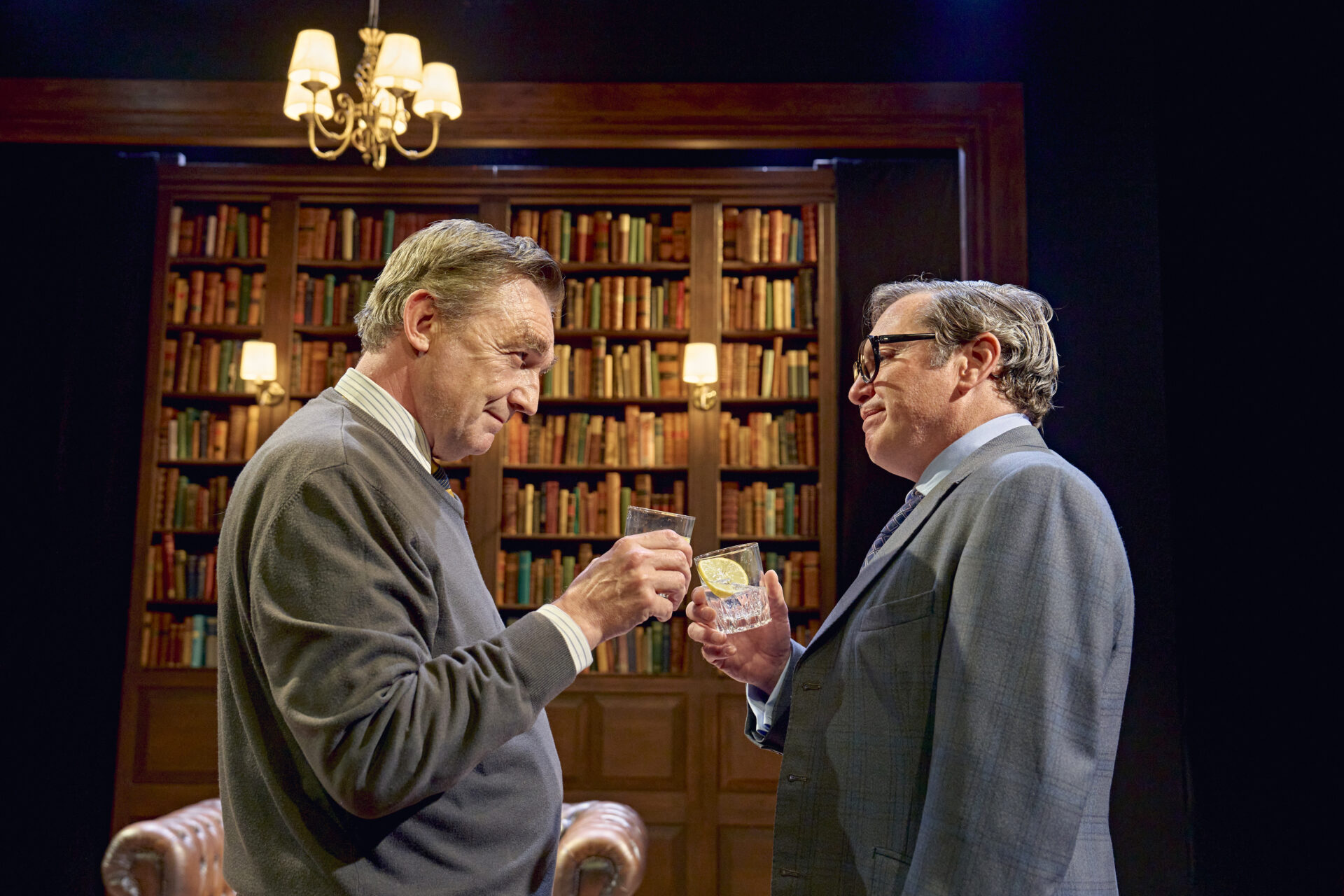
It’s Budget Day as I sit in the foyer of the Oxford Playhouse. Down in Westminster, Chancellor Healey faces his first major test. But up here, another Chancellor Healey faces his own, as the tour of acclaimed political drama The Gang of Three comes to Oxford. Robert Khan and Tom Salinsky’s play dramatises the political and personal rivalries between Labour heavyweights Roy Jenkins, Denis Healey and Tony Crosland. I sit down with co-writer Robert Khan to discuss political friendship, the enduring appeal of the ‘70s, and what today’s Labour Party might learn from its predecessors.
Khan and Salinsky have been writing together for years. After a successful run of their play Brexit at the Fringe, it transferred to the King’s Head Theatre. A producer asked them to “pitch me some more ideas, boys”, and asked whether they’d read Giles Radice’s Friends and Rivals, the comparative biography of three modernising men of the Labour Party after Harold Wilson’s surprise resignation. Khan had. “There’s a play in that”.
Initially worried about how to make it relevant to a modern audience (“Does anyone under 50 know who these duds are?”), concerns were quickly dispelled. The play’s debates are hardly confined to the 1970s: do the ends justify the means? Can political allies really be friends? And what happens when personal ambition gets in the way of a shared political project?
There are clear parallels between then and today. Khan’s clear that the piece needs to stand on its own, but there’s no denying the resonances: geopolitical issues, price of oil and cost of living crises throughout the 70s. It is 50 years since the IMF crisis. Jenkins’ resignation as Deputy Leader in 1972, at the Shadow Cabinet’s decision to back a referendum on Britain’s entry into the European Economic Community, offers another reminder of how easily political disagreements can become personal divisions.
The Labour leadership election earlier this year carries particular echoes of 1976. I ask what lessons he’d want Burnham to take away if he were in the audience that evening. Khan is quick not to put down the new PM – “It’s not for me to give lessons to our Prime Minister!” – but if there’s one thesis of the play, it’s to avoid infighting. The divisions between Jenkins, Healey and Crosland ultimately prevented any of them from becoming Prime Minister. Callaghan won against all three in 1976. Michael Foot narrowly beat Healey in 1980. Because three politicians “who basically believed the same thing” “couldn’t come together”, none became leader or PM. 18 years of Tory government followed.
Yet the three were formidable figures. Healey championed the term “hinterland” in discussion of politicians, and Crosland drew up the seminal work The Future of Socialism. For Khan, they are “heavyweight figures who we don’t get in politics anymore”. They fought in the war, something he wonders may have given them a particular perspective on political life.
Could a similar play work in 50 years’ time about Burnham, Healey, and Mahmood? Maybe, Khan says, but they’d need to be tested. Or have strong personalities. Johnson would work, and did for Khan and Salinsky’s Kingmaker. Truss might, if only as a farce.
Staging such big figures seems to present a challenge. How do you capture the essential qualities of such well-known figures? Khan recalls a particularly useful piece of advice when going over the script with Bill Rodgers, who, alongside Jenkins, formed the ‘Gang of Four’ who split from Labour to form the SDP in 1981. “The thing about Roy Jenkins was that he was an Edwardian. He needs to be played as an Edwardian”.
Other things changed when dramatised. Tony Crosland loses a “so posh” RP accent. Some less palatable comments Healey made in the House likewise aren’t represented. But the one thing that makes the transformation convincing, Khan says, is actors who can completely inhabit the characters.
Though this evening there’s an understudy in the house: co-writer Tom Salinsky steps in for a role. It’s a big night. Denis Healey’s son is also in attendance (decked out with a similarly glorious pair of eyebrows, apparently).
Khan and Salinsky seem to have a far more harmonious relationship than that of their protagonists. They met at Southampton in 1990, but, as Khan jokes, “it only took us twenty years to come up with our first good idea”: Coalition at the Fringe in 2012. Since then, they’ve written plays on Murdoch, Houdini, and the post-Brexit Tories, and even audio dramas for Doctor Who’s Tom Baker and Peter Davison. “We don’t sit together and write it like Galton and Simpson”, Khan tells me. Instead, they draw up character developments together and write scenes by themselves, which the other edits. “It’s like magic fairies have come along and improved it by the morning”.
What’s next for the duo? At the King’s Head next week, they launch Saving Alan Turing. “What hasn’t been done is the last two years of his life”, according to Khan. With the 75th anniversary of Turing’s conviction for gross indecency approaching, the production also promises to revisit a story whose significance extends well beyond its historical setting. Turing’s pioneering work in computing and artificial intelligence gives the play an especially contemporary dimension.
But for now, The Gang of Three is here in Oxford, apt for a play with a connection to the city. All three were contemporaries here – Healey and Jenkins at Balliol, and Crosland at Trinity – with Jenkins and Crosland briefly being lovers, as explored in John Campbell’s 2014 biography. Cherwell itself gets a mention or two (Robert says the actors’ pronunciation had to be corrected). And just as his ambitious real-life politicking never got him the top job, Healey is the object of a gag about an imagined unsuccessful run for Union President. How little some things change.
‘The Gang of Three’ is running at the Oxford Playhouse until 31st October.