

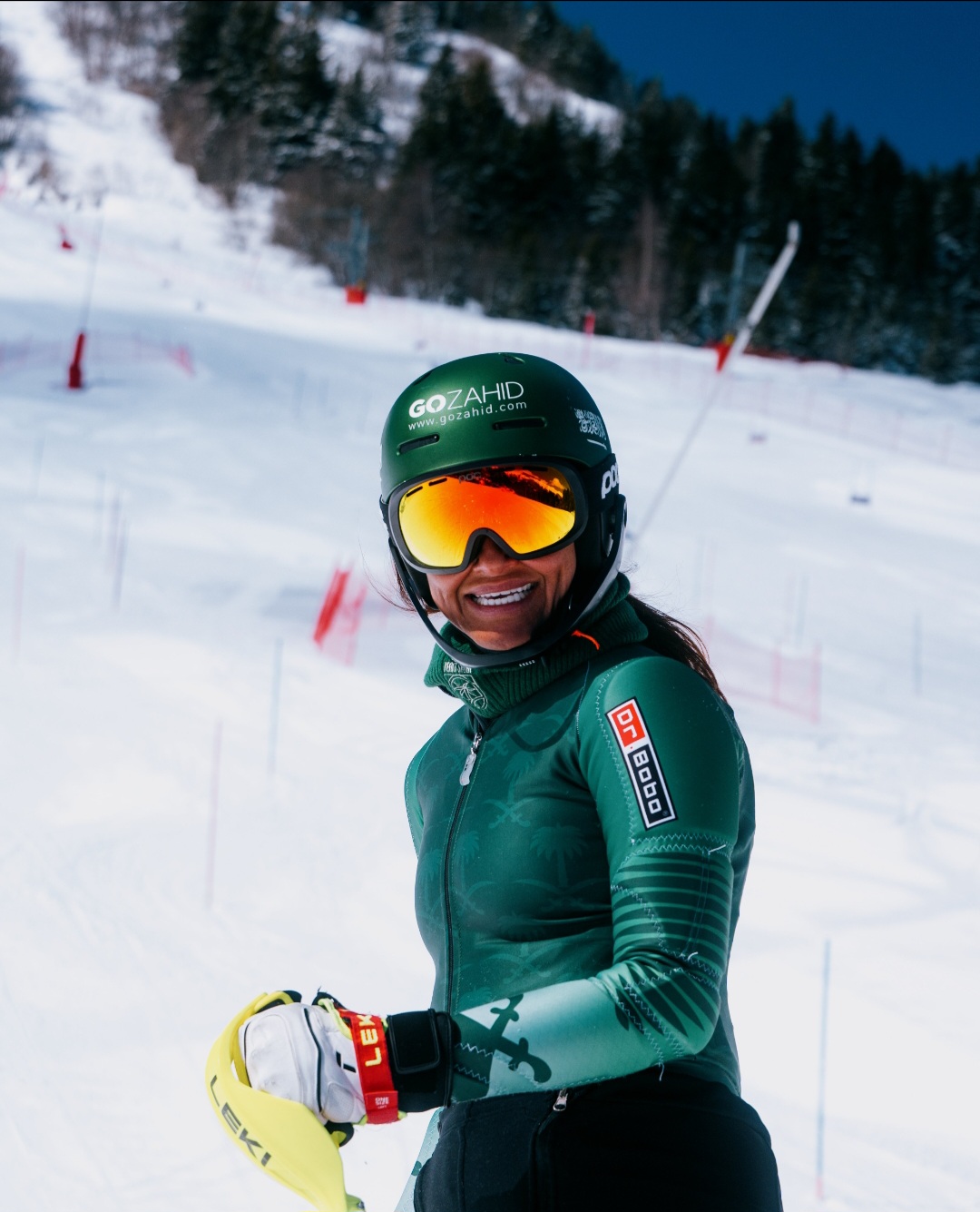
Saudi Arabia, a country renowned for its desert landscapes and scorching temperatures, seems an unlikely starting point for an alpine skier. Yet Sharifa Al-Sudairi grew up in snow-free Jeddah and pursued one of the most snow-dependent sports. Perhaps even more compelling, she started competing in her mid-30s, an age when many athletes consider retirement.
Al-Sudairi is Saudi Arabia’s first female alpine skier, competing internationally as her country undergoes a period of rapid social and sporting change.
“Skiing was not part of my childhood in terms of seriously doing this competitively,” she says. Instead, she grew up near the beach and remembers participating in water sports such as sailing, surfing and “just trying every sport under the sun”.
Al-Sudairi tells me: “I was in every sports club in my school.” She lists tennis, basketball, and “probably football at some point”. Yet while Al-Sudairi’s family encouraged her to do sports, she notes that “it was kind of something you do on the side”. Skiing first began as a “casual hobby” when her parents took her and her sisters on ski holidays in Switzerland: “Once a year we would go on these holidays.” She laughs as she recalls being “more excited about the hot chocolates”.
Her family’s interest in skiing began after a friend of her father recommended that they visit a beautiful spot in Switzerland, which they enjoyed and kept returning to. She describes her father as an “adventurous traveller”, the type of person “that spins the globe and says this is where we’re going to travel to in the summer”. So, skiing in Switzerland was something “we were going to try as a family, and that’s how we got introduced to it”.
At the age of 16, she moved to Switzerland for boarding school, bringing her closer to the Swiss Alps and giving her the opportunity to “really focus on skiing”. But even then, she did not ever see herself becoming a professional athlete. The sport remained a “casual thing in the back of my head; there was nothing more to it, at this point of my life”. What she did have, however, was what she calls a “competitive athletic bug”, but her professional life would first take her in a different direction.
After studying fine arts in London and continuing with a Master’s in Art and Business, Al-Sudairi worked as a gallerist, later becoming associate director at London’s Pace Gallery. All the while, skiing remained a passion pursued separately from work. This changed in the early 2020s, “when my country was going through all these significant changes”. She recalls feeling intrigued when she heard Saudi Arabia was starting a snow sports federation: “I said, ‘Wait, that’s something I know how to do really well.’”
It was a moment in her life when she felt she “really wanted to give back to my country”. Joining the federation, she says, was “my way of giving back and I get to do my sport professionally”. She told herself: “I don’t want to look back when I’m 80 and say ‘I wish I did this because that was the moment’.” Despite all the reasons that could have stopped her, she knew: “This was the chance.”
The sudden change came with many sacrifices. Al-Sudairi tells me she had to miss a lot of events and personal occasions with her friends and family, but “I did that kind of happily, because it really gave me so much fulfilment, you know, doing what I did”. While Al-Sudairi had to cut out some of the social aspects of her life to prioritise her athletic goals, she has no regrets because her friends were “always with me along the journey”.
For instance, when she had to turn down dinner invitations and late-night plans because protecting her sleep was important to maintaining her training and performance, her friends “understood that if I couldn’t make it for dinner, then they would come and see me for lunch”.
Her decision to take on skiing professionally at Olympic level in her mid-thirties stemmed from “just being inspired by what my country was going through”. Her journey representing Saudi Arabia began in 2022 when she took the leap and registered with the Saudi Winter Sports Federation. Her early races came at Ski Dubai, where she competed in regional indoor ski events that helped launch her competitive career. She remembers the support she received from her Jeddah community, which she says encouraged her throughout the process: “I felt like I went to the Olympics. The love that I got from my community was incredible.”
Competing in the sport competitively and nationally was, at first, unfamiliar territory. “I kind of didn’t know what I was doing”, she admits. Yet her presence alone marked a historic first for Saudi Arabia.
When asked whether there were moments when skiing felt impossible, her answer was immediate: “Right from the start it did.” Her decision to change careers and train as a professional athlete, at an age when many athletes were considering retirement, “did not make sense to many”. Someone even suggested that she take a desk job with the ski federation instead of skiing, but Al-Sudairi persisted and continued training. She recalls there being many moments where she “could have easily left skiing” but there was always “something inside me, a voice in me that said just go”.
The conventional route into elite sport is typically mapped out from childhood, starting with specialist coaching, participating in junior competitions, then national teams after years of progression. Yet Al-Sudairi’s journey was not planned as such, and growing up in Saudi Arabia, skiing was hardly the obvious career choice: “I think our way of getting into sports, as females in Saudi, was quite unique to other nations.”
Growing up, Al-Sudairi recalls being very aware that there are misconceptions about women in Saudi Arabia and, more broadly, the Middle East, but believes that “maybe at some point you don’t blame [people for having] the misconceptions”. For Al-Sudairi, the changes she has witnessed in Saudi Arabia are particularly significant for women. She describes Saudi women as “leaders”. Women in Saudi Arabia are working across sectors from some of the region’s largest companies to ambassadorial roles or, like herself, at the forefront of women’s sport.
Particularly in the past eight years, Saudi women have “slowly broken those barriers, probably in our way” and “kind of just proven to the rest of the world that women here are capable”. Even if not every woman was given these opportunities as a child, the next generation of Saudi women will certainly “know a world where they’re doing the exact same thing as any girl or woman anywhere in the world”.
But barriers remain. At the moment, Al-Sudairi believes the biggest challenge that young Saudi girls face in skiing is the lack of proximity to snow: “These sports need to be really accessible, and at the moment, it is a trip that you have to take.” She also considers family support and encouragement as factors in a young athlete’s success. “It makes it easier”, she says, believing that first and foremost, one’s journey pursuing their sport “has to be a family affair, because you have to commit a lot of time to it”.
Regarding her own challenges with sports, Al-Sudairi has also had her share of injuries. In 2023, during the ski season, she tore a ligament, which caused her to miss the summer training block. In December the following year, she broke her arm while training in Italy: “In these moments, you stop, and you think, is this worth it?” But she recalls that “even on the hospital bed when I broke my arm, it made me think, ‘I want to get back and show that I can do more’. I love the grind. I think I thrive off of this feeling.”
Her results have since reflected that determination. In February 2025, she was part of Saudi Arabia’s debut team at the ninth Asian Winter Games in Harbin and Yabuli, China, where she competed in the women’s slalom and served as a flagbearer at the opening ceremony. The following month, in Kolašin, Montenegro, she secured two second-place finishes across a series of International Ski and Snowboarding Federation (FIS) and national championship races. In March 2026, she returned to Kolašin and placed fourth in the National Championships slalom and fifth in the National Junior Championships slalom. She also competed in the National Junior Championships slalom events in Kopaonik, Serbia, that month.
However, being the first woman to achieve something was never her primary motivation. “I knew I had to put in double the work”, she says, and so she “wasn’t sitting there being focused on the fact that I was the first”. Representing Saudi Arabia as the first female alpine skier is an “incredible honour”, but equally, she “wasn’t quick to go and do it because ‘you might be the first’”. What mattered more to her was that she “just wanted to go out and ski”.
Yet she recognises the significance that being the first can have for others: “I think what matters to people who look like me is to know that there is someone from your background.” She adds that “it does make a big difference to them”. Despite the significant impact representation can have, Al-Sudairi grew up having no Saudi female alpine skier role models to look up to. Now, she has become the first herself. For a young girl considering an unconventional path, her advice is clear: “I would say, put your blinders on, put your head down and do the work. Don’t listen to the noise. There’s going to be a lot of it, but just be prepared to put in the work.”
She says sports, or any ambition for that matter, “has to consume your life, because every aspect of your life plays a role in whatever it is, something unconventional, challenging, difficult or not the norm that you are pursuing. Just keep going at it, even when it doesn’t make sense.”