

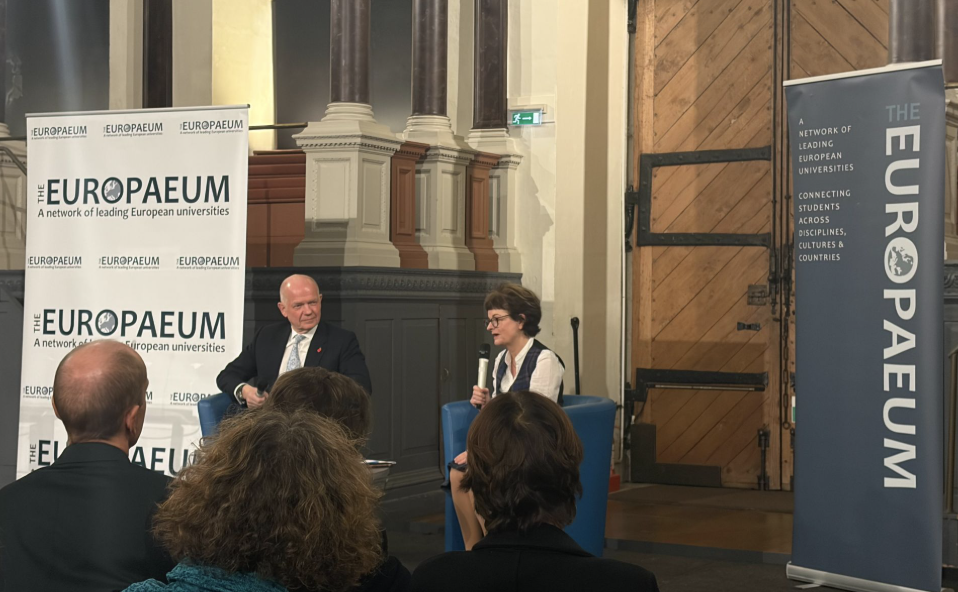
Chancellor of the University of Oxford, Lord William Hague, delivered the 2026 Europaeum Annual Lecture at the Sheldonian Theatre on 4th November. Hague called for closer UK-EU ties as a matter of urgency, including strengthening cooperation on technology, defense, and climate change, whilst upholding democracy and doubling down on multilateralism.
Hague’s wide-ranging speech is the second ever Europaeum Lecture. The series brings together high-profile speakers from top European universities to discuss Europe’s challenges. Describing the current era as “the most dangerous period since 1945”, Hague outlined his vision for Europe to escape decline by rebuilding through renewal and resilience. In response to Prime Minister Andy Burnham’s call for the UK to eventually rejoin the EU, Hague expressed scepticism about the move’s feasibility, but declared that “our fate is as entangled with the fate of the continent as it has ever been”.
On technology and the rise of artificial intelligence, Hague warned that Europe risks becoming either a “digital colony of the US or a tech dependency of Beijing”. He urged the continent to “take back control”, including by ensuring the “free cross-border flow” of global talent. The Chancellor portrayed universities as “engines of ideas” crucial to spurring innovation. Oxford ranks as Europe’s leading university for spinout value creation, accounting for 20% of all investment into spin-outs across Europe.
Noting Britain’s record summer temperatures, the Chancellor called for new measures to adapt to the effects of climate change and greater investment into “novel technologies”. These included carbon capture, geoengineering, and genetic engineering. Citing Greece’s recent launch of a satellite system for wildfire prevention, Hague urged the UK and EU to work together on a similar scaled-up Europe-wide solution. He also encouraged both sides to unify carbon markets and simplify trading of electricity.
Cherwell asked the Chancellor about possible reductions in tuition fees for EU students at UK universities, currently under consideration as part of UK-EU negotiations. In his reply, Hague told Cherwell: “We’d love to see it easier for EU students to come to our universities, but it does require governments to reach agreement.” He expressed support for a youth mobility scheme enabling young British and EU citizens to live and work in each other’s countries. However, Hague also referred to negotiating conflicts over equalising tuition fees for EU nationals with British citizens to pour cold water over a deeper UK rapprochement with the EU.
In exchange for a youth mobility scheme, the Chancellor encouraged the EU to involve Britain in its “Made in Europe” industrial policy. He also endorsed closer defense cooperation through the EU’s €150 billion Security Action for Europe (SAFE) loan scheme, as well as joint UK-EU leadership on international governance of new technologies, including creating guardrails against artificial intelligence.
Founded in 1992 by former Oxford Chancellor and the only-ever British President of the European Commission, Roy Jenkins, Europaeum offers postgraduate programmes to students across 17 European universities. The network describes itself as “an alliance of pre-eminent universities” focused on interdisciplinary learning to tackle Europe’s major issues. The University of St Andrews is the only other UK member of the organisation, which continues to be headquartered at St Antony’s College, Oxford.