

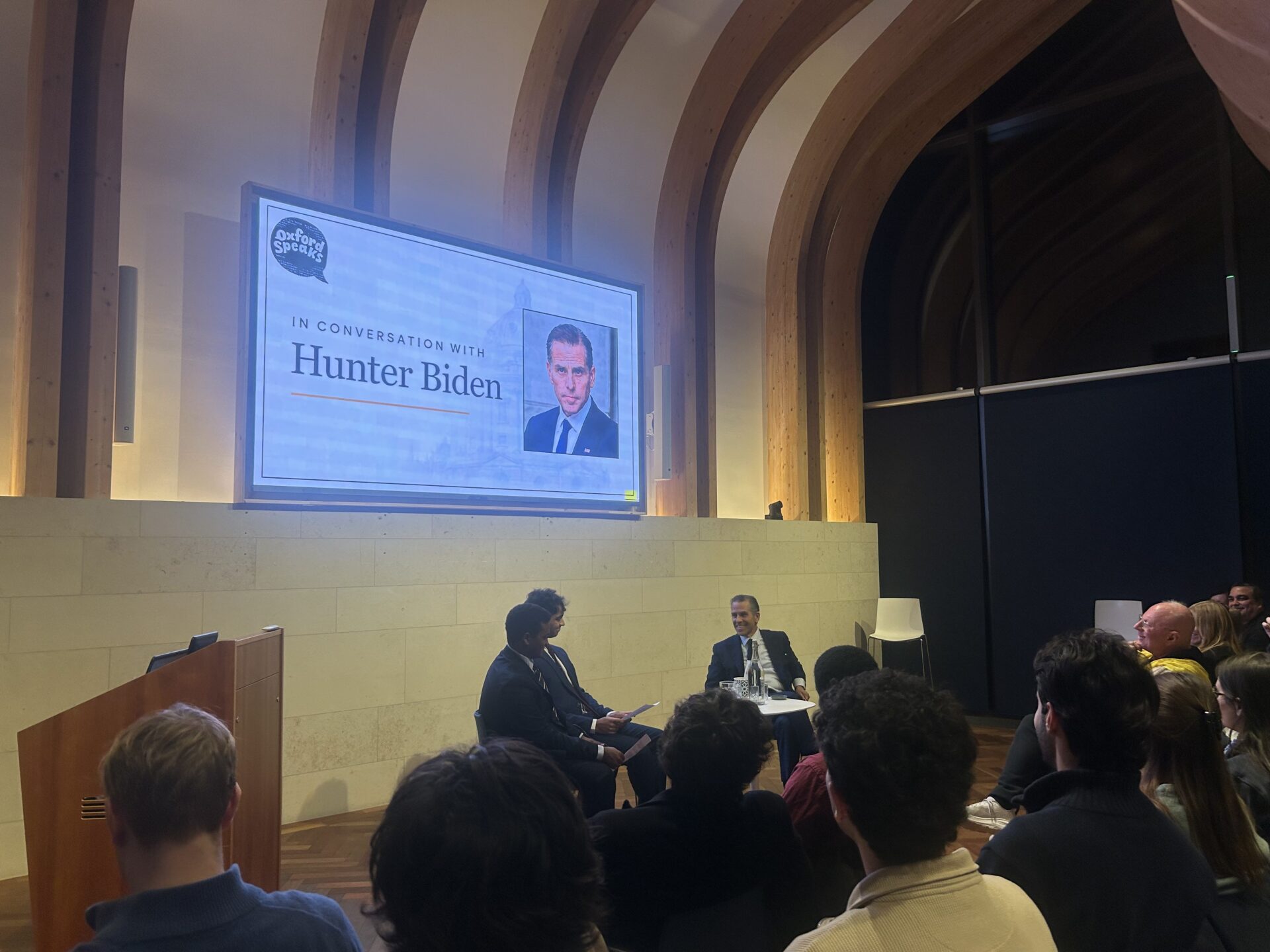
Son of former US President Joe Biden, Hunter Biden, spoke to Oxford students at a free event organised by OxSpeaks Thursday evening (14th November).
In a Q&A, Hunter spoke about his struggle with addiction, being at the centre of a media storm, and the current state of the Democratic Party. The former president’s son was positive about the party’s new progressive wing, many of whose members have been strongly critical of his father, especially over Gaza.
The session began with an address of the former president’s health, as President Biden suffers from stage 4 prostate cancer. Hunter told the audience that “he’s a fighter” and “I complain about it more than he does”.
Hunter was candid about the impact of addiction. Referring to the worst parts of his addiction to crack cocaine, Hunter said: “I was at a point in my addiction where I didn’t think I had another chance.” At times, “I [Hunter] wanted to be dead. I couldn’t stand myself anymore, I couldn’t stand all the broken promises and all the times that I’d lied”. In a touching moment, the former president’s son pointed to his wife in the audience, saying that “without her” he would never have gotten through the toughest times.
Hunter was also happy to address the controversies surrounding his ‘laptop’ that led to his targeting by right wing media. He decried the amount of coverage the story received versus the alleged corruption of the Trump administration, claiming that the laptop “showed not a single evidence of crime, other than drug use”.
Asked about the right-wing media ecosystem that heavily reported on the story, Hunter argued that they are “really really good at propaganda”. He also admitted that “I gave them great material… sex, drugs, rock and roll, and politics”.
Hunter was upfront about the controversial pardon his father gave in the last days of his presidency. He admitted that “it set a bad precedent”. However, he will remain “eternally grateful” to his dad for saving him from the “most corrupt, vindictive, vitriolic president”.
Regarding US politics, Hunter celebrated the Democratic Party’s victory in the midterms last week. He argued that the result, in which the Democratic Party achieved the highest share of the popular vote of any party since 1976, was “the single greatest repudiation of a sitting president in my lifetime”.
When asked if he had a preference for a future Democratic Party candidate in the 2028 presidential campaign, Hunter picked out the Governor of California, Gavin Newsom. The former president’s son noted his “deep personal affection” for the governor and praised him as a “really effective communicator”.
Hunter also spoke positively of Governor Josh Shapiro of Pennsylvania, Senator Jon Ossoff of Georgia, and Governor JB Pritzker of Illinois. He concluded that progressive New York Congresswoman Alexandria Ocasio-Cortez would be the hardest to beat because “all of the energy is there”.
Thereafter, Hunter was positive about the new progressive energy in the Democratic Party. Of Abdul El-Sayed, a former Oriel College PhD student who became Michigan’s Senator-Elect, Biden told the audience that “I don’t see anything radical about [El Sayed’s politics] at all,” citing the Senator-Elect’s advocacy for clean water and affordability. Considering Democratic Socialist New York Mayor Zohran Mamdani, he argued that “the idea that we have to do something about the cost of rent in New York City is, in my opinion, not socialism” but a fulfillment of the “social contract”.
Hunter was no less scathing about structural issues facing the country. Asked whether he would describe the country’s political system as an oligarchy, he answered in the affirmative, arguing that “it is broken and it is broken because of the money”.
The former president’s son also spoke about his feelings on Gaza, the issue which led large numbers of progressive voters to lose faith in Joe Biden as president. Just this week (Tuesday) Joe Biden’s appearance with his son at a ceremony in Dublin honouring Hunter’s contribution to public life was met with pro-Palestine protests.
Regarding Gaza, Hunter said that “I have a lot of feelings that are not necessarily my dad’s” and that “what is happening right now in Gaza is mass murder.”
He was less willing to accept the charge, levelled by a member of the audience, of a cruel “American Empire” being rejected by students at protests, like those in Dublin. Hunter, noting the right of students to protest, defended American power saying: “I still believe that despite all our failings and despite some of the cruelty… when we are at our best we are a force for good”.


.)