

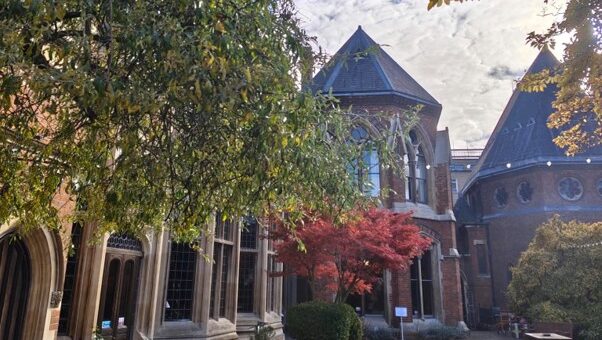
On 22nd October, the Oxford Union rejected the motion ‘The UK Should Withdraw From The ECHR’, with 192 members voting against and 54 in favour.
The motion follows ongoing calls for Britain to leave the European Convention on Human Rights (ECHR), with the most significant political declaration coming from Conservative Party Leader Kemi Badenoch.
The debate, opened by President Gareth Lim, began with a contentious start. Speakers debating in favour of the motion included Lord Peter Lilley PC, Martin Howe KC, and Suella Braverman KC MP – the latter arguably the biggest draw, given the mass exodus of audience members after Braverman’s concluding argument.
Opposing the motion included George Peretz KC, DPhil Law Candidate Dane Luo, and second-year Philosophy, Politics, and Economics student Sambhav Jain.
Second-year law student Leyton Styles opened the debate with an introduction hinged on his Substack being shared on Tommy Robinson’s social media this summer. Starting on sovereignty, Styles demanded, “Why assume British people are incapable of defending themselves?”. He insisted that most individuals on the opposition already “oppose British empires,” so why “concern [themselves] with legal systems of foreign lands?”. Styles argued that the rights of British people have “been endangered by violent and criminal foreign nationals”.
Jain followed Styles with a cheeky remark that Braverman was seated at the nearest exit because of her record of withdrawals. (This writer can report that Braverman did indeed stick out the whole debate). Jain framed his argument with a metaphor, saying: “We agree that the patient is unwell. Nobody is denying that the UK has a problem at its borders or that the government must act. But the proposition has misdiagnosed the problem.” He left the audience with the reminder that “the test of human rights isn’t what protects the popular but the unpopular, because that can be one of us”.
The debate entered full swing with the proposition’s continuation from Lord Pilley, who told the audience that the “ECHR is 75 years old, the age at which British judges have to retire”. He cautioned that England must leave the ECHR to avoid becoming “like America, with lifetime judicial appointments”, and explained further: “Laws are made by Parliament, accountable to the people and applied impartially by non-political courts. Under the ECHR, laws can be made by the courts accountable to no one and without voters or their elected representatives having a say. This turns the British Constitution on its head [sic]”.
Peterz sparked back, proclaiming that “the [ECHR] is about underpinning democracy and underpinning cooperation with our neighbours.” He emphasised the significance of the courts: “You can’t trust any politicians to hold on to those values.”
Concluding on Britain’s importance to European unity, Peterz urged the audience to remember that “when one European state stops [respecting] human rights, the consequences start affecting everyone else… even those who shove their fingers in their ears for that lesson have to accept that the [ECHR] underpins the cooperation that we need to deal with the array of security threats that we and our continent face”.
After Peterz came Braverman, along with objections to her attendance. Her opening was interrupted by heckler Leo Buckley, who declared, from the balcony, that Reform UK operated as a company rather than a political party.
Braverman’s speech drew an analogy of a failing marriage between the UK and the ECHR, declaring to audiences that “our partner began to control us, coerce us, and frankly, humiliate us”. She said that the UK and ECHR have been in “marriage counselling” for decades, adding that “whenever we say there is a problem… we’re told by Strasbourg that we’re overreacting and getting hysterical. But the reality is, it’s just not working”.
She asserted that rights existed before the creation of Strasbourg, contending rights were provided to women before they were members of the ECHR. “We don’t need a foreign court telling us how to protect civil liberties,” she said, deeming Britain’s ability to self-govern inexplicably required.
As former UK Home Secretary, Braverman pleaded that her political role was restricted because she was “unable” to deport foreign terrorists, paedophiles, drug dealers, and murderers because of their human rights, and that “a nation that cannot control who leaves or enters its territory is not a nation”.
Yet, assuring the audience of her humanity to the struggles facing all individuals, Braverman added: “I’m not here this evening to say that human rights don’t matter. I’m here to say and ask you who should be responsible for defining them and protecting them.”
Luo, next to speak in opposition, listed specific case examples of the necessity of the ECHR, including the court’s eradication of leather-strap discipline, the military ban on gay personnel, and Northern Ireland’s criminalisation of homosexuality. Luo emphasised the ECHR’s strength in protecting the “vulnerable and the voiceless, the little person, against the might and the power of the state”.
Luo also rejected the proposition’s sovereignty argument, saying that “when Parliament has thought that the ECHR has gone too far, it has legislated to limit it”. Luo cited the overseas armed forces legislation and the Rwanda Bill, which Braverman voted against while she was an MP.
Thereafter, Howe provided a legal philosophy from the proposition’s perspective, assessing that the law should be the servant of democracy, not its master, including “our human rights law”. Howe’s call centred on a sense of nationalism and the need for sovereignty, as he urged that “we need to leave the convention in order for the people, our people, to regain democratic control over our laws” and that because Britain is “proud to belong to a country with the longest and deepest history of the protection of fundamental rights and liberties of any country in the world, there is no need for a foreign court to protect national liberties”.
Finally, Bold asked the audience: “Sovereignty, for whom?”. Framing Luo’s reference to the little guy once again, Bold boldly posed an inquiry: “who will uphold the rights of the non-violent protester, who will uphold the rights for the worker whose right to strike is curtailed?”. Asserting the significance of basic freedoms, Bold emphasised her point on the essentiality of the ECHR in a simplistic utterance, “The democratic process is necessary, but not sufficient condition for the protection and vindication of human rights”.
Whether persuasion prominently perfumed the air or audience members left the chambers with the same beliefs before entering, the motion was rejected.
When asked about his perspective, Styles shared his thoughts at the Union’s bar: “Sometimes the numbers in the chamber are skewed by either left-wing activists or students with very overly liberal views. I respect the opinions of all people, and we promote free speech. It is why the Oxford Union is so brilliant, and despite losing the motion, we will not lose the heart of the country. Long live free speech.”