

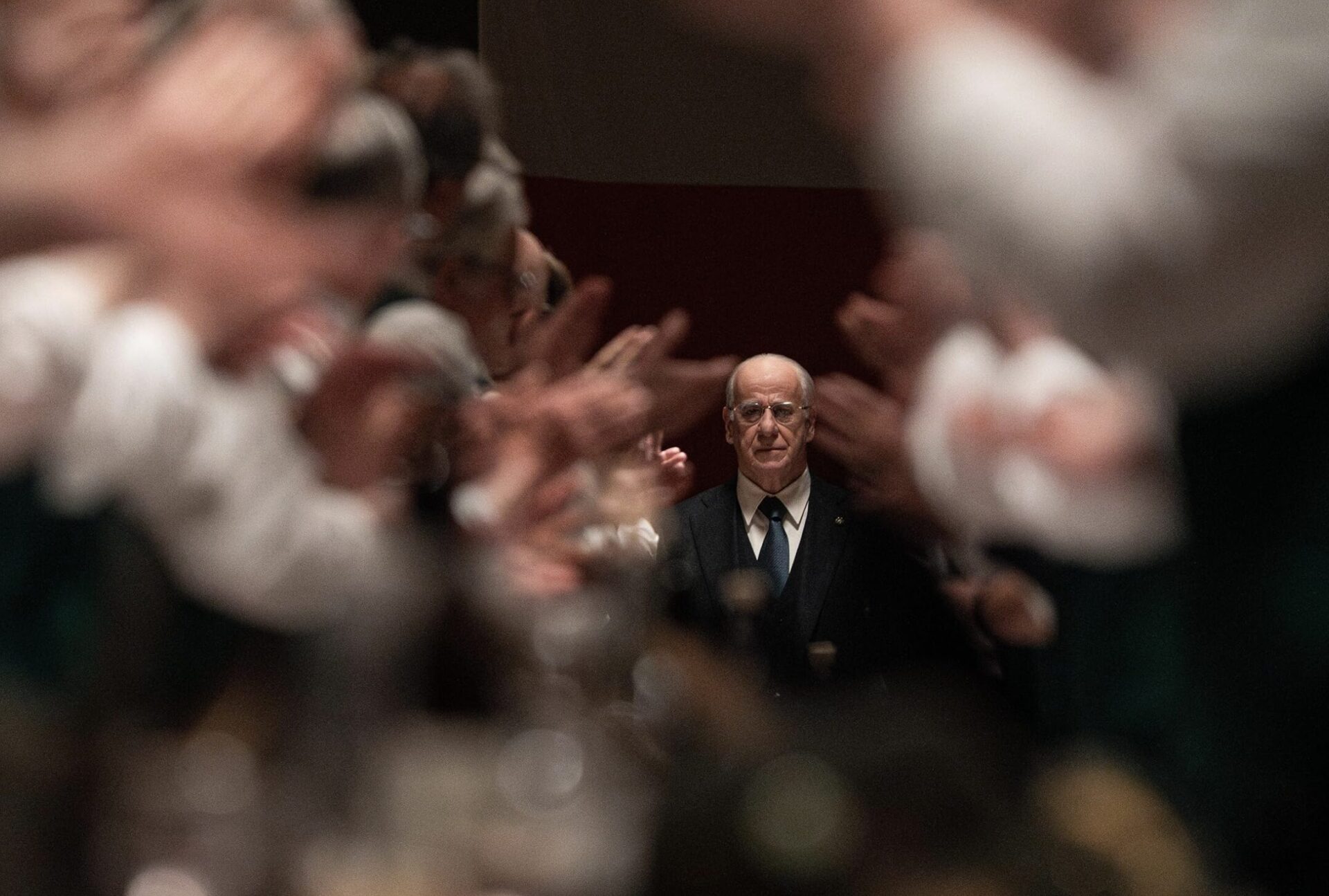
Does Big Tobacco sponsor Paolo Sorrentino’s films? Almost certainly not, but their money would be worse spent elsewhere. One of the lasting images from Sorrentino’s latest feature, La Grazia, is of Toni Servillo smoking on the parapets of the Quirinal Palace overlooking Rome. Servillo’s expression is enigmatic, the view exquisite. As viewers of Sorrentino’s 2013 Oscar-winning triumph The Great Beauty will know, there are few things eminently more watchable than Toni Servillo slowly dragging on a cigarette.
La Grazia sees Sorrentino reunited with his long-time muse – and what a welcome reunion it is. Servillo plays the ageing, lame duck president Mariano De Santis, a legal expert who is a “jurist”, not a politician (sound familiar?). He would normally be facing his last six months in office with the same detachment and letter-of-the-law rigidity that have earned him the nickname “Reinforced Concrete”. However, a bill passed through parliament on assisted dying must be signed by him to become law, and thus, the president is faced with a dilemma. If he signs, he is an “assassin”; if he rejects the bill, he is a “torturer”. Two petitions for presidential pardons for convicted murderers complicate the picture: De Santis has the power to offer the titular “grace” to those on all types of life sentences, medical and criminal.
A tired and grieving De Santis (he lost his wife some years before) proves an excellent vehicle for the film’s meditations on life, loss, and legacy. Who better to weigh up the suitability of euthanasia than a man who has seemingly lost all flair for life himself, who falls asleep when he prays and is still obsessed with an extramarital affair his late wife may have had 40 years ago? “Who owns our days?” is the question that De Santis keeps coming back to with the help of his daughter and legal advisor, Dorotea (an effectively exasperated Anna Ferzetti). But the film also asks: “Why should we care who owns our days?” Though De Santis is a genuine Catholic, the existentialism at the heart of the film is reminiscent of the tortured questioning of a lapsed Catholic at confession.
Boy, does Servillo have range. This is not his first time playing an Italian president, yet the contrast with his muted, shuffling Gulio Andreotti in Il Divo, and his exuberant Silvio Berlusconi in Loro is remarkable. He is able to convey a world of emotion in the most subtle of movements. It is no wonder the Venice Film Festival awarded him the Best Actor award.
As in those films, all the hallmarks of a Sorrentino film are here, if rather downplayed. The trademark big set-piece scenes do not disappoint. The Portuguese president’s welcome to the palace in biblical rain is reason alone to head to the cinema. A dinner for veterans of the Alpini, Italy’s mountain regiment, at which De Santis is the guest of honour, is profoundly moving. As ever with Sorrentino, the soundtrack is full of thumping electronic music, although this time with the humorous (you’ll see why) addition of some Italian rap. You will leave the cinema with a host of unexpected, striking images – and a surprising affection for a horse called Elvis.
This is the most melancholic of Sorrentino’s films that I have seen, but it was nonetheless much funnier than I expected from a film about assisted dying. From the reactions of those around me, the Ultimate Picture Palace audience certainly agreed. Much of the comic relief comes in the form of the acerbic Coco Valori (Milvia Marigliano), De Santis’ old friend, whom I could happily watch an entire film about. (Or maybe I already have? As a critic-cum-impresario, she is like a female version of Servillo’s man about town in The Great Beauty.)
If the film fails to fully capture the deep sadness of the assisted dying debate, it is due in part to the at-times clunky dialogue, also, unfortunately, something that can be expected of Sorrentino’s films. The ending might strike some as too saccharine, but if you allow yourself to be swept up by the admittedly contrived plot, you will leave the cinema feeling pleasantly revived. Sorrentino’s more muted direction here might also surprise those who came expecting the bright colours and relentless opulence of The Great Beauty. Sorrentino’s famous maximalism may be gone, but the dry humour is certainly still there, just not wrapped in a bouquet of colour but instead a dull, wintry palette.
Will this be the definitive film about euthanasia? Probably not. But it certainly makes you ponder the similarities between death and justice, and to question the suitability of those who wield such decisions. If nothing else, it is worth going for Toni Servillo’s performance alone.


