

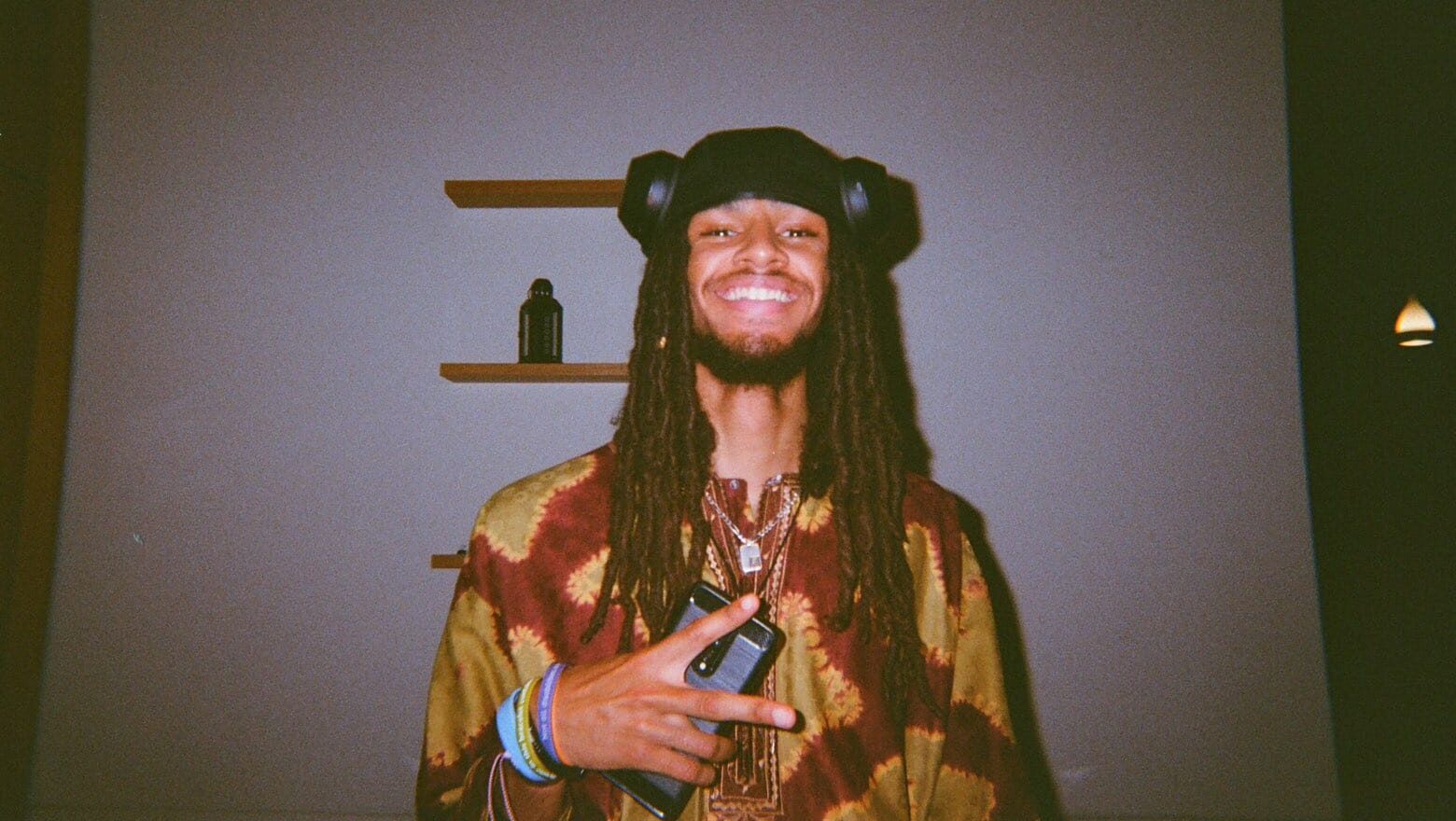
The jubilance in George Abaraonye’s demeanour matched my memory of our first encounter, coincidentally placed at the location where his university career may be defined: the Oxford Union. I first met the student – who has subsequently become a polarising figure among the politically conservative and a victim of online racial persecution approximately a year prior – at the Oxford African and Caribbean Society (ACS) meeting, Say It With Your Chest. Leading the event as then-Vice President, Abaraonye moderated the society’s annual debate meeting, posing questions on the legitimacy of Conservative leader Kemi Badenoch and offering his views on topics such as the definition of Black excellence. Ironically, he would occupy the hot seat months later for his political views, but in a much different capacity. Abaraonye’s ideology in the Oxford Union would instead make him the subject of intense, highly publicised scrutiny. Celebrating the shooting of right-wing podcaster Charlie Kirk in an internal WhatsApp group chat and on social media immediately upon the release of the news, the then-President-Elect of the Oxford Union would be ousted.
“I’m doing great, Maddie. I’m doing great. I’ve had a nice little summer, a nice little bit of time. Just relaxed. I’m doing good. How are things in New York?” Abaraonye said, appearing on our call in a New York Knicks T-shirt, seemingly fitting for a conversation organised from my Brooklyn bedroom. My icebreaker, “How are you?”, carried the expectation of unpacking much more than sentiments of a courteous greeting. The year Abaraonye experienced was an aberration from the routine of the typical rusticated Oxford student, to say the least. Much had happened since the controversy that ignited a media storm of right-wing publications, his widely reported removal as President-Elect of Oxford Union, and scathing tweets regarding his race, sixth-form grades, and clothing.
Now, preparing to complete his Oxford degree amidst the one-year anniversary of Charlie Kirk’s death and racialised hostility towards Black academics in Britain, Abaraonye’s reflection on the past year appeared quite light. “I’m coming back to Oxford, and I’m excited. Oxford is ultimately a means to an end. It’s not the end in itself.” After a summer of reflection working for a film company in Cairo, Egypt, the weight of the controversy no longer appeared insurmountable. “Being in Egypt and not quite having that freedom, or having to know people in a certain district in order to go there, really made me appreciate why I grew up with the freedoms I had growing up. And it helped put things into perspective. It made Oxford feel very small in a sense. There’s so much more going on in the world, and it helped me reorient what was important.”
Yet, this was the tranquillity Abaraonye was trained to adopt. After losing the vote of no-confidence among members and alumni of the Oxford Union, he remained in Oxford as a rusticated student for the next few months, hounded by the press and unprotected by any authoritative figures, Abaraonye tells me. Reduced to a mere member of the public rather than a matriculated University College student, Abaraonye immediately received clarification on where he stood with his college. “On Monday, October 19th, after my no-confidence vote, is when I had my panic attack… I had a really, really bad panic attack in Oxford. I remember being taken to college by two people, both in my college, and we spent the day at the University. I spoke to the senior chaplain and porters, and they set me up in a room with the agreement and understanding that I would vacate by Friday. They let me stay for a couple days, and then the porters kicked me out around 11am that Friday, like, on the door… They said, ‘You’re not allowed to come back to college because you’re a safety risk.’ I get it, but it felt very much like done and dusted. You’re not my problem anymore.”
Abaraonye faced boundaries that barred him from his familiar student life. “I had received an email from the senior tutor reminding me once my temporary accommodation had run its course, I would not be able to reside in college or access college facilities without prior written permission. I was also told no extension to temporary accommodation would be granted, and no subsequent request for college accommodation would be considered while I was rusticated, and that if for whatever reason I did not vacate college premises, it would become a disciplinary matter.”
Friday morning, after being escorted from his college, Abaraonye received a final message from the senior chaplain: an email wishing luck and permission to “reach out” if needed. Apart from the Master of University College, Baroness Amos, Abaraonye said he was offered little mental health support. “At the time, the email from the senior chaplain felt a little harsh and, to some degree, did compound a feeling of not having any safe or neutral spaces during that scary time. In hindsight, I do understand where the college is coming from with a safeguarding duty… I am grateful for being allowed to stay onsite. It felt like I wasn’t too welcome back, especially with the whole news saga, but again I do understand why.”
Still, Abaraonye recalls that the loneliness caused by Oxford administrators remained with him. “There wasn’t much of a connection there, or if I wanted to, I could not really go to them and say, ‘I’m really struggling with this, I need help.’ There was no support, for example, of how to navigate the press or the press scrutiny or the news cycles or anything like that, which was arguably the most difficult thing… I was quite lucky that I have friends and people that, you know, could help me write statements… but Oxford provided nothing.”
In a final return to his London home after spending the remaining months of Michaelmas as a rusticated student in Oxford, his ultimate retreat was rest and he spent most of his days asleep. Abaraonye grew accustomed to the many stares by Londoners on public transport and being cold-approached by strangers of both political spectrums: “I remember a couple times being approached on trains, for example, and people, complete strangers, come up to me and ask: ‘Are you the Oxford Union guy?’ I remember being in the pub once with my cousins, and someone asked me to take a picture with us. I had some people come up to me and ask, ‘Why did you say it?’”
In context, the celebration of the death of a media figure who had expressed racial insensitivities such as “Happening all the time in urban America, prowling Blacks go around for fun to go target white people, that’s a fact. It’s happening more and more” is illuminated by Abaraonye’s past record as a self-described pro-Black activist. Born in London, Abaraonye attended a multicultural state academy with a majority of economically disadvantaged students who received free school meals, himself included. Starting as a transportation advocate at 14, speaking out about road safety and bike protections, his social activism soon followed. At 17, as deputy head boy, he and his fellow schoolmates organised a workshop on microaggressions, guiding school teachers on how to spot any racial bias they may hold. Further, as a sixth-form student, Abaraonye helped draft anti-racism guidelines for his school, supporting the creation of a complaint system that let students hold teachers accountable.
Past activism aside, Abaraonye admonishingly reflects on his reaction to Charlie Kirk’s death. “Was my reaction time appropriate? No. Probably not. I should have taken a touch, guys. It didn’t need to be that quick and that public… It’s not to say that I hated free speech or I even hated Charlie Kirk or that I wanted to see this happen.”
Yet, as Charlie Kirk memes occupy social media timelines, and viral skits by comedians such as Druski poke fun at the lack of emotions displayed by Kirk’s widow, Erika Kirk, Abaraonye sees a racialised double standard in how he was treated. “I also think it would have looked very different if I wasn’t a Black person who’s debated Charlie Kirk. It feels disingenuous how strong the reaction was before, and now we have none of this energy for the general public who make the same jokes. I wouldn’t call myself a martyr, but I do think people will look back in a couple years and think: ‘Did we have to pop off on him like that?’ I don’t know, man. Maybe not.”
While his personal feelings towards the Kirk family are not rooted in spite, he directs contentious feelings to the institution from which he was removed: the Oxford Union. The Oxford Union’s vote of no-confidence sparked controversy. Grievances were raised regarding the Union’s poll, including the ballot-counting process, admission of proxy votes, and accusations of intimidation. Abaraonye maintained he lost because of a “compromised” poll due to alumni participation rather than student engagement. Community assertions of a “racist witch hunt” would support Abaraonye, yet to no avail, as a presidential successor was subsequently elected.
“I still have a modicum of respect for the Oxford Union… but the Union is not doing anything productive right now, at least in my opinion.” The Oxford Union, considered one of the world’s most prestigious student societies and an institution with its own Wikipedia section on ‘Allegations of institutional racism’, is, according to Abaraonye, an organisation steeped in anti-Black sentiment. “Being Black, especially in the Oxford Union, places you in a box. You can’t display yourself with truly radical ideas or even have the luxury of really making a mistake. Or you’re punished, and you’re punished tenfold.” As the debating society has attracted much attention and protests due to the invitations of right-wing figures such as Tommy Robinson and Laurence Fox, Abaraonye argues that the Union’s attempt at division is not only internal but external. “The Union seems more concerned in attracting attention by that division than by actually addressing issues with a level of attention needed to have a productive conversation… You will not catch me there during Hilary term. I’ll tell you that.”
So, what is next for George Abaraonye as he prepares to begin his final year? Well, for one, his activism continues. Recently penning a piece on the death of Cambridge Professor Jason Arday, who was alleged by self-identified race realist Nathan Cofnas to be a career fraud, Abaraonye found similarities between himself and Professor Arday were too great to ignore. Aside from the likeness of wearing locs and studying or working within elite UK universities, both Black scholars were ridiculed by right-leaning news articles, largely receiving racist comments from British audiences regarding their academic achievement in the slot of diversity, equity, and inclusion. “It was traumatising having to watch Professor Arday go through that this year. And it really motivated me. I feel like I should have perhaps said more when I was going through what I did. I feel like I should have said more now, when Professor Arday was going through what he did. The next time this happens, because I know it will happen again, I hope that I’ll be able to stand up and actually say something,” Abaraonye reflects. “Now, in the context of Professor Arday, I understand things could have gone very differently, and my story could have ended very differently.”
As Black figures at England’s most prestigious institutions continue to face accusations of incompetence – The Spectator declared the Black principal of Cambridge’s Homerton College “not fit” to lead – Abaraonye asks institutions to protect the vulnerable from media scrutiny. “For us, as horrible, horrifying, and disgusting as the incident with Professor Arday is… I actually don’t think anything would have been different if the Professor Arday incident had happened after the Kirk controversy. We’re yet to see any institutional change come as a result. We have barely seen so much as an apology from Cambridge or the Vice-Chancellor at Cambridge for how she handled the Professor Arday’s situation, calling him an aberration, which is wholly inappropriate given not only was an inquiry still open, but so many of the kind of allegations against Professor Arday being completely falsified or untrue. Because we’re so underrepresented, these spaces also don’t accommodate us, so we aren’t given adequate support in terms of counselling. I’ve now seen a professor die at Cambridge, and these are clearly, for as much as we hold them up, these great institutions. They’re clearly not safe spaces. Otherwise, people wouldn’t be dying or… people wouldn’t be dying as often as they are.”
Unsurprisingly, Abaraonye’s concerns about Oxford as an institution heightened his reservations about returning this October. Although he may attend a few Oxford events, interacting with tutors after his controversy raises anxiety, particularly as a report revealed that academics from the University of Oxford have signed the letter defending Cofnas in his investigation of Professor Arday. “Even though it’s not my tutors [who signed the petition], that’s the academic environment. I’m coming back into a level of complicity with what was essentially a murder, murder by the media. I can imagine, especially for a student of colour, if they’re coming back and their tutor is on that list, it must be a really uncomfortable situation to be around someone who not only is in a position of power in regards to you, but then also has clearly come out in support of someone who would happily see a member of our community die.”
More positively, Abaraonye said he has begun to receive more communication and support from the University: “My college Disability Advisory Services representative recently reached out to me, offering support and anything that I need coming back, which was nice. And my personal tutor also reached out to me in regards to the academic transition and coming back into university. So I had some contact with the University. And to be fair, in the last couple of months, in the summertime, I’ve not really needed much support from the University.”
Acknowledging that his return to Oxford may be sensationalised by students and professors alike, he said that “it feels very much like a spectacle, as if you’re engaging with me as a concept, as an idea. It feels less like you’re a person in Oxford sometimes”. Abaraonye does not plan to let his past controversy hinder his enjoyment of his final year of university, nor spoil his future professional ambitions. “If I was going to do anything, being a mayor would be a dream. That would be amazing. But, I think for me, it’s not necessarily about the office. I want to improve people’s lives. I want to improve my community’s lives. I don’t get the privilege of living a comfortable life, going home and taking that £110k a year by the time I’m 24 because that’s done through the oppression and institutionalised harm of millions. Whatever I do, it’ll be rooted in a lot of blackness. It’ll be rooted in a lot of good people doing good things, and I feel like that’s where I wanna be… If not me, then who?”
Asked if he has any regrets, Abaraonye offers advice instead. “Stay firm in your convictions. You’re not a bad person. You made this mistake. Sure. But don’t let them paint you out as this person that you’re not, and don’t let yourself fall into this idea that you won’t go and do something with your life because you absolutely will.”
In response, the Oxford Union told Cherwell: “Since 1823, the Oxford Union has upheld the principle of free speech through the exchange and debate of a wide range of ideas and opinions, presented by a diverse range of speakers – some inspiring, others controversial. We acknowledge that certain speakers may hold views that are regarded by some as unacceptable but nonetheless believe that it is more important to debate an issue in full rather than shy away from a difficult subject or to silence certain voices.
“Like any other member of the Oxford Union Society, Mr Abaraonye is entitled to voice his opinions. The Society maintains a variety of fora for its members to do this, including weekly meetings of the Consultative Committee open to all, public questions of officers at the Society’s public debates, and termly elections. We look forward to Mr Abaraonye’s contributions.”
In response, University College told Cherwell: “At the time of this incident, Mr Abaraonye did not have accommodation in College. This was because he had already withdrawn from his studies for a year, at his own request, and therefore was not living as a student in Oxford. Mr Abaraonye subsequently requested and was given temporary accommodation in College on an agreed short-term basis. He vacated this temporary accommodation on the date which he had agreed. The College is committed to providing appropriate welfare support to its students, including both those who are on course and those who have suspended their studies.”
The University of Oxford was contacted for comment.


 meeting, Say It With Your Chest.)