

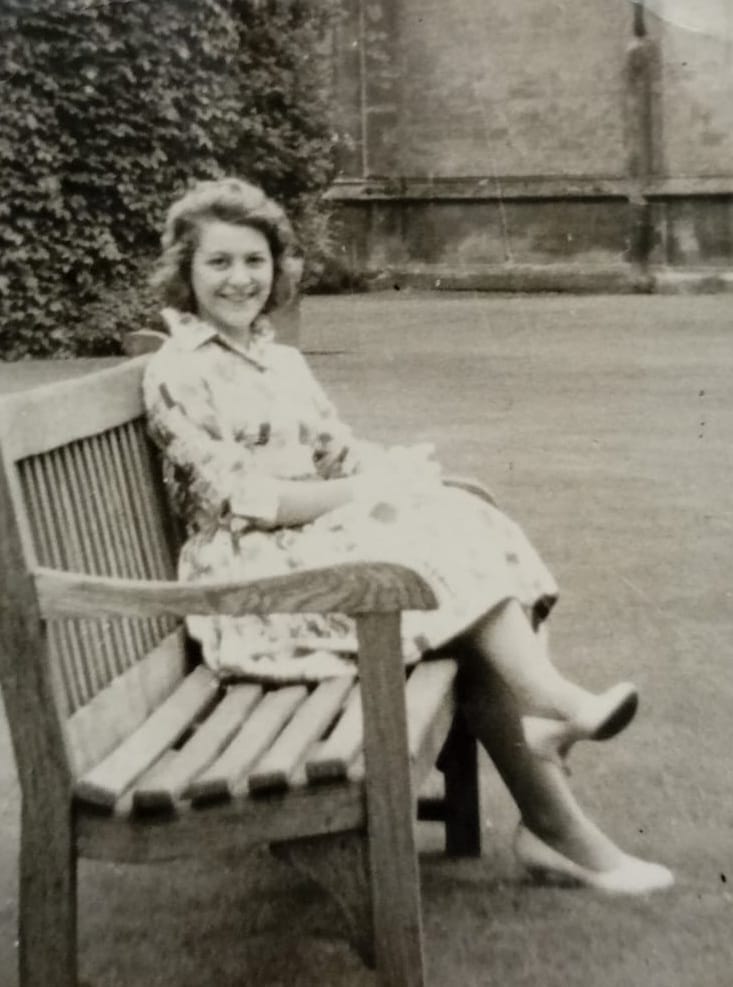
The year Naomi Lightman came to study at Oxford – 1962 – was the first in which women were allowed to become members of the Oxford Union.
Four years earlier, the five women’s colleges had finally been granted equal status with the men’s colleges. Six years before that, the quotas limiting the number of female students at Oxford had been abolished. 43 years previously, women had been allowed to obtain degrees for the first time. 84 years earlier, in 1879, 21 women entered two cloistered halls of residence – the newly-founded colleges of Lady Margaret’s Hall and Somerville – and were the first female students at Oxford. Much remained to be done, but change was already under way.
Naomi Lightman (née Claff), my grandmother, was born in September 1943 in Blitz-ridden London into a Jewish family. In her early days she was put under the kitchen table to keep her safe from the relentless wartime bombings. Soon after, she moved with her mother to Ayr, a small town in Scotland, to escape the Blitz. Her father was a doctor in Scotland in the Navy. “He was very deeply affected by the very high casualty rate”, Lightman tells me. “It had a lifelong psychological effect on him.”
Lightman turned two just days after World War Two ended. The war that had defined her earliest years now existed not in bombs or evacuations but rationing and ruins. Postwar London was a site of rapid reconstruction as thousands of evacuees returned to what had previously been the site of enemy attack.
But school was not trouble-free. Bullied at her previous school, nine-year-old Lightman was sent to a recently opened Jewish girls’ school: Hasmonean High School.The following year, she did the eleven plus exams to apply for a grammar school. Her English paper was one of the best, but “the maths paper was the worst they had ever seen, so that was the end of that.”
With less than a decade having passed since the Holocaust, many of the students at the Hasmonean were the children of survivors. But the Holocaust was never mentioned. “This was the 1950s. People were so traumatised they didn’t want to talk about it or pass on the information to their children”, Lightman tells me. “I had to learn about it myself. I heard girls in the corridor whispering to each other.”
As sixth form approached, Lightman says that she “had every intention of staying on to the sixth form.” The only problem was, there wasn’t a sixth form. In previous years, very few girls stayed on at Hasmonean past the age of sixteen; many left to attend secretarial college and then get married. “As far as they were concerned, they had no desire and no incentive to carry on, and the school didn’t provide any incentive either,” she tells me.
“A friend of mine, Freya, wanted to stay on too, and so the school had to create a sixth form for us,” Lightman recalls. “Because she was doing different A levels from me, I had private lessons for two years, and I was very fortunate that there was one outstanding English teacher.”
During the first year of her A Level studies, the teacher said: “I read English at Oxford. Why don’t you have a go at it?” The teacher suggested she apply to Somerville College in particular, rather than any of the other women’s colleges, as it was seen as more inclusive – accepting of women who had not attended prestigious private schools like Cheltenham Ladies’ College or Roedean. “Of course the Hasmonean would have been totally alien, not only because it was not recognised by the Ministry of Education, but because it was a very new school and it was also a Jewish school”, Lightman notes. She was one of the first Hasmonean students to even apply to Oxford.
She then found out she had been called to interview. “I had never been away from home before,” she tells me. “I hadn’t even been on a train on my own before. I really was inexperienced in every respect.”
Lightman remembers the trepidation she felt as she sat waiting to be called into the interview, surrounded by “very sophisticated young women”. “When I got there, all the girls were sitting there wearing little black suits, high-heeled black shoes, and very smart handbags, and they all had cut glass accents.”
The interviews themselves were no smooth affair. The first interview saw Lightman appear before a panel of people all wearing black gowns. “Very intimidating”, she remembers. “They shot questions at me, and I had never been in a situation like that before.” Her second interview was with the Somerville College Principal, Dame Janet Vaughan, a woman who was both warm and dignified. Lightman describes vividly how, on entering the cavernous interview room, she was unable to spot Vaughan. “You’re supposed to sort of walk into a room and look vaguely confident. But for me, it was the exact opposite. I spent some time trying to see where she was, and then eventually she put her arm up and said, ‘I’m here, dear.’” Lightman felt that Vaughan was “quite interested” in her, as she was “an unusual candidate from an unconventional background”. Years later she discovered that Vaughan, a haematologist, had been sent to the Bergen-Belsen concentration camp after its liberation in 1945 to aid in efforts to feed survivors suffering from extreme starvation.
The result of her Oxford application came by telegram, or rather, “a man on a bicycle.” “To my absolute and everybody else’s astonishment, I got a scholarship.” But Lightman felt she could not accept the offer. “I was an only child, and my mother and I were very attached to each other. She and my father had a very difficult relationship, and I thought it would upset her very much if I lived away from home for three years. So I decided on my own to turn the scholarship down, and I wrote a letter to the Principal.” She still wanted to continue her studies whilst supporting her mother, so she enrolled at University College London to study English. Very quickly she realised she had made a mistake; she had little in common with the academic assigned to support her studies and realised that the tutorial system at Oxford would have been ideal for her.
Lightman wrote a letter to Vaughan, explaining her mistake. Vaughan responded that she could take up her offer the following year, but this time would have to pay her fees. How would she pay the fees to attend Oxford? While it only cost a few hundred pounds, it was money her family – living in their cramped London flat – could not afford.
“I made some inquiries, and I discovered there was a Jewish charity that gave money for education”, Lightman tells me. “I had an interview with them, and it was very stiff and uncomfortable, but eventually they said they would give me part of the money.” The rest was lent by a friend of her mother. Finally, after numerous exams, interviews, letters, and changes of plan, Lightman was to matriculate at Oxford.
The first thing Lightman remembers about Oxford is that she had her own room. “I had never had a room of my own”, she says. Due to her family’s poor financial situation, she had shared a bedroom with her grandmother her entire life and would do so until she got married.
Life at Oxford was markedly different for men and women. The latter were in the minority: in 1959, women made up just 16% of the university’s undergraduate population. Male students only could enter Somerville during set hours, and female students were barred from male colleges in the evenings. Lightman recalls that fellow students used to climb over barbed wire to enter college secretly if they had been out later than curfew.
Male Oxford graduates were expected to use their degrees as launching pads for impressive careers. Women, meanwhile, were still expected to do little more than marry and have children. This was no more clearly demonstrated than when, in Lightman’s second year, a fellow English student at Somerville was told by the careers service that she should aspire to become a tour guide at Blenheim Palace. Lightman also remembers writing arts reviews for Cherwell, though the paper was, in the 1960s, no bastion of female empowerment: there were few, if any, women in senior positions.
“When I went to seminars and social events, there were very few women, and the men seemed very confident in a different sort of way”, Lightman observes. Many of the men carried themselves with the effortless assuredness and sophistication born of their public school education. “It was like a very rich family and we were the poor relations,” Lightman says, describing her experience in these situations.
Lightman had three very close friends throughout her time at Oxford, all of whom remained friends with her long after she left. Their rooms were close together, and they were constantly in and out of one another’s. One, whom Lightman remembers as lively and friendly, acted in a play for which Lightman designed the costumes. Another was at ease in Somerville’s intensely academic environment, as her father was a Cambridge professor. Of the third, Lightman recalls that “we could talk to each other about things that upset and worried us more than with others”.
One aspect of Oxford life that has changed little is the stress of Finals. To cheer her up during the agonising wait for results, Lightman’s mother took her to a play, but halfway through she fainted out of nervousness. Just a few days later, she received the telegram informing her that she had been awarded a First.
After graduating, Somerville offered Lightman a graduate scholarship. She told them she was getting married. She had met her future husband, Gavin, the year before she matriculated at Oxford, through a mutual friend. They started dating in her second year. “Gavin used to come at weekends to visit me, and it was very sweet because the girls used to say, ‘It’s a Gavin weekend, isn’t it?’ and they said they could tell from my face.”
Continuing graduate study at Oxford was impossible, as Gavin worked in London as a barrister. Somerville found a Doctor of Philosophy (DPhil) supervisor in London, where Lightman worked on her thesis. One day, years into the DPhil, her supervisor said: “I’m retiring in three months, and you haven’t finished yet. You’ve got three months to finish it.” This prompted weeks of frenzied writing as Lightman rushed to finish her PHD even whilst pregnant. Soon after, her supervisor “rang me up and said, ‘You’ve done it, Naomi. You’ve got your DPhil”.
Graduating with an Oxford degree – and a doctorate – may have opened doors for men, but it certainly did not for women in the 1960s. Lightman recalls an interview at a London university for a lecturing job. The first question she was asked was: “Does your husband approve of you working?” She was so taken aback she was unable to answer.
Her mother had built careers for herself despite the barriers facing women in the workplace, working variously as an artist, agony aunt and magazine editor. Lightman would do the same, working as an English tutor at Surrey University, Royal Holloway, the Open University and Birkbeck.
Fifty years after graduating, Lightman returned to Somerville for a reunion. The college, she found, looked almost exactly as she remembered it. The entrance hall, the Junior Common Room (JCR), and the gardens, seemed untouched by time. Each room she entered resurrected a memory, a tutorial, a seminar, a friendship. “There were ghosts, the shades of the people as they had been in their youth,” she recalls. “I could see them in my mind”.
But amid the familiarity, there was a marked reminder of how much had changed. Two decades before Lightman arrived at Somerville, Margaret Roberts had studied Chemistry there. Better known by her married name, Margaret Thatcher, she went on to become Britain’s first female prime minister. A woman reaching the highest political office in the country would have been unthinkable when Lightman attended Oxford in the 1960s. She expected, therefore, to find Somerville proud of its most distinguished alumna. But the students and faculty were more concerned with the substance of Thatcher’s policies than the significance of her achievement. “There was a bust of Thatcher in the college, but it was nowhere to be seen”, Lightman recalls. “I asked someone in the college and they said they had to put it in a hiding place as it was being assaulted. People intensely disliked her policies.”
Even as the college grappled with how to pay tribute to Thatcher, the very fact of her success captured something of the changes that had occurred since Lightman’s student days.
When Lightman left Somerville after the reunion, she was leaving a college that had changed little in appearance but profoundly in the possibilities it offered its students.