

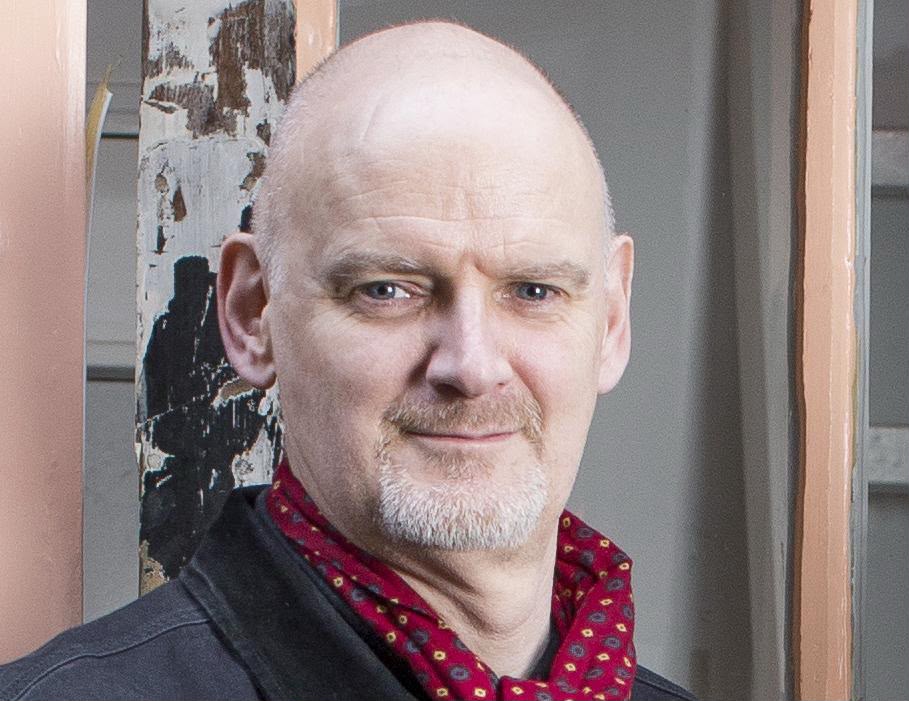
It’s safe to say that Stuart Jeffries has a complicated relationship with the University of Oxford. He is now a freelance arts journalist, writing regularly for The Guardian, Financial Times, Spectator, and Mail on Sunday. Earlier in his career, he also wrote as a jazz critic for the communist newspaper Morning Star, under the pseudonym Lew Lewis and penned his first book, The Oxford Handbook. Since then, he has written four more. He published his most recent, A Short History of Stupidity, last September. Before that, he was the first person in his family to attend university, matriculating at Exeter College.
As we settle down at a table just around the corner from his third-year accommodation, he tells me: “I really hated it. I came from Solihull Sixth Form. Oxford was really loud, really boorish… and it was very rugby-oriented, which was just not part of my culture.”
Jeffries recounts a specific evening when the team had been on a club dinner. He says: “They were scrumming down, in the quad, and just being absolute a***holes.” He then describes his retaliation. He and the drummer in his short-lived band “got a fire extinguisher and… sprayed it on [the rugby team]… which, of course, is just like a red rag to a bull. They all came tanking up the staircase and… there was a bit of a fight.” He stops for a moment, then adds somewhat more bashfully: “In retrospect, we were the people who started the trouble.”
For him, another stark difference between his state comprehensive and university was the quality of teaching: “The teaching I had at sixth form was really, really good, consistently… all the teachers were really passionate. And I didn’t really feel that with many of the teachers I had at Oxford.” Again he stops and counters himself. He considers his consistent love of philosophy: “I had a couple of philosophy tutors who I really loved, and clearly left a mark on me, because I’m still really interested.”
It sets the tone for the conversation. For Jeffries, Oxford “was f***ing hard”. His strong Birmingham accent set him apart, with tutors regularly ‘correcting’ his pronunciation and taking aim at his flattened vowels. He felt out of place with the “ethos” of the college, especially in 1981, when Exeter had gone co-ed only two years earlier. He says that a postgraduate student that he spoke to when he last returned, in 2007, described his time as “specifically… quite a bad era”. But then he soon continues: “Part of the problem was mine. I wish I had been more mature.”
He seems caught between the haunting memories of that “bad era”, which he “suspects” he “probably repressed a lot”, and the opportunities the University offered him. He mentions the weight of his place at Oxford more than once, and it is something he also wrote in his first book, The Oxford Handbook: “There was no question I could drop out… I think I was quite depressed and was probably struggling a bit mentally, but I didn’t feel that I could yield to any of that.” He is smiling as he considers his past: “I can’t remember myself that clearly when I was young… why didn’t I have a breakdown?”
Then he tells me: “You shouldn’t whine too much.” His tone, as it has been throughout, is light and joking. And he admits that Oxford is “absolutely worth it”. He adds: “For that name alone, the name of the University.” After all, it is also at Oxford where he found his love for philosophy. This love manifests clearly in his literary work, and it is obvious as we discuss his most recent book, A Short History of Stupidity. Beginning with the Ancient Greeks and taking us all the way to the artificial intelligence of our modern day, Jeffries looks at humanity’s moments of ‘stupidity’.
He talks to me specifically about intelligence and IQ tests: “They were first introduced in France, in 1905.” This, he says, was in an attempt to help students that the government thought were being left behind: “The psychologists’ idea was that if you introduced some sort of battery of tests… you would be able to help the kids who are struggling… but it very, very quickly became what the eugenics movement made of it… You get a number, and it hangs around your neck like an albatross…The eugenics movement perverted a really hopeful idea of what education could be, and instead became an absolutely racist means of trying to change society.”
“Oxford was absolutely part of it… it’s shocking to me that Rhodes is still up,” he continues, referring to the controversial statue of Cecil Rhodes in Oriel College. This sparks another memory: “I remember when I was at Oxford there was a massive fuss about putting up the Thatcher statue in Somerville.” Jeffries picketed against it. He also protested against his college’s association with Rio Tinto Zinc, for their involvement in apartheid in South Africa. Although he was demonstrating against the University, he says: “You didn’t feel as though you were necessarily pushing against a closed door… you could do something.”
He is not sure students today have the same opportunity. With rising university fees and the omnipresence of social media, there are “consequences” and “risks” he never really thought about. He thinks about recent headlines, and says that “the panopticon of social media has a chilling effect on… protest”. For him, “being a student was three years in which you were kind of expected to be a pain in the a***… for the powers that be”. Once more, reflecting on his time at Oxford, he adds: “Not that I did all that much.”
Jeffries admits that he thinks his perspective has been “skewed” by the experience of his daughter, who took up a degree in history at Oxford last year. His delight is palpable: “I was just desperately proud… I’m so proud that she went to Oxford.” He also notes the very important impact that access programmes such as Opportunity Oxford (OppOx) have made: “OppOx is extraordinary. I think it is really, really amazing… I could have done with it. It would have really helped me… just getting used to this weird environment.” An environment he felt was made to “wrongfoot” him, in the 1980s.
For the first time, he was very aware of his place in the English class system. He was different from his public school peers, who thought of him as one of “these state school oiks”. He tells me: “I was being completely transported into a world that was… like an old class structure, which was actually the reality of what our country is. This is where the power is.”
As much as Oxford and his perspective might have changed since he was last studying at Exeter, he tells me he thinks the university “is a symptom of our divided society”. According to him, public schools and their “business model” of education must be abolished: “Until that happens, this country is going to be, I think, a very divided and… unfair one.” It is a sober note to end on, and speaks to the difficulty of a university he experienced in 1981, that he otherwise covers with a joke that it is hard not to laugh at.
Stuart Jeffries is not a man who takes himself too seriously, and as he tells me about his time at Oxford, it is easy to smile with him as he manages to make a comedy out of an experience I certainly do not envy. But it is also clear that the University made a profound impact on the arts journalist, and he will always be followed by those three years at Exeter.