

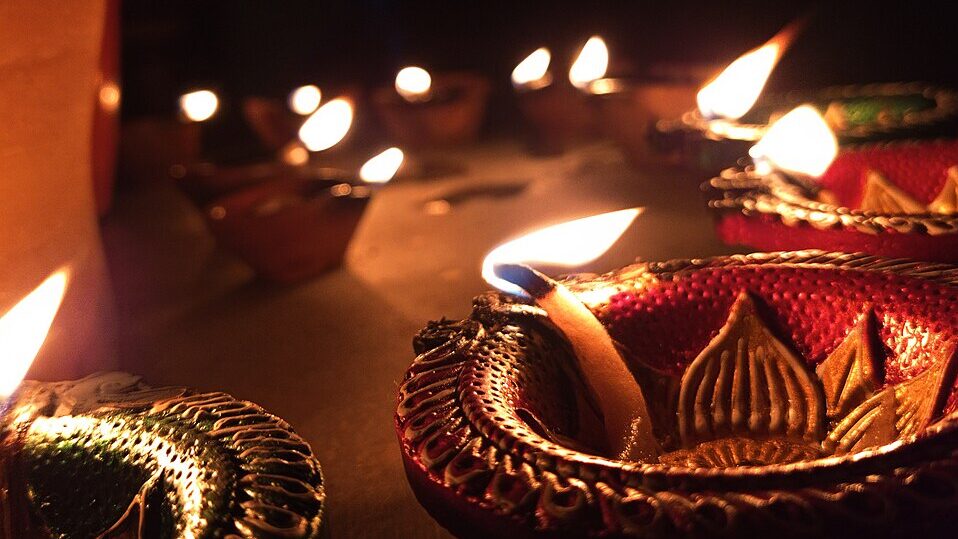
Oxford has a curious relationship with time. We do not so much live through autumn as progress through Michaelmas, dividing our lives into eight neatly numbered weeks. Ask a student the date, and you may get a blank look. Ask what week it is and the answer comes instantly, usually with a sigh.
Somewhere among the tutorials, the essay deadlines and the increasingly frantic conversations about fifth week, Diwali arrives. This year it falls on Sunday 8th November, the very first day of fifth week. The festival of lights is entirely indifferent to the university calendar. It does not know that an essay is due on Friday. It simply turns up, as it always has, and asks to be celebrated.
Diwali had been looming in my calendar for weeks, heralded by a formal hall whose menu did the festival few favours. Even so, it has managed to creep up on me, and I am yet to buy a single card or box of sweets. Oxford time, it seems, runs rather faster than the lunar kind.
Spend long enough here, and the eight-week term stops feeling like an administrative convenience and starts to feel like the natural unit of existence. We talk about time as though it were a countdown: “It’s already fourth week”, “I’ll deal with that after sixth”, “I can’t believe we’re halfway through”. Each phrase measures life by how much of the term has been spent and how much remains. There is something charming about this private language, but also something faintly alarming. The Oxford calendar becomes so dominant that everything else must be fitted around it. Birthdays, visits home, and religious festivals become things to be accommodated, slotted between a tutorial and a deadline or postponed until ninth week.
The point is not that Oxford prevents anyone from celebrating Diwali. Nobody is forbidden from lighting a diya – fire regulations permitting. It is that Oxford shapes how we think about the time available for celebration. The term does not tell us what to value. It simply makes sure we are always counting. Diwali demarcates a different kind of time. Its date moves with the lunar calendar, landing anywhere between the middle of October and the middle of November, but its substance barely moves at all. It has been celebrated across generations and continents, through migration and through the ordinary upheavals of family life, and it asks for many of the same things each year: lamps lit at dusk, the house made ready, sweets shared, and family gathered. Where Oxford is preoccupied with moving forward, Diwali is built on return. Part of its meaning lies in the fact that you have done this before, and that others did it before you.
I inherited Diwali from my nani. For as long as I can remember, it has been the thing that draws our family together. My dad is English, and he has never once treated it as someone else’s festival. He has thrown himself into it so wholeheartedly that it now belongs to all of us, and we all love it. This points to a quiet paradox. We tend to treat repetition as the opposite of progress, the thing you do once you have stopped improving. Yet traditions draw much of their meaning from being repeated. A ritual performed once is a novelty. Performed for a lifetime, it becomes a way of belonging.
Oxford continually urges us to advance: to read more, achieve more, and move on to the next deadline. Diwali suggests that coming back to something familiar can matter just as much. Why, then, can a festival like Diwali feel like an interruption to university life rather than part of it?
It would be rather unfair to accuse Oxford of being hostile to tradition. Few places are quite so enthusiastic about preserving it. This is a university where students sit exams in gowns and carnations, where grace is said in Latin before dinner, and where a college’s age is a matter of competitive pride. Tradition is not merely tolerated here. It is the house style.
Yet there is a telling difference between the traditions built into the institution’s routine and those students must make room for themselves. Formal hall is on the timetable. Matriculation has its own day. Christmas falls conveniently during the vacation, so nobody has to ask for an extension because of it. Diwali, by contrast, is something you fit in: a society dinner, a puja between essays, a call home squeezed in before the library.
At Oxford, Diwali often feels makeshift. Last year a few of us held a puja on our staircase, with candles and a handful of murtis, small statues of the deities, balanced on cardboard boxes. It did not go especially smoothly, and it was over almost as soon as it began. But we had made the time to celebrate, and that, more than anything, was what gave it meaning.
None of this requires anyone to have been deliberately exclusive. Institutions tend to remember what they were built to remember. The question, perhaps, is not whether Oxford makes time for tradition, but which traditions have the privilege of being considered part of ordinary life. This is not an argument for abolishing the term, or for telling everyone simply to slow down. Oxford’s eight weeks are useful. They concentrate effort, give shape to an otherwise shapeless amount of work, and end, mercifully, on a fixed date. But they are also an artificial structure, and life carries on beyond their boundaries.
Diwali is a reminder that not everything important can be measured in deadlines, achievements or weeks remaining. Some things are measured instead in years of return: the same lamps, the same food, the same people, one autumn after another. Perhaps the strange thing about celebrating Diwali at Oxford is not that an ancient festival must find its place within an eight-week term. It is that we have grown so used to the eight-week term that we forget how arbitrary its boundaries really are. Diwali does not interrupt Oxford time. It reminds us that there are other ways of keeping it.