

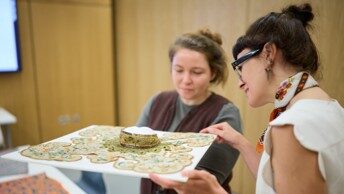
The Collections Teaching and Research Centre (CTRC) now brings together over one million objects from Oxford University’s four museums: the Ashmolean Museum, History of Science Museum, Museum of Natural History, and Pitt Rivers Museum.
It aims to facilitate object-based teaching and research visits. Dr Sumner Braund, acting head of research, told Cherwell: “My ambition is for students to start thinking of museum collections like libraries.
“These are historic objects that are critical to your research. You should be using them in your essays. You can use them as historic sources. Start using the collections as you would a book in the Bodleian”.
The CTRC is a resource for staff, researchers, and students within and beyond Oxford. It is a part of the University’s Gardens, Libraries and Museums (GLAM) division, and most of the CTRC’s objects are from the History of Science Museum. It is located within the Reuben College building, beneath the Radcliffe Science Library.
Rather than centralising collections, the team behind the project hopes it will make Oxford’s unique collections accessible in one space. Claire Parris, PR Manager for Oxford GLAM, told Cherwell: “We encourage professors across every discipline, even medicine, for anatomy, to come visit with their students.” The gallery is only a small percentage of the full scale of the collection, but it has collected almost all of the HSM’s collection from off-site storage in Oxfordshire.
Extending over two floors, the entrance to the CTRC is decorated with purposefully unlabelled and digitised photos of some of its objects. There are 3 different teaching rooms, capable of hosting up to 96 people when their walls are retracted to form one room. Diverse materials and techniques are incorporated in the design so students can closely engage with the objects they are studying, including plastic foam, movable tables, and cameras with multiple angles that can be mobilised to attend each item.
Most recently, the room was used for a course on citizenship where academics and staff could bring together Bodleian material and History of Science Museum material on the same desk. Braund told Cherwell: “Normally that would never have happened. You couldn’t necessarily bring collections from different institutions into one space but having a centralised storage and a teaching space like this makes it actually possible. Students interact with the objects and the texts which contextualise them.”
The CTRC operates an open-storage technique, “rather than having a collection boxed, where appropriate, we have them free on the shelf,” Braund explained. A great wall of antlers hangs near trays of some of the 1.2 million British insects from the Natural History Museum. “Even with the best intentions in the world you’re only ever able to portray in a gallery a small percentage,” Braund told Cherwell. “Making your storage an active space of your museum expands the scope of research, public engagement and visits”. Objects are usually quarantined for three months upon arrival, and some are locked in a giant deep freezer at -30 degrees Celsius for two weeks.
A digitisation studio is one of the CTRC’s key features. Currently working on project ‘DiSSCo’ to digitise British insects, they use a five-angle camera to scan butterflies less invasively. Describing the loss of biodiversity as a direct “result of the current climate crisis”, Sumner told Cherwell that “being able to research biodiversity in historic periods could facilitate future thinking”. Their dedicated conservation laboratory with a full-time staff member collaborates with the studio.
Pre-arranged tours are offered by the CTRC for objects found on the University Museums online databases. Sumner told Cherwell: “It’s not as frictionless as pulling a book off the shelf of the Bodleian but you are absolutely welcome to come look at an object up close. We’ll train you in how to handle it properly and you can study and include it in your work.” The CTRC has a particular interest in supporting students.
It is also home to the beloved brown bear from the Natural History Museum. Enjoying its retirement from public life, conservators have “very lovingly” restored its fur in places where it had lost it to the public affection of over one million visitors in eight years. The bear guards the entrance, welcoming future visitors of the CTRC.


 now brings together over one million objects from Oxford University's four museums.)