

Thursday 14th May 2026
Blog Page 341

CHERWELL SEXTIGATION: Exeter Top Shaggers, St John’s least straight college, Keble students ‘crap in bed’

With over 550 students responding, Cherwell can release the results of the 2022 Sex Survey. A look into Cherwell history shows that this publication has never shied away from sex. In 1970, the editor at the time, Peter Stothard, published a poster featuring a naked woman, which some have claimed was a first for British newspapers. Stothard pursued the paper’s new image by publishing a nude photo of Gully Wells, a move that was considered ‘daring’ for the time. Three years later, the paper is said to have become a ‘cause celebre’ in national media when Cherwell published a photo of an editor next to a topless model, resulting in a personal fine for the editor to proctors of the University. 

Most notably, going back to 1946, Cherwell suffered a brief hiatus in printing after the paper was banned by the University for distributing a survey on the sex lives of students. Now, in 2022, the survey is back

A Cherwell survey of the sex lives of students at Oxford University has found that the average number of sexual partners students have had is 7.7 in total, with students having had an average of 5.2 partners since coming to university.

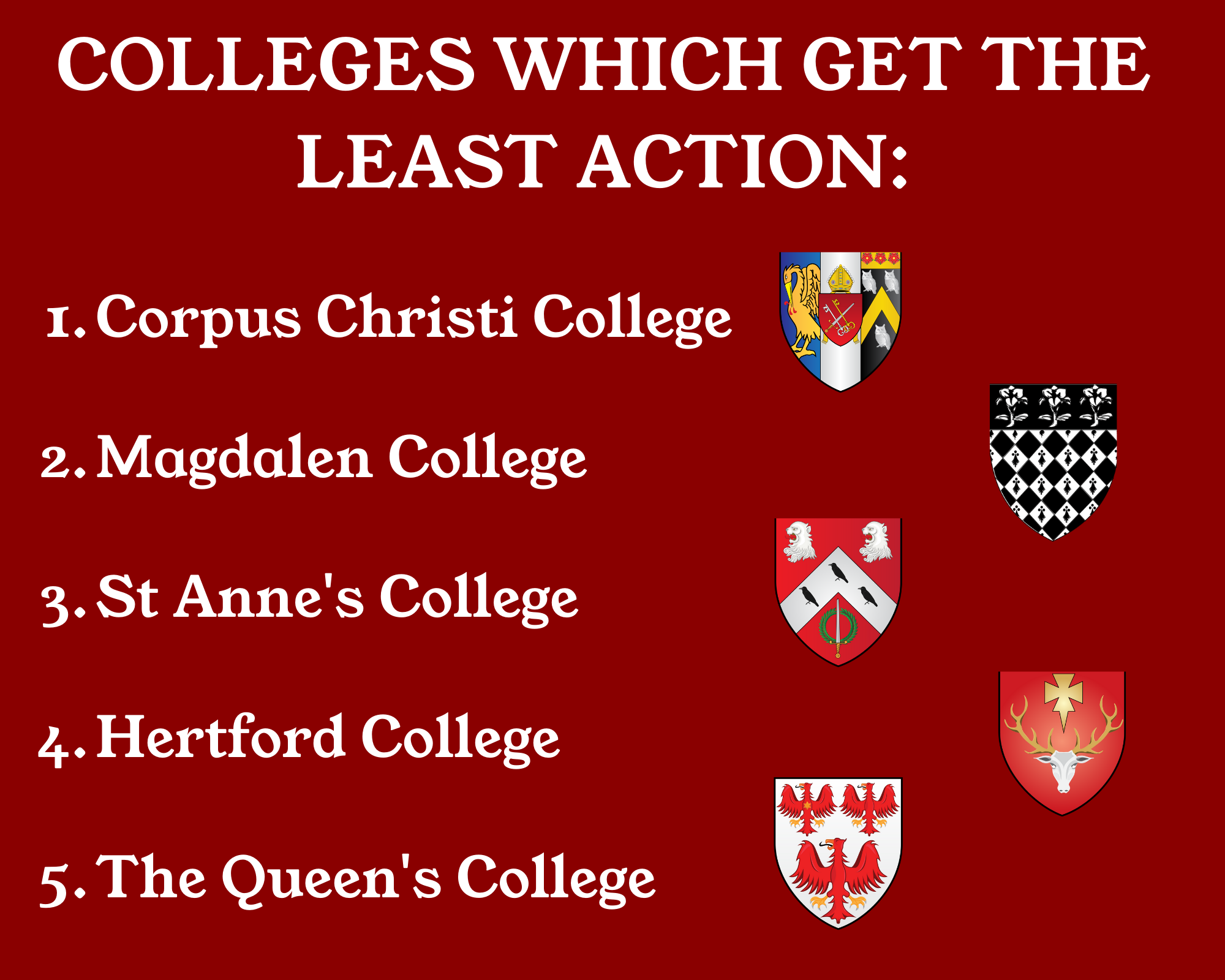
Respondents from Exeter reported the most sexual partners with the average number of total sexual partners being 17.8. The rest of the top five of colleges reporting most shags consisted of Brasenose, Trinity, Somerville and Mansfield. Corpus Christi reported the fewest total sexual partners, with the average number being  2.5. 

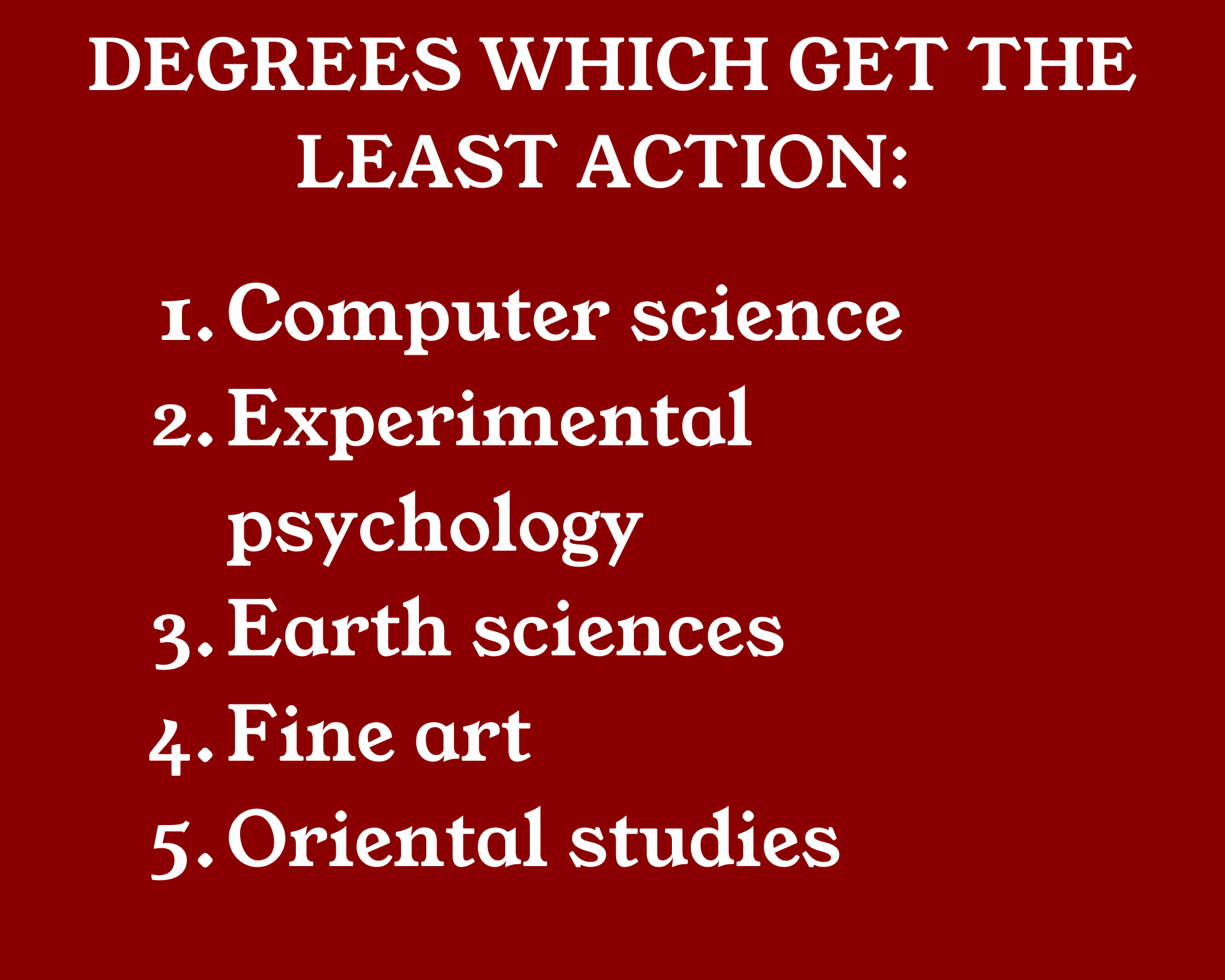
Theology, English and Modern Languages, and Law students are the most sexually active, with Theologians reporting an average of 13.5 sexual partners in total. The least sexually active degree was Computer Science, with their mean reported number of sexual partners since arriving at University being 0. 
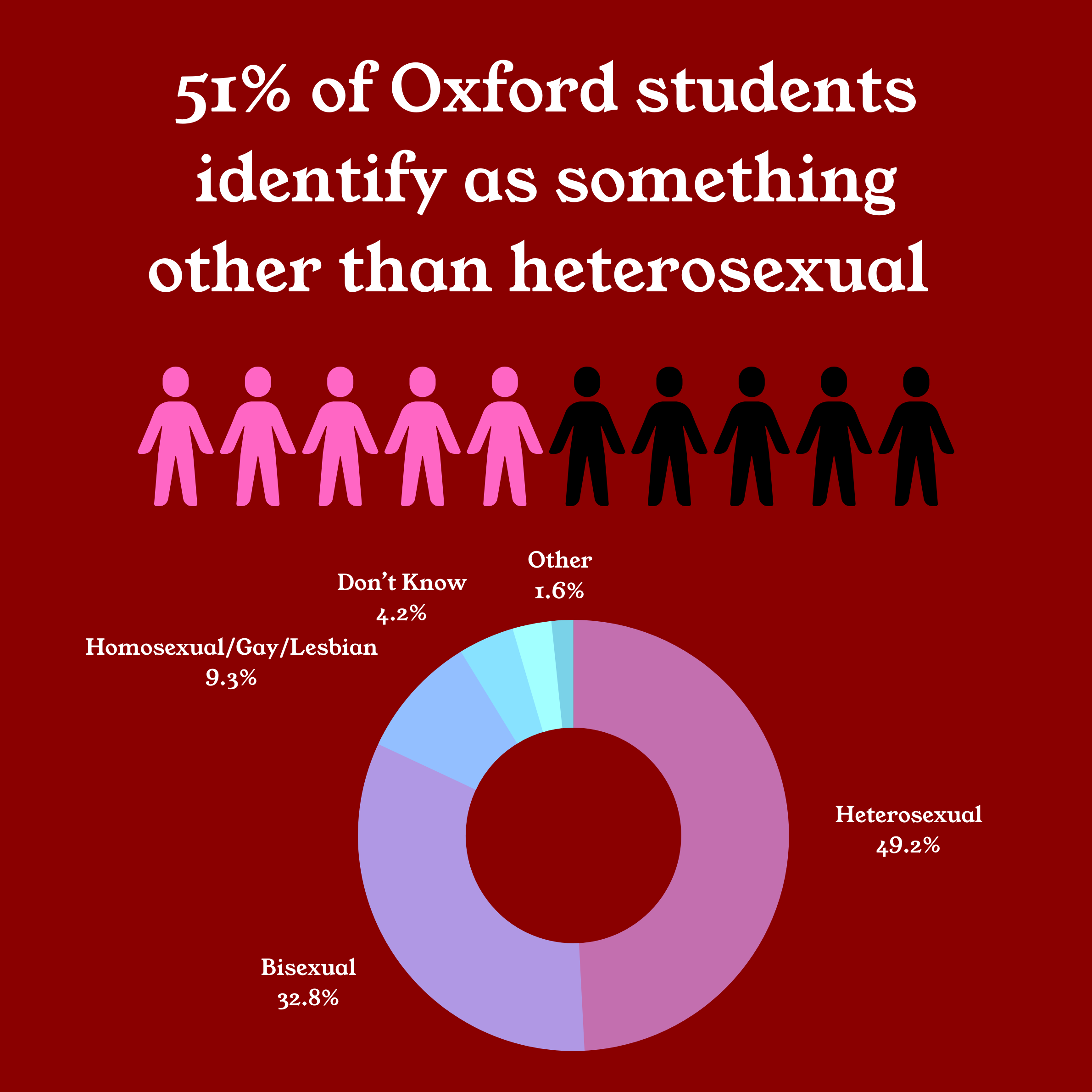
St John’s is the college with the most LGBTQ+ students, with 68% of respondents identifying as not heterosexual. John’s was closely followed by Worcester and St Annes. The Queen’s College is Oxford’s straightest college, with 75% of respondents identifying as heterosexual. On a University-wide scale, 49.8% of students identify as straight.

The form of contraceptive most frequently used by students is condoms with 41% of respondents opting for this method. 23.58% of students do not use a method of contraceptive. 

When asked about their masturbation habits, 13.8% of female students responded that they masturbate 4-5 times a week, while 28% of both male students and nonbinary students responded that they masturbated that amount. 20.7% of female students masturbate ‘rarely’ compared with only 6.8% of male students. Lady Margaret Hall took a clear lead in college masturbation habits, with 56.30% of respondents masturbating more than four times each week. 

57.8% of respondents claimed to have broken lockdown restrictions for sexual activity, with 13.1% claiming to have done so at least 20 times. Oxford students said that the pandemic had a negative impact on their satisfaction with their sex lives. On a scale of 1-5, 1 being ‘a lot less sex’ and 5 being ‘a lot more sex’, the mean response was 2.3.

One respondent told Cherwell that Covid has had a disproportionate impact on people’s sex lives:  “I went very quickly in HT20 from casual sex to a relationship to long distance with my new partner, and when we were able to be in the same place again my sex drive had really decreased due to the long isolation. Two years later, it’s still something I’m working on, and is just one way in which the pandemic has changed young people’s lives in unpredictable ways.”

46.8% of students have had sex in a ‘public place’, with respondents listing a number of picturesque locations across Oxford. University Parks and various college libraries were among the most common responses, while the Park End cheese floor, Gatwick Express, New College Mound, and Blenheim Palace all received mentions. 

Where are you most likely to find someone to bring home? Students say its Plush, bringing in 22.5% of the vote with Park End coming in at second place with 20.7% of the vote. A night at the Bullingdon, however, is unlikely to lead to a hook up, with only 3.1% of respondents lending the club their votes.

Overall, students reported a mean level of satisfaction with their sex lives of 3.3 out of 5. 

One student responded that men at Oxford are “cautious and afraid of intimacy” and “overly cautious in initiating sexual interactions”. Another said that it’s easy to have sex and casual relationships at Oxford but added that “the short intense terms (especially with moving-out obligations for many people) make relationships especially difficult”. 

Others voiced concerns over the sexual appetite of certain Oxford students with one student saying that “Keble students are crap in bed” and another asking “Why people so kinky and so vanilla? Why do tory boys have to be like that?”. One respondent offered up advice on having sex at Oxford, sharing that “Piers Gav helps, it is amazing to find fellow queer students for hookups and more”.  

Here is a closer look at our stats: 

Colleges by average number sexual partners since coming to Oxford:
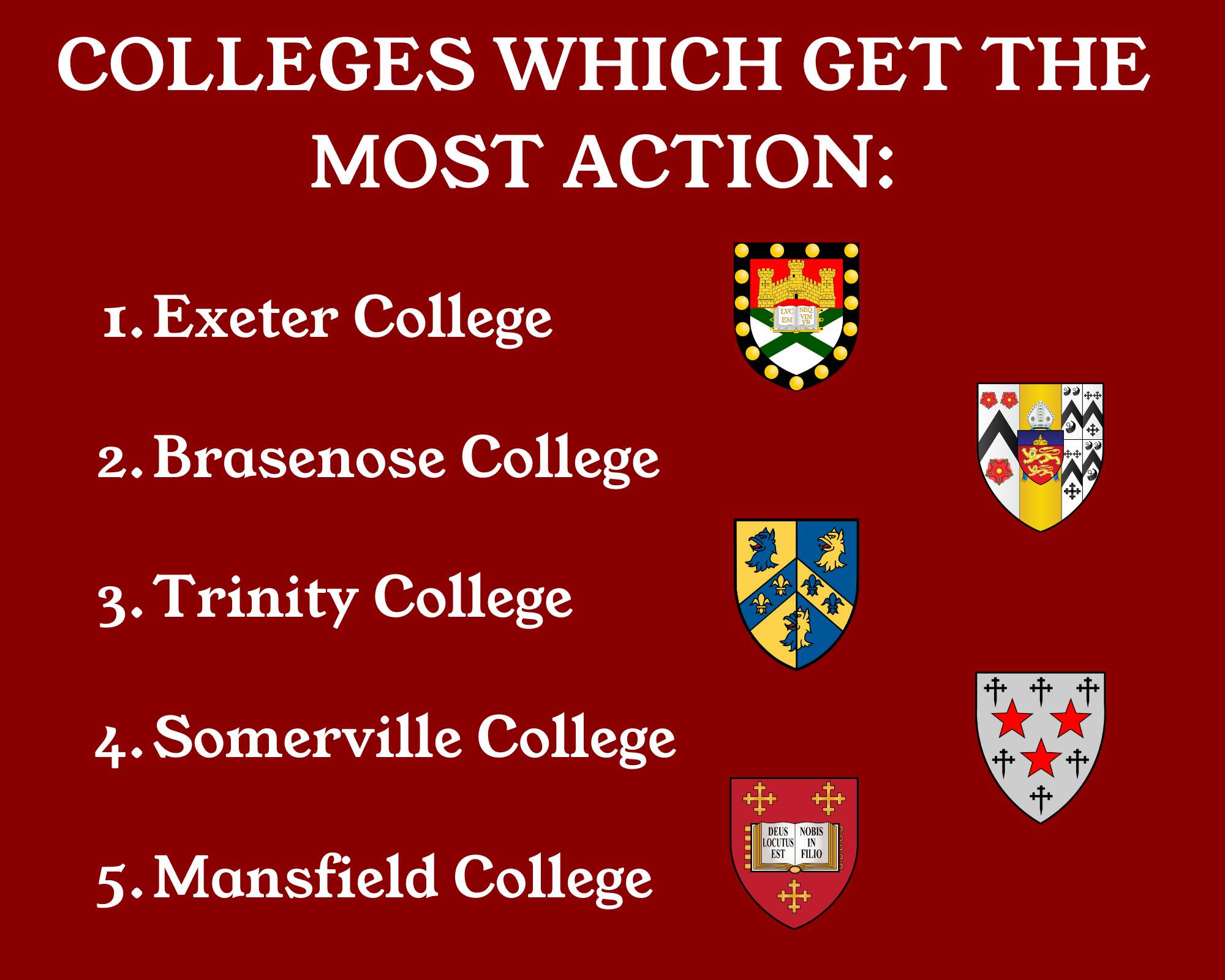
  1.  Brasenose – 9.4
  2. Trinity – 8.8
  3. Exeter – 8.5
  4. Somerville – 8.2
  5. Mansfield – 7.8
  6. Merton – 7.7
  7. St Hugh’s – 6.6
  8. LMH – 6.36
  9. St Catherine’s – 5.6
  10. St Peter’s – 5.3

University average – 5.2

  1. Keble – 5.1
  2. St Hilda’s – 5.1
  3. Christ Church – 5
  4. Worcester – 5
  5. Regent’s Park – 4.7
  6. University – 4.2
  7. Balliol – 4.1
  8. St Edmund Hall – 4.1
  9. Jesus – 3.98
  10. Lincoln – 3.8
  11. St Cross – 3.8
  12. Green Templeton – 3.5
  13. Pembroke – 3.5
  14. St John’s – 3.5
  15. Oriel – 3.4
  16. Wadham – 3.4
  17. New – 3.1
  18. St Anthony’s – 3
  19. The Queen’s – 3
  20. St Anne’s – 3
  21. Hertford – 2.6
  22. Magdalen – 2.3
  23. Corpus Christi – 2
  24. Kellogg – 1.5

Degrees by average number of sexual partners since coming to Oxford:
  1. English and Modern Languages – 15.5
  2. Theology – 9.8
  3. Ancient and Modern History – 8
  4. Law – 7.5
  5. Modern languages – 7
  6. Archaeology and Ancient History  – 7
  7. Medicine  – 6.3
  8. Biochemistry  – 6.07
  9. History and Modern Languages – 6
  10. History – 5.7
  11. Classics – 5.43
  12. Philosophy and Theology – 5.3
  13. PPE – 5
  14. History & Politics – 5
  15. Mathematics and Statistics – 5
  16. English – 4.6
  17. Economics – 4.5
  18. Biology – 4.31
  19. Music – 4.3
  20. Psychology  – 4
  21. History and English  – 4
  22. Computer Science and Philosophy – 4
  23. Chemistry  – 3.94
  24. Geography  – 3.8
  25. E&M – 3.5
  26. Physics  – 3.4
  27. Physics and Philosophy – 3.4
  28. CAAH – 3.2
  29. Arabic and Islamic Studies – 3
  30. Materials Science – 3
  31. Human Sciences  – .8
  32. Classics and English  – 2.67
  33. Mathematics – 2.5
  34. Politics – 2.4
  35. Public Policy and Sociology – 2
  36. Philosophy – 2
  37. History and Economics – 2
  38. Biomedical Sciences – 2
  39. Engineering  – 1.8
  40. Earth Sciences – 1.2
  41. Oriental studies  – 1
  42. Mathematics and Philosophy – 1
  43. Fine Art – 1
  44. Archaeology and Anthropology  – 1
  45. Experimental Psychology – 0.6
  46.  Computer Science – 0

John Evelyn: 7th Week, Hilary Term 2022

0

Run. Hide. Lock the door. The hacks are upon us. 

With the LMH enforcer and the Anti-Politician each loved up with their own newspaper, the Univ Queen and the Blue were left awkwardly glancing at each other across the dance floor. Alas, no romance flourished. John Evelyn is not sure if this was because of a fundamental incompatibility or just because the Blue is yet to strum up the courage to start a conversation.

Meanwhile, Daddy Oxlove has gathered 4 of his finest sugar babies and slid into the fray. Come to think of it, John Evelyn hasn’t seen many critical Oxfess posts about his campaign. Strange, that.

The swarms of tourists around Oxford have excitedly noticed that Harry Potter is running in the Union elections this term. However, in this version, Lord Voldemort is played by the Atik cheese floor. Shaken by this new wave of attention, Hermione scurried off to buy a new scarf because “the only other one I have is Gucci and I can’t really wear that in election week haha”. John Evelyn hopes these two magical candidates won’t be joined by their friend Ron on Friday. 

Speaking of optics, there was a horrible mix-up last Saturday, as the Union thought they had secured some pro bono stonework on the front entrance, but were surprised to see a gaggle of white-tie-toting elderly gents flood the bar. Turns out there is a difference between a free mason and a Freemason. Apparently one difference is that free masons don’t enjoy tucking into the free snacks left out for the 93% Club in the Goodman.

Friday’s election is not the only one on people’s minds, as the Union’s approaching bicentenary had Lieutenant “Initiative” and Mr Put-Me-On-Bicentenary-Committee jockeying for an early advantage in the race to still be here for the celebrations. But that’s another story for another Jevelyn.

After hours of gruelling scrutiny, interrupted only by the odd rat or Freemason, our candidates are ready. By Union standards, this campaign has run without too much drama. But Nullius in verba my friends; predictions of electoral civility can age almost as fast as a Union career. To your marks my little hacklings, the polls await.

No more to come. John Evelyn x

Last Dance at Iffley: Cherwell meets the Cuppers captains

0

In the lead up to the Men’s Cuppers final between Balliol and Jesus tonight, Cherwell met the captains of both teams, to find out what the second-oldest competition in world football means to them, and what they have been doing to prepare for it.

Balliol: Noah Britten

Balliol have had an exciting road to the final so far, with a dramatic penalty shootout win over Teddy Hall securing their place in the final. They came down from 2-0 and then 3-2 to clinch the game after the shootout went to sudden death.

Noah Britten captains Balliol from the left wing. He’s a third year E&M student with a lovely first touch and a knack for dribbling, and he believes Balliol has what it takes to bring the trophy home to Broad Street.

Balliol are coming into the final as underdogs. Has that affected the preparation for the match?

If anything, it’s made preparation easier. We know how good a football team we are, and we know Jesus don’t know how good a football team we are, and they’re almost certainly underestimating us. All we can do is go and play to the best of our abilities; it makes it easier for us to play as well as we can.

Are Jesus’s social media antics firing up the team?

It’s definitely fired up the team. There are a few players who are more active and have a more inflated ego than others, who I’m sure may be on the end of a few targeted challenges at the beginning of the game, just to welcome them. But, in all honesty the club has been focused on itself and its own performance. We could be playing any other of the thirty colleges in Oxford, and it wouldn’t influence us. WE’ve been focused on what we need to do to ensure that we win.

What did the team learn from the comeback?


We didn’t actually learn that much. We know how resilient of a team we are and it was just another example of us exhibiting that resilience. We played a lot worse than we are capable of playing, and the fact that we were able to not play to the best of our ability and still grind out a result in the end is a testament to the mindset of our players and our team.

Who do you see being the key players for Balliol in the final?

Josh Goldstein. If we can get him on the ball and he can dictate play, I believe he has the ability to really challenge Jesus defensively. They haven’t been challenged that much over the course of their cuppers run. Also Caleb Mbanaso, who can stop and stifle their attacks at the source before they get it out to their wide men and their strikers. If that can happen, and we win the midfield battle, we have an excellent chance of winning the game.

How important is the support from the fans?

The support is massive. There’s been an enthusiasm that Balliol students have shown, many of which don’t necessarily get involved with football, or play it, or even support it outside of college football. Many of them have gotten involved massively, and it’s been really good that the supporters seem to have grasped the special occasion that a Cuppers final is, given that many of them have had a very turbulent two years at Oxford. They understand how important this is.

Jesus: Adam Shaffer

Adam Shaffer is a second year engineer at Jesus who commands the team from centre back. His team includes several Blues players including top talents like Alfie Cicale. In their semi-final, they bulldozed St Hugh’s 4-2.

Jesus are the favourites – how has this affected the teams mental state in the lead up to the game?

We’re more just focussing on playing the best football we can. A lot of people are speaking loud on social media and stuff and we’re just ignoring it and playing how we want to play and we’ll show Balliol on the pitch.

A lot of people have said that the team’s instagram account (@jesuscollegefc) can be a bit lippy – is this part of a strategy of creating a ‘siege mentality’?

I think the social media probably more affects the opposition than us – if they think that it has a big part and we’re talking lippy, then it means that we’re not gonna be in the right headspace. But I can promise that the players just think of it as a joke and when it comes to the football anything we say on it doesn’t have any effect on the pitch.

Who do you see being the key players in the final?

Well the one everyone would say is Alfie, who’s in the blues. He’s a very skillful player, but often the opposition’s flaws are when they focus on Alfie, so they’ll put two defenders on him, but then they don’t realise the other qualities we have up top. We have two more Blues forwards and a very good fresher in Gonzo. Quite often they’ll double up on Alfie, and then all of a sudden our other Blues players are just free in space.

Has the preparation been different to a regular match?

We’ve tried to keep it as normal as possible. There’s obviously a difference in fan numbers and sorting out tickets. On the administration side, with different grounds and changing rooms, that’s been different, but for the players, it’s all pretty much the same. We have our standard team meeting before Cuppers games, we had a team dinner–it’s all just about the team sticking together and I’m sure no doubt we’ll go out tonight and everyone will play the same high quality level of football.

How important are the fans to the team?

It’s very important. We have a big community. It’s another advantage of our Instagram – more and more people have just been wanting to get involved because it’s become such a big part of the Jesus culture. We have a lot of fans, they’re all making banners and songs, and hopefully they turn out in full force. We’re getting non-stop messages from people. They’re very excited and they will play a big part today.

The final kicks off at Iffley Road Sports Centre at 7:30pm tonight.

Oriental Studies faculty to propose changing name to “Faculty of Asian and Middle Eastern Studies”

0

The name “Faculty of Asian and Middle Eastern Studies” will replace “Faculty of Oriental Studies”, Prof David Rechter, the Faculty’s chair, announced on Thursday morning. The proposed name change will now be recommended to the Humanities Division and the University’s Council.

The decision comes after eighteen months of discussion and debate among students and faculty, according to Professor Rechter’s statement. The process will now occur at the university’s administrative level, which may take months before a finalised decision is made.

Opened in 1960, the Oriental Institute building has long housed the Oriental Studies faculty at Oxford, which includes the bachelors-level Oriental Studies degree and a range of masters and doctoral programs focusing on the cultures, histories, religions, and languages of Asia. 

Today, the Faculty is housed across multiple sites, including the Griffith Institute, the Middle East Centre, the Nissan Institute, the Khalili Research Centre, the China Centre, the Hebrew and Jewish Studies Centre, and the Nizami Ganjavi Centre. It offers instruction in twenty-five languages.

The term “Oriental” to describe the “Eastern” world has been the subject of controversy in academia and beyond. Drawing on Edward Said’s seminal 1978 text Orientalism, critics allege that the word evokes stereotypes and caricatures of Asian people, and has a legacy rooted in colonialism. The first permanent post in Sanskrit studies at Oxford was established in the 19th century by Colonel Joseph Boden of the East India Company, as Britain embarked on a colonial campaign in the Indian subcontinent.

The Oriental Studies Faculty acknowledges its origins, and strives toward a “rejection of colonial and Euro-centric ideologies”.

The University of Cambridge changed the name of its Faculty of Oriental Studies to the Faculty of Asian and Middle Eastern Studies in 2007. The University of Chicago, the Pontifical Oriental Institute in Rome, the School of Oriental and African Studies in London, and some others maintain the controversial “Oriental” name.  

The Oriental Studies Faculty and the Humanities Division have been approached for comment. 

Image: Kyle Bushnell

Putin’s ‘hockey buddy’ funded Teddy Hall and Saïd Business School

UPDATE: On the 29th June, The UK Government announced a new round of sanctions on several high profile Russian figures including Potanin, with the aim of “hitting Putin’s inner circle”. A government statement read: “Potanin continues to amass wealth as he supports Putin’s regime, acquiring Rosbank, and shares in Tinkoff Bank in the period since Russia’s invasion of Ukraine.”

As the Western world moves to sanction overseas Russian money, Cherwell has found that St Edmund Hall and the Saïd Business School accepted donations from Vladimir Potanin, the oligarch and metals tycoon who is the second richest man in Russia.

Potanin, 61, has a net worth of $27 billion, as estimated by Forbes. In 2020, he was included on the US Treasury’s list of 210 Russian oligarchs, businessmen and politicians under considerations for sanctions, dubbed ‘Putin’s List’. He is widely known for regularly playing ice hockey with Putin. Potanin’s fortune fell by $3 billion on the day that Russia invaded Ukraine. Potanin also served as the Deputy Prime Minister for 7 months between 1996 and 1997. 

In 1999, Potanin founded the Vladimir Potanin Foundation to “implement large-scale humanitarian programs” in the fields of “culture, higher education, social sport and philanthropy development”. The foundation donated £3 million to St Edmund Hall in 2018 to endow a research fund for Earth Sciences, and to jointly establish the Vladimir Potanin Associate Professor and Tutorial Fellow in Earth Sciences with the University of Oxford. The endowment also funded the three-year Vladimir Potanin Tutorial Fellow of Russian Literature and Modern Languages.

The foundation also granted $150,000 to the Saïd Business School in 2017 for a fellowship scheme for the Oxford Social Finance Programme. The school selected 15 Russian charity workers to attend this programme between 2017 and 2019. 

The collapse of the Soviet Union in the 1990s allowed well-connected individuals to profit from the bloc’s transition to a market economy by gaining control over newly privatized state assets. Many of these deals were done privately, without competition. While in office, Potanin proposed the controversial ‘loans for shares’ scheme, which is seen as having furthered the rise of the oligarch class. This scheme effectively caused the consolidation of oligarchs’ control over the Russian economy. ‘Loans for shares’ encouraged wealthy businessmen to loan money to the Yeltsin government in exchange for state-owned shares in companies, many of which extracted and processed Russia’s abundant natural resources. 

Of the programme, he told The Financial Times: “It is the biggest PR tragedy of my career. Of course, the privatisation process has to be transparent. And in our case it was not. My plan was different. I wanted to privatise the companies with banks and qualified people, raise their value, and then sell them.”

Through this scheme, Potanin and his long-term business partner Mikhail Prokhorov acquired a 54% share in Norilsk Nickel (Nornickel). The two businessmen separated their assets in 2007, leaving Potanin with 34.6% of the shares in Norilsk Nickel. The company’s total assets amounted to $20.7 billion in 2020.

On top of being the world’s largest producer of nickel, Norilsk Nickel is one of the world’s largest industrial polluters. In 2020, the company produced 1.9% of total global sulphur dioxide emissions. The company has announced that it intends to reduce suphur dioxides from its plants in the heavily polluted Norilsk region by 90% by 2025 from a 2015 baseline.

Potanin is the only Russian to have signed The Giving Pledge, in which the super-rich pledge to give a majority of their wealth to philanthropic causes. Other signatories include Elon Musk, Mark Zuckerber, and George Lucas. He said his decision was motivated by a belief that “wealth should work for public good”, and as a way to “protect [his] children from the burden of extreme wealth”.

A spokesperson for St Edmund Hall told Cherwell that the gift was accepted “in good faith and at a time when relations with Russia were in a substantially better place. This was a one-off donation and the College does not anticipate any further funding from The Potanin Foundation.

“The College is deeply concerned at the events happening in Ukraine and sincerely hopes that a peaceful outcome will soon be reached,” they added.

The Saïd Business School told Cherwell: “The grant went through the University’s robust approval process and the partnership ended in 2019. The focus of the programme is to improve the social impact and philanthropic work of charities and non-government organisations (NGOs) across the world. As a global business school with students and alumni from across the world, we have been deeply saddened at events happening in the Ukraine and hope a peaceful outcome is soon reached.”

The University of Oxford, Interros, and The Vladimir Potanin Foundation were approached for comment.

Image credit: Kremlin.ru/CC BY 4.0 via Wikimedia Commons

Exclusive: Politics Faculty refuse to record ‘Politically Sensitive’ China lectures

0

For the last two years the Faculty of Politics and International Relations has not recorded lectures titled “Is China a Democracy?” and “On China”. All other faculty lectures are recorded, so these lectures would be exceptional to normal practice.

Emails obtained by Cherwell show that lectures, delivered by Professor Thornton of Merton College in week four of Michaelmas 2020 and week three of Michaelmas 2021 included warnings that the content was “politically sensitive” and not recorded. They further reveal that Professor Todd Hall’s lecture “on China” was only delivered live.

The emails, sent by Ms Durga Sapre, Politics Undergraduate Studies Coordinator, also reveal first year students were required to sign a legal undertaking in order to attend the live online lecture given by Professor Thornton. Freshers, who wished to remain anonymous, told Cherwell the undertaking represented an agreement not to disclose the contents or participants of the lecture. The University has stated that this is incorrect and that they were never prevented from discussing the lecture.

Any students who refused would not have been allowed to attend, despite the lecture forming an integral part of their Practice of Politics module. Those who watched the lecture in 2020, and those attending Professor Hall’s lecture were not required to sign an undertaking.

Several first years declined to discuss the lecture at all, citing fears over the consequences of breaking the undertaking. However, Tallulah Brady, a first year PPEist, told Cherwell that she was “not at all bothered” by the fact the lecture was not recorded, stating it was boring and she had no incentive to watch it again. While also refusing to discuss the contents of the lecture in detail, Tallulah stated that she did “not remember there being anything particularly controversial” about the material. On the subject of the undertaking and the lecture’s politically sensitive label she commented “I was/am under the impression it was given this level of caution to protect the contributors and participants from potential consequences. Exactly what those consequences are or could be I do not know. “

This confusion about what in the lecture constituted politically sensitive content is echoed by Struan Hancock, a second year PPEist who attended the lecture last year: “I believe Oxford is a centre of learning where it is possible to have frank and free discussions about difficult issues. I’m confused why the department felt the need to remove the possibility of students re-watching the content. Students only had one chance to watch the lectures.

“The lecture was a nuanced analysis with opinions from multiple viewpoints on the state of democracy in China. Who do they believe will be offended by an academic conversation?”

The Department of Politics and International Relations told Cherwell: “It is not departmental practice to label courses or lectures ‘politically sensitive’ and restrict access to them on those grounds. In  exceptional circumstances, to advise and protect students, we will alert them that material is considered sensitive by external bodies and that they may need to seek further guidance. Oxford freshers have never been prevented or discouraged from discussing any of their prelims lectures, nor would they ever be; and course instructors have accommodated every student who has reported a documented learning needs assessment, and will continue to do so.”

Image credit: Edward He

Oxford’s twin city in Russia has spoken out in support of Ukraine

0

This weekend Oxford experienced numerous protests in solidarity with Ukraine against the Russian invasion. Over 4000 km away in Perm, Oxford’s twin city in Russia, protests have also broken out. People there have also spoken in support of Ukraine. 

Karen Hewitt is the chairman of the Oxford Perm Association. She is also a professor at Oxford University and an honorary Professor at Perm State University. She has revealed the Association’s stand against the invasion: “Appalled at Putin’s decision to invade Ukraine.” 

In Perm, members of the Oxford Perm Association have also been in protest, “Supporting [the Ukrainians] in their outrage and grief.” These protests have joined the call, “Not in My Name” (taken from Boris Johnson’s statement “I do not believe this war is in your name.”) Similar protests have been taking place across Russia. 

Oxford made its first contact with Perm in 1989, founding voluntary links in 1991. The two cities have been officially twinned since 1995. 

Links between the two cities are not restricted to the university. Participants involved in this connection span to Oxford City, Oxfordshire County, Sobell House Hospice as well as to Perm City administration, Perm Hospice and Perm-Oxford Organization. 

Perm is Europe’s most easterly city. It is located 900 miles east of Moscow. On the outskirts of the Ural Mountains, it is surrounded by forests and the Kama River runs through it. With 1.2 million inhabitants, it is Russia’s sixth largest city. In addition, it is a key Russian centre of art and culture. Of particular, note it has three universities, the famous Tchaikovsky Opera and Ballet Theatre and the renowned Perm Museum of Contemporary Art.  

The Oxford-Perm connection has usually been limited to social and cultural exchange. The Oxford Perm Association organizes events between Russia and England. For example the association has hosted group exchanges between Oxford University and Perm State University. In addition, volunteers have run events such as dancing, sports tournaments, art displays and journalism conferences across all ages. 

This encouragement of cross-cultural exchange and interest is key in raising awareness and support. The society was quick to comment and express their stance on the current war in Ukraine. Standing in solidarity with those in Perm is critical to the association strengthening and maintaining their strong ties to this city and its inhabitants.

Image: A. Savin via Wikimedia Commons

Overthinking dating: Am I more in my head than he’s into me?

0

It went well with Isaac. It went well when he asked if I’d had a tour of the house; when we stood alone in the upstairs bedroom and he leant across to kiss me; when I pulled my cardigan tight around me in the alley beside his house and he mumbled “are you ok? Are you cold?”, as the rectangle of sky above us hardened into an abrupt and chilly grey dawn.

Isaac is creative, clever, and he wrote his dissertation on feminist philosophy. After so many drinks I stop trying not to get excited about us; I am exuberant, attentive, bubbling. Leaving the party in an Uber, I am confident – “let’s go for drinks soon?” – he nods, smiles, we kiss again. The next afternoon, I sing in the shower, hangover miraculously mild – what a difference a day makes.

A week later, my Guardian-reading, musicsharing, dry humour coupledom fantasies are increasingly interspersed by spikes of bad stomach butterflies. Why hasn’t he messaged? Was it a bad sign that he asked me to stay over that night? Was it bad that I said no? Had it been just a bit mechanical, like he maybe only kissed me because my eyes were visibly swimming with desperation? Had he rushed downstairs a bit too quickly when his flatmate called up about a spillage in the kitchen? The spark of connection from our evening together begins to dull and a familiar shame spiral takes its place. I recall sidling up to him earlier in the night while he was mid-conversation with a smooth-haired brunette; lingering far too long at the party; literally screaming into his face: “I’m an introvert too!” I remind myself of the needy protagonist in He’s Just Not That Into You; I resent myself for taking such a toxic movie to heart.

My attitude to Isaac’s radio silence oscillates with my self-esteem. I remember that he’s notoriously shy and renownedly passive. It doesn’t mean he didn’t like you! I seethe silently at our mutual friend for failing to get intel, presumably because she knows that he found me repulsive and can’t bring herself to relay it. You were definitely too much.

As the condemnation of my bickering thoughts gradually encroaches on every facet of my personality, I note that I haven’t felt like this for a long time – I haven’t cared. It makes me sad because it is so rare to meet somebody with whom I feel the click, so rare to feel anything other than temporarily entertained or dismissively contemptuous towards prospective romantic suitors. It makes me sad in case I never see Isaac again. I remind myself to be grateful – that there are still people out there who I might like; people who might like me back; that I’m free to go out and meet those people; that my stomach still has the latent capacity to make the good butterflies as well as the bad.

Another week passes. I continue to bore my friends, my mum, and my brother with the what-ifs and the what-should-I-dos of my non-relationship with Isaac. I’m scared to reach out into the ether with a casual WhatsApp because I’m simply not casual: I am fragile, afraid of being batted off because it always feels more personal than I know it’s supposed to. I’m scared because I like Isaac, and if Isaac doesn’t like me back my mind joins up the dots that no amount of candle-lit self-care baths can rub out: you will never be enough.

The fool-me-once trauma of heartbreak keeps me from stepping into the ring for another round. I milk memories instead, replaying the patchy, alcohol-stained reel of a six-hour evening, stitching moments this way and that, turning words and glances and smiles over and over in my head until their edges begin to blur. If I keep on ruminating, maybe I can clarify exactly what happened, who felt what, whether he’ll want to go out with me if I ask. Maybe the polluted building site of my mind will manifest the potential that was sparked between acquaintances in a student-y house party on a muggy Saturday night and in the sudden predawn temperature dip of an adjacent alleyway.

Amongst my stubborn self-doubt and hamster-wheel thoughts, the only thing I can be certain of is that my romance with Isaac will remain forever nascent. Better kept safely, eternally unfulfilled than invited out for drinks; welcomed into the lab for trial, testing, and probable error.

Never mind. I’d rather imagine what might have happened than know that nothing could.

‘Stirred to breathless heights’:  Wolf Alice Concert Review 

0

Wolf Alice have had a whopper of a year. The London-based alternative rock band released their third studio album, Blue Weekend, in June 2021, to rave critical reviews, and in January they won the Brit Award for Best Group. They are now touring with Blue Weekend, glittering on stages across the UK.

The disruption Covid created for live entertainment has been gutting for music lovers, many of whom have not been able to experience a live concert since 2019. Storm Eunice’s disturbance in Fifth week also led to the added stress of transport cancellations and delays. As I tried to prepare alternative travel arrangements for the journey from Oxford to London, a feeling of uncertainty, so painfully familiar to us by now,  began to cloud over the experience. Although forced to get a train several hours earlier than initially intended – which led to an extremely chaotic morning – Wolf Alice delivered a night that was completely worth the extra faff.

This was the second of three successive sold-out nights for the four-piece at the London venue, and it proved one for us and the remaining five thousand people in attendance to remember. Wolf Alice performed a number of songs from Blue Weekend, as well as a handful of staples from their older records. The show began with the explosive ‘Smile’, kicking off with an exhilarating number that appropriately roused the crowd in anticipation for a night where the band’s – and the fans’ – energy levels would not waver. Following ‘Smile’ came ‘You’re A Germ’ from their 2016 album My Love is Cool, matching the opener’s dynamic chord progressions and thumping beat.

As  a lead singer, Ellie Rowsell’s comfort onstage was unquestionable, her presence fierce. Clad in an oversized blazer and elegant bootcut trousers, she delivered consistently powerful vocals and guitar solos aplenty. Her impressive vocal range was showcased as she transitioned effortlessly from the thunderous pace and half-screams of the hard rock song ‘Play the Greatest Hits’ to the softer tones of ‘Feeling Myself’. The stage lighting mirrored the cooldown between the numbers by turning a deep violet from a flashing neon green.

Indeed, Wolf Alice are a band who serve up phenomenal artistic variety. The mélange of genres to be found in their music is evidence enough of this: indie, rock, grunge, shoegaze… Witnessing them in concert only confirms their chameleon knack for transformation. We were stirred up to breathless heights in one song, the bassline pounding through our bones, and lulled back down to soothing, melancholy introspection in the next.

And the fans responded accordingly. They became an undulating, frenzied mass during the roaring ‘Visions Of A Life’ – mosh pits and all – and in the same song they stood gently swaying as Rowsell held them enchanted on a stage lit up with red and blue. The nostalgia-inducing song ‘Silk’ moved some fans to tears.

To perform an intimate, mellow rendition of folk song ‘No Hard Feelings’, Rowsell came down to sit on the edge of the stage, where she was given a bouquet of tulips by a fan in the front row. She accepted the bouquet with delighted surprise – and later flung it back into the crowd, returning the fans the love they show the band in a gesture of her personal appreciation. That, or maybe she just doesn’t like tulips.

Bassist Theo Ellis kept firing up the crowd with his volcanic energy, leaning at the edge of the stage into the audience to ecstatic shrieks. ‘This song’s for you, London!’ he yelled before the band played ‘Bros’, another classic from My Love is Cool.

A mention must be given to the band who opened for Wolf Alice on their first and second London dates, Lucia and the Best Boys. An electrifying four-piece from Glasgow, they established the mood of the night with a selection of characterful indie-pop songs from their 2020 EP The State of Things. Vocalist Lucia Fairfull stomped vigorously on the stage in a black leather jacket, making the auditorium quake with fervour.

At the end of the night, Wolf Alice returned to the stage for an encore, playing fan-favourites ‘The Last Man on Earth’ from Blue Weekend, and, of course, ‘Don’t Delete the Kisses’ from their 2017 album Visions of a Life. The euphoria in the room was palpable. ‘Me and you were meant to be in love!’ the fans screamed, almost drowning out Rowsell herself. It’s unsurprising that Wolf Alice have long been hailed the best band in Britain.

Not a bad way to celebrate the return of live music.

Image Credit: Paul Hudson/CC BY 2.0 via Flickr

The revival of the print book

0

This summer my friend and I went on holiday together. Her bag was lightweight, full of clothes and swimsuits, whilst mine was half-packed with books. At the beach, she would whip out her Kindle, whilst I was balancing a weighty tome in my hand, trying not to drop it on my face and probably injure myself in the process (I was reading American Wife by Curtis Sittenfield, which at over 500 pages, could have done some damage). Smugly, my friend pointed out that she could read basically any book in the world on her tiny Kindle whilst I lugged about a miniature library in order to entertain myself during the many days we spent sunbathing. She had a point, of course, and for the last decade or so many people have made the swap from physical books to their electronic cousins. 

Last year, however, saw 212 million print books sold in the UK, the highest number of sales in over a decade. But why are people returning to print books despite the fact that they are more expensive, more inconvenient and less portable than e-books? I’m sure the lockdowns and people’s whole-hearted attempts to get back into reading played a large part, but why did the general public decide to buy print books specifically? I think there’s just something special about holding a book in your hands, something unique and timeless that isn’t replicated in a e-book. 

There is, of course, the opportunity reading provides to escape the glare of a screen for a while. Getting lost in the turning of pages is also a nostalgic act for many whose reading habits have probably petered out since childhood. But there’s also something to be said about the book as an actual, physical object. The rise of the internet has meant saying goodbye to a lot of the physical paraphernalia of our hobbies. Our music, our books, our films, our TV shows are all now online. I think people want to have actual things that represent the art and culture they love. They want to be able to browse through their own library of books, reminded of the time they read that book and the person who gave them that novel for Christmas. Just like with vinyl, people want to be able to see and touch the art that inspires and moves them rather than just be able to access it invisibly through the Cloud. 

There is also the showy element of owning print books. A book in your hand as you wait at the bus stop and a bookshelf crammed to the brim with classics are both signs of curiosity and intelligence. If you walk around with a copy of A Little Life under your arm, you’re declaring that you’re emotional, complex and clever enough to read super long books. A copy of Pride and Prejudice and you’re a sentimentalist, an old soul, and a romantic at heart. The shiny, grey rectangle of a Kindle is anonymous – you could be reading anything from Eat, Pray, Love to Crime and Punishment. Print books make it so much easier to announce your bookish snobbery loud and clear. 

The print book also allows you to have a different sort of reading experience to one you would get with an e-book. The physical book has a certain smell, margins to scribble in, pages to dog-ear and sentences to underline. The books become yours, an extension of yourself. That isn’t to say that there isn’t something magical about other forms of reading too. The audiobook, for instance, can envelop you in a fictional world in a totally different way. I can still remember listening to David Tennant’s fantastic reading of the How to Train Your Dragon books as a child. He would roar to mimic the dragons’ cries, bellow for the Viking chief and whimper in fear when the protagonist was afraid. Audiobooks can be magical too.

But in a world full of podcasts and background TV, it’s quite nice to have an entirely non-electronic hobby. Just you and the book. Try and think of your favourite book right now. Chances are, it’s not one tucked away in the corners of your electronic library but rather one you can picture in your mind’s eye.

Loving reading is, of course, loving the words on a page. Loving the print book is something a little more complex; it’s loving the turning of the page, the lending of your battered copy to a friend, the placing of the book on a bookshelf which encapsulates your interests. Even if, on that beach with my friend, her Kindle was more practical, it was also less joyful. After she swiped the last page, she was finished with her book. When I opened American Wife again a few months later, at a café table, a tiny little stream of sand trickled out from between the pages, immediately taking me back to where I first read it and the memory of being on holiday with my friend. Print books become artefacts of our lives, tied to specific places and people and forming a physical representation of who we are and who we want to be.

Image Credit: David Orban // CC BY 2.0