


Monday 6th April 2026
Blog Page 537

Laurence and Olivia

Her feelings were in constant melancholy. When that Thursday had accumulated into a sunset, she was unmoved. The dwindling clouds did not produce in her the wonder of a new-born, but reminded her that time erases. Turning to her husband, whose boulder-like face had seemed closed for hours, she saw him wide-eyed. Some element of that fatal sky had forced him to spread his features. In wonder, his saw mouth had dropped open into a smile. It was not for pain. There was no blood starting from the edge of his bottom lip. Since she noticed nothing glorious before his sight, she could not tell if his reaction was rational. She wondered if perhaps her own irrationality had prevented her from seeing something, or appreciating what she had already seen. She looked at the sun and felt her lids stiffen. It was a large, red porthole in the sky and the cirrus flaked alongside it like a shoal of fish. It would sink, she thought, and drown in the night. Unless her husband meant to worship a representation of death, she could not understand him. 

Celestial objects were nebulous things to behold. One had to place her opinion on top of them in order to like them, fabricating a mirror out of their various substances. She already had a mirror inside the cottage, but she was too wrinkled to enjoy looking in it. She said to herself ‘People must look at the sky because their reflections are no longer beautiful’, but this did not sound convincing any more. Traces of dampness lingered in the air from the rain that morning. The scent of watery leaves on the patio was apathetic to her scepticism. It astonished her husband in combination with everything else.  

She would not talk to him about it. For her, the rare instance of the day worth commending was the silence that had remained between them over most of its course. She was convinced she loved her husband, but sometimes she desired to be reminded that her consciousness existed by itself. With Laurence, the necessaries of conversation were never enough. He did not want to grunt when he poured her tea, but complement the variety of perfume she had used. He did not want to cough and say pardon, but comfort her that his indigestion was little cause for her concern or worry. He did not want to talk of pointless things, but speak on the subjects of architecture and politics which she had endeared to teach him from the beginning of their marriage. He had done so well, and she did not know what she could return him in exchange. Quietness absolved this expectation of hers. Without having heard his loving comments she felt no obligation to deliver her thanks, which always felt arduous or guilty.

As a result, her imagination became more available, as if the noise that did not come out of her mouth was saved in its primordial form within her mind. Many times after waking, she had closed her eyes and studied the numerous shapes that were created behind them from large blotches of darkness; the same material, she supposed, of which her words were made. Now, before the indifferent sun, she repeated this task again, reorganising the moulds of possible flirtations and complaints to produce certain fond projections within the theatre of her head. A sculpture of twigs and tracing paper that she had structured in her ninth year solidified into the bench on which she had grieved during her thirteenth. The transition was immediate and reasonable. It was justified by the figure of a horse: the animal that she had wanted as a toddler, received as a girl, and lost as a teenager in the suddenness of a lightning storm. 

When this explanation manifested on the stage, so did a heavy fog that promised thunder. It was as tall as the roof of her mind. She half-expected it to leak into the material cosmos outside when it reformed itself into the same gold ring that she now wore, although in a form that glistened instead of rusted. The original was bound tight. It seemed like it would totally restrict the joint on the wearer’s finger. She could not believe that she had accepted the thing during the wedding that proceeded her education. She felt the older, battered object on her own bony digit and considered how much it had joined with her. It was no more a piece of jewellery than a knuckle, and she preferred it that way. The ring on the stage was virginal in comparison. It had arrived to her at a young age when she denied new experiences, and it affirmed that denial despite the change it signified. 

Now, she revoked the colour of the lightning. The ring was transfigured into the pallid whistle which Laurence had used once that day to call his dog. She knew he bought it the day before but, since he always hid it, she could not work out the precise hour. It might have just appeared to him, like the object of a curse. Its nozzle sloped like a mallard’s bill and the metal at the back dropped down like the top of a neck. To her, it resembled the severed head of a bird. She could not tell if that was significant, yet the whistle in her mind had changed into it. The whistle was the splintered cranium of an old iron duck. She knew it was significant, she was just uncomfortable. Laurence did not deserve the pain of having it. 

She recalled the set of a dry and sandy January, where he first described himself as a singer. He had no interest in a musical career, but he liked to mention his hobby in a professional manner because it gave him a wild sense of confidence. He said on that same date that he liked wildness. Anything untamed pleased him, especially the improvisations of a runaway tongue. He told her the Swiss rhymes he learned on a boyhood trip. He could talk and sing and whistle without interruption for impressive periods of time. He always preferred to exasperate himself than remain placid, and he always hated to rely on other people and other things. He only got the whistle  recently, when he got bronchitis. 

He had left the hospital two nights ago, grinning like a soldier who had lived. He had never before felt well after feeling so terribly ill. Till dawn, he snored in his sleep and when she complained at breakfast he laughed. ‘My body is celebrating.’ he said, before lowering his cutlery to the table. His grin became uncertain. His feet shuffled. Then, he chewed down on his lips, not to withhold one laugh too many, but because laughing had strained him. He was still recovering, it seemed, and he would have to refrain from using his voice if he desired to keep it. He refused to lie down and he demanded to go on the walk they had planned after the meal. She refused, and so he went alone. He went into town with their collie and he came back scarred on the mouth, having grinded his teeth and lips trying to hold back from coughing. It was at dinner she noticed the string hanging around his neck. He told her it was the Cross.

She did not have to ask him much else to discover it was a reluctant purchase. When she knew that, she guessed it was something to make the dog obey him, now that he could not befriend it with his bird-like call. This was reason enough for her to plunder through his coat before he got up the next morning. She seized the string from the breast pocket and pulled it out, learning that he had bought a whistle, not a dog-whistle, and must have been trying it all his walk home to the failed comprehension of the animal with him. For pride, she guessed, he had not queried for the help of the shopkeeper, and now he was suffering for it. 

Still, he refused to be rid of it in the days following, just as he refused to lie down. His pace was as ecstatic as his blow, whether contending the low and airless flats or the high and windy cliffs. So, his throat grew more terrible than both. He defied the world to take away his sense of humour after so long staying in a ward. She told him he would lose his speech if he continued like that. He called her a constant nanny, never allowing him to do as he pleased. He always preferred to exasperate himself than remain placid and defensive and helpless. To him, the whistle had stolen part of his voice, so it might as well have stolen all of it. By Wednesday evening, he struggled to read the headlines.

In the theatre, the whistle dropped and merged with the whispers he had not had the chance to press against her ears. Together they became a murky water, then the blackness that was the interior of her eyelids, then something that dripped beyond them. Olivia opened her eyes and saw that she was crying. They only fell like an involuntary sweat, but they were tears all the same. 

She gaped at the sun like she did before, trying to mimic Laurence’s outer features in such a way as to guarantee the achievement of the same inner conviction. There was the sun again, incompetent and red. If it were a pimple, she should have pierced it. If it were a tangerine, she should have tasted it. If it was of blood, surely she should have heard it drip by now. Merely the pattering of the damp leaves was summoned, and not by a fay or sprite, but the staggering of Laurence’s feet. She understood the sun was a great, garish object that hurt her eyes and from this she could tell that her mind had circled back on itself.

Maybe the roundness of the sun was wonderful because it generated her wheel of remembrances. But the theatre stage she had imagined was square and she knew that she had more frequently drifted into pleasing and shocking sights there on an earlier occasion. Why, when they were walking on the cliff that morning, she had imagined a peacock spreading its wings in the pews. She had enjoyed regarding it better than the spree of unfixed emanations she had just conjured up. 

The paving stones of her back garden were not sublime for thinking. Laurence had laid them some seven years ago and they were only now in use. He looked about as breathless as he did when he first set them down, and back then the sun was shining brightly. Intransigent, his smile remained open, although it could not have improved his breathing. She finally decided to query him about it. 

‘Why does it amaze you into a grin?’ she said. He croaked, turned a small way and wiped his cheeks. ‘Why?’ She approached him nearer.

‘Is it important?’ he said. ‘You were grinning too.’ He coughed twice, but it was hard to tell if he was signalling the fact that he had few words left. 

Olivia felt her mouth to find it was a grimace. ‘When did I stop?’  

He sighed. ‘When you closed your eyes. It’s a pretty sunset, but it hurts to look at it after a while.’

‘After a while. . .’ She paused to scour the heavens for commiseration and murmured to discover they were as they ever had been. Laurence adjusted her coat for her, tutted affectionately and wiped her eyes. He made a sign to go in, but she told him no. She could not believe that a revelation had passed her by.

Ennis and Marie

Ennis reduced me from the thing I was,
Rounded and massive friend of crazed Marie,
And lifted me and placed me in his palm
As I were only of a sand-grain’s size.

He was a concubine to self-respect
And only loved by sympathy: a desert.

I was with Marie before the sand had fell
Trying to harbour me within a dune,
For she would broaden with unhomeliness
Till Ennis had not size to gather me.   

She was a force on several continents
That I, lone moon, controlled: a wild sea.

THE IDEA OF LAND

Of the firm landscape
Men see much
But hold little for sure

What they learn is grown
Before work
Gathers them into a field

Each one admires
A settling
In place, and never going

From the land, all know
There comes not
A house, a room, a pillow

No tractor forms,
Foliaged
With rust, from the earth alone

No post-box rises
From sheathed leaves
Like a new, humble flower

No telephone poles
Mark a road
Back to where all life started

THE IDEA OF HEAVEN

Heaven must be
That old dream
Of my garden, but lasting

When I wake, the leaves
Seem to shred
In the wind like manuscripts

The pollinated
Jungleland
Becomes a sodden ivy

And bouldered ruins
Shrink to squares
In patios that are quite brown

If those sights lasted
If there was
No alarm to disturb

Me, I would see a
Cosmic light
Projected through the woodland

Like a patch of
Certainty
Through the coils of my own brain

Review: Laura Marling’s ‘Song For Our Daughter’

0

Laura Marling’s seventh album, Song For Our Daughter, was scheduled for release later this year. But, like many other artists and entertainers, the likes of Dua Lipa included, she chose to drop it early last month in the hope of providing entertainment for her homebound fans. In a statement accompanying the album’s release, she wrote: “it’s strange to watch the façade of our daily lives dissolve away, leaving only the essentials; those we love and our worry for them.” Her album, she says, is “stripped of everything that modernity and ownership does to it”, and is “essentially a piece of me”. “I’d like for you to have it. I’d like for you, perhaps, to hear a strange story about the fragmentary, nonsensical experience of trauma and an enduring quest to understand what it is to be a woman in this society.”

It is a quietly powerful album, with moments of softness interspersed with more upbeat folk-rock. Her lyrics are introspective and wise, and, set against her characteristically clear vocals, make you feel like you’re being offered advice by an old-soul kind of sister or friend. Building from 2017’s Semper Femina, the title of which alludes to Virgil, Marling explores femininity in all its facets, this time directing her wisdom to an imagined daughter, a figure she describes as ‘The Girl’. It is this universalized listener that she feels she can now guide through life, or, as she describes it, “the chaos of living”. Exactly as she says, the album is like a ‘whisper’ – gentle, brooding snippets of advice that drift into your consciousness through Marling’s clear and soulful voice.

The opening track, ‘Alexandra’, sets the tone – it’s a reference to Leonard Cohen’s ‘Alexandra Leaving’, which ends with the lines: ‘say goodbye to Alexandra leaving, then say goodbye to Alexandra lost.’ In Marling’s song, she’s wondering “what became of Alexandra? Did she make it through?” It is a strong opener, one of the most powerful songs on the album. Marling was inspired to write it because, as she says, “there’re no suggestion that [Alexandra] has an interior life that’s anything more than being alluring.” So, she wonders “what did Alexandra know?” The urgency of this song implies her drive to delve more deeply into interiority, harking back to the lyrics of her own musical influences and (possibly) drawing upon a recently-acquired Masters degree in Psychoanalysis to wonder at the other side of the story. She probes into Alexandra’s inner life, drawing our attention to what the male perspective in the original song simply cannot tell us.

The quieter songs struck me the most, particularly ‘Blow by Blow’, the only piano-track on the album. It is gentle and sad, more ballad-like, with yearning lyrics like “knowing thunder gives away what lightning tries to hide”, and “sometimes the hardest thing to learn is what you get from what you lose.” The song has elicited comparison to ‘River’ on Joni Mitchell’s Blue: a momentary change in medium to convey something softer and more immediately reflective. Marling is often compared to Mitchell, with her impossibly wise lyrics, open-tuned guitar, light and airy vocal lifts – such as in the second track, ‘Held Down’– and in this album she perhaps most explicitly makes clear her musical influences. The last track on the album, ‘For You’, recorded together with her partner, who plays the electric guitar riff, is inspired by Paul McCartney’s solo work, particularly his song ‘Jenny Wren’ from the 2005 album Chaos and Creation in The Backyard. In other songs, such as the more upbeat, percussive ‘Strange Girl’, her tone resembles that of Bob Dylan. Musical progenitors aside, however, the album is intrinsically Marling – perceptive and nuanced lyrics, folk-rock, a beautifully breezy voice.

As she says, the album is stripped back to its essentials, most clearly embodied by songs like ‘Fortune’, with its beautiful, open-tuned picking. It is soft and steady, profoundly wise, with moments of interspersed lightness and soulfulness that fully display the agility of her voice. Marling has recently been featured in an episode of ‘Song Exploder’, the podcast in which musicians take apart one of their songs, where she talks about being inspired by Maya Angelou’s Letter to My Daughter to re-examine her own experiences as a young woman and seek out a similar, fictionalized ‘daughter’ figure as a way to shape them. It is a great accompaniment to the album, for those of us who can’t get enough of it. And, if you’re inspired to attempt some playing yourself, I can recommend her ‘Isolation Guitar Tutorials’ series on Instagram, where she takes you through everything you need to know about the tuning, strumming patterns and chord progressions of her songs.

On the relation between Autumn and Spring

The days of Spring are Autumn’s accolade
For that it can enjoy them, unadorned
With the cloak of sparrows or with the skirt of maize,
Preserving each in a frame upon a wall.

There they do hang and glow, like David’s coat
Had all its glory lasted till the age
Its wearer looked a shrivelled rag himself,
Unknit of fabric worthy young man’s strain.

Among the season’s other furniture
Of darkened leaves and dampened valley grass,
Like ghosts themselves, those ancient clothes remain
And beam remembrance, when they once were worn.

A Phenomenology of Lost Cinemas

0

Every time I frantically peruse my notes, I find the keystone unlocking the bliss of unbridled writing flow by way of recalling. I remind myself of how stepping into an ethereal film theatre imprinted itself in my internal memory, shepherding me hic et nunc. I was in my second semester of undergraduate studies, planting my roots abroad, in academia, and, tentatively, in tipsy adulthood. In other words: I was utterly and foolishly open to possibilities. 

Amsterdam, end of March. The day after my birthday I moseyed up to the Eye Filmmuseum: an experimental exhibition held by local filmmakers excavated its way into a raw, uncultivated facet of the self that I did not yet know was so close to the core. An epiphany. I felt like a novel St Paul on the cinematic road to Damascus realising that I needed, almost vocationally, to call art – the most synthetic of the arts – to the centre stage of my academic endeavours. This way only could I feel whole, authentic to my aspirations. 

Oxford, end of March. Four years later. The day before my birthday, I nostalgically fathomed that I didn’t know when I could return to the MOLT, the cinema auditorium at St Anne’s College where Film Aesthetics students spend afternoons relishing screenings and unpredictable heating. However, that in this quarantine of grief a film student would also mourn the closure of cinemas should have not come as a surprise. A more subtle, unanticipated chord was struck instead by many non-cinephile friends reminiscing, missing, and even dreaming about going to the movies. A collective phenomenology of the lost cinemas started to claim irrefutable urgency.

As soon as I launched my little informal survey I was submerged by a cluster of familiar, yet unexpected voices invoking cinema’s place as an institution of empathetic sensibility, an aesthetic panacea, and a precise landmark in their social geographies of feelings. “It’s like being on a plane; you’re locked in for a certain amount of time away from the world. You succumb to it fully” wrote C., and I cannot help but wondering whether in the neurosis of multitasking, cinemas reconfigure themselves as sites of healthy suspension. But behind the passivity that cinematic immersion seems bathed in, lies a trusting commitment to the unfolding moment, a total presentness, a full-fledged embracing of the cinematic flow. 

Indeed, most interviewees took pains to punctuate all the ritualistic legs from “vacating my own environment” to entering a whole other realm, as J. puts it. Driving long ways in anticipation, liturgical walks, rushing through shortcuts delusionally taken to be only theirs, secret. Ticket checks, excited smiles. Tearing the velvety veil onto the solemn darkness. The smell of popcorn. The infamous search for the seating. Lights out, world gone.

“I love that moment, like I’m about to go on a ride”. Freed from the entrapment of  notifications, “at the cinema stories fly high”. D. and N. make me smile for their fitting use of the vocabulary of juvenile emotionality. Larger-than-life, the engrossing physicality of the moving image enraptures, making one abdicate themselves: a sacrifice in the name of the mystique of wonder. “Cinema began in wonder”, Sontag[1] writes, recalling the faces of the first audiences erupting in stupor while watching the Lumiere brothers’ The Arrival of a Train at La Ciotat Station. Indeed “all of cinema is an attempt to perpetuate and to reinvent that sense of wonder”. It then becomes easy to sympathise with D., who during oppressing times went every Sunday to the cinema “because real life wasn’t enough”. The devotion to that very sense of alive wonder made me envision cinemas as places of aesthetic worship, with the MOLT as the latest simulacrum of that first Dutch encounter. 

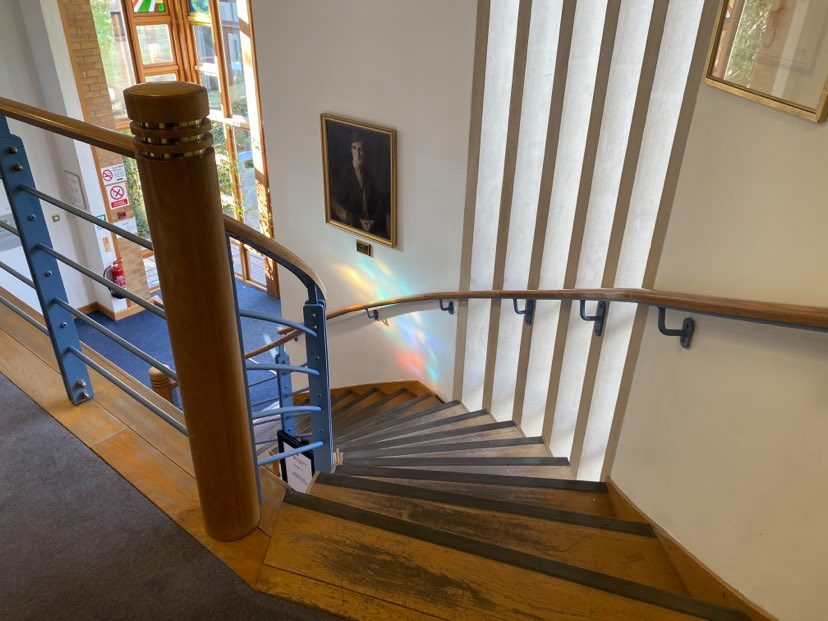
Sometimes a refracted rainbow graces the staircase as you leave the MOLT cinema auditorium at St. Anne’s.

The faith in cinematic wonder is a strange kind of faith, since it demands its disciples to abide by a sole, strict requirement: opening up to the possibilities of your feelings, and to strangers. Taking up the risk for the film to be underwhelming, or of enduring an annoying neighbour. In other words, it’s the only faith that doesn’t promise you any sacred land, but asks you to be a sensitive, appreciative traveller. The creed unravels through visual meditations, reimagining temporal and spatial coordinates. The experience of contemplation becomes on a par, and at times even superior to its object. “Whether I do or do not understand the film, ‘the eye licks it all up instantaneously’ all the same”, S. remarks, quoting Wolf’s[2] famous essay on cinema.

However, aesthetic solace is also to be found in observing the observing: G. loves witnessing how the film speaks to the ethereal space of the dark theatre, the relationships that it creates with the audience and intersubjectively, between the viewers viewing. In doing so, the audience becomes part of the sublime: “You didn’t write the film. But [..] you contribute to the story that we’re telling because suddenly when you hear this song, it’s your emotions, it’s your sensibility [..] you become a writer of the film and we’re writing it together”, recounts film director Xavier Dolan[3].

Hence, it is no mystery that philosopher Stanley Cavell[4] titled the first chapter of his systematic study of film, “An Autobiography of Companions”. In his introductory enquiry on the consciousness of film experience Cavell elevates empathetic engagement as a psycho-social condition inscribed in the very metaphysics of the filmic medium. Intentional and embodied sharing of intimacy makes the external forms of life of the screen personal, and the personal reactions external. A sense of community. “I’m at one with the audience”, all my friends have reported. 

Seen this way, the film theatre experience becomes the aesthetic offspring of the Ancient Greek storgé, the instinctive familial affection, but voluntarily gifted to strangers. But families need not be only metaphorical. Indeed, for P., going to the movies elicits childhood memories of joyful family gatherings, reunited for the occasion. At the end of his contribution, he also writes, somewhat furtively: “Now I bring to the cinema only “serious” dates”. It might be naïve, but since then I can’t help but asking whether he uses film theatres to see if his date would fit his picture of affective happiness. As for me, in the museum of loved paraphernalia, cinemas would not be an object. They would be the museum itself.


[1] Susan Sontag, “The Decay of Cinema”, New York Times, last modified Feb 25, 1996, https://archive.nytimes.com/www.nytimes.com/books/00/03/12/specials/sontag-cinema.html

[2] Virginia Wolf, ‘The Cinema’ in Selected Essays. ed. by David Bradshaw, New York, Oxford University Press, 2009, p. 172.

[3] Xavier Dolan, ‘Xavier Dolan on Blink-182, Bottoming, and Being the World’s Biggest Kate Winslet Fan’, last modified Dec 8, 2016, https://www.vulture.com/2016/12/xavier-dolan-on-his-new-film-critics-and-more.html

[4] Stanley Cavell, The world viewed: reflections on the ontology of film, New York, Viking Press, 1971, pp. ix, 9-12.

Friday Favourite: Crush

0

When I was a kid, I would re-read the books I found exciting, and which had characters I ‘got on with’ – a lot of Enid Blyton and Eva Ibbotson. The main reason I re-read things now is because I have to sit an exam on the text(s) in question; a process of revising plot and picking out quotes to memorise. It’s rare that I read anything twice for pleasure … yet, I’m not sure that pleasure is the reason I come back to Crush. I think I keep re-reading these poems because I’m still trying to understand them.

Crush won the Yale Series of Younger Poets award when it came out in 2004 and author Richard Siken was 37. The following year Siken received the Lambda Literary Award for Gay Men’s Poetry for it. It’s a small collection – the copy I have is 62 pages – but it’s not a light read. The 21 poems are dark in character and panicky in structure, falling somewhere between the dual meanings of “crush” as compression and as an infatuation. 

The opening poem is called ‘Scheherazade’, and its first lines do a good job of capturing the mood of the collection: “Tell me about the dream where we pull the bodies out of the lake / and dress them in warm clothes again.” The “Tell me” is a recurring phrase in this collection, reminiscent of the call for Scheherazade’s storytelling in One Thousand and One Nights. It’s also worth noting that many of the poems here have grown from the death of Siken’s boyfriend in the early 90s; sometimes they seem to be speaking to a ghost (or perhaps a body pulled from the late). Often it’s pretty explicit: the line “I don’t really blame you for being dead but you can’t have your sweater back”, from ‘Straw House, Straw Dog’, is typical in its black humour. In my personal favourite of these poems, ‘Seaside Improvisation’, Siken writes “You wanted happiness, I can’t blame you for that, / and maybe a mouth sounds idiotic when it blathers on about joy / but tell me / you love this, tell me you’re not miserable.” The frequent use of the second-person pronoun throughout these poems creates such a degree of intimacy that it almost feels as if you, the reader, are the lost lover. Line breaks that run all over the page present a visual version of Siken’s often highly intense tone.

It’s understandable if this isn’t sounding like the type of escapism you need right now; you may well feel plenty compressed already, and if mentions of mental ill-health, self-harm and suicide are triggers for you, I probably wouldn’t recommend this one. On the other hand, I’ve always found Crush a thought-provoking rather than depressing read. For me, its effects are comparable to being awake in the early hours of the morning, on your own; it feels a bit dangerous and difficult to decipher, but the emptiness also brings a form of peace. It’s not just about the crush, in whatever sense of the word, but also about the escape with it, the idea of calling on someone to take you away. To return to the story of Scheherazade, whose tales were designed to put off being killed by her husband, there’s a sense also of poetry for survival. Scheherazade succeeded and escaped her fate, so why can’t we?

The final line of the last poem in Crush, ‘Snow and Dirty Rain’, is “We are all going forward. None of us are going back.” Siken is clearly going through something in these poems, but in taking us on the journey with him he shows himself to ultimately come through it. I re-read these poems, still not fully understanding them – but I’m not sure they’re really meant to be understood. Their identity is so specific and intimate that their individual images are often elusive. As a whole, these are poems that are themselves still trying to work out how to talk about the loss of a person, how to cope in general, and how to keep going forward. If you’re going through something yourself – and who isn’t? – this collection may be the catharsis you need. 

Oxford Union falls short on Michaelmas reforms

0

Union staff have failed to complete diversity and equality training, and committee training in Hilary term was not attended by the full committee.

In Michaelmas, blind Ghanaian student Ebenezer Azamati was violently removed from the debating chamber of the Union, and had his membership temporarily revoked. This led to impeachment proceedings and the resignation of the President and subsequently, the Union implemented new standing orders for the training of staff and committee members.

Standing Order E15 states: “The President shall each term approach the University Training, Mentoring and Advisory Services to arrange for: a) An implicit bias workshop b) A race awareness workshop c) A disability awareness workshop to take place for all members of staff and committee.” These workshops, however, took place for students, but not staff, in Hilary term.

Staff training has not yet occurred, despite it being mandated by the standing orders. Rule 59.a, concerning staff, in particular staff supervision, states that “general oversight” for the Society’s staff lies with the Bursar, who is part of the Society’s permanent paid staff.

Training sessions for the student committee were held in first week of Hilary term, but were not attended by those who had “valid reason” (clarified in an announcement to committee as ‘a tutorial that can in no way be moved’). While there was supposed to be “another [session] for those members of committee who did not make the first one”, this session did not occur.

Sara Dube, the ex-President, told Cherwell: “Organizing the training was a priority for me in Michaelmas, after I brought the Standing Order change to TSC. I was well aware that everyone’s schedules would fill up quickly once term began, so wanted to get the training dates and times in as soon as possible.

“I booked two sessions for the first week of Hilary, one with the University Disability Advisory Service and one with OUSU, over six weeks in advance. I made it clear to committee that the training was compulsory, and was glad to see the majority of committee attend both sessions (those who couldn’t attend had an immovable academic commitment at the same time).

“When the possibility of arranging a second training came up in Access Committee a few weeks later, I agreed. However, the initial trainings were booked over six weeks in advance and it wasn’t possible to find a suitable date for us until the last couple of weeks of term. I suggested to Access Committee that it may be more practical to have the next session at the start of Trinity, and they agreed.

“To ensure ease of arrangement of training for all future Presidents, I left all correspondence regarding the arrangements on a folder in the President’s inbox.” 

In a comment to Cherwell, current Union President Mahi Joshi, said: “In accordance with the Standing Orders, all members of committee were required to attend two compulsory training sessions at the beginning of Hilary Term 2020. The first of these sessions covered Disability Awareness, facilitated by the University’s Disability Advisory Service, and the second was an Equality Training workshop, covering both race and disability awareness.

“A large proportion of the committee at the time attended, actively participated in and engaged with both of these training sessions. Since these sessions were organised by the President at the time, Sara Dube, with no record passed on to myself or the current committee, I am unable to provide exact attendance figures, or details of logistical arrangements.”

In relation to staff training Dube stated, “I booked both training sessions with the intention of them being held for both staff and committee. Before the first of the sessions, myself and the Head of the Disability Advisory Service (who was running the session) were informed that the staff already had access to online training covering the areas of both the scheduled sessions, which would be completed.”

Joshi said, “It is my understanding that staff training was to take place in Week 8 of Hilary Term, but could not, due to changes to staff schedules resulting from the COVID-19 crisis, to which the Union was having to adapt.”

She added, “The training was to take place online, and the provider had beenidentified by the member of staff in chargeof overseeing it. I am told that, due to the frequent turnover of staff in the Union, the training was to be undertaken by members of staff once the shifts for TT20 had beenidentified.”

Some staff have been trained prior to Michaelmas, but exact numbers were unavailable. The Union was unable to comment on whether the security staff involved in events in Michaelmas had received training, due to it being an ‘ongoing disciplinary matter’.

In a Standing Committee meeting in first week of Trinity Term, after questions from the Access Officer about commitment to staff training, the Bursar stated that she was “still investigating it.”

Staff and committee for Trinity Term have not yet been trained, due to the closure of the Union as a result of the Covid-19 pandemic and ensuing lockdown restrictions. Staff have now been furloughed. 

In relation to the Union’s staff and their training Joshi stated: “The majority of the Union’s staff members work with us on a part-time basis, with wide-ranging hours. In order to work around this, provisions were being made for staff to partake in online training, which could be accessed in their own time, overcoming the logistical and contractual challenges of gathering all the staff in one place at any given time. The vast majority of the staff has since been furloughed due to the pandemic, naturally bringing opportunities for training to a halt.”

Concerning the future training of both student committee and paid staff, she said: “In spite of the unprecedented circumstances, the Union remains committed to training both its committee, and its staff. Had it not been for the pandemic, and had the Union continued to have in-person events, we would have ensured to train committee at the very beginning of term, before commencing their logistics, press and other term-time duties, which involve interacting with the membership, and members of the public. 

“However, given that no members of committee will be interacting with the membership this term, the Access Officer and myself have taken some time to research alternative sources of training to the University services, and have approached a few training companies to see what they might offer, and how this might suit us. We have also reached out to the Disability Advisory Service, and the Student Union, to check what they might be able to offer us remotely. We remain committed to ensuring that the requirements stipulated above are met by the conclusion of the term. 

“In Michaelmas Term 2020, when the Union will hopefully be in a position to resume in-person events, my successor will be committed to ensuring that the new committee is trained at the beginning of the term, before commencing their duties. We are also committed to ensuring that provisions for staff training are in place for when they return to work from furlough.”

Image credit to Kaihsu/ Wikimedia Commons

SIMONE, WHOSE HAIR IS THE WORLD

0

Once was a girl who so long lying slept
Into the pastures, and the roots beneath,
Her hair extended and became one with them
In its way.

Her golden plumage shivered to a mane
That grew the stalks and limbs of flowers and trees,
And mired the rivers and oceans with its weeds,
And scantily drew the fire-tufts of the arctic.

Where now it lasts there nestles a bird, or fox,
And berries loom; yet, should Simone asleep
Be found, and stirred, by a single man awake
Shall not she cease to live in that man’s mind,
And grow her hair from him into his works?