Saturday 9th May 2026
Blog Page 962

BREAKING: Shakira Martin is next NUS President

0

Shakira Martin has just been elected the next President of the national Union of Students, winning with first preference votes alone.

In the first round, Martin won 402 votes – 56% of the vote share. Malia Bouattia, who was running for re-election, won 235 votes and Tom Harwood, an NUS delegate from Durham University, received 35 votes.

She identifies herself as a black single mother from a working class family, and positioned herself as a centrist candidate. She is currently an NUS Vice President.

Following her election victory, she said: “I am honoured and humbled to have been elected as NUS’ National President. I take this as a vote of trust that our members believe I can lead our national movement to be the fighting and campaigning organisation we need it to be, representing the breadth of our diverse membership.

“Further Education made me who I am today and look forward to sharing stories of just how powerful all forms of education can be when we’re all given access to it. During my term in office I want to spend my time listening, learning and leading.”

Tom Harwood, whose candidacy has been the source of much controversy in recent weeks, told Cherwell: “”I am so proud of the role I have played in this election. Our campaign shifted the debate and helped set the course for what can be a more moderate union.”

Others reacted to the result on Twitter:

https://twitter.com/frankiehsimons/status/857189760506490880

An analysis of the campaign from Cherwell can be found here.

Malia Bouattia or Tom Harwood for NUS?

We need Malia, now more than ever, as a bold, principled leader – Aliya Yule

The year is 2009. The financial crisis looms large. Students are already at the razor edge of falling living standards, with Educational Maintenance Allowance to be decimated and tuition fees tripled. Students will soon become one of the groups worst-affected by austerity. Meanwhile, the National Union of Students abandons its free education policy, and openly criticises precarious academics on strike against pay cuts. It seems strange now to tell this story. Amid attacks on the ‘radical’ and ‘out-of-touch’ NUS, it’s easily forgotten that not so long ago, the NUS was not at the heart of a vibrant student movement. Instead it was an active opponent of student activism. It was then that Malia Bouattia and many others decided to organise and fight for a movement that stands up for all of us, as she narrates in her recent video.

We must not give up that fight now. This year, the NUS has been unapologetically bold, articulating students’ vision of the future when it is under threat. The Liber8 Campaign, launched by Malia, links up eight issues as broad as mental health, curriculum reform, and defending international students, to show how our institutions could provide a real, free, liberated education. And it has not just been all talk—I participated in workshops in the politics department this year using NUS resources, where we discussed how to rethink our stale pale male curricula. Oxford Migrant Solidarity organised a walk-out to stand up for migrants for #OneDayWithoutUs, an initiative supported and widely publicised by the NUS.

Last month, I attended a cross-sector national summit called ‘Trump, Brexit, and Beyond’, organised by Malia, to co-ordinate our struggles across and beyond the education sector. I went to workshops on combating anti-Semitism—held by UJS—to talking about gender oppression with organisers of the Women’s Strike and pro-choice campaigners in Ireland. Just after Malia won the election, I spoke on a Preventing PREVENT panel in Oxford with academics, trade unionists, anti-racist organisers, and NUS officials. We discussed how to oppose academic surveillance, which overwhelmingly targets Muslim students, and threatens our academic freedoms.

The previous NUS President, Meghan Dunn, was lukewarm in her opposition to PREVENT. Now, the NUS now leads the charge against it. After a campaign that emphasised the vital role a strong student movement must play in a world increasingly dominated by the right, Oxford overwhelmingly said Yes to NUS. There is still much work to be done to unite all of us, but this can only be done behind a bold vision for the future. And this last year has demonstrated a Malia-led NUS will empower students to make change from the ground up.

In the coming year, Brexit will threaten so much that we hold dear, from research funding to the security of international students. The choice couldn’t be clearer: it’s no to Brexiter Tom Harwood, who has no vision for our movement other than to trash it, and yes to anti-racism, free education, and student power. That’s why I’ll be voting to #ReElectMalia at this year’s NUS Conference.

Tom Harwood will focus on concrete issues and stay relevant – Daniel Villar

If you’re like the average student, you have not noticed that the National Union of Students, the body that is supposed to be representing all of you, is in the throes of an election for its presidency. Not only that, but that the election is between two dramatically opposed views as to the role of the NUS, between the scandal-plagued left-wing candidate Malia Bouattia, and the more conservative Tom Harwood.

Sadly it’s too late for the average student to have a say in the presidency of the NUS, since elections for the delegates who actually elect the NUS president occurred months ago. However, that shouldn’t stop all Oxonians from contacting their NUS delegates, and urging them to vote for Tom Harwood. At the beginning of this article I mentioned that Tom Harwood is the more conservative candidate: he did support Brexit after all, and is well known to frequent more right wing student Facebook groups like the Young Liberal Society. However, though I disagree with Harwood’s positions on most national political issues,I believe that he is absolutely right about the fact that for far too long the NUS has been controlled by a small cabal of activists who do not care about concrete student issues, and instead use our student union as a platform to grandstand about world events.

Perhaps the clearest example of the tendency of the NUS to focus on issues that do not pertain to students comes with its attitude towards Israel. Again and again the NUS has hounded the sole democracy in the Middle East, with many of its leading members, including Malia Bouattia, using the term Zionist as an insult. This has created a culture in the NUS which at the very least tolerates anti-Semitism, as the numerous scandals where Malia Bouattia has expressed anti-Semitic views has shown. That alone should be enough to disqualify her from getting the vote of anyone opposed to bigotry, but under Malia’s leadership the NUS has made itself even more irrelevant by focusing on issues like clapping at meetings and opposing police presence at pride marches, as opposed to concrete student issues. In addition to the fact that Harwood, unlike Bouattia, seems to want the NUS to focus primarily on its actual purpose, protecting student interests, and doesn’t have an history of antisemitism, he has the advantage of actually being a student.

That’s right: Malia Bouattia, the current president of the National Union of Students, isn’t a student. Indeed, she has been out of university education for nearly a decade; how she has managed to remain in the student movement well after leaving the period of her life where she is a student is a mystery to me, but it seems almost commonsensical that the leadership of the National Union of Students should be made up of students, and Harwood is the sole current student standing for the presidency of the NUS. I have my problems with Tom Harwood: he is not the ideal candidate. But at the moment he is the sole candidate standing that has the ability to shock the NUS into a semblance of relevance, and make it do its job, representing the interests of all students, not just a small cabal of activists who alienate the vast majority of students in the UK.

Oxford poet wins prestigious award

0

Poet and director of Oxford Business College Dr Padmesh Gupta is to receive the Padmabhushan Moturi Satyanarayan Award for his poems written in Hindi.

Dr Gupta said: “It was a great honour when I found out. My poetry touches base with simpler life and smaller incidents, which I pick up on. Every day inspires me.

I feel that people living outside India, when they write in Indian languages, bring that culture and literature to so many people.”

The award is similar to the Order of the British Empire, and recognises exceptional contribution to Indian literature. It is part of the Hindi Sevi Samman Awards which are given for the promotion of Hindi abroad.

Dr Gupta, who also owns Eurobar on George Street, has lived in Oxford since 2006. He has been writing poetry for more than 30 years, and has published and edited the Hindi magazine Purvai for 18 years.

He will receive the award along with one other non-resident Indian in May. The winners are awarded with a prize of around £7000, a citation and a shawl from President Pranab Mukherjee.

Week in Science: this week’s top talks

It’s never easy keeping up with all the events going around the University. With Week in Science, the Cherwell Science and Tech editors bring to your attention interesting talks around the city.

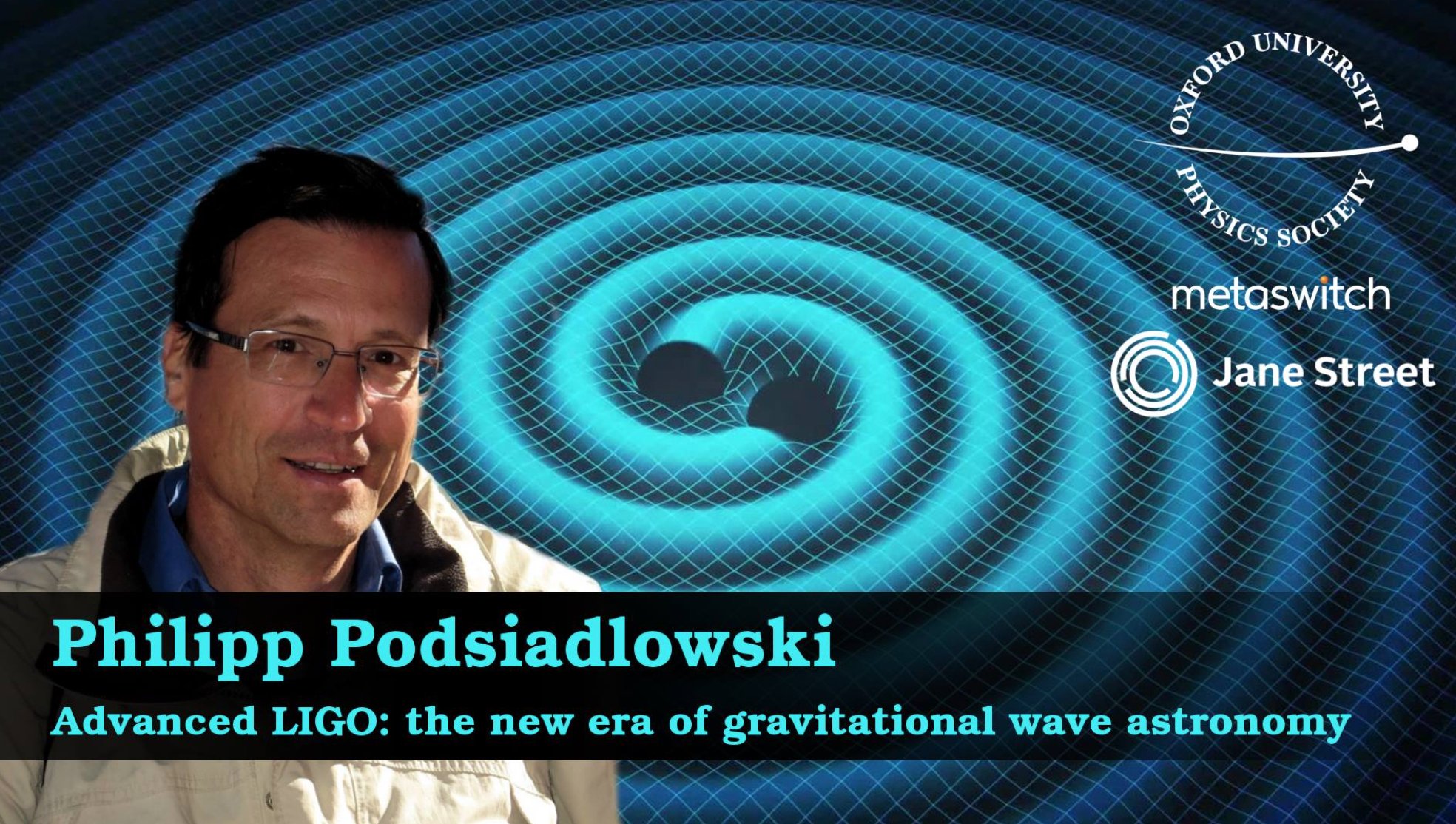
Advanced LIGO: the New Era of Gravitational Wave Astronomy
Presented by the Oxford University Physics Society

Source: Oxford Physics Society

Date and Time: 8.15pm Thursday 27 April
Location: Martin Wood Lecture Theatre, 20 Parks Rd, OX1 3PU

Speaker: Professor Philipp Podsiadlowski

Description: A year ago, the Advanced LIGO (aLIGO) gravitational-wave detector reported the discovery of the first direct detection of gravitational waves confirming Einstein’s Theory of General Relativity in its extreme limit. In this talk I will first discuss the importance of gravitational waves for fundamental physics and the main sources aLIGO is expected to detect. I will then focus on the discoveries over the last year. All sources of these gravitational waves detected so far were caused by the merging of two massive stellar-mass black holes. I will then outline some of the astrophysical channels by which such systems can form and provide an outlook for what can be expected once aLIGO has achieved its design sensitivity.

Entry: £3 for non-members. Free for members (membership is £10, and for life).

Brain ageing: using neuro-imaging to understand risk for and resilience against dementia
Presented by the Oxford Institute of Population Ageing

Source: Oxford Institute of Ageing

Date and Time: 14:00 – 15.30pm Thursday 27 April
Location: Oxford Institute of Population Ageing, 66 Banbury Rd, OX2 6PR.

Speaker: Professor Clare Mackay

Description: Brain imaging plays an increasingly important role in experimental medicine for dementia by providing biomarkers for diagnosis, prognosis, patient stratification and monitoring treatment response. Imaging can also provide insights into mechanisms of risk and resilience for neurodegeneration. The Translational Neuroimaging Group investigate brain ageing in both health and disease. We have demonstrated that people at increased risk of later developing Alzheimer’s and Parkinson’s disease have particular ‘signatures’ of brain activity. I will introduce some of the methodology and describe how the techniques are being used to improve our understanding of brain ageing. 

Entry: Free


Interested in getting your society’s event listed here?
Email
[email protected]

“Sharp humour with profound philosophical underpinnings”

Patriarch and architect Hector Blavatsky lives with his family on the 25th floor of a tower block designed by himself. Apart from the eldest sister, the Blavatskys never leave their home. One day, the arrival of an outsider in the form of a doctor upsets the family’s unusual idyll.

Summarised in just a few sentences, the plot to Moira Buffini’s Blavatsky’s Tower nonetheless reveals its unique potential for suspense. This tantalisingly short synopsis, however, cannot do justice to the play’s ambitious thematic range, its admixture of a sharp sense of humour with profound philosophical underpinnings.

The play dramatizes the tensions that exist between the outer and inner worlds of the self; the intruding doctor, played by John Livesey, represents external society’s scientific and logical attitude, while the family members, several of whom experience visions of angels, are more in touch with the spiritual side of existence.

Playgoers interested in absurdist or existentialist theatre will find plenty to think about in Buffini’s play. By refusing the comforts of the outside world, Hector is said to have ‘devoted his life to suffering’, while his son Roland spends his days trying to ‘cope with the fact that the human race is an evolutionary failure’. The play does not commit the mistake of taking itself too seriously, however, and this pessimism is often comedic in its mundanity. The family’s refusal to use the lift instead of the stairs, part of their self-professed ‘responsibility to endure’, is a homespun parody on the lofty theme of penitence. But the Blavatskys’ determination to suffer comes at a huge cost, and the play bravely confronts the question of whether it is possible to live in constant darkness without succumbing to despair.

Opposed to this awareness lies the possibility of suppressing the suffering through convention: ‘routine is a great anaesthetic’, as Roland puts it. This line is a variation on Vladimir’s famous ‘habit is a great deadener’ in Waiting for Godot: Beckett’s influence is indeed pervasive throughout play. Nowhere is this clearer than in the character of Hector, the dominating but dying father who closely resembles Hamm in End Game. Both are blind, immobilised, and nearing death: both dominate while remaining dependent. Hector’s attempt at retaining authority appears in one scene as he orders Roland to kneel and proceeds to palpitate his son’s trembling face; his vulnerability is revealed a moment later when he pleads: ‘forgive me’.

The pace is fast and engaging throughout, the dramatic tension sustained by the ever-shifting balance of power relationships that the characters are involved in. The audience sees characters aspire for dominance at one moment, only to be pulled down by their vulnerabilities at the next. Madeleine Pollard displays both this authority and weakness in her convincing portrayal of eldest sibling Audrey Blavatsky. Proud of her role as the family’s breadwinner, and empowered by being their only member with access to the outside world, Audrey at first appears to be the most ‘normal’ of the group. As the play progresses, however, her own insecurities emerge, and her frustration at being unable to assume a position of authority threatens to break into violence.

Director Philippa Lawford’s production boasts several other strong performances. Marcus Knight-Adams is appropriately neurotic as Roland, combining a disturbing childish petulance with a savage sense of humour. He is forever writhing around the stage, tearing at his shirt and biting his nails in a realistic portrayal of a tortured yet sensitive mind. Louisa Iselin also impresses as youngest sister Ingrid: she succeeds in endowing her character, seemingly the most vulnerable and innocent in the play, with a steely and manipulative edge.

This rendition of Blavatsky’s Tower managed to excite and disturb even in the brightly lit Regent’s Park College rehearsal room, with the actors lacking costumes and props. This suggests both that meta-theatricality is an important dimension to Lawford’s direction, with the characters being literally bounded by the stage/house which they cannot escape, and that the actual production, which takes place next week at the Michael Pilch Studio, is one that will stay with the audience for a long time.

Blavatsky’s Tower will show at The Michael Pilch Studio, 26-29 April (Wednesday to Saturday of 1st Week). Tickets are £7 for students.

Slow start for England’s IPL stars

0

T20 cricket’s showpiece tournament, the Indian Premier League, is back for a tenth edition, and this year involves a record number of English players.

However, a week into the tournament, the Englishmen have underwhelmed.

After he broke the record for the most expensive international signing ever at the auction back in February, Ben Stokes has been under immense pressure to perform in his opening three games. The £1.7 million-man’s bowling has failed to impress: bowling the 20th over against the Delhi Daredevils, he was dispatched for 23 runs by the South African Chris Morris in a performance that seemed like a horrible throwback to his infamous final over of the World T20 final last year. With the bat, a well-made 50 on Saturday was a timely reminder of his undisputed talent.

After a series of mightily impressive performances in the Test arena, Kolkata Knight Riders’ Chris Woakes has found the transition to limited overs cricket challenging. He recently confessed that he must improve his bowling at the back end of the innings, and after a solid start, he will improve as the tournament progresses and he begins to find his rhythm.

Jos Buttler returned to the IPL as one of the few English players to have taken part last season. He has found himself in an entirely new role however, opening the batting for Mumbai Indians. But he has flourished in that position, hitting his highest Twenty20 score of 77 on Thursday off just 37 balls. Indeed, it would be silly to bet against Buttler bettering that before the tournament is out.

Injury to South African superstar Quinton de Kock presented Sam Billings with an opportunity to impress for Delhi. He has got his side off to some quick starts so far with breezy knocks of 24 and 25, but his side’s overall IPL record is so poor that he may be the victim of restructuring in the side as the tournament goes on.

Meanwhile, Jason Roy and Tymal Mills have already been dropped by their franchises after playing in their sides’ opening games. After signing for £1.4 million, left-armer Mills would have been hoping for a better return than his three wickets so far, and with stand-in Royal Challengers skipper Shane Watson using him ineffectively, he was left out of the side to face Stokes’ Pune on Sunday. Roy, meanwhile, has failed to score heavily, and bizarrely went in at number six against Mumbai.

Finally, both Eoin Morgan and Chris Jordan have failed to play a game for their sides: time will tell if they would have been better off honing their red-ball skills in county cricket.

The twin trends of remake-mania and sequelitis

0

With cinema-goers being treated to at least 40 sequels and remakes this year, it is evident that money talks louder than creativity. But a continuation of a pre-existing timeline is likely more insidious than an attempt to restart it.

The late critic Roger Ebert noted “no movie executive has ever been fired for green-lighting a sequel,” as the average sequel rakes in eight times the box office earnings of an original.

Such good odds of financial success make them safe bets, but ‘safe’ sequels are essentially repeats—they rely on similar plots and similar jokes, all resulting in two hours of formulaic nostalgia. Think about Transformers or Independence Day: Resurgence if you need any proof of that.

Obviously, there are exceptions, the Star Wars of the world, but they’re rarely sequels: they’re sagas, where a story has been developed before the first installment even hits the screen, often adapted from already successful books or comics.

Remakes have greater creative potential, but also present a larger risk of being soul-crushingly awful. Remaking something just because it was popular is a safe way of manufacturing garbage, à la 2016’s Ben-Hur and Point Break.

There is nothing creative about merely modernising an existing story, or even just its visual effects, such a waste of time often highlighting why the original is so admired. Instead, a good remake needs to have a reason, and be taken as an opportunity to do something different with the property.

John Carpenter’s 1982 remake of The Thing worked because it focused on different elements of its short story source material to the 1951 original; the 2011 version, which at times plays like a shot-for-shot remake of Carpenter’s masterpiece, was unsurprisingly a critical and commercial flop. There is no excuse for such lazy filmmaking.

This idea applies to both types of film. If you don’t understand the appeal of the movie you are remaking, or are just a studio stooge airdropped in to fast-track a sequel, then even attempting something different loses all meaning. Real success comes from the passion behind a project, resulting in something that both resonates with and excites fans.

It won’t work out every time; the commendable attempt at an all-female Ghostbusters remake suffered more from terrible writing than from being a careless cash-grab. But such misfires are a world away from the terrors of Zoolander 2 and Ice Age 5 which seemingly exist only to prove the existence of the creative vacuum currently enveloping Hollywood.

On That Point: Hitchens and Chechnya

0

Mrs May’s election ethos has one enormous Hitch

It is an unfortunate fact of political life that those you feel are best placed to respond to political events are often long deceased before they occur. With a snap election approaching, I feel this most keenly when thinking of Christopher Hitchens, a man without whom the journalistic and literary community, and the world of politics, has been made immeasurably poorer.

If Hitchens were alive today, I think he’d be one of the few people to get to the core of the great fallacy surrounding May’s reasoning in this election, because what May has claimed she is seeking is the pursuit of a political culture Hitchens raged against for his entire life—that of the construction of the tedium of ‘consensus’ politics.

When Mrs May said: “At this moment of enormous national significance, there should be unity here in Westminster, but instead there is division. The country is coming together, but Westminster is not,” Mr Hitchens would have quickly pointed out that she was, at best, displaying a woeful misunderstanding of how the British parliamentary system operates, and, at worst, being deliberately deceitful, in an attempt to diminish Parliament’s power to scrutinise the government over Brexit. As Mrs May is not a cretin, I believe the latter is more probable.

Mrs May has sought to spread a mistruth that would have Churchill and Thatcher cringing. When Hitchens used to appear on C-SPAN in the 1990s (and I know this because I’ve actually watched them), he would always question why people thought that ‘consensus politics’ was such a grand idea, when, in fact, it represented nothing more than tepid acquiescence. That is what May is demanding that Parliament becomes now: a servile arm of Her Majesty’s Government with no power to infringe on Downing Street’s plan for Brexit, about which we are still being kept blissfully unaware.

When Mrs May stands at the despatch box for PMQs, does she not realise how all of the opposing parties are deliberately made to sit opposite her? Is it not obvious, being the Prime Minister, how British politics is supposed to operate? It is confrontational, it is fierce, it is deadly. The Prime Minister may not like it, but that is simply the way it is, with vapid ‘consensus’ flung out of Westminster to be crushed by passers-by on the streets of Whitehall.

Hitchens missed Trump, Brexit, Corbyn, Syria, and Mrs May and her government. But one thing is for sure—the Hitch would have smelled bullshit over the moralistic farce that is May’s election, and we should too. So call out Mrs May’s supposed reasoning behind this poll for what it truly is: an archaic and deceitful ruse to bludgeon Parliament into accepting her government’s hollow Brexit, before she is eventually set upon by a despairing British public.

We should export some British values to Chechnya

Britain never had any issues in the past with exporting our views on homosexuality across our empire. Pink News recently reported that, on the celebration of the 40th ‘Commonwealth Day’, more than one billion people are still living under anti-gay relics of colonial law, blighting the lives of millions of LGBT+ people across the world. This is one part of our colonial past which has been exported to devastatingly great effect. This legacy should weigh on our minds when we consider what we can do to deliver the values that Britain stands for today to the oppressed gay community of Chechnya, which is, quite simply, facing extinction.

If I lived in Chechnya today, it’s rather likely I wouldn’t have long to live, either killed by my own family or gangs of thugs. I cannot imagine how scared I would be, that fear of being captured, tortured, and erased. But I am fortunate, because my British citizenship means I can enjoy the freedoms our democracy and liberal values provide. But the young gay men persecuted in Chechnya have no such freedoms, and there seems to be no end to the terror they are enduring. Our preoccupation should be how Britain can be most impactful in minimising the horror, in an attempt to do anything before we must all bear the moral burden of our nation, having just stood by whilst crimes against humanity were committed.

Britain should not just be a bastion for equality within its own borders, for the rights of a gay man in Chechnya are no less valuable than mine. Whilst I would not be so naïve as to suggest anything similar in this instance, Britain has had no qualms in the past about liberating oppressed peoples, such as in Kosovo and Sierra Leone. Today, with Trump in the White House, we certainly cannot rely on the United States to intervene on our behalf. We shall simply have to get on with doing things ourselves. And, although you may call me a pessimist, our government is the only entity capable of changing anything. By all means continue with your Change.org petitions and protests—it is a noble thing to do—but unfortunately I don’t think anyone in Chechnya is listening.

It is obvious what is required of our government: it must ensure that we are the first nation to offer full asylum to all gay men fleeing Chechnya. And, to make up for its previous sins, offer the same sanctuary to gay men escaping the beheadings and hangings they face in Saudi Arabia, which are, of course, carried out by a regime of which Mrs May is such a nauseatingly firm supporter.

Although Boris Johnson and ministers in parliament have condemned the Chechnyan authorities, words do not prevent torture, beatings, and murder. Action does. Britain must be clear: if the gay community is not welcome in Chechnya, we will have them, and we will be proud to have them, and I am in no doubt that these people have immeasurable talent which can be used to improve British society.

So let us begin to make amends for the actions of our forbearers, and be the strong, progressive, and morally righteous country every Briton thinks we should be, and offer a new home to the oppressed gay community of Chechnya, before it is too late.


Nature fights back in the Korean DMZ

Almost 250 kilometres in length, four kilometres in width, and bristling with weaponry on either side, the Korean De-militarized Zone (DMZ) marks the uneasy border between North and South Korea. This narrow strip of land encompassed by barbed wire and dotted with landmines is for all intents and purposes devoid of human life. It is not, however, the barren warzone that one might imagine; the soldiers patrolling its borders are serenaded by the calls of a plethora of rare bird species sparse elsewhere in the region, while rumours abound of the ghostly roars of long lost apex-predators. In the absence of human activity, nature has healed its wounds and fought back to turn the DMZ into an ecological paradise.

The DMZ was created in 1953 as an attempt to maintain an armistice between the two warring Koreas. Much of the peninsula had been ravaged by intensive agriculture, industrialisation and military movements—a study in 1994 revealed the dire truth: nearly half of the peninsula’s mammals, reptiles and amphibians were endangered. However, since the establishment of the DMZ, the lack of human activity has produced the perfect conditions for wildlife to regain territory and flourish in this unlikely safe haven, becoming one of the best-preserved habitats in the world.

Being long and narrow aids the DMZ’s bio-diversity by stretching across a wide range of habitats. Such diversity allows the region to provide for a huge range of rare species from across the animal, plant and fungal kingdoms. An important symbol of Asian artistic culture, the red-crowned crane is just one of the species that has gained a foothold within the DMZ, seemingly halting its downward spiral to extinction in the region, while the critically endangered Asian Black Bear has managed to evade persecution for their fur and gall bladders, used in traditional Chinese medicine. There are even reports of the elusive Amur leopard and Siberian tiger inhabiting the region, though these remain unconfirmed.

In total, 2900 plant species, 70 types of mammals and 320 species of birds have been identified by ecologists as finding refuge from the destructive influences of man in the DMZ.

However, the future of this biological utopia is far from assured; the Koreas are still technically at war and the armistice in place is far from stable, with both sides consistently antagonising the other. There have been numerous incursions by both sides into the DMZ, resulting in the deaths of more than 700 soldiers. Since 1974 South Korea has discovered four tunnels spanning the entire DMZ, through which they believe the North could be planning to invade. Lying between two heavily armed nations, the future of wildlife in the area is uncertain in the event of the outbreak of war, although it is not hard to imagine the repercussions of a major conflict complete—complete destruction.

Even the agreement of a lasting peace on the Korean peninsula does not guarantee the ecology of this unique area, as there would be no need for this strip to continue in its current undisturbed state. South Korea has expressed interest in establishing the area as a UNESCO Biosphere Reserve but such moves have been met with opposition from the North. However, there is hope. Two projects attempting to safeguard the biodiversity have proven successful. Both have established large conservation areas in key resting grounds for over 1000 white-naped and red-crowned cranes. These projects bring together scientists from both sides of the wire, a rare example of placing hostilities aside in pursuit of conservation, perhaps a shred of hope for a better future for the unsettled region.

But in the short term, the continuance of the uneasy armistice ironically appears to be the best chance for the multitude of animals that rely on the DMZ as an island of protection against the rising tide of human in influence that threatens to submerge the world.

UK should follow Canada’s cannabis lead

0

Now, I’ve never been a ‘stoner’, but I can’t help but notice that, following the example set by US states such as California and Colorado, Canada has decided to legalise marijuana for recreational use. I think it’s time Britain followed suit.

I see cannabis legalisation as one of those issues where it’s ‘only a matter of time’ before popular support for such a move forces the government into action. Rather than wait for its hand to be forced (by a petition etc.), this government should take the initiative (and take cues from other countries and states that have already legalised cannabis usage). We live in a country where drugs which kill a great many—be they alcohol or tobacco—are perfectly legal to buy. Why is it that we balk at the idea that cannabis could be in the same category as these other drugs which have been legal for time immemorial? Because, the fact of the matter is, were these other drugs discovered tomorrow, there is not a chance they’d be as easily available as they are—in fact it’s easy to imagine such things being totally banned on health grounds, given the sheer number of things which are prohibited. Drugs will always have a presence in our society, but we have the power to influence this presence.

As the Americans discovered in the 1920s with Prohibition, criminalising something only spurs those black marketers who seek to capitalise on supplying such things illegally. With legalisation, we can do much to supply this demand, and determine the strength of the marijuana on sale, as well as investing the money such legalisation may raise into the NHS, because cannabis would surely incur far lower spending than drugs and alcohol do currently—given that there are seldom very few examples of deaths from it. Drugs have the potential to do an inordinate amount of damage to our society, but this damage is largely down to the warped and mutated varieties of drugs that end up in circulation. It’s true that cannabis (in the mutated form of skunk) can act as a gateway drug to stronger and nastier drugs such as cocaine and heroin. I think we have a duty to control the flow of cannabis and shape the strains that are available, rather than trying to stem the ultimately incessant supply of whatever form of marijuana drug-dealers formulate next, this we can do.

Several American states, as well as Canada, Portugal, Uruguay, and other nations such as the Netherlands have already taken this step before us—there are clear blueprints and roadmaps for Britain to follow if we are to legalise marijuana and follow Canada and four US states. It has been estimated that Canada could generate more than £2 billion in tax revenue from a legal cannabis trade. Surely it is better for the government, rather than gangs, to have a monopoly on the supply of marijuana and its profits? More than anything else, we must end the inconsistencies in our drugs policies. Alcohol and tobacco are legal and more or less ubiquitous in our society in terms of accessibility and availability—the same being true even of solvents.

If all these things can be legal and readily available to us, then why not cannabis? Just as alcohol and tobacco have become assimilated so easily into our society, so too could cannabis. The drug (in a state-controlled form less harmful than stronger versions such as ‘skunk’) could be bought in the same way we buy tobacco. We live in a very turbulent age: of this we can be in no doubt. Vexed questions such as Brexit negotiation and legislation, and of war with North Korea, pervade our society, and too often rob us of the sleep we need at night. Rather than have our days be dogged by these dilemmas (and their attendant difficulties), let us conquer them with cannabis. Even though the road ahead is long and arduous, there does exist a drug that could be of use to us in these trying times. So let us legislate legalisation in our nation, the legalisation of marijuana.