

Blog Page 991

Interview: A.C. Grayling

0

The adjective ‘professorial’ might have been derived from Latin just to give A.C. Grayling a category to belong to. He seems plucked from an earlier time, one where scholarly contemplation had less to compete with in the rivalry for human attentions.

All this is borne out in his distinctive style, the delicate glasses, his nimble conversation, and the unmistakable mane of silver hair. The hair most of all, I suppose. I wonder if he’s ever thought of getting the hair insured. “Do you know what, you’re the first person in my entire life who’s ever suggested such a thing.” He laughs at length. “No, no. You’ve put a new idea into my head. I had never thought of this before.”

The hair aside—or brushed back to be accurate—Grayling is probably most widely known as one of the chief figures among the New Atheists. Along with friends and lauded horsemen of the movement like Richard Dawkins and Christopher Hitchens, he has spilt his fair share of ink in the rail against God and organised religion. He seems to go about it though, I put it to him, in a decidedly different way from his rather more fire-breathing partners on the podium.

“Somebody once, to my immense pleasure, described me as a velvet atheist, or the velvet atheist”, he confesses. But he is keen too to emphasize his deep solidarity with his brothers in arms. “I wholeheartedly agree with Christopher Hitchens and Richard Dawkins, but I try to present the argument in a way which is in a slightly different decibel level and a slightly different key.

“The one thing I add, which my colleagues don’t concentrate on so much is this: people say ‘if you don’t have a religion then how are you going to make sense of life?’. My argument is that there is an incredibly rich and profound tradition of ethical thought flowing from classical antiquity, from the Socratic challenge to ask the question, what sort of person should I be and how should I live. And this great tradition in ethics provides us with lots of routes into thinking about what we owe our fellows in the human story.”

I wonder whether he perceives that the movement, which emerged out of the rubble and dust of the World Trade Centre, has experienced a slow contraction, or been quietly intellectually deprioritised, perhaps given the assault today that seems to be coming from avenues other than religion. “I don’t think that it’s over”, he considers, “but I think it’s moving into a new phase.

“If I were to give you a parallel: imagine when in a rugby match, you know when there’s a tackle and the ball-carrier is brought to ground and a maul forms around him, and the backs sort of line up and get ready for the ball to come out for another attack.” I try to grunt in recognition, wondering how things got so out of hand.

“Well I think this debate is just at the point where the scrum-half is waiting for the ball to come out of the back of the maul.” I offer a noise which is meant to be agreement, but probably sounds more like the anguish of an interviewer trying to get to grips with a sporting metaphor.

Thankfully, Grayling continues. “The American Atheist Association has adopted a really interesting tactic which is the gay tactic—‘I’m gay, and I’m out, and I’m proud’—they say, ‘I’m an atheist, I’m out and I’m proud about it’. To this day in the United States of America there are many places in the Midwest and the South where, if you say you’re an atheist you don’t get a job, you can’t sell your products, people won’t come to your shop. But this movement of saying I’m out and proud about being an atheist is little by little beginning to make a difference—more people are able to come out the atheist closet.”

Grayling gives example to a certain philosophic persona, or rather a sensibility, outnumbered in the tradition, perhaps, but a persistent feature of its history—in which philosophy has a decidedly practical aspect, as well as a theoretic interest. And he seems to have made it his life’s project to pursue both—as at ease in the public square as the armchair.

He studied philosophy in its “golden age” at Oxford, and was taught by A.J. Ayer and Peter Strawson. “I think philosophy at Oxford is very strong still. I mean, it’s one of the greatest centres of philosophy in the world.” Nevertheless the subject does seem to suffer from something of a public image problem, perhaps due to its absorption into the academy and the resultant specialisation that leaves it regarded as either faintly forbidding or excessively trivial. But as Grayling sees it, even the rather austere forms of analytic philosophy practiced here at Oxford have a special contribution to make to public life.

“The scrupulousness and the rigour of philosophical analysis is needed now more than ever. When you think about what’s in play when you are thinking about concepts like necessity and truth and meaning and the rest, what you’re having to do is dismantle the really important concepts to try and get at the structure, to try and get at its implications, which means that you can’t fudge matters.

“You can’t go for the kinds of explanations or viewpoints that are emotionally driven or have a political drive behind them.”

Is the contemporary philosopher guilty of being too inward-looking, then? Is it not fair to ask them to follow Grayling in confronting the public with his subject matter? “Well a great philosophical answer coming up now: yes and no”, he chuckles. “Anybody who has the interest and the ability to communicate these ideas really ought to do it. It’s a kind of obligation we have, so that we can pay back the opportunity that we got from having a wonderful education.”

But there are other ways to be useful. “Think of a Formula One racing team.” (I concentrate). “You need somebody who can tune the engine, somebody who can work on the suspension, and not just the person who’s going to be driving it around the track.

“So it can be that there will be great contributions made by people who just work away in the ivory tower: I think Derek Parfit—the late, so much lamented, Derek Parfit—is a wonderful case in point.

“He was very, very much somebody who worked on the technicalities, but in a pretty remarkable way, which will without any question impact the way people do things out there in the world.”

Grayling has hardly shied from turning his clear-sighted gaze to political events of late. He described the Leave campaign as “a big con”, and seems to think the coming general election is more of the same.

“Really our situation in the UK at the moment is pretty bloody poor, if you’ll excuse the French.” He argues that the Leave campaign exploited numerous “small constituencies of disgruntlement, or disbelief, or sense of exclusion or something, and those different constituencies were aggregated together on the basis of some absolutely scandalous falsehoods and distortions and false promises.

“And the thing that is really shocking about this is that the referendum was sold as advisory only, and so in Parliament there was no need to ask for a supermajority bar, and there was no built-in protections against anybody thinking that a mere 37 per cent of the electorate—and by the way it was a restricted electorate—that a mere 37 per cent of that electorate could be regarded as mandating exit from the European Union.

“This is another act of dishonesty which is tantamount, really, to a kind of coup.”

“Really as a direct result of the Brexit-Trump phenomena, in an act of white heat, I’ve written yet another book, I’m sorry to say”, his mood lightening.

“I argue that representative democracy of the kind that we are meant to have in the UK and the US and most advanced democracies is actually the best solution. I mean you’ll know, you’re a philosophy undergraduate right?” Yes. “So you’ll remember what Plato says in book seven of The Republic”, he hurries along. Hmm, I assent, using my best tutorial nod.

“Well [Plato’s] problem about how you make democracy work without collapsing into mob rule was solved really by Montesquieu, James Madison, de Tocqueville, and Mill, by setting up this idea that a representative democracy would provide a kind of filter where you could get popular consent to sound and stable government, but you would get sound and stable government because you would have representatives.

“People ought to understand what they’re doing when they vote in a representative democracy, that they’re not sending messenger boys and girls to Parliament, they’re sending people there to get the facts, to listen to the arguments, to make a judgment, and act in the best interests of the country.”

One thing that Grayling feels has to go is the party disciplinary system: “MPs should be independent in every respect other than the party manifesto pledges, and they shouldn’t be allowed to be whipped”, a practice that he deems to constitute an unacceptable throwback deriving from the Palace of Westminster’s anomalous legal status.

There is throughout our conversation a sense of Grayling’s urge to confront public life in its endless churn and see if philosophical thought cannot add some light. To be concerned with public understanding at the moment must be a fairly dispiriting enterprise, though, and it is impressive, and somewhat inexplicable, that Grayling can keep at it with such characteristic vigour.

He must be at least a closeted misanthrope, I comfort myself. One thinks of one of Grayling’s intellectual heroes, Bertrand Russell, and his phrase that most people would rather die than think, and as it turns out, most do.

How to avoid this paralysing realisation? “Well, what’s the alternative to optimism?”, Grayling protests, “I’d say the alternative to being optimistic is to find a high building and jump off it.”

Professor AC Grayling, philosopher and Master of New College of the Humanities, is speaking at Blackwell’s on Monday 1 May. Tickets available: https://www.eventbrite.co.uk/e/professor-a-c-grayling-on-war-tickets-30894266583 
Former US presidential candidate Bernie Sanders is coming to Oxford

0

The former US Presidential candidate Bernie Sanders is coming to Oxford for a book launch.

The US senator, who was beaten by Hillary Clinton for the Democrat nomination last year, will speak at the Sheldonian Theatre to promote the paperback edition of his bestselling book on his failed presidential bid.

The event will be chaired by Helena Kennedy, the Principal of Mansfield College.

Sanders is not new to Oxford, as his brother, Larry, lives in the East of the city. He ran as the Green Party candidate in last year’s by-election in David Cameron’s old seat of Witney, close to Oxford.

The talk is set to be held at 2.30pm and is titled ‘Our Revolution: A Future to Believe in’ – the slogan of his failed presidential bid. Tickets will cost £15.

Sanders was recently confirmed as one of this term’s speakers at the Cambridge Union. However, he did not feature in the Oxford Union’s Trinity term card, leaked exclusively by Cherwell last week.

The talk forms part of a wider literary event – The Hay Festival – to be held in Wales. Festival director Peter Florence is hopeful the left-winger will inspire students and young people attending.

He told the Oxford Mail: “What we hope from Bernie is that he’ll galvanize young people like he did in America. The way he’s working to interrogate every stupid bill in the Senate is heroic and essential. He’s a model opposition leader.”

Waterstones will be selling books after Sanders’ visit.

Tickets can be purchased at hayfestival.org or by calling 01497 822 629.

Cambridge beats Oxford in new university league table

0

Cambridge University has beaten Oxford to top the 2018 Complete University Guide rankings.

Cambridge kept its place at the top of the survey which it has held for the last seven years, scoring 1000 points to Oxford’s 998, which placed it second.

The rankings rate UK universities across a range of factors, including student satisfaction, research quality, and employment prospects.

Oxford was ranked above of Cambridge for research quality and student-staff ratio, but fell behind in entry standards and student satisfaction.

St Andrews University was placed third and London School of Economics fourth.

Suffolk, a new entry, was ranked last in a table of 129 universities.

Same theme, new style in ‘Better Call Saul’

0

Rifling through the filing cabinet of successful prequels, we might find such works as Shakespeare’s Richard II and Henry IV—either of which I would choose to see over his original Henry VI trilogy—or Rhys’ Wide Sargasso Sea, which serves as a post-colonial answer to Charlotte Brontë’s Jane Eyre.

But of course, the term is more often associated with the infamous Star Wars prequels, which are now widely scorned, and branded a disgrace to a venerable cinematic universe.

Coming off the back of Breaking Bad, arguably the greatest television drama ever to have been broadcast, the arrival of Better Call Saul, whose third series began last week, was a source of both excitement and apprehension.

The dilemma faced by a Breaking Bad prequel, despite the uniqueness of its predecessor, is generic enough: how do you offer viewers the opportunity to reconnect with the world and characters of the original series while ensuring that the prequel does not itself descend into vacuous, self-indulgent fan service, cynically milking the popularity of the parent programme?

Better Call Saul holds onto many of the signature stylistic elements of the original, including extensive use of flashbacks and flash-forwards, elaborate montages and symbolic music choices. Visually, however, the difference is striking: the colours and shots are generally far brighter, the sets and locations look cleaner, even glossier. Where Breaking Bad dealt in grit and grime, Better Call Saul deals in flamboyance and sparkle.

This is because the visual style of each show reflects the outlook of its central character. The very first scene of Better Call Saul, for instance, introduces us to Saul’s life after the events of Breaking Bad, in which he has become a low-level manager at a fast-food restaurant. At one point, he becomes afraid that he may have been recognised, his disguise blown. Crisis averted, he returns home and reflects upon his life before Walter White sent the entire thing careering off course.

The beauty of the scene exists not only in its nod towards continuity (Saul had joked about becoming “manager of a Cinnabon” in Breaking Bad) but also in the contrast with what came before. The viewer is jarred by the sheer banality of Saul’s life after the Earth-shattering drama that characterised Breaking Bad’s final episodes. The events that precede that series will also provide a stark contrast, albeit in a very different way.

Its pace and tone, too, differ from the original, with many viewers finding the show’s relatively slow pace off-putting. That, however, is the point. The ‘Jimmy McGill’ we are introduced to is not yet ‘Saul Goodman’ and, crucially, his metamorphosis must feel organic.

Better Call Saul is not simply a series of skittish side adventures (although comedy is an essential component of the show). We find Jimmy Not-Yet-Saul to be a complex character, morally ambiguous, but hardworking and willing to go to great, and sometimes unethical, lengths for those he cares about.

He is, for want of better terminology, pond-life, struggling to stay afloat. While certainly never being saccharine, Better Call Saul is at times moving, because the viewer is made to empathise deeply not only with Jimmy (to the extent that ‘Saul Goodman’ seems to be something of a façade) but with those around him as well.

Walter White’s maxim still applies: this show is “the study of change.” The overarching theme of both shows is the central character’s metamorphoses. But the show’s success at finding a new angle on the same core theme, whilst still being a worthy complement to the original series, more than justifies Better Call Saul’s existence.

BREAKING: Shakira Martin is next NUS President

0

Shakira Martin has just been elected the next President of the national Union of Students, winning with first preference votes alone.

In the first round, Martin won 402 votes – 56% of the vote share. Malia Bouattia, who was running for re-election, won 235 votes and Tom Harwood, an NUS delegate from Durham University, received 35 votes.

She identifies herself as a black single mother from a working class family, and positioned herself as a centrist candidate. She is currently an NUS Vice President.

Following her election victory, she said: “I am honoured and humbled to have been elected as NUS’ National President. I take this as a vote of trust that our members believe I can lead our national movement to be the fighting and campaigning organisation we need it to be, representing the breadth of our diverse membership.

“Further Education made me who I am today and look forward to sharing stories of just how powerful all forms of education can be when we’re all given access to it. During my term in office I want to spend my time listening, learning and leading.”

Tom Harwood, whose candidacy has been the source of much controversy in recent weeks, told Cherwell: “”I am so proud of the role I have played in this election. Our campaign shifted the debate and helped set the course for what can be a more moderate union.”

Others reacted to the result on Twitter:

https://twitter.com/frankiehsimons/status/857189760506490880

An analysis of the campaign from Cherwell can be found here.

Malia Bouattia or Tom Harwood for NUS?

We need Malia, now more than ever, as a bold, principled leader – Aliya Yule

The year is 2009. The financial crisis looms large. Students are already at the razor edge of falling living standards, with Educational Maintenance Allowance to be decimated and tuition fees tripled. Students will soon become one of the groups worst-affected by austerity. Meanwhile, the National Union of Students abandons its free education policy, and openly criticises precarious academics on strike against pay cuts. It seems strange now to tell this story. Amid attacks on the ‘radical’ and ‘out-of-touch’ NUS, it’s easily forgotten that not so long ago, the NUS was not at the heart of a vibrant student movement. Instead it was an active opponent of student activism. It was then that Malia Bouattia and many others decided to organise and fight for a movement that stands up for all of us, as she narrates in her recent video.

We must not give up that fight now. This year, the NUS has been unapologetically bold, articulating students’ vision of the future when it is under threat. The Liber8 Campaign, launched by Malia, links up eight issues as broad as mental health, curriculum reform, and defending international students, to show how our institutions could provide a real, free, liberated education. And it has not just been all talk—I participated in workshops in the politics department this year using NUS resources, where we discussed how to rethink our stale pale male curricula. Oxford Migrant Solidarity organised a walk-out to stand up for migrants for #OneDayWithoutUs, an initiative supported and widely publicised by the NUS.

Last month, I attended a cross-sector national summit called ‘Trump, Brexit, and Beyond’, organised by Malia, to co-ordinate our struggles across and beyond the education sector. I went to workshops on combating anti-Semitism—held by UJS—to talking about gender oppression with organisers of the Women’s Strike and pro-choice campaigners in Ireland. Just after Malia won the election, I spoke on a Preventing PREVENT panel in Oxford with academics, trade unionists, anti-racist organisers, and NUS officials. We discussed how to oppose academic surveillance, which overwhelmingly targets Muslim students, and threatens our academic freedoms.

The previous NUS President, Meghan Dunn, was lukewarm in her opposition to PREVENT. Now, the NUS now leads the charge against it. After a campaign that emphasised the vital role a strong student movement must play in a world increasingly dominated by the right, Oxford overwhelmingly said Yes to NUS. There is still much work to be done to unite all of us, but this can only be done behind a bold vision for the future. And this last year has demonstrated a Malia-led NUS will empower students to make change from the ground up.

In the coming year, Brexit will threaten so much that we hold dear, from research funding to the security of international students. The choice couldn’t be clearer: it’s no to Brexiter Tom Harwood, who has no vision for our movement other than to trash it, and yes to anti-racism, free education, and student power. That’s why I’ll be voting to #ReElectMalia at this year’s NUS Conference.

Tom Harwood will focus on concrete issues and stay relevant – Daniel Villar

If you’re like the average student, you have not noticed that the National Union of Students, the body that is supposed to be representing all of you, is in the throes of an election for its presidency. Not only that, but that the election is between two dramatically opposed views as to the role of the NUS, between the scandal-plagued left-wing candidate Malia Bouattia, and the more conservative Tom Harwood.

Sadly it’s too late for the average student to have a say in the presidency of the NUS, since elections for the delegates who actually elect the NUS president occurred months ago. However, that shouldn’t stop all Oxonians from contacting their NUS delegates, and urging them to vote for Tom Harwood. At the beginning of this article I mentioned that Tom Harwood is the more conservative candidate: he did support Brexit after all, and is well known to frequent more right wing student Facebook groups like the Young Liberal Society. However, though I disagree with Harwood’s positions on most national political issues,I believe that he is absolutely right about the fact that for far too long the NUS has been controlled by a small cabal of activists who do not care about concrete student issues, and instead use our student union as a platform to grandstand about world events.

Perhaps the clearest example of the tendency of the NUS to focus on issues that do not pertain to students comes with its attitude towards Israel. Again and again the NUS has hounded the sole democracy in the Middle East, with many of its leading members, including Malia Bouattia, using the term Zionist as an insult. This has created a culture in the NUS which at the very least tolerates anti-Semitism, as the numerous scandals where Malia Bouattia has expressed anti-Semitic views has shown. That alone should be enough to disqualify her from getting the vote of anyone opposed to bigotry, but under Malia’s leadership the NUS has made itself even more irrelevant by focusing on issues like clapping at meetings and opposing police presence at pride marches, as opposed to concrete student issues. In addition to the fact that Harwood, unlike Bouattia, seems to want the NUS to focus primarily on its actual purpose, protecting student interests, and doesn’t have an history of antisemitism, he has the advantage of actually being a student.

That’s right: Malia Bouattia, the current president of the National Union of Students, isn’t a student. Indeed, she has been out of university education for nearly a decade; how she has managed to remain in the student movement well after leaving the period of her life where she is a student is a mystery to me, but it seems almost commonsensical that the leadership of the National Union of Students should be made up of students, and Harwood is the sole current student standing for the presidency of the NUS. I have my problems with Tom Harwood: he is not the ideal candidate. But at the moment he is the sole candidate standing that has the ability to shock the NUS into a semblance of relevance, and make it do its job, representing the interests of all students, not just a small cabal of activists who alienate the vast majority of students in the UK.

Oxford poet wins prestigious award

0

Poet and director of Oxford Business College Dr Padmesh Gupta is to receive the Padmabhushan Moturi Satyanarayan Award for his poems written in Hindi.

Dr Gupta said: “It was a great honour when I found out. My poetry touches base with simpler life and smaller incidents, which I pick up on. Every day inspires me.

I feel that people living outside India, when they write in Indian languages, bring that culture and literature to so many people.”

The award is similar to the Order of the British Empire, and recognises exceptional contribution to Indian literature. It is part of the Hindi Sevi Samman Awards which are given for the promotion of Hindi abroad.

Dr Gupta, who also owns Eurobar on George Street, has lived in Oxford since 2006. He has been writing poetry for more than 30 years, and has published and edited the Hindi magazine Purvai for 18 years.

He will receive the award along with one other non-resident Indian in May. The winners are awarded with a prize of around £7000, a citation and a shawl from President Pranab Mukherjee.

Week in Science: this week’s top talks

It’s never easy keeping up with all the events going around the University. With Week in Science, the Cherwell Science and Tech editors bring to your attention interesting talks around the city.

—

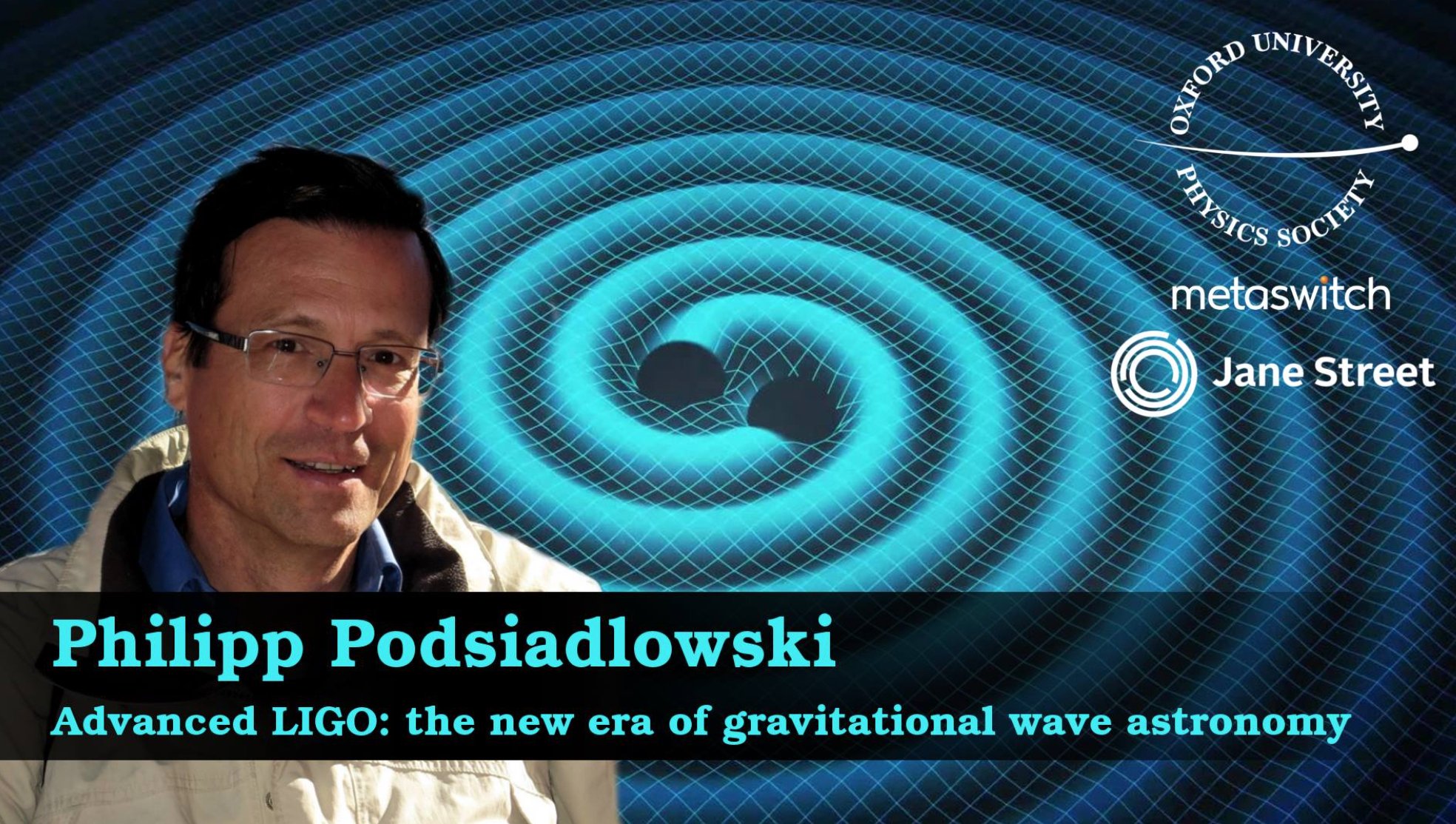
Advanced LIGO: the New Era of Gravitational Wave Astronomy
Presented by the Oxford University Physics Society

Source: Oxford Physics Society

Date and Time: 8.15pm Thursday 27 April
Location: Martin Wood Lecture Theatre, 20 Parks Rd, OX1 3PU

Speaker: Professor Philipp Podsiadlowski

Description: A year ago, the Advanced LIGO (aLIGO) gravitational-wave detector reported the discovery of the first direct detection of gravitational waves confirming Einstein’s Theory of General Relativity in its extreme limit. In this talk I will first discuss the importance of gravitational waves for fundamental physics and the main sources aLIGO is expected to detect. I will then focus on the discoveries over the last year. All sources of these gravitational waves detected so far were caused by the merging of two massive stellar-mass black holes. I will then outline some of the astrophysical channels by which such systems can form and provide an outlook for what can be expected once aLIGO has achieved its design sensitivity.

Entry: £3 for non-members. Free for members (membership is £10, and for life).

—

Brain ageing: using neuro-imaging to understand risk for and resilience against dementia
Presented by the Oxford Institute of Population Ageing

Source: Oxford Institute of Ageing

Date and Time: 14:00 – 15.30pm Thursday 27 April
Location: Oxford Institute of Population Ageing, 66 Banbury Rd, OX2 6PR.

Speaker: Professor Clare Mackay

Description: Brain imaging plays an increasingly important role in experimental medicine for dementia by providing biomarkers for diagnosis, prognosis, patient stratification and monitoring treatment response. Imaging can also provide insights into mechanisms of risk and resilience for neurodegeneration. The Translational Neuroimaging Group investigate brain ageing in both health and disease. We have demonstrated that people at increased risk of later developing Alzheimer’s and Parkinson’s disease have particular ‘signatures’ of brain activity. I will introduce some of the methodology and describe how the techniques are being used to improve our understanding of brain ageing. 

Entry: Free

— 

Interested in getting your society’s event listed here?
Email
[email protected]

“Sharp humour with profound philosophical underpinnings”

Patriarch and architect Hector Blavatsky lives with his family on the 25th floor of a tower block designed by himself. Apart from the eldest sister, the Blavatskys never leave their home. One day, the arrival of an outsider in the form of a doctor upsets the family’s unusual idyll.

Summarised in just a few sentences, the plot to Moira Buffini’s Blavatsky’s Tower nonetheless reveals its unique potential for suspense. This tantalisingly short synopsis, however, cannot do justice to the play’s ambitious thematic range, its admixture of a sharp sense of humour with profound philosophical underpinnings.

The play dramatizes the tensions that exist between the outer and inner worlds of the self; the intruding doctor, played by John Livesey, represents external society’s scientific and logical attitude, while the family members, several of whom experience visions of angels, are more in touch with the spiritual side of existence.

Playgoers interested in absurdist or existentialist theatre will find plenty to think about in Buffini’s play. By refusing the comforts of the outside world, Hector is said to have ‘devoted his life to suffering’, while his son Roland spends his days trying to ‘cope with the fact that the human race is an evolutionary failure’. The play does not commit the mistake of taking itself too seriously, however, and this pessimism is often comedic in its mundanity. The family’s refusal to use the lift instead of the stairs, part of their self-professed ‘responsibility to endure’, is a homespun parody on the lofty theme of penitence. But the Blavatskys’ determination to suffer comes at a huge cost, and the play bravely confronts the question of whether it is possible to live in constant darkness without succumbing to despair.

Opposed to this awareness lies the possibility of suppressing the suffering through convention: ‘routine is a great anaesthetic’, as Roland puts it. This line is a variation on Vladimir’s famous ‘habit is a great deadener’ in Waiting for Godot: Beckett’s influence is indeed pervasive throughout play. Nowhere is this clearer than in the character of Hector, the dominating but dying father who closely resembles Hamm in End Game. Both are blind, immobilised, and nearing death: both dominate while remaining dependent. Hector’s attempt at retaining authority appears in one scene as he orders Roland to kneel and proceeds to palpitate his son’s trembling face; his vulnerability is revealed a moment later when he pleads: ‘forgive me’.

The pace is fast and engaging throughout, the dramatic tension sustained by the ever-shifting balance of power relationships that the characters are involved in. The audience sees characters aspire for dominance at one moment, only to be pulled down by their vulnerabilities at the next. Madeleine Pollard displays both this authority and weakness in her convincing portrayal of eldest sibling Audrey Blavatsky. Proud of her role as the family’s breadwinner, and empowered by being their only member with access to the outside world, Audrey at first appears to be the most ‘normal’ of the group. As the play progresses, however, her own insecurities emerge, and her frustration at being unable to assume a position of authority threatens to break into violence.

Director Philippa Lawford’s production boasts several other strong performances. Marcus Knight-Adams is appropriately neurotic as Roland, combining a disturbing childish petulance with a savage sense of humour. He is forever writhing around the stage, tearing at his shirt and biting his nails in a realistic portrayal of a tortured yet sensitive mind. Louisa Iselin also impresses as youngest sister Ingrid: she succeeds in endowing her character, seemingly the most vulnerable and innocent in the play, with a steely and manipulative edge.

This rendition of Blavatsky’s Tower managed to excite and disturb even in the brightly lit Regent’s Park College rehearsal room, with the actors lacking costumes and props. This suggests both that meta-theatricality is an important dimension to Lawford’s direction, with the characters being literally bounded by the stage/house which they cannot escape, and that the actual production, which takes place next week at the Michael Pilch Studio, is one that will stay with the audience for a long time.

Blavatsky’s Tower will show at The Michael Pilch Studio, 26-29 April (Wednesday to Saturday of 1st Week). Tickets are £7 for students.

Slow start for England’s IPL stars

0

T20 cricket’s showpiece tournament, the Indian Premier League, is back for a tenth edition, and this year involves a record number of English players.

However, a week into the tournament, the Englishmen have underwhelmed.

After he broke the record for the most expensive international signing ever at the auction back in February, Ben Stokes has been under immense pressure to perform in his opening three games. The £1.7 million-man’s bowling has failed to impress: bowling the 20th over against the Delhi Daredevils, he was dispatched for 23 runs by the South African Chris Morris in a performance that seemed like a horrible throwback to his infamous final over of the World T20 final last year. With the bat, a well-made 50 on Saturday was a timely reminder of his undisputed talent.

After a series of mightily impressive performances in the Test arena, Kolkata Knight Riders’ Chris Woakes has found the transition to limited overs cricket challenging. He recently confessed that he must improve his bowling at the back end of the innings, and after a solid start, he will improve as the tournament progresses and he begins to find his rhythm.

Jos Buttler returned to the IPL as one of the few English players to have taken part last season. He has found himself in an entirely new role however, opening the batting for Mumbai Indians. But he has flourished in that position, hitting his highest Twenty20 score of 77 on Thursday off just 37 balls. Indeed, it would be silly to bet against Buttler bettering that before the tournament is out.

Injury to South African superstar Quinton de Kock presented Sam Billings with an opportunity to impress for Delhi. He has got his side off to some quick starts so far with breezy knocks of 24 and 25, but his side’s overall IPL record is so poor that he may be the victim of restructuring in the side as the tournament goes on.

Meanwhile, Jason Roy and Tymal Mills have already been dropped by their franchises after playing in their sides’ opening games. After signing for £1.4 million, left-armer Mills would have been hoping for a better return than his three wickets so far, and with stand-in Royal Challengers skipper Shane Watson using him ineffectively, he was left out of the side to face Stokes’ Pune on Sunday. Roy, meanwhile, has failed to score heavily, and bizarrely went in at number six against Mumbai.

Finally, both Eoin Morgan and Chris Jordan have failed to play a game for their sides: time will tell if they would have been better off honing their red-ball skills in county cricket.