

CW: rape.
This week, Cornell University has made headlines as prosecutors reopened an investigation into the alleged rape of a student at the Ivy League in 2024. The case is characterised by extreme violence and the university’s apathy towards the anonymous Jane Doe. When victims are ignored, and perpetrators’ punishment is to write an essay, what can we learn from those who use art as protest on campus?
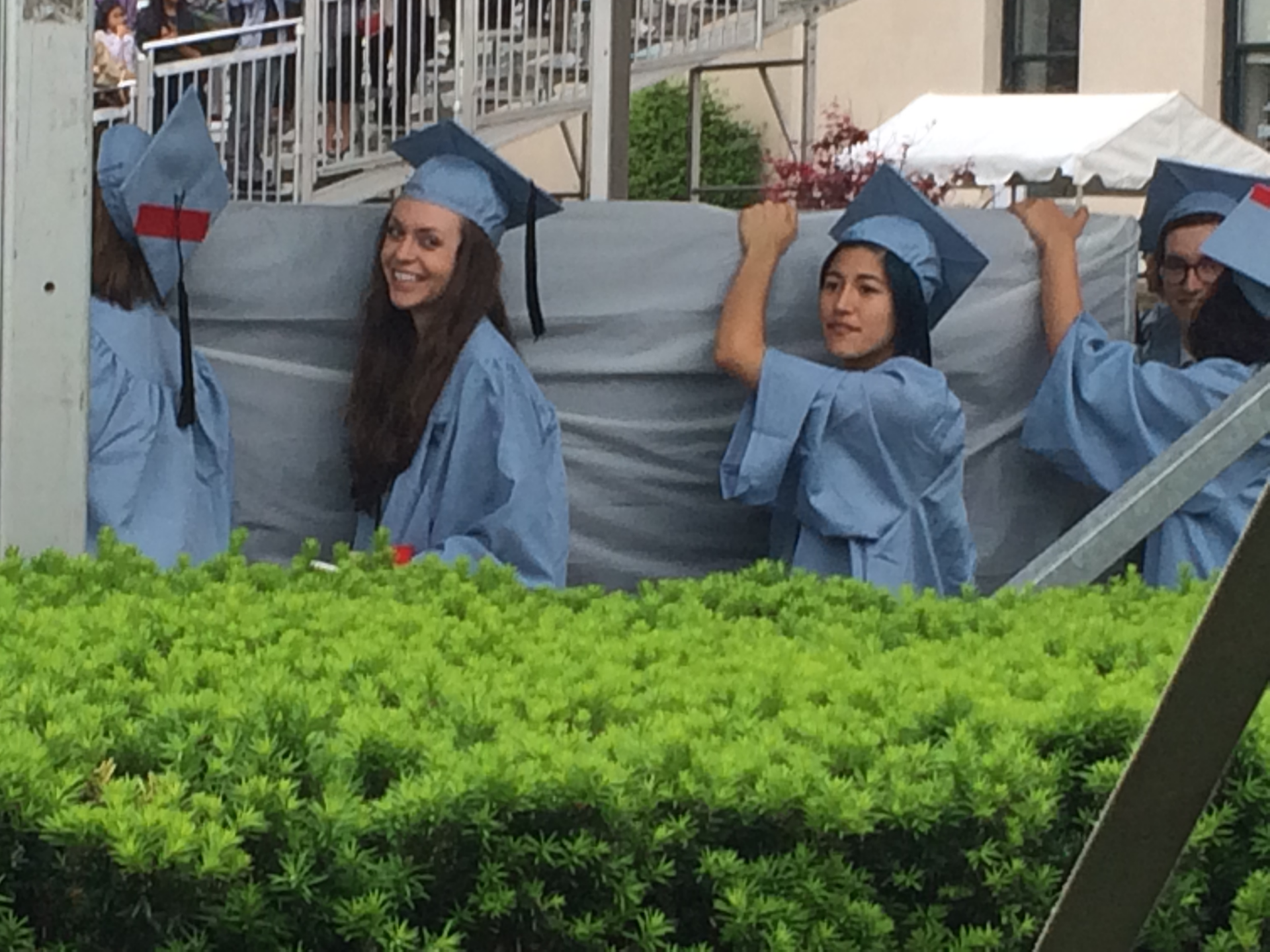
In 2015, Columbia University student Emma Sulkowicz carried her dorm room mattress across her graduation stage. She had been carrying it for months: every day the university failed to expel the man she accused of anally raping her. Having reported the assault to the university in April of 2013, Columbia found her attacker, Paul Nungesser, “not responsible” for his alleged crimes. She filed a report with the New York City Police Department to no avail.
In response, the visual arts student embarked on a performance art piece entitled Mattress Performance (Carry That Weight), as her senior thesis. Starting in September 2014, Sulkowicz carried a 23kg, dark blue, extra-long twin mattress, identical to the one on which she was raped, with her constantly while on campus. Dubbed by Sulkowicz to Columbia Spectator as an “endurance art piece”, she described the mattress as “the perfect size for me to just be able to carry it enough that I can continue with my day, but also heavy enough so that I have to continually struggle with it”.
Her performance was intended to travel by “word of mouth”. Having written the rules of engagement for lugging the heavy mattress around the walls of her studio space, she left the rest of her performance unexplained: a student walking around campus with a blue rectangle of springs and plastic.
On the steps of university buildings, at coffee shops, covered in a sheet matching the shade of Sulkowicz’s graduation gown, the mattress is always there. The mattress’ out-of-placeness is off-putting, interrupting a space of efficiency, learning, and practicality. It is cumbersome, attention-grabbing, and unsettling. It’s a weight not only to those who carry it, but a disruption to the lives of those around it. Its presence speaks to an absence of accountability and justice in the space it inhabits. Notably, under Sulkowicz’s regulations, the mattress was not allowed to be removed from the university campus, even when she was elsewhere. The burden of truth and violence was made big, blue, and bold. It’s difficult to move and impossible to ignore. In a piece written for TIME, Sulkowicz accused Columbia of being “more concerned about their public image than keeping people safe”. When the words of victims have limited consequence and perpetrators fail to be held accountable, art speaks in a tongue that cannot be twisted.
Protest is often remembered through its material objects. We picture the hourglass of Extinction Rebellion, the peace sign of the anti-Vietnam War movement, the crouching panther of the Black Panther Party. The visual memorabilia and graphic art of protest leave a lasting cultural and personal impression. In an interview with Tate, artist Jeremy Deller recalls the impact the protest art of the 2017 Women’s March had on him: “It was kind of the first time you saw… those body parts being drawn or in public being displayed, those sort of reproductive organs.” Really, women’s reproductive systems have been displayed on museum walls with varying accuracy for centuries. Think only of Gustave Courbet’s 1866 L’Origine du monde: it’s all the ‘taboo’ bits and nothing else. Possibly, it is the presence of these taboo bits paraded so pointedly, with overt political sentiment behind them, as well as the real-life person holding the placard, that makes protest art, at least to Deller, so remarkable. It discards any question of whether art should be political and forces it to be so. It gives the aesthetic political purpose; it upsets how we understand, use, and display art. In Sulkowicz’s case, it makes the mundane, purpose-driven object an aesthetic anomaly that first surprises, and then frightens.
Sulkowicz’s performance art protest draws on the visual interruption caused by something being in the wrong place, detaching the signifier from the sign. The spatial anachronism of mattress-in-library, or mattress-in-cafeteria, creates an unsettling instance of a stubborn, physically cumbersome dedication to truth-telling. The mattress is impossible to ignore; so is the silent system of gender-based violence that permeates university culture. Sulkowicz makes the location of violence mobile, unavoidable, and universal. While the weight of assault can be carried by anyone anywhere, the mattress is a reminder that the perpetrators of such violence are just as present.
The tool of oppression deployed by universities like Cornell and Columbia is language in the form of excuses and essays. Language is fortified to protect the guilty and complicit from the consequences of their actions. Art, at this moment, confuses the schemes of language. It evades clear distinction, forces itself to be acknowledged, and upsets the campus’ playhouse of power and punishment.