

If it won’t completely discredit me as a reviewer, I would like to start this by making an unqualified comparison to disgraced YouTuber Cody Ko. Before Tana Mongeau came forward with allegations that Ko assaulted her when she was 17, there was one instalment of his and Noel Miller’s ‘That’s Cringe’ series that, at 13, I thought was the height of humour. In it, they react to a video entitled ‘you.’, which is essentially a VSCO-colour-graded montage of a couple living together in LA, overlaid with an awkwardly unscripted conversation about love, art, and entrepreneurship (by which they mean finger-painting and making smoothie bowls). The couple recount how they met: a month ago at Whole Foods, when she was buying celery, and he was buying rosé. “I always knew I would meet my soulmate at Whole Foods”, she rasps, completely serious. They seem utterly high and deluded about their love for each other, convinced that they see the world differently than everyone else, and that their ‘work’ has the capacity to change everything. At one juncture, there is an extended shot of the shadow of a hose dripping water, the phallic nature of which prompts Ko and Miller to joke that they get it now.
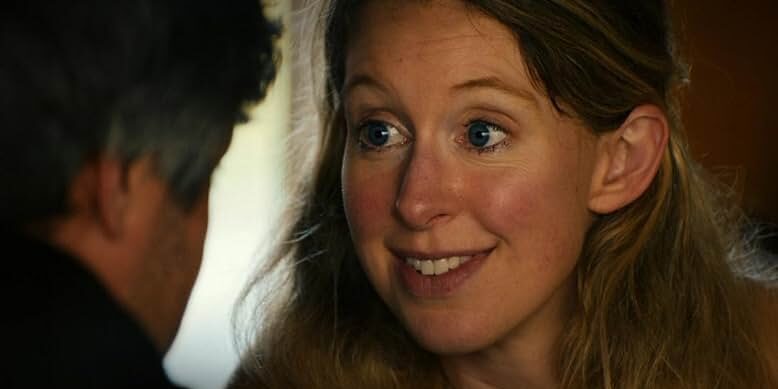
Early in Nathan Fielder’s You Can See Everything, we watch Elizabeth Holmes’ romantic and business partner Billy Evans in the shower while Fielder stands outside with headphones on. He doesn’t seem to know where to look, or what to do with his hands. The audience doesn’t fare much better, as the wide shot of Evans’ naked body occupies the screen for an oppressive amount of time. This is when the uncanny feeling that I had seen this film before finally realised itself. What Fielder captures throughout the first half of the documentary is that when Holmes and Evans talk to one another, no actual constructive dialogue ever happens. Instead, they stare unblinkingly into each other’s beady, blue eyes and rattle off these therapy-speak neologisms that seem to put up more barriers than they take down, all under the guise of compassion. “I know exactly how you feel,” Evans tells Fielder repeatedly, as he near-literally pulls it out and slams it on the table. Later, it becomes clear that he would also purport to know exactly how Holmes feels. About everything. To the point that she doesn’t need to be around, and if she were, it would only decrease the efficiency of their product – sorry, relationship.
What I mean to say is, much of You Can See Everything feels like a mockumentary. Some viewers, whose eyes are more trained to Fielder’s quirks than mine, claim that it actually is, and that many of the interactions are scripted to max out on absurdity. Perhaps because it was a midnight showing, perhaps because I had just had two cocktails, or perhaps because I was sitting in the fourth row on a friend’s recommendation, so the possibility of Holmes and Evans crawling out of the screen The Ring-style felt low but not zero; that was not the impression I got. The absurdity felt eerily real. Parts of the three-hour-long footage are plain, laugh-out-loud ridiculous: Evans tells Fielder he did not recognise Holmes upon their first meeting because she was wearing a hat and a bandaid, Holmes claims not to understand the gag in Abbott and Costello’s “Who’s on first?” routine, which somehow proves her innocence, and the couple spend pretty much their entire screen-time with dry lips and red-rimmed eyes, sniffling between every word they speak (one X post about the film reads, “You Can See Everything more like Me and My Gay Cocaine Husband Need Some Lip Balm”). Other parts, however, are akin to something from A24’s horror catalogue.
The question the film asks (and fails to answer) is whether Elizabeth Holmes is innocent. What it proves is that anyone can become a conspiratorial maniac under the right circumstances. Holmes and Evans are convinced that the world is out to get them, and they feign a failure to understand how they ever got into this situation in the first place. As a result of this self-victimisation, Evans begins to lash out – he eventually reveals that Holmes has granted him power of attorney, which he has been using to post deranged political takes on X under her name and make an AI bot of her likeness. He shrugs when Fielder asks how he would feel if someone used it to create a pornographic video. “If anything happens to me, this needs to be out there,” he says, pupils blown wide. He declares that this is what Holmes would want; if she were free, she would spend all her time building “monuments of love” for him. So what’s the difference if he exploits her will when she is unable to speak for herself?
Fielder’s position remains unclear for most of the film, but by the end he has obviously developed a fondness for Holmes that is clouding his judgment. He wants the truth, but he also wants to avoid making Holmes look like a villain. The most interesting position is that of (spoiler alert) Amanda Seyfried, who Fielder consults on the project after Holmes begins serving her sentence. Arguably the most well-adjusted of the whole lot, even Seyfried seems stir-crazy at times. She expresses some guilt over her portrayal of Holmes in the 2022 Hulu show The Dropout, but she continues to assist Fielder in ‘re-enactments’ of his interactions with Holmes that he could not get on camera. One particularly poignant re-enactment is of Fielder’s visit to the prison – we watch Seyfried-as-Holmes lament Seyfried’s depiction of her, and (irony of all ironies) say that she never wants to be portrayed that way again. The re-enactment is cut with a scene where she and Fielder read the ‘script’ together, and she appears frustrated at Holmes’ gripe with her. “I was playing a character!” she exclaims. Seconds later, she walks it back: “But she did do that.” She, like Holmes, doesn’t want to be the villain of the story.
Of course, we aren’t exempt from the cabin fever either. At about the halfway point, Fielder reveals to Seyfried that before they began filming, Evans struck a deal with the A24 executives so that he and Holmes would receive a portion of the profits that the documentary made upon its commercial release. Fielder argued that on top of being uncustomary for documentary subjects, this deal would look uniquely terrible for Holmes and Evans, as it would put into question the objectivity of the narrative. Evans threatened to pull out of the project, so the filmmakers were forced to agree. This puts the audience in a position where, for the next hour and a half, we are forced to reckon with the fact that we’ve made a transaction not with an independent film studio but with a money-laundering fascist. We are only released from this moral anxiety at the very end, where some postscript tells us that Evans decided to cancel the deal right before the film’s official US release. The relief of this reveal is so immense that for a moment we sympathise with those that are actually complicit.
In the prison visit re-enactment, Fielder asks whether Holmes knew about Evans’ deal, or about anything else he has been doing under her name since her imprisonment. Seyfried-as-Holmes tells him that she doesn’t know, and doesn’t care. She has never felt closer to Evans; they are constantly “building monuments of love” for each other. Fielder never points out this verbal parallel – in fact, he is convinced of her sincerity. The only thing that is clarified by the time the screen fades to black is that Holmes and Evans certainly were, are, building monuments. Towards what, it remains to be seen.