

It was my final day at what had been a simultaneously controversial and underwhelming Venice Film Festival – controversial because of the lack of major Hollywood releases and the scarcity of female directors among the lineup, and underwhelming because the films which remained were boring, pretentious, or a combination of the two. The festival had a promising start, opening with the adrenaline-filled Ink, directed by Danny Boyle, and the crowd-favourite Wild Horse Nine, directed by Martin McDonagh, a couple of days later. However, there was a run of complete filler throughout the middle portion of the festival. The lack of female voices in the lineup was noticeable in the films themselves, with one film after another about a man struggling with his conscience while also cheating on his wife. Needless to say, I was feeling the fatigue.
However, upon the release of the festival lineup, there was one that I just knew was going to be good. That film was NAZA, a documentary produced by The Guardian and directed by Yuval Abraham and Rachel Szor. The title refers to “collateral damage”, according to one of the officers – the number of civilians who are killed in a targeted strike, in this case the drone strikes which Israel can use to kill any person they want, at any time. Both directors made the incredible No Other Land in 2024, and the premise of this film – interviews with Israeli intelligence officers about the systems used to remotely kill Palestinians essentially at will – was too good to fail. Going into my 28th film screening of the festival, I was proven right, with the film prompting the longest standing ovation in the festival’s history – 25 minutes. While watching it, I knew I had to write about it, especially while details of its wider release are still emerging.
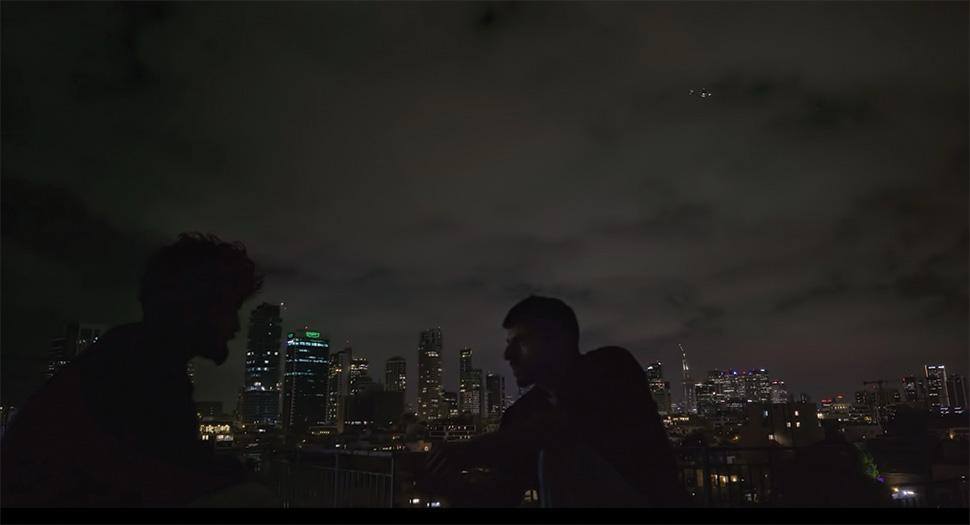
The death and destruction feel remote and are not shown to the audience until the film’s very last moments, in an emotional gut-punch. This is fitting, as the interviews focus specifically on remote killing. The filmmakers interview 24 Israeli operatives on the rooftops of Tel Aviv – only 60km away from a site of extreme devastation. Tel Aviv, however, is unsettlingly quiet. We see people in high-rises doing yoga, washing up, watching television, leading normal and uninterrupted lives. The interviewees, silhouetted and with digitally altered voices, talk matter-of-factly about the methods of remote massacre which they helped to create and execute. NAZA creates geographical, moral, and cinematic distance from the destruction in Gaza, withholding what many other filmmakers would want to confront their audience with. I am reminded of The Zone of Interest, in which violence is kept just out of frame, and the film’s normality is made unsettling by what it chooses not to acknowledge. The filmmakers of NAZA clearly know that beyond physical distance, emotional distance is what allows the violence in Gaza to continue, and show us just how easy it is to ignore what is going on right under our noses.
In case the film does not get a wider release, I will take some time to describe some of the topics discussed by the Israeli officers. We begin by being told that every phone in Gaza is being tracked and constantly surveilled by the Israeli government, which is how the following technologies can function. Firstly, ‘Lavender’, an AI program that tries to evaluate whether a potential target’s phone ‘behaves like’ a Hamas phone by comparing your activity to that of a confirmed Hamas member. It is a program which, despite creating thousands of targets to be bombed, is often incorrect – at least 15% of the ‘targets’ are incorrect, according to one of the tech officers who helped make it. The idea that the decision of whether a person should live or die is decided by artificial intelligence is harrowing, and yet is described as safer than being in the hands of a person who has a personal vendetta against Arabs.
We then learn of ‘Daddy’s Home’, which spies on family members’ phones to see or hear when a target returns home, so that they can be killed in their house. We are told that the preference is to strike Palestinians in their homes, often at night, when they are least expecting it. Again, it is a system which often makes mistakes, as we are told of a case where the potential target simply left their phone at home, and only the man’s family was home, including his daughters of ages 3 and 6. We learn that the computer program used to analyse homes (every home in Gaza has a ‘serial number’) informs you of the expected NAZA, including whether they are children.
The IDF has rejected the film’s central allegations, but NAZA’s emotional force comes from the accumulation of testimony, and the calm, technical language of those who say they participated in the system. The Israeli officers being interviewed don’t care about who they are killing, and this is clearest through their damning language. Here are a few quotes given by interviewees about the murder of Palestinians:
“It’s like a video game.”
“Quantity not quality.”
“The goal is to destroy.”
“Destroy everything as quickly as possible.”
“We expect them to learn it through blood.”
“If they want him dead, he dies.”
“We erased history.”
While some interviewees express guilt for what they have done to the Palestinian people, the overwhelming sense created by the language of the officers is that of pride. Some describe it as fun, an exhilarating, mission-driven sense of accomplishment. Of course, the people involved have been brainwashed to an extent into this way of thinking. In one clip, Benjamin Netanyahu is shown saying that he believes that all Palestinians knew about the 7th October attack before it happened, and that they are all implicated in the attacks. Another shows him advertising a book he edited in 1986 – Terrorism: How the West Can Win – in which he ironically describes terrorism as the targeted murder of civilians for political reasons.
I gained no comfort in watching NAZA, no cathartic ending, and no sense that anything will change because of it. It plainly describes a machinery of violence operating at this very moment. After the screening, the audience leaves in a sombre silence, like a funeral procession. It is a strange feeling to leave a film about mass death by walking over a red carpet, above which the Israeli flag flies. I leave on a vaporetto and say goodbye to this year’s festival.