

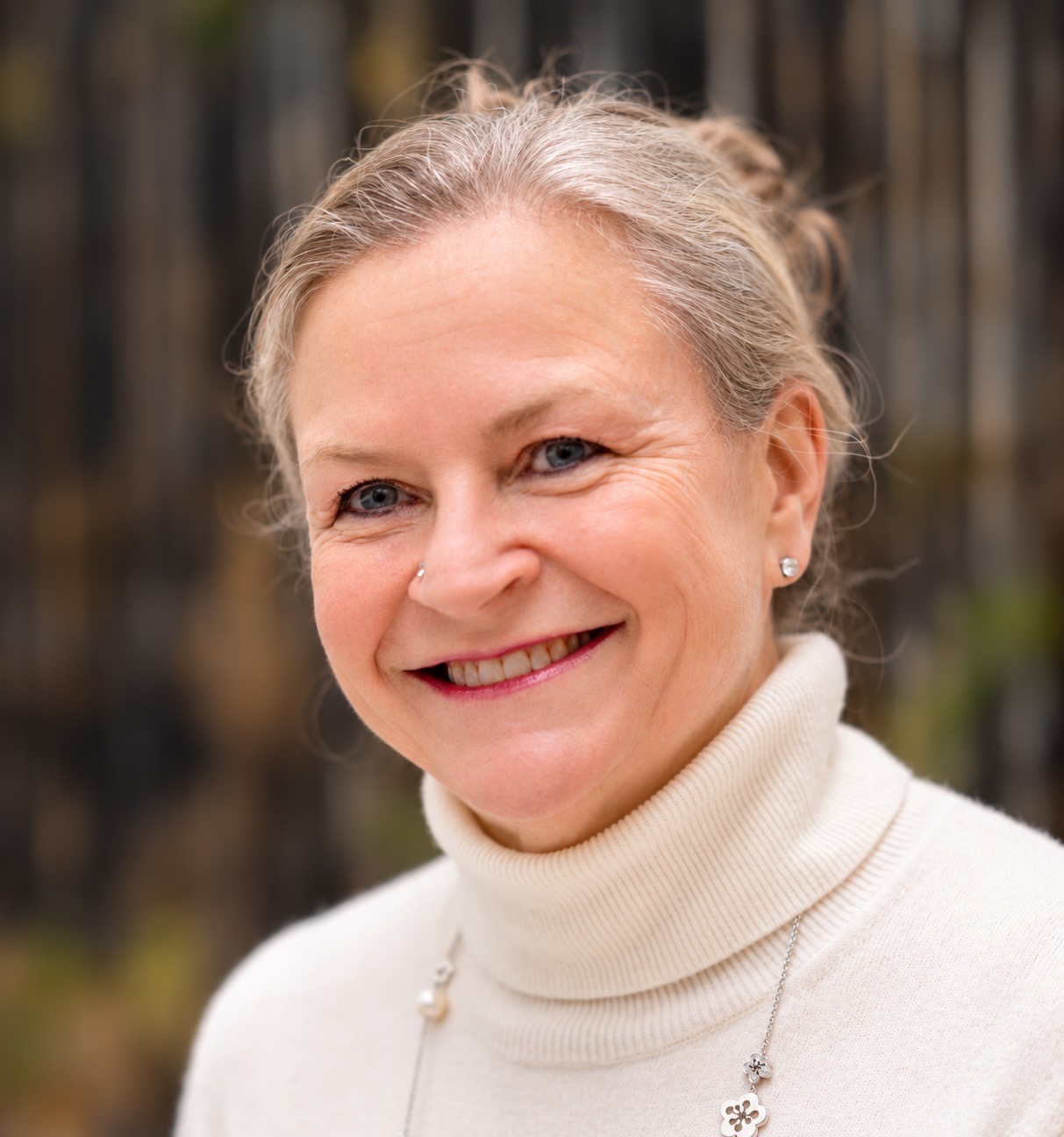
We begin our conversation somewhat unconventionally, discussing Professor Sally Collins’ love for acting. Striking a deal with her father, anxious about her future security and wanting her to have a “proper” degree to fall back on, Collins studied chemistry at the University of East Anglia: “It was always acting, but science kept my father happy.” After three years, however, her need to perform remained. With her father’s support, Collins completed a postgraduate diploma in theatre arts and spent her twenties working across film, television, advertisements, and theatre.
Then came what she calls a “Damascene moment”, a turning point familiar to many navigating early adult life. While watching a play in Oxford, she overheard a highly successful actor complaining about his Hollywood career, agent, and pay. Even so many years later, Collins relates this anecdote with a palpable sense of indignation, still aggrieved by how the actor’s dissatisfaction sat against the circumstances of her friends in the industry, talented people who had devoted a lifetime to theatre, yet remained on minimal pay.
His discontent led to unexpected self-reflection: “He’s got everything I think I want. He’s got this career that I think I want. Am I just going to end up as sad and self-interested and horrible as he is?” This encounter marked a radical change of direction, and Collins found herself pulled back towards science: “The only other thing I’d ever wanted to do in my life other than be an actor was to be a doctor.”
Collins’ career has been shaped by unexpected turns, each a testament to her willingness to embrace challenges and venture into new territory. Graduating from Oxford Clinical Medical School in 2002, Collins trained in obstetrics and gynaecology at the Thames Valley Deanery. When choosing her speciality, foetal medicine held a special attraction: “My mum was a lifelong nurse and midwife, and she made no secret of the fact that midwifery was her love… and I suppose that just lodged in my soul.”
Looking back, Collins sees her work as an actor as an important preparation for her clinical career: “I am glad I didn’t do medicine at 18 because I had a lot of growing up that I had to do. Being an actor, living on income support between jobs, helped me understand why people make the dodgy choices in life that they do”, something she felt her colleagues from more privileged backgrounds sometimes struggled to appreciate. Nor does she see the arts and medicine as opposed as one might expect: “You’ve only got to go to the hospital orchestras and see the medical school student shows to just know there is something about performance and caring that crosses over… there is something that I think is giving of yourself in performance and medicine that is very similar.”
Having her first child shortly before her final medical school exams, Collins says people assumed she would become a GP, a path that perhaps lends itself more to family life than obstetrics and gynaecology. However, Collins knew that general practice wasn’t for her: “GPs have to know a little about everything, and that’s not really my forte. I’m much better at knowing a lot about much less.”
Her self-knowledge has proved invaluable to medicine. Collins is one of the world’s leading experts on placenta accreta spectrum, a potentially life-threatening pregnancy complication in which the placenta attaches too deeply to the uterine wall. Her doctoral research focused on using ultrasound to examine the placenta in the first trimester of pregnancy in order to predict foetal growth restriction, one of the leading causes of stillbirth: “If you’ve had to look a woman in the eye and tell her baby’s dead, you know you really don’t want to do that very often.”
The challenge, she explains, is to identify women whose babies are at risk, monitor them closely in the later stages of pregnancy to decide to deliver the baby in the case of growth restriction. Yet clinicians lacked an effective way to identify these pregnancies early enough.
This is where Oxailis comes in. The culmination of more than 17 years of research and 2 large clinical trials involving over 7,500 women, Oxailis is an AI-based decision-support platform developed by Collins and her team. It uses ultrasound images alongside a risk stratification algorithm to detect vascular perfusion, which Collins found to be a critical marker of disease.
Crucially, Oxailis is a “very simple technology. It’s just software that analyses ordinary images. We don’t need any extra or different hardware. We just use the ordinary ultrasounds that come off ultrasound machines”. In a health service where financial constraints and limited access to equipment can pose significant barriers to adopting medical innovations, this is a significant advantage.
And the results so far are highly encouraging. Collins speaks proudly of the software’s performance against current screening tests: “For the same false positive rate, we detect almost twice as many growth-restricted babies.” Collins’ initial breakthrough in obstetrics now also has potential applications beyond pregnancy, in ovarian and prostate cancer screening and in nephrology.
Oxailis officially spun out of the University late last year, and it is nearing the close of its first angel investment round while making progress towards regulatory approval. This is a significant milestone for Collins and her husband, who have poured their life savings into the venture, demonstrating their commitment and belief in its value. Collins acknowledges the University’s integral role in the company’s success as Oxailis received a substantial grant from its Strategic Innovation Fund. However, she also emphasises the importance of continued institutional support for innovation, particularly amid the extensive financial cuts to research. “Oxford has more brilliant scientists and more great ideas and more phenomenal research than just about anywhere … the University probably needs to invest a little more in supporting them.”
I ask Collins what she has learnt from navigating fields as diverse as drama, medicine, and now entrepreneurship, and what has sustained her through the inevitable rejections and setbacks. “If you’re too frightened of failure to try something, then you’d fail. Inherently, you’ll fail. You have to try. The only way that you won’t end up on your deathbed, regretting things is to give it 110% when you have the opportunity and stop when it’s not happening and move on and don’t let it stop you from trying again.”
Earlier this year, Collins retired from clinical practice. The delivery of her final baby proved more emotional than anticipated: “I was more emotional about it than I expected I would be. But I have to admit, I’m quite glad to be out. The NHS is a hard place to work at the moment.”
Our conversation did touch on the pressures facing maternity services. Years of negative headlines, staff shortages, financial strain, and rising litigation have, in Collins’ view, eroded public confidence in healthcare professionals: “By the time I retired this March, I just felt like they had totally lost faith in us. And that’s really sad because maternity is packed full of people who just want to do their best.”
Indeed, part of Collins’ research has been focused on looking at post-traumatic stress following childbirth. Having had two children herself and cared for thousands of women, she is particularly troubled by the fact that emotional wellbeing is often among the first things sacrificed when services come under pressure. She recalls how just a few sentences could make the difference to a woman’s experience of childbirth, particularly after an assisted delivery: “When I did a forceps delivery, I always used to say to the woman: ‘I know I delivered your baby with forceps, but you did the hard work. You laboured to full dilation. You pushed this baby down low enough that I could help you at the very last minute. You have not failed. You did brilliantly.’” Yet in a system stretched to its limits, the time and space needed to offer this reassurance are increasingly hard to find.
Despite these challenges, Collins has no regrets: “I’ve been there at some of the most amazing moments in people’s lives, and I’ve been there at some of the absolute worst times in people’s lives. You can’t stop awful things happening to good people; that happens every day. But if you can make a little bit of a difference and make it more bearable, that is what you can bring to it.”
Oxailis represents the latest stage in Collins’ lifelong commitment to care: “I am the most inadvertent entrepreneur. It was no plan of mine. But we had something too precious to just let it go. And if there’s one baby in this world who is alive as a result of our screening test, that will be enough for me.”