

The election for Oxford Union Presidency for Trinity 2027 is set to take place on Friday 27th November. Tomorrow’s poll is the first with new rules requiring voters to display two forms of ID, after election fraud scandals affected the last two end of term elections.
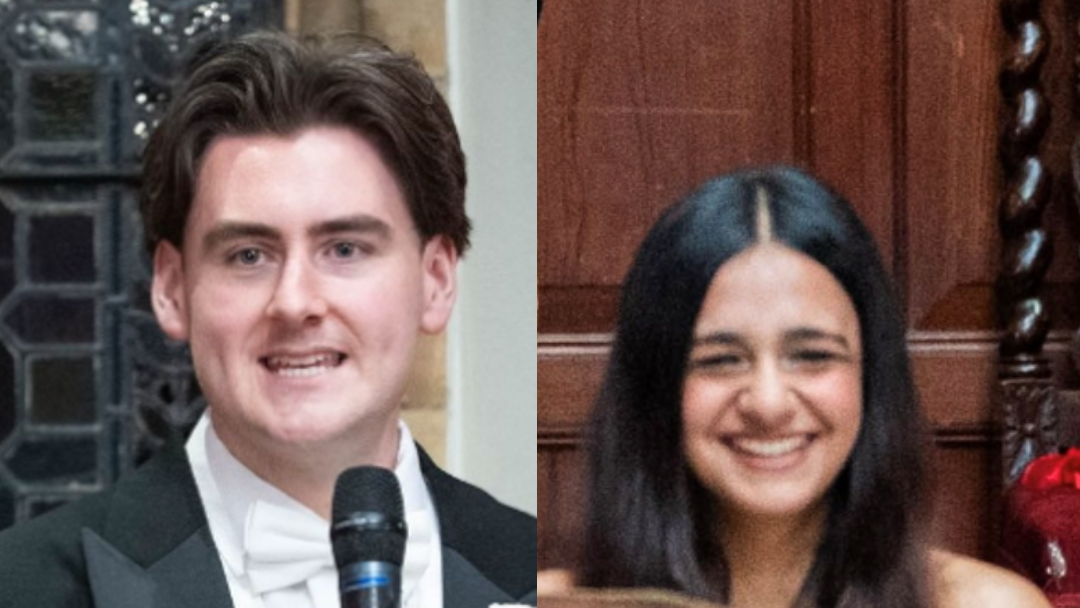
The candidates running to be President in Trinity Term 2027 – current Librarian Harry Aldridge and current Secretary Saara Lunawat – spoke to Cherwell about the current state of the Oxford Union, their reason for running, and their dream debate. Below is a shortened version of the full conversation, to hear the full interviews listen to Cherwell Spoken on Spotify.
First tell us who you are and why you’re running for Union President?
Harry Aldridge: My name is Harry. I’m a finalist at New College and I’m the Union’s Librarian this term. I grew up in Plymouth and I was the first student really from my school to come to Oxford…Before I came to Oxford, I didn’t really have any experience in public speaking, so the Union’s been the place which has allowed me to build up those skills. The reason I’m running for President quite simply is because I want the Union to give that opportunity to other members as well, allow them to have that same experience, and allow them to get engaged with the opportunities the Union offers. Far too often I think the Union has simply become this endless election society instead of the debating society which we all signed up to when we got here in Oxford.
Saara Lunawat: I’m Saara. I’m a second-year law student at St. John’s. I come from India and I used to be a debater back home in India. I’m serving as the secretary of the Oxford Union right now. It’s a pretty exciting role, pretty busy role.
In your opinion, what does the Union stand for?
Harry Aldridge: I’ve served for over five terms on committee now. During my first year, I served as Schools Outreach Officer, and in that role I tried to do something very different: I organised eight different state school visits. It was a chance for students from underrepresented backgrounds to come along to the Union, see some of our debates, see some of our speakers, and then to have the chance to build up those skills themselves.
For me, the Union has two core purposes. I think our driving mission very much is free speech: allowing the free exchange of ideas, allowing members to engage with one another, allow[ing] them to talk about the contentious issues of the day. Not only has hosting the brilliant speakers at the Union been one of the highlights, but it’s also the other students I’ve met and having a chance to actually engage with other students who care about the same issues I do, who are interested in the same subjects I am. I think the Union is the best place here at Oxford to have the contentious discussions outside of necessarily university context and with some of the brightest minds in the world. I think the second focus, which I think the Union over the years has lost its way, is that when we were founded, the Union was not just a free speech society but also a society where we have social events. We have our library, we have our bar. For far too long the Union hasn’t been lively enough. We’ve not done enough to actually keep that running. For me, if I was elected as President, one of my key pledges is very much to try and bring back the fun.
Saara Lunawat: The pretty straightforward answer is that the Union was founded on the principles of free speech, and the way we approach free speech in our society today, even the words ‘free speech’,has itself become contentious. Like I spoke about in the Week Five debate about censorship and extremism, this is something I really strongly believe in. When we talk about ‘what the Union can do’ and ‘what it stands for’, it is this fundamental idea that everyone deserves a right to speak, like I quoted in my speech that “I may not agree with what you said, but I will defend until death your right to say it.” I think that’s something we can all agree on.
What manifesto commitment are you most passionate about?
Harry Aldridge: The fun answer I’d have to give you is one of my pledges – and I did this when I ran for Secretary as well before the idea was eventually vetoed – is I would want to run a Minecraft ball. I know it sounds completely ridiculous. I know it sounds a little bit nuts, but I think very much for me in a Trinity term when the Union isn’t as lively as it could be, it’s ridiculous ideas like that which will actually get members to come back, get involved, come along to our socials, and to actually spend a little bit more time at the Union.
Talking about some of my more serious pledges, there’s two I want to talk about. Firstly, one of the big things which I’ve experienced when I’ve been in the Union, and something I’ve very much felt as someone who came from an underrepresented state school is that throughout my time in the Union I’ve experienced, to be honest, quite a degree of classism. I very much want to tackle that and the feeling that [those] people in the Union aren’t welcome. I want to make sure that every member who walks through our doors actually does feel welcome and is able to enjoy our events and our socials, because for far too long a lot of students have felt deterred by our reputation. I think they’ve felt deterred by often some of the remarks we see online made by members of the Union’s committee, even. For me, I really want to increase the accessibility of the Union.
I also want to bring that focus back to competitive debating. I think when I got to Oxford, not only was I interested in the brilliant speakers, but I was also interested in the debating the Union had to offer. You know, that was the first time I’d ever had the opportunity to do public speaking. It was really the first chance I was able to build up my confidence. So I really want the Union to kind of hone back on its key purpose. Fundamentally, the Union needs to operate much more as a society where the main interaction everyone has with the Union every term—if you don’t go that often, frankly – is a bunch of messages from people you’ve never met saying, “Come and vote for me.”. I think that needs to change. The thing people should be engaging with is our brilliant socials and our brilliant speakers, and very much if I was elected as President, that’s what I’d be trying to bring back.
Saara Lunawat: This is the kind of question, if we had an hour, I could speak for an entire hour about it. I don’t think there’s a lot that the Union needs to improve on. I think it’s our approach towards what we need to change that matters more. So if it goes from the simplest thing, like how we approach this idea of student engagement and student governance, the first step is making sure that these committees and students are more involved and more informed about what their role is. From my personal experience, when I joined the Secretaries Committee, the way it was presented was ‘Oh, it’s a very simple role, you just have to help around the debates and the events.’ But the Union can be a lot more. It doesn’t matter what level you run on, it matters how you approach that role. So the first thing I would want to do as President is have clearer briefings about what people can and cannot do. And empower these people to care more about it.
Beyond that, of course, I would hopefully be the first female Indian citizen who becomes a president. And I think that’s a big pressure for my country. But I’m really excited to do it. I’m really excited to platform speakers from all across the world, especially the Global South.
Finally, as a woman I care about gender parity on the Committee, about equal representation and rights, and continuing with this tradition of having an all-women debate.
It’s a time of year when many members are inundated with these hack messages for the first time. Do you support Milo Donvoan’s, next term’s president, proposal to ban them?
Harry Aldridge: I might be guilty of sending a few too many hack messages during my time here in Oxford. But look – I think Milo’s completely right. Fundamentally, the incentive structure in the way elections operate at the moment is simply to soullessly spam every single member you possibly can with endless messages, to see whether they’ll come out and support you and support your candidacy. That’s not how the Union should operate. Not only does it deter people from getting involved in the Union, not only does it deter people who would run in elections and do brilliant jobs because they think it would harm their social reputation, but more fundamentally, when people talk about the Union’s reputation – when I first came to Oxford and told people I was going to join the Union, people said, “No, don’t do it because you’ll be inundated with all these hack messages.” And I think very much it really deters people from getting involved in the Union.
Saara Lunawat: It is a pledge that seems extremely well founded. However, I would be lying if I said I didn’t have some concerns, because from a public policy standpoint. I believe the reason hack messages are sort of the easiest way to express your enthusiasm or your motivation to run. My concern would be what comes next. If you imagine a world where hack messages are banned, firstly, from a legalistic point of view, it’s not really clear what that means. If I say something like ‘Hey, I’m running for Secretaries committee’ and that’s suddenly banned, I can still message you saying ‘ I’m really interested in the Union.’ There are a lot of ways to present a message where you can’t really, without seeming like autocratic, control messaging. Beyond that, even if we pass that barrier, what comes next? I assume people can continue calling or they can show up to colleges.I’m not really sure whether that snowball stops rolling. At the end of the day, I do think it’s a great idea – it’s more about how we can envision it in practice in a way that it does not turn into something worse.
Moving on to your opponent, what’s something you admire about them?
Harry Aldridge: I first met Saara, I think, at G&D’s in Michaelmas of her first year and in my second year. And I think the thing which I always admired about her is that she’s an incredibly determined person. When I met her I could tell she was going to go really far in Oxford – she was always going to make her mark on student politics here. I’ve always got on with her really well.
Saara Lunawat: I think he’s a big fan of peace and love. And so am I. So I’m glad to see we’re on board with that.
The Union has become known for its invitation of controversial speakers, particularly the Tommy Robinson and Laurence Fox invitations. Where should the Union draw the line on who it invites?
Harry Aldridge: For me, the line we have to draw is when bringing in a speaker or a guest is going to actively cause harm to our members. The invites of both of those people, not only for some of the extreme views they espouse, but Tommy Robinson has faced a significant amount of trouble with, frankly, the law. He’s not someone who I think would particularly be appropriate to speak here at the Oxford Union. It’s a privilege for speakers to come in and speak at the Union. I want to give that platform to as many speakers as we can, and I have no issue debating some of the toughest ideas: The Union should be the place where we challenge people, where we test people, where we scrutinise people. That is the Union’s core mission. But there is a difference when a speaker is actively going to cause harm to our members.
Saara Lunawat: I do understand that this has become a contentious question. At the same time, I don’t understand why it needs to be, because free speech as a fundamental right, of course, allows everyone to speak about what they believe in.
However, the line is pretty clear when it comes to people, perhaps that have criminal charges or have said problematic things that amount to inciting violence or can be attributed to hate speech. That is very clearly where we should draw the line, which is why I was very happy to support candidates in the past who have been vocal about their condemnation of these invitations. Beyond this, this really importantly loops into this idea of what we should do if we are future presidents., I really take pride in the fact that the Union is an independent organization. That’s what we love about this place. That is good. At the same time, we must not forget that the Union is an institution at the heart of Oxford. If we see that there are dangers of protests, violence, people feeling uncomfortable, basic welfare, the fact that we have this independence should not be used beyond the limits of what is right for society. I remember when the Tommy Robinson invitation happened, I was one of the people that could not even go in because of how much the protests had taken over the city. I think if that isn’t a clear enough line for why someone might be problematic, I don’t see it as any more clear than that.
Who would be your dream speaker event and what would be your dream debate?
Harry Aldridge: My dream debate motion would be: “This House would abolish grammar schools.” I’m passionate about that motion because, as you can probably tell from some of the things I’ve said earlier, I’m really passionate about access. It’s getting people to have the opportunities which often are not afforded to students from lower-income or underrepresented backgrounds. I think grammar schools are frankly a debate about meritocracy and who gets opportunity. They’re also a debate in which everyone has a stake. If you went to a comprehensive school, you have a stake in students who went to grammar schools. If you went to a private school, it’s a very similar case. If you went to a grammar school yourself, you’re directly affected by the issue, or if you’re like me then you also have a stake in it. It really touches on the things I would want to bring to the presidency, debating things like meritocracy and ensuring young people have a level playing field.
In terms of a dream speaker, there’s two answers. The serious answer is probably Jacinda Ardern: she’s someone I’ve long admired, former Prime Minister of New Zealand, who very much always talked about having kindness in politics. I think leading with empathy is a leadership style which is not only incredibly fascinating, but is something of which we need to do more. In terms of a fun answer, the best speaker event I ever went to was in Trinity term: it was with Abby Lee Miller. She was incredible. I went to the meet and greet and got a photo with her – it was, like, the best day of Trinity. So, I would want to bring in Cathy Nesbitt-Stein. She was Abby Lee Miller’s rival on Dance Moms and I think the Union needs a bit more joy, a bit more fun, and having more speakers like that is the way to do it.
Saara Lunawat: I would kind of like to twist the question a little because there’s not one singular speaker I want – there are so many speakers, and the way I approach this question, the same way I did in my manifesto, is that the Union does its best work when we platform those who need a platform rather than those who already have one. We need to strike a better balance between inviting people that already have, how the kids say, ‘clout’, and then people who deserve that platform. The way I see it, there’s a lot of countries around the world where people do not have the same freedom of speech that the Western liberal order sees, and if they don’t have those platforms available in their own countries, the Union can take more of an active activism route in its idea of free speech and invite these people, and give them a new platform outside their own country.
Moving from an individual speaker’s idea, I would say a panel of speakers should be able to have a platform where they can have free speech and a panel of people all around the world would be very interesting, especially a panel of activists who are fighting a cause that we do not really hear about in common news. that really irks me is this idea that you do not need a person from a certain background to get elected for those ideas to be spoken about, even if that pattern seems apparent – like, ’We should not wait for someone from Rwanda to speak about the civil order’, ‘we should not have to wait from someone for Haiti to talk about what is happening with the blue helmets there’. A combined panel of us, firstly, putting in the effort of recognizing where these countries and people and these issues come from, and then bringing them all together to have a larger multipolar discussion of ‘hey, where should the world go? What are the avenues which we can discuss?’ That’s what excites me the most.
A debate I’m really excited about is an ode to the debater I used to be in high school, what made me want to do human rights law and public international law, was a motion I did in a debating competition: ‘This House believes that developing countries should bear less of a burden than developed countries when it comes to the climate crisis’. That was like a ‘whoa’ moment for me, because we think of many of these world issues as a global challenge, but we do not look at it from the lens of equity. When you talk about, for example, renewable energy, it is very easy to say that the entire world should adopt it, but what about a country like Bangladesh or India, that haven’t really gone through the industrial revolution the West…Do we think that we should divide that burden more equitably rather than equally? It will be a very cute full circle moment for me to debate that with climate activists like Greta Thunberg, for example.
This is an edited version of a full interview. To listen to the whole interview, visit Cherwell Spoken on Spotify.