Thursday 7th May 2026
Blog Page 483

Oxford artist spotlight: in conversation with LZYBY

0

Emerging from the depths of lockdown, Oxford-based singer LZYBY (George Cobb) has made light work of spelling ‘Lazy Boy’, and even lighter work of establishing a name for himself.  Not only did his debut single, ‘When the Rain Stops’, land him an interview on BBC Oxford, ‘Frustration’ has featured on articles with slightly more relevance than this one, and he’s got a six-track EP, Lazy &Waiting, dropping later this month.

As we sit down for a chat over a beer in my Cowley-based kitchen, he tells me that LZYBY encapsulates how he’s not “an overly serious person”. As to why he wanted a stage name? “George Cobb is quite dull as names go. It’s just two syllables: George. Cobb.” I can’t argue with that.

For transparency and Covid’s sake, I have to admit that my kitchen is also his kitchen. He may be Oxford’s hottest new Singer/Producer, but he’s also my housemate and, I suppose, quite a good friend. But don’t you worry: while I value our friendship, I value my integrity as a student journalist far more. What follows is a completely unrehearsed, authentic interview between an up-and-coming artist and his up-and-coming friend.

I get the ball rolling with a few icebreakers. Slightly surprised to see him take this seriously, I follow suit, asking how this all came about. Was LZYBY born in lockdown, or bred by it?

“I’d say [lockdown] gave me the time and space to pursue it. I mean, everything’s that’s being going on this year has been…” he proceeds with caution, “…pretty dreadful. But as a silver lining, it did suddenly give heaps of time. I’d always wondered, what if I taught myself to produce music? […] But it was one of those things I thought I’d never actually pursue.”

I ask how, as a self-taught producer, his creative process has developed since those early lockdown days. 

“Wow that’s a good question.”I nod in agreement, impressed by his perception.

“I think that I have simplified things more. When I first started, I went quite over the top with it […] but it got very complicated and it made it sound worse. […] I ’d keep thinking I’ve got to use entirely new instruments otherwise people will notice, and it would be less original. But actually, finding your sound and binding all your songs together is having those similar building blocks, but using them in different ways.” 

We both murmur a knowing “less is more”.

LZYBY’s soon-to-be released songs feature powerful and intricately layered violin arrangements. They are coming to shape LZYBY’s sound, bringing an atmospheric moodiness that’s beautiful, yet at times melancholic.

“Basically, I’m a huge fan of Kelsey Lu. She performs live with her cello and I always thought that was so cool. Then I thought, hang on, I play the violin. […] It’s nice to be able to record a live instrument.  You can get that similar degree of emotion and sort of rawness playing an instrument live as you can singing live.”

We talk about his upcoming gig at the Moustache Barin Dalston this November. While he’s not sure it will definitely go ahead, he says it’s an exciting starting point. I’m reminded of the constant uncertainty we’re facing at the moment, and ask what are the biggest challenges that he’s faced starting out as an artist in a pandemic. 

“Performing is one of the big things. [University] would’ve been a really great way to ease myself in and get comfortable performing. I could have performed at student-run societies and small venues in Oxford where all of my friends could’ve come […] Whereas right now it’s as if I’m doing this all on my own, almost in secret in my bedroom. Then one day suddenly it’s like, oh god, now I’ve got to perform it all.”   

I probe him as to whether he felt anxiety in putting his songs out there for everyone to hear. Was there anything that nearly held him back from releasing that first song, ‘When the Rain Stops’?

“Well I hadn’t sung for a while because I’d had a vocal injury when I was eighteen. I didn’t actually sing until my third year at university.”

“Nodes?” I exclaim incredulously, thinking Pitch-Perfect had made it up.

“Mmm, correct. I lost a lot of my confidence. […] My friends at university were aware that I sang but had never heard me sing, so there was definitely that anticipation of throwing a blinder on everyone. [‘When the Rain Stops’] is also written about someone, quite, you know, um, a very, like, special person; I was aware he would hear it and it might be quite strange for him. But, at the end of the day, I was really proud of the song. I put a lot of work into it, and I wanted people to hear it.  That took priority in the end.”

The conversation moves on to his upcoming EP and the inspiration behind it.

“It was all written when I was 21, that time of your life where most people are becoming adults […] When you’re crossing that line, you’re faced with all these questions of, like, What do I want to do? What do I want to be? Who do I want to be?

He adds there’s definitely an uplifting side to it. “I learnt a lot about myself through writing this EP. I discovered so many personal quirks that I had either not been aware of before or had been embarrassed about. I think I learnt to embrace them and express those qualities.”

I ask about the role that queerness plays in his music, knowing George to be openly gay since I met him. “I definitely want to embrace a lot of queer culture into my music. It’s something that I’m trying to embrace more into me as a person. Again, it’s one of those things that I almost feel l turned a blind eye to.”

I express surprise at this since he’s always seemed, at least to me, completely confident in his sexuality. I remember how he made the whole process of coming out at university much easier for me in our first year.

He explains that while he felt assured enough to come out to his parents at the age of eleven, and to his friends at sixteen, “I was at an age where people weren’t as accepting as they are now.  I still had a good time of it and didn’t get bullied, well pretty much, and I still had really strong friendships. But, I almost think part of the reason for that is I subconsciously buried some of those elements of my personality to make myself more palatable to the society I was growing up in. […] There are probably so many more parts of me that would want to engage with [queer] culture way more than I have thus far.”

We discuss how coming out early brings with it with a different kind of cost. “There’s a small print: you can come out and it can be fine, but don’t be too gay”,he adds jokingly. But I realise that LZYBY clearly means something far more to George than just the music: it’s an unashamed exploration and celebration of all aspects of his identity.

As to his plans for after we graduate next year? “Fully commit to music. I love my degree and my university, but I’m excited to start the next stage of my life.”

I end by asking how we can support up-and-coming artists like LZYBY during an ongoing pandemic.

“To be honest, there’s more of an issue right now with the wider music industry in general, especially the live industry. […] So if you can, donate to your local live venues. There are various charities that have been set up to gain funds for them. Or, write to your MP and encourage them to get the government to put together some sort of a grant to look after these businesses that are probably going to be the last ones to come out of this.”

On such a poignant note I stop recording, thanking him for his time. He laughs and suggests we have another beer and watch some Schitt’s Creek.

LZYBY’s debut EP, Lazy & Waiting, is out on all streaming platforms on 6th November 2020.
BREAKING: University reports 212 cases this week

0

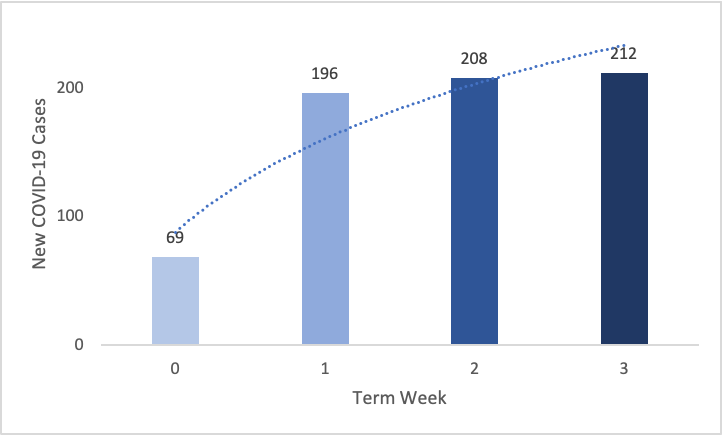
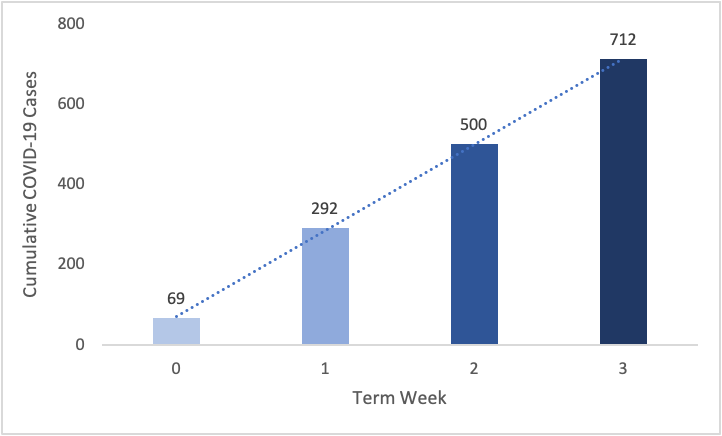
The University’s testing service has confirmed 212 cases of COVID-19 among students and staff for the week 24th-30th October, with a positivity rate of 29.2%. This marks the third consecutive week in which the number of new cases has remained constant and brings the total number of confirmed cases since the implementation of the University’s testing service on August 20th to 708.

The University’s Status and Response website states that the figures released do not include positive test results received outside of the University testing service. It notes further that “due to the time interval between a test being done and the result becoming available, it is expected that there will be a mismatch between actual results and those confirmed to us on any given day”.

On Saturday, Oxford was moved into Tier 2, which will remain in place until new national lockdown restrictions come into place on Thursday. Following the government announcement on Saturday night, the University has updated its guidelines: “New National Restrictions will be introduced from this Thursday (5 November). The University is now considering the impact of these measures, and further information will be made available on these pages as soon as possible. You should also refer to the UK Government website for the latest advice.”

Figure 1: Cumulative COVID-19 Cases recorded by the University’s testing service. Data: https://www.ox.ac.uk/coronavirus/status
Figure 2: New COVID-19 Cases recorded by the University’s testing service. Data: https://www.ox.ac.uk/coronavirus/status

Until Thursday, Oxford will remain in Tier 2 and residents will have to adhere to the following new measures:

  • People cannot meet “socially” with anybody outside their household or support bubble indoors, including at home or in public places such as restaurants and bars. 
  • People should try to reduce the number of journeys they are making, and if they need to travel should avoid public transport where possible. 

The University has implemented a four-stage emergency response, depending on how wide the spread of COVID-19 is. The current status is Stage 2, which allows the University to operate “in line with social distancing restrictions with as full a student cohort as possible on site”, with teaching and assessment taking place “with the optimum combination of in-person teaching and online learning”. A Stage 3 response would imply “no public access to the University or College buildings” and “gatherings for staff and students only permitted where essential for teaching and assessment to take place”.

Conflict in the Caucasus: The escalation of the Armenian and Azerbaijani conflict

0

Recent clashes between Armenia and Azerbaijan have left many dead on both sides. As a result, further violent protests took place around the world. Cher and the Kardashians have been among the many outspoken individuals, seeking to raise awareness and demand action.

Both sides accuse the other country of igniting the conflict. The fighting has been conducted mainly through artillery and drones, to deadly effect. The current skirmishes appear to show the most serious spike in hostilities since the April War of 2016 which saw hundreds killed over several days of fighting.

Violence erupted in the afternoon of the 12th of July along the two countries’ northern border of the Tovuz District of Azerbaijan which borders Armenia’s Tavush Province. 16 people are reported to have been killed, a civilian amongst them.

In a statement released by Azerbaijan’s foreign ministry, it was revealed that the civilian killed was a 76-year-old member of the village of Agdam. It claims the attacks on the civilian population were deliberate and “an integral part of Armenia’s aggressive policy”. It went on to add that Armenian armed forces “continuously” shelled Azerbaijani population centres from heavy weapons and also seriously damaged people’s farmsteads and properties, and infrastructure in residential areas.

The violence left multiple Azerbaijani servicemen dead. Protests were sparked in the country’s capital Baku following the funeral of an army general who was killed. An estimated 30,000 people took to the streets demanding the Azeri government fully deploy the army in all-out war against Armenia demanding “Start the war” while shouting “Death to Armenians” and “Karabakh is ours”. Several demonstrators also managed to break into the parliament building.

Armenia, meanwhile, has accused Azerbaijan of bombing a Kindergarten building in the village of Aygepar. Reports have also emerged of Azerbaijani forces using human shields in order to attack the Armenian position. Azerbaijani soldiers allegedly used the gardens and yards of civilians in order to fire at Armenian forces knowing that return fire would not be possible. There have also been reports of the Azerbaijani military opening fire in the direction of a mask production factory, which plays an essential part in the country’s coronavirus response. A Chernobyl style ‘catastrophe’ has also been threatened by the Azerbaijani Defence Ministry spokesperson who has claimed that Azerbaijani drones are capable of targeting an Armenian nuclear power station.

This is no new occurrence. The two countries have been locked in conflict over the Nagorno – Karabakh region since the end of the 1994 war, which followed the collapse of the Soviet Union. The territory is currently inhabited by ethnic Armenians and is known locally as Artsakh. It is nevertheless internationally recognised as part of Azerbaijan.

The recent violence took place to the north of the disputed territory which led the Turkish foreign ministry to claim that the attacks were “attempts by Armenia to divert the attention of the international community from the illegal occupation of the Azerbaijani territory of Nagorno-Karabakh… and to block the political solution by adding new dimensions to the conflict”. Turkey is Azerbaijan’s closest political ally.

Russia, one of Armenia’s closest allies, has called any escalation of the situation “unacceptable” and urged restraint and compliance with the ceasefire on both sides. Trust in Russia has declined in Armenia recently according to public opinion surveys. Russian arms sales to Azerbaijan despite its strategic partnership with Armenia may be one of the factors behind such a decline.

Around the world protests and violence by the diasporas of both countries have taken place. In Los Angeles, a violent clash between Armenian protestors and Azerbaijani protestors erupted in front of the Azerbaijani consulate resulting in the injury of four people, including a police officer. In London, scuffles broke out in front of the Armenian Embassy between Azerbaijani protestors and Armenian counter protestors. “Safarov” was allegedly chanted by the Azeri side. Ramil Safarov is an Azerbaijani Army Officer who axed an Armenian soldier to death in his sleep during a NATO sponsored training seminar in Budapest. Having been convicted and sentenced to life imprisonment in Hungary, he was then extradited back to Azerbaijan, welcomed as a hero and pardoned by the president Ilham Aliyev.

Prominent celebrities have also tweeted their solidarity with Armenia over the recent conflict. Cher tweeted about Azerbaijan’s threat to bomb Armenia’s nuclear power station. Kim Kardashian tweeted about Azerbaijan’s unprovoked attack on Armenia during a global pandemic, ignoring the UN’s appeal for a global ceasefire. The hashtag #SupportArmenia has been widely circulated on social media platforms. Baroness Cox has also written to Foreign Secretary Dominic Raab urging a firm stance be taken by the British Government to work with the Armenian Government to ensure security in the region. She has also urged immediate steps be taken to promote de-escalation of the conflict.

Despite unanimous calls for the de-escalation of the conflict, deep ethnic and historic ties to the territory on both sides means that a resolution to the conflict seems unlikely in the near future.

Fatima doesn’t want a job in cyber – and she knows it

0

Throughout the pandemic, the government has been repeatedly criticised for their lack of support for the arts. This was compounded last week with the government’s cyber recruitment advertisements. One of these adverts included a ballet dancer sitting next to the text, ‘Fatima’s next job could be in cyber. (She just doesn’t know it yet).’ The internet exploded at the crass advert. Many pointed out that the advert was only made possible by people in the creative industries, including ballet dancers. This was only made worse by the Culture Secretary visiting the Royal Academy of Dance the same day. At a time when thousands of performers have been unemployed for months and with no sign of being able to return to work, was the internet right in its fury?

The dance industry has been one of the worst-hit sectors of the performing arts. The Royal Opera House has lost £3 of every £5. They are now selling a David Hockney painting, estimated at £18 million, to save jobs. The English National Ballet had to furlough 85% of its ballet dancers and staff and saw its lowest box office takings since 2011, below 40%. Tours and productions have been cancelled, dancers have had to make the gut-wrenching decision over whether to stay in the UK or return to their home country and social distancing rules has meant that dancers have been unable to dance with others.

Ballet, indeed any performing art, is not an easy career choice. I should know. Since the age of four I have trained to become a musician and now work as a freelance composer. I studied for years to hone my craft before reaching an undergraduate and postgraduate level. I’ve put in hundreds of hours practising, rehearsing and studying to perform at the highest level possible. I’ve travelled sometimes hundreds of miles across the country to pursue my chosen career and supported the cost of my training by working, sometimes multiple jobs at a time. This is not so that I can have a hobby that I can pick up or drop whenever I fancy, but so that I can have a career in a sector that is constantly challenging and brings a huge amount to the country, spiritually and financially.

This was not the first insult that the government had made towards the creative industries since this pandemic began. At the start of the pandemic, the government stated that performers, the majority of which are freelancers, could claim some of their income through the Self-Employment Income Support Scheme. However, it soon became apparent that freelancers would only be able to claim 20% of their income. It took the government months before proudly announcing a £1.57 billion package for the arts in July. Unlike packages other countries were using to support those working in the arts, the government’s package meant that money could only be used to protect venues and businesses. It did not support the people who make the arts possible. The final insult was made by Rishi Sunak’s in an interview to ITV News where, when asked specifically about support for musicians and those in the arts, Sunak suggested that only jobs that were ‘viable’ would be supported and saved and that people should retrain.

All of this has occurred at a time when the arts have been in greater demand than ever before. People across the world have turned online to watch British films, television series’, plays, ballets and concerts as well as the flood of free material that our artists have poured online. At a time when people have been unable to see and support loved ones, sometimes for months at a time, the public has turned to the arts to help express their feelings and reconnect with people. For the government to repeatedly disregard the tremendous contribution the arts have made during this pandemic is thoughtless at best and at worst offensive.

The idea that the natural progression from ending a ballet career should be working in cyber shows a huge lack of understanding of the industry. Many ballet dancers on ending a performance career continue in the industry in some form, whether as a teacher, choreographer, director, ballet master/mistress, community arts therapist, performance psychologist, physical physiotherapist, arts journalist, fitness trainer, studio owner. Why wouldn’t they? They’ve invested a lifetime’s work into an industry that they are highly knowledgeable and skilled in. Why would they abandon it?

Fatima doesn’t need to retrain. She trained for decades and invested financially and personally to an arts industry that contributed £32.3 billion to the economy in 2018, according to the government’s own report. The thousands of students currently training in the arts don’t need to retrain. They are working in an industry that studies have proven time and again to improve children’s development and our mental and physical health. Those already in the arts don’t need to retrain. They already have a wealth of skills that, if this government is not careful, they will take abroad where they can use them and be respected. The arts are more than ‘viable’. They are vital. When will the government realise this?

‘Consent Matters’ Review: University offers Stick Figure Sex Education

0

TW: discussions of sexual assault and harassment. Slurs and verbal abuse against women.
Anyone affected by the themes of this article can contact Oxford Univerity’s Sexual Harassment and Sexual Violence Support Service.

Coronavirus safety regulations are jeopardising not only the glitzy club nights and socials of Freshers’ week but, more importantly, the consent education necessary to protect its vulnerable students from attack. Sexual harassment and assault are rampant in universities, often disguised as jokes, sometimes not disguised at all. Restrictions on the size of student meetings require that workshops stay online. But it is clear these workshops are necessary to address the problem of sexual assault and harassment in our University. They must be standardised across colleges, occur on Zoom or in-person, and, most importantly, must include discussion. Tick-box online courses are not fit for purpose in addressing problematic views or tendencies. It does not allow facilitators to moderate or flag dangerous attitudes and, by extension, puts students at risk.

Consent Matters, an online course by Epigeum, has been touted in a uni-wide email to freshers as a way to “develop your understanding, communication and respect.” It asks, tepidly, that all students participate, ignoring the blatant fact that the students most likely to join are the least likely to need it. Consent education must be mandatory, or it will not catch the niche of students unaware of the complicated sexual scenarios hurtling their way from the fresher’s week bar and post-corona bops.

Perhaps, it may be posed to this article’s cynical writer, that such an online course can tackle topics too awkward and gritty for face-to-face seminars. Perhaps, Consent Matters will be thought-provoking, shake the unaware students from their virginal high school ignorance. “Whore,” this erudite sexual scholar, “is not a very nice thing to call a woman.” Consent Matters believes lessons of this broad, vague, common-sense vein are all that sex-ed is able to teach. It manages to avoid the hard truth that women (including myself and my friends) have been called ‘whores’ even in Oxford, even by other students. Yet, it simultaneously confines its lessons to a sterile overview of the most obvious situations. Students do not need to be told that misogynistic slurs are inappropriate. They do need to be told how to tell whether someone is too drunk to consent. They do need to be told what types of comments on women’s bodies or dress are hurtful or sexist. If Consent Matters wants to teach students not to use misogynistic slurs, then it should do so in unequivocal terms that do not shy away from the common reality of female students who suffer this abuse on the regular.

With other such pithy wisdom awaiting me, I travelled hopefully into three twenty-minute modules proposed by the University to address our problem of sexual assault and harassment. Consent Matters combines a series of endearing stick figures tackling topics completely unrelated to the experience of sexual assault and harassment on modern campuses. In the last module, for instance, a stick figure walks up to a couch, on it a sleeping fellow student. “Sex?” the stick figure asks, to the other stick figure, reposing on the arm of the couch, wine glass slipping out of his anatomically incorrect fingers. In another cartoon, a perplexed friend stands by as his friend vomits on the floor of the bar. When a nefarious stick figure attempts to take the drunken victim home, the friend is perplexed: should he intervene or not?

These anecdotes preach, through beady-eyed cartoons in the style of Gaiman’s “How to Talk to Girls at Parties” that one should not have sex with girls who have had a drink. We aim to provide “realistic advice” and it acknowledges uni students may still, against Epigeum’s advice, have their drunken reveries. This advice lacks (pun intended) a human touch. A consent facilitator, on this topic, would immediately discuss body language which would indicate a potential partner is apathetic, too drunk, or (ideally) enthusiastic with their non-verbal consent. Consent Matters is sterile, lacking in any practical advice which will help students navigate the real sexual landscape.

At best, Consent Matters is patronising (the acronym FRIES, anyone?). At worst, it woefully fails at preventing/mitigating dangerous tendencies in its students. Colleges, due to safety concern and the new six-person rule, are unable to hold consent courses in person. There are not enough trained consent facilitators to take on mere groups of five. The danger is colleges will rely on Consent Matters to reduce instances of sexual assault and harassment, and will not supplement adequately with online workshops. Consent Matters is not fit for purpose as the sole method of consent education.

Colleges may choose to supplement the course with additional material. They are not obliged to. It is probable that students, asked or even mandated, to take the course will click through using the upper right-hand arrows, digesting none of the content and consuming the (ostensibly 1 hour long) course in a mere five minutes. Consent Matters is not fit for purpose as the primary method of consent education. As a consent facilitator myself, I know all too well that the handouts, power-points, pithy buzzphrases, and cheeky acronyms of consent education do nothing to provoke change. Ask anyone who has chaired a consent workshop – “why are we here?” The discussion.

Scenarios are posed; freshers are given time to read; and at the end, the group discusses any consent issues and how we personally might react. Consent facilitators are there to answer questions that otherwise go unanswered. I once had a participant brush away his 2012 Bieber-bangs and ask, in the mire of fresher’s week awkwardness, how one could ask for consent without killing his partner’s arousal. I looked at that man, gave him an equally awkward answer, regarding dirty talk and body language too explicit to be recorded here, but felt, in hindsight, glad that someone had given him the straight answer needed to be a consent-focussed partner, however awkward that exchange had been for both of us. Indubitably, students are emboldened by the safe space of consent workshops, free to ask questions and receive practical answers that the Epigeum stick figures are unable to give.

There is a darker side to these consent workshops. Students have asked me how it could be rape if someone, blackout drunk, hadn’t said, ‘no.’ Bop outfits, however fashionable, tasteful, and well-themed, have subjected their female wearers to name-calling of the harshest degree. “Whore.” “Slut.” “Slag.” These words are not the arsenal of a drink-emboldened stranger down Cornmarket. They are said jokingly. Endearingly, even. By other students. University administration and the misguided writers of Consent Matters are disconnected from the reality of sexual assault and harassment in Oxford. A course which divorces consent education from face-to-face discussion is ineffective. The students most likely to take, with earnest attention, this online consent course are the least likely to need its guidance. The University must impose a mandatory course, consistent across colleges, which allows discussion between consent facilitators, freshers, and their peers. It is worth the expense and time for us to answer those awkward real-life questions and, in doing so, reduce the emotional and physical danger to our students.

The author wishes to remain anonymous.

Greta’s Gap Year: A Catalyst for Change?

0

It has become quite self-evident to say that solving climate change requires a united effort from all stakeholders around the world. But what is the role of the climate activist in this complex landscape, and to what extent do they truly catalyse change?

When the term “climate activist” is mentioned, the first person that comes to your mind might be a teenage girl from Stockholm. On 24 August 2020, after a year of campaigning, Greta Thunberg ended her sabbatical year, and returned to school in Sweden. The 17-year-old climate activist may not have been in the spotlight a great deal the past few months due to the COVID-19 pandemic, but by now, most people are probably aware of her and what she stands for.

Throughout the past year, Greta has kept herself busy as a climate activist. She rose to global prominence when she addressed world leaders at the UN Climate Action Summit in New York City on 23 September 2019. In her searing speech, she admonished world leaders for their “fairy tales of eternal economic growth” in the midst of the impending climate catastrophe.

“I shouldn’t be up here. I should be back in school on the other side of the ocean. Yet you all come to us young people for hope. How dare you! You have stolen my dreams and my childhood with your empty words,” she chided.

The online reactions came swiftly, with some applauding her for her unabashed bravery, and others responding with ad hominem attacks. Politicians were not pleased either: Brazilian president Jair Bolsonaro responded by calling her a “brat”, while Vladimir Putin dismissed her for being “poorly informed”. The criticism, however, did not faze Greta, who carried on with her activism in full force. In the same month, she went on to lead a series of climate strikes across Montreal, Canada, which gathered an estimated 315,000 to 500,000 people.

Greta also spoke at the UN Climate Change Conference (also known as COP25) in Spain in December 2019. The conference was initially meant to take place in Santiago, Chile, and Greta had planned to travel overland to arrive there. However, a last-minute change in location of the conference due to political unrest in Chile meant that her travel plans had to change as well. Refusing to travel by plane, she took to social media and sought for help, eventually sailing across the Atlantic on a catamaran owned by an Australian couple. She carried this momentum into the new decade, addressing world leaders once again at the World Economic Forum (WEF) in Davos, Switzerland in January. Even the COVID-19 pandemic did not stop her from organising a series of “digital strikes”, where she invited social media users to post pictures of themselves with protest signs.

The question now, as Greta returns to school, is whether she has been successful in changing the way nations, businesses, and individuals view and respond to the climate crisis over the past 12 months. Quite clearly, her work has made significant ripples. The growing public awareness of climate change – evinced by how Google searches for the phrase ‘climate action’ and ‘climate emergency’ increased twenty-fold in 2019 – can likely be attributed to her, thanks to her ascent to global stardom after the UN Climate Action Summit in New York. And while some politicians have dismissed her entirely, others have acknowledged the pertinence of Greta’s viewpoints. German Chancellor Angela Merkel admitted that her government was driven to act faster on climate change due to young activists like Greta, while Joe Biden, the 2020 US Democratic presidential nominee, told US President Trump to “learn a few things from Greta on what it means to be a leader”.

On the level of national and regional policies, however, Greta’s efforts have not led to much significant change. Despite (or perhaps because of) her harsh rebuke at the New York summit, some world leaders at the WEF in Davos earlier this year remained unconvinced. Coming out of the forum, Greta commented that world leaders “completely ignored” her demands for an immediate end to the fossil fuel economy, and that climate change was still not being treated like the crisis that it is. In addition, Trump still intends to withdraw from the 2015 Paris Agreement, which will terminate US$3 billion of funding for climate change research and compromise on the world’s ability to reach the Agreement’s goals.

It is probably unfair to blame Greta for the limited extent of change on the policy front: after all, she has had merely a few months to campaign on the global stage during her gap year, before the COVID-19 pandemic swept across the world and occupied most of the media’s attention. (It should be mentioned, however, that Greta has been actively campaigning even before 2019. For instance, she criticized world leaders at the COP24 in 2018 for not being “mature enough to tell it like it is”. Prior to her gap year, she had also been staging weekly protests outside the Swedish parliament.) Furthermore, considering that it took decades of scientific research to convince the world of the seriousness of climate change, it is a tall order for a 17-year-old teenager to change the trajectory of the world within 12 months. We should also remember that the end of Greta’s sabbatical does not mark the end of her activism, for she is likely to continue fighting.

Notably, when Greta first rose to global prominence last year, some pointed out that she is far from the first youth climate activist, and therefore should not be the only one whom we pay attention to. Indeed, social media users responded to Greta’s meteoric rise by sharing information about other less prominent – but equally respectable – youth activists, particularly those from the global South and/or those of non-white ethnicities. There is, for instance, Helena Gualinga, an 18-year-old indigenous environmental activist from Ecuador, who shared her concern about oil extraction from indigenous land in Ecuador at the COP25 in Spain. Such examples should not, of course, be viewed as an attempt to undermine Greta’s achievements, but as an invitation to expand the space for climate change discourse to include a greater diversity of voices, particularly because the effects of climate change are expected to be the most severe in the developing world.

As Greta now heads back to school, in a world completely different from the one we knew just a year ago, many are hoping for a green recovery from the pandemic, to pave the way for long-term sustainable growth. Of course, it is entirely possible that world leaders will simply stick to their old playbooks, focusing on economic recovery with renewed passion at the expense of environmental sustainability. Just don’t expect Greta Thunberg to take that lying down.

Atmospheric autumn reads: ‘Cemetery Boys’

0

Each year, when I find my romantic sensibilities tingling, I know it’s autumn again. Everything from its unique palette of warm colours to its scenes of “whispers and small laughters between leaves and hurrying feet” (to nick a line from T. S. Eliot), family reunions and festivities, and bountiful harvests piques the imagination. Death may linger in the air, yet refracted through the bustle of activity, the coming of winter promises renewal and rebirth: soon, it will be autumn again – and for people of many nationalities, ethnicities and religions, the last days of the season are for remembering and honouring the departed and the past.  

The Mexicans, for instance, celebrate ‘Día de Muertos’, the ‘Day of the Dead’. From October 31st to November 2nd, communities gather together to welcome the spirits of the dead home. They clean and furnish the graves of loved ones; set up ofrendas (altars) for them with mementoes as well as their favourite food and trinkets; decorate the communal space with bright candles and marigolds; and party all day and all night. It is a time when themes of tradition, memory and family come to the fore, and in recent years directors and writers alike have told stories along those lines. Lee Unkrich’s animation Coco (2017) comes to mind, and this year, just in time for autumn, we have Aiden Thomas’ YA debut Cemetery Boys (2020).

Cemetery Boys unfolds among a Latinx community of brujx, guardians of the paranormal world whose powers are granted by the Latin American goddess, Lady Death. The protagonist and narrator, Yadriel, is one of them. Or at least, he wants to be: because he is transgender, his traditional family and community will not accept him as a brujo. They have delayed his quinces ceremony where he would’ve received the blessing of Lady Death and been able to effectively wield magic.  The novel begins just before ‘Día de Muertos’, which the brujx celebrate as their most important festival. Yadriel’s cousin is mysteriously murdered, and his body is nowhere to be found. If his spirit is not summoned and released before ‘Día de Muertos’, he cannot return along with the other departed brujx. Yadriel sees a chance to prove himself. If he can perform the quinces ceremony and summon and release Miguel’s spirit, the brujx will have to see him for who he is. With the help of his other cousin and best friend, Maritza, he carries out his plan. But instead of Miguel, the ghost Yadriel summons is his schoolmate Julian, who is determined to find out about his death as well as make sure his friends and family are okay. Together, Yadriel and Julian journey to solve a murder mystery as literal and metaphorical ghosts close in and autumn draws to an end.

Cemetery Boys is the perfect autumn read for so many reasons. The characters revel in the spirit of the season, casting the novel in a warm, hazy glow that is all the more atmospheric. Julian, in particular, is autumn’s dynamic side incarnate: funny, reckless and outgoing, he lights up the pages of the novel. Julian and Yadriel travel all around Los Angeles, and as we follow them from the underground to the streets, suburbs, woods, beach, sea and back, scene after scene of autumnal wonder unfolds before our eyes. What better image of autumn is there than two boys driving along the coast and watching the sun set as their hearts beat along to the car engine? Thomas appears particularly fond of descriptions of the sky, its different hues and tones, and I think I know why: it is only fitting that, in a novel about two boys who are brave, young and brimming with life, the narrative focus is directed to the horizons to create a sense of expansive possibility.

Thrumming along autumn’s energy and liveliness is its Bakhtinian carnival spirit. For Mikhail Bakhtin, the carnival is a transgressive and liberating alternative to established power structures and authorities. Autumn can be seen in this light as its many festivals – whether Halloween or All Hallows’ Eve or ‘Día de Muertos’ – place emphasis on communities bonding together and creating a space of celebration and joy. In Cemetery Boys, the young adults form a carnivalesque community. Coming from disadvantaged and/or marginalised backgrounds, they support one another in collapsing the suffocating traditions of their society and finding their true selves. Yadriel has to establish the fact that he is a man and make his family come to terms with who he is. Julian has to learn to navigate the complications and nuances surrounding families and relationships. Maritza, meanwhile, struggles to perform her bruja magic because traditionally animal blood is used in the process, and she is vegan. These young men and women make a home for one another. Their carnival spirit gradually spreads to those around them, and as the novel progresses we begin to see the possibility of a utopia where everyone is accepted for who they are.

Another major subject which makes Cemetery Boys so autumnal is death. Spirits and ghosts, of course, can be found in every corner of the world of the novel, but Yadriel and his friends are haunted by more than that. For Yadriel, it is his past identity and past self as a girl. Yadriel has put his past behind him, but because of his family, it threatens to overshadow him like a malignant ghost. This theme of death, rebirth, and renewal can perhaps be traced in the brujx community as a whole, whose younger generation has prompted them to change: they, too, have to let some of their unreasonable ancient traditions die away to be reborn into a stronger community. It is thus no wonder that Thomas chose to tell a story about this particular area of Latinx folklore and culture: the brujx’s ability to see, summon, and release departed spirits is a metaphor for the rite of passage they must go through.

And that is why, to me, Cemetery Boys is ultimately a celebration of life. The novel shows us a utopian vision in which our ghosts can be cathartically released, in which rebirth and renewal is possible. This year’s autumn is certainly a peculiar one: we have not yet had the time to recover from months of lockdown, but cases are already rising again, and the winter ahead is looking grim. I’m not saying that reading Cemetery Boys will solve any problems, but it at least, I hope, allows us to imagine a vision of autumn that is brimming with life and love, opening a window to and promising a better world.

Oxford responds to no holiday free school meals

0

Since the government voted down Labour’s proposal to provide free school meals throughout the school holidays, various sources in Oxford have responded, both in favour and in opposition of the decision.

Local government has been split. All four of Oxfordshire’s Tory MPs voted against the extension, while Labour MP for Oxford East, Anneliese Dodds, and Liberal Democrat MP for Oxford West and Abingdon, Layla Moran voted in favour.

The Conservative MP Robert Courts of Witney defended his decision, saying: “The Government has provided £9.3 billion extra to help those most in need during the pandemic. An additional £63 million has also been made available to local authorities to ensure that targeted support is available to those needing help with food and other essential.

“Free school meals have always been meant for term time and the best, most sustainable way to support families outside of term time is through Universal Credit.”

Victoria Prentis, MP for Banbury and Parliamentary Under Secretary of State for Food, said: “I am not blind to the challenges many children and families are currently facing. […] Schools have worked tirelessly during the pandemic. It is neither reasonable nor sustainable to ask them to continue to provide food for pupils outside of term time.”

A senior Labour councillor from Banbury, Sean Woodcock, has criticised Ms Prentice, suggesting that 2,092 children in the Bicester and Banbury constituency are at risk of going hungry.

Anneliese Dodds said: “No child should go hungry over the holidays. I am deeply disappointed that the Government blocked the action needed to prevent this.” Layla Moran shared the sentiment, saying in Parliament that the extension should have been “a no-brainer.”

Oxford’s Lord Mayor, Craig Simmons, tweeted that, “About 3,500 school children in Oxford are eligible for free school meals. I have asked what can be done in Oxford City to help outside of term time.” So far, Oxford City Council have announced that they are providing vouchers of up to £15 per child over half term.

The City Council told Cherwell: “Support mechanisms are in place to help vulnerable families, and these have been targeted at those who need it most. Oxfordshire’s councils have a strong track record of delivery through third-sector partners and these links shone through during the lockdown period earlier this year.”

Councillor Marie Tidball told Cherwell: “The brinkmanship of the Conservative government in stubbornly refusing to support the extension of free school meals over half-term and Christmas is creating fear and anxiety amongst children and families who receive them.”

Over 30 councils across England including Liverpool, Greater Manchester, Rotheram, and some London boroughs have pledged to provide free school meals during the holidays.

According to the House of Commons Library, 10,127 children across the county were known to be eligible for free school meals in January 2020. When asked how the vote was likely to affect these children, Oxford Mutual Aid, a local community support charity established during the pandemic, told Cherwell that the decision “is disastrous for families.”

They already deliver more than 100 food parcels and over 750 cooked meals per week and receive up to five emergency food parcel requests every day. They predict this number will rise.

They added: “Although this policy will have a hugely negative impact on the community, it is also cause for people to come together and support each other.”

Many local charities and businesses have stepped forward to provide aid to these children. Oxford Mutual Aid, for example, has partnered with local independent school, St Edwards, along with local restaurant, Taste Tibet, to provide free meals to those in need. Similar initiatives have opened up across the county, including the Deli-licious coffee shop, Mission Burrito, and PHO in central Oxford.

Various food banks in Oxfordshire provide support, which can be found here. Donations to the Oxford food bank can be made online or at local supermarkets.

Image credit to David Iliff/ License: CC BY-SA 3.0

Local councillor appears to insult cyclists

0

Liam Walker, an Oxfordshire councillor for transport, became subject to scrutiny last week after responding to a tweet insulting cyclists. There has since been a formal complaint against Walker, which is under investigation by the Oxfordshire County Council. 

The tweet came in response to a suggestion from the Twitter account Build Back Better Ox, which cited superior infrastructure as the best means of improving cycling capacity in Oxfordshire and linked to a YouTube video demonstrating the efficiency of the Dutch system. 

A Twitter user replied to the post, suggesting that cyclists who praise the Netherlands for its attitude to cycling should simply relocate there, to which the councillor replied that it was “well put”. This tweet met was met with widespread negative reactions from local cyclists and residents, among these being Green Party councillor Dick Wolff’s letter calling for the councillor to be dismissed. 

Both the tweet and Walker’s reply have since been deleted. In an article by the BBC, Walker is quoted as saying that he “implied [he] agreed with the view” that people who supported a “pro-bicycle” outlook should move to the Netherlands, and states that it was “a tongue-in-cheek-comment”.

Mr Walker has also stated that he is “sorry if anyone was offended” and denied that he was attempting to discourage people from adopting more sustainable transport methods. He has also addressed the resignation of former Oxfordshire cycling champion Suzanne Bartington, calling it “a great shame” and promising that active transport remains on the council’s agenda.

Image Credit: Tejvan Pettinger.

Local residents campaign against St John’s quarry plans

0

For the past five years, residents of Barford have protested a county council minerals plan that would lead to a large sand and gravel quarry to be built on the edge of their village. The land it would be constructed on is part of the assets of St John’s College.

Protestors argue that the quarry would contradict claims that St John’s “takes every opportunity to reduce its environmental impact”, as published on their website.  

Matt Western, MP for Warwick and Leamington, has stated that his belief that “the proposed quarry has wide-reaching negative implications for public health and environmental protections.” He has further said that this specific quarry “is the only site in the minerals plan in such close proximity to a residential area, and it simply isn’t needed” claiming that the site was proposed on predictions of overinflated figures for housing demand. He has supported the Barford campaign for an extended period, securing a debate in parliament and presenting a petition urging the government to intervene and halt the proposals. 

Those protesting argue that the construction of this quarry could expose 1,500 villagers and 200 primary and nursery school children to toxic particulate dust, causing permanent damage to their lungs. The building of the quarry would also destroy the high-quality agricultural land. 

Charlotte Morgan, Oxford University alumna and committee member of Barford Residents Association, said: “The college says it does all it can for the environment, but this is a huge site, with top grade of agricultural land, growing four different crops of vegetables a year. If the quarry goes ahead it will never be restored.”

St John’s College released a statement concerning their involvement: “As a registered charity and landowner, we have an obligation and responsibility to both the local community and county to respond to a request for sites, via our appointed agents, to be considered to provide sand and gravel for the district councils to build homes for those people needing homes in the future.”

A committee member, Malcolm Eykyn said: “We have worked tirelessly for the last five years raising awareness about the proposed quarry threat as well as raising substantial funds to help fight our cause.” The villagers raised £15,000 in vital funds in less than two weeks during March, in order to provide professional advice to prepare the best case to take to the inspector in a meeting held last Tuesday. 

Last Tuesday, in one of the final rounds of the decision being made, government inspector, Stephen Normington, heard both sides of the argument, attempting to resolve the ongoing dispute. While a final decision remains to be made, he has stated that “without prejudice to my eventual conclusion on the soundness of the Plan, the concerns raised by participants do appear to have some degree of basis”.

Image Credit: Wikimedia Commons.