


Blog Page 485

The limits of liberté: France’s ‘global security law’

0

At the end of November, returning to the UK on my way back from the first part of my year abroad, I passed through the Place de la Bastille and the Place de la République in Paris. Over the years these two squares have played host to thousands of people protesting against political and social injustice. A mere couple of hours after I had left, they were once again awash with protestors and police officers in full riot gear, silhouetted against a backdrop of tear gas and plumes of firework smoke.

As alarming as this sounds, it was by no means an unprecedented occurrence. Tensions between participants and the French security forces have always been high at demonstrations such as these, particularly since the emergence of the gilets jaunes (‘Yellow vests’) movement in 2018. However, whilst police and gendarmes have always been a presence at protests, on the 28th of November they not only found themselves at the heart of the action, but at the root of the protest’s cause. The explanation for this shift? A proposed law which talks about ‘global security’, camera phones and protecting police identity.

The ‘global security law’ was passed by the French National Assembly in mid-November and was awaiting approval by the Senate when the waves of public protests against it began. It gives legal justification for police and gendarmes to share footage captured on their body cameras and for security forces to use drones to monitor public spaces. The most controversial section is article 24, which criminalises the publication of images of on-duty police officers if there is an intent to damage “physical or psychological integrity”. The latter offence would be punishable by up to a year’s imprisonment or a fine of €45,000 (£40,500).

The proposed law has attracted severe criticism both within France and from members of the international community. Journalists’ unions and French politicians (including some representatives from within President Macron’s own party, La République en marche) have condemned the bill for undermining freedoms of the press and expression. They are concerned that people will be discouraged from filming acts of police violence for fear of prosecution. Nor has the law escaped the wrath of the French public. According to government figures, on 28th November 133,000 protestors across France took to the streets to voice their opposition. These protests were mirrored, although not quite to the same scale, in the weeks that followed.

It might be tempting for onlookers to roll their eyes and dismiss the entire episode as an example of French protectiveness surrounding their beloved liberté d’expression. After all, freedom of expression has been embedded in French culture since the Revolution. Freedom of the press (and by implication the freedom to inform and be informed through diverse forms of media) was awarded explicit legal protection in 1948. Yet some aspects of the proposed law have caused some anxiety from a universal human rights perspective.

Amnesty International, the European Council and the UN have all expressed concern over the global security law. Advisory experts to the UN Human Rights Council have judged the bill to be “incompatible with international law and human rights”, a bold statement which has been echoed by Michelle Bachelet, the current UN commissioner for this area. Particular unease surrounds article 24, prompting many NGOs to call for the article to be scrapped altogether. Clearly, this is much more than a case of the French ‘overreacting’.

Criticism of this law goes much further than defending a core element of French culture. As well as being seen as a means of protecting freedom of expression, the right to film on-duty police officers has become a key tool for those seeking justice against instances of police brutality. The most widely known examples of this, such as the murder of George Floyd, centre in the US. But one recent French incident to make international headlines concerned the black music producer Michel Zecler, who was attacked by four police officers in his Parisian studio in November. According to Zecler’s lawyer, it was primarily due to the CCTV recordings of the event that he has been able to pursue legal action. When news of the case emerged the global security law was already under heavy scrutiny, fuelling public indignation and motivating several key members of the French sporting community to express their outrage over the matter.

Less publicised was the case of Cédric Chouviat, a father of five of North African descent, who was stopped by police in Paris. After being pinned down by three police officers, he died in hospital two days later. A broken larynx was listed among other injuries in the autopsy report. The officers involved denied any wrongdoing, but several passing motorists filmed the incident, providing footage which some have said was instrumental to the opening of a criminal case.

These two cases, along with images showing French police using force when deconstructing a migrant camp in Paris a few months ago, reflect the growing global awareness around police brutality that has emerged during the past year. Whether the level of violence itself is rising is open for debate – some argue that a number of police officers have been employing similar methods for years and that the true picture is only just coming to light. But the experiences of Zecler and Chouviat (among others) also demonstrate the vital role that civilian footage can play if police officers deny the use of violence. Restricting the right to film these incidents is seen by many as inhibiting justice – the right to which is recognised in international law.

Yet to declare that the global security law is an unquestionable breach of international human rights would be to ignore the opinions of those who find themselves on the other side of the debate: the police officers themselves. The lawmakers who drafted the bill claim that they had no intention of limiting freedoms of expression or the press; their primary concern was the protection of individual police officers.

In recent history there have been cases where images of French police officers have been posted on social media with the purpose of identifying them and causing them harm. The rather woolly phrase describing “a threat to physical and psychological integrity” in article 24 refers to the very real fear that some officers have for their own or their family’s safety, should they make enemies whilst carrying out their duties. The police “are not protected enough”, insisted the French Minister of the Interior, Gérald Darmanin, when questioned on the article’s relevance.

Moreover, there are those who believe that the proposed law does not go far enough to ensure the protection of individual officers. Numerous regional leaders of police unions have expressed their desire for more decisive government intervention in the matter. “We want actions, laws and regulations which will protect our officers,” said a departmental representative of the union SGP Unité Police. The French government thus finds itself in a rather problematic position, unable to fully satisfy either group’s demands and accused of undermining people’s rights on both sides.

Darmanin has tried to bridge the gap between the camps by insisting that “protecting police and preserving freedom of the press are not in competition”. Yet such comments remain unconvincing when juxtaposed with the words of Christophe Castaner, parliamentary leader of LREM, who described it as a balancing act between the two. Should concerns over police safety prevail over the right to freedom of information?

In turn, this raises the question of whether police officers – in France and elsewhere – deserve the level of individual protection that the bill affords. The right to privacy is stated in the 1948 Universal Declaration of Human Rights and is mentioned in over 150 national constitutions. However, public figures who cite this right (often after details of their private lives have appeared in the tabloids) are frequently met with the argument that they sacrificed this right when they entered the public sphere. The public has the right to know what the country’s representatives are doing, and therefore any legislation ‘concealing’ these private details would be a violation of both the freedoms of expression and of information. 

Police officers are by definition employees of the state. Back in 2019, ten officers involved in misconduct proceedings in Scotland lost a battle to discount a series of Whatsapp messages as evidence in the case. Senior figures in the Scottish judiciary system concluded that police officers should be held accountable to certain standards whether they are on or off duty, in order to preserve public faith in the law enforcement system. The case in question concerned private messages as opposed to identifiable images, but the message resonates with our debate: in many Western democracies, police officers cannot expect the same right to privacy as ordinary citizens. For those who interpret this principle in its most fundamental format, French officers have no right to the level of individual protection that the proposed global security law awards them.

It is all very well to come to this conclusion through logical deduction. But the harsh reality that this verdict would produce if enforced verbatim – namely, with police officers and their families being exposed to identification by those who might wish them genuine physical or psychological harm – has significant moral implications. There are officers whose conduct is far from blameless and it is an unfortunate fact of our times that some will have been involved in incidents of police brutality. But we must ask ourselves the question: do we want to live in a society which, in certain contexts, condones people taking the law into their own hands? The majority of us would agree that we do not. This perhaps explains why opponents of the global security law are choosing to shout loudly about the threat to freedom of expression rather than directly addressing police officers’ concerns. Such an appraisal might force them to face some rather uncomfortable moral predicaments.

Succumbing to pressure from NGOs, public figures and political protestors, at the end of November Macron’s government announced that the global security law would be “completely rewritten” before being presented once again to the French parliament. Yet the concession was not total. Rather than scrapping the infamous article 24 (as the UN advised), Castaner promised that “the intention to harm” police officers using images will still be subject to punishment. This is where the fundamental issue lies, and why the global security law is likely to remain a simmering issue for quite some time.

The idea of “intentional harm”, central to the wording of article 24 itself and in the rhetoric of the controversy surrounding it, is subjective. Indeed, this was one of the many criticisms of the law: people feared that police officials might use the phrase’s ambiguity to abuse the powers afforded to them. But it is not only the word choice which is problematic; in the article, French lawmakers are attempting to concisely codify a rather hazy offence. The addition of the prospect of psychological damage exacerbates this. It is difficult to conceive of a way in which “the intention to harm” can be defined objectively in a way which will satisfy both police officers and the law’s original critics. A layer of subjectivity will always remain. This inherent subjectivity is what makes it so difficult to conclusively and convincingly attach a label to the law, either as a necessary step to protect individual police officers or as a threat to international human rights. 

The dual aspect of this entire debate was summed up quite nicely by one political commentator, who wrote that the government’s decision to redraft the bill was ‘un signe de sagesse et de faiblesse à la fois’ – a sign of wisdom and weakness. Macron’s promise to revisit the law has kept critics at bay for a short while, but this is unlikely to last long. We can expect a revival of the debate when the government begins the review process later this month.

Whatever the outcome, the matter is sure to have a significant impact on Macron’s 2022 re-election campaign, where he will undoubtedly face criticism for his and his ministers’ handling of the situation. As the world looks on, it will be interesting to see how the matter continues to play out in the land of liberté and the implications for the future of similar legislation elsewhere.

The Beginning of the End

0

In the early 1000s, Archbishop Wulfstan of York wrote a sermon for his fellow Englishmen, hailing the imminent end of the world as punishment for their bad behaviour. The opening of the sermon is as follows:

Lēofan men, gecnāwað þæt sōð is: ðēos worold is on ofste, and hit nēalǣcð þām ende

(Beloved men, know that which is true: the world is in haste and it nears the end)

What I find so captivating about his opening line is not only the familiarity of some of the language (especially the word ‘ende’), but also the feeling which Wulfstan is trying to evoke here, that of living close to the end of the world. Evidently, the world didn’t end in the 1000s, we’re still here after all, but the threat of Viking invasion which caused Wulfstan to lament the coming of the end is a sentiment which I believe is common to all periods of humanity, including our own day.

Wulfstan’s focus on the end of the world has led me to question Matt Hancock’s phrasing in describing the vaccine as the “beginning of the end of the pandemic”. These words, repeated across myriad articles about the vaccine, push a sense of optimism, hailing an end to the pandemic which has so devastatingly characterised 2020. Yet, if we look at the definition of this phrase, ‘the beginning of the end’, we find that the usual meaning is far more pessimistic; the Cambridge Dictionary defines it as ‘the point where something starts to get gradually worse, until it fails or ends completely.’ It seems that Hancock’s words have a rather more Doomsday feel about them, one which he might not have necessarily intended, but one which I cannot seem to elude whenever I think about this vaccine and what it means for us among our conceptions of beginnings and ends. The prediction made by Wulfstan obviously didn’t come true; what then, should we believe about the prediction made by Hancock, one thousand years later?

Strangely enough, it’s an episode of the TV show Glee, and its depiction of the hysteria which surrounded the 2012 Mayan Apocalypse that sticks out to me when considering our attitudes towards beginnings and ends. The episode, titled ‘Glee, Actually’, which aired on December 13 2012 (just a week before the apparent date of the end of the world – December 21), follows the notoriously ditzy cheerleader Brittany, who watches a documentary about the Mayan Apocalypse, and along with fellow Glee club member Sam, creates an Apocalypse club, trying to warn others about what is coming. Whilst Glee is famous for it’s over-dramatic plotlines and exaggerated characters, I think it deals with the 2012 end of the world well in two ways. Not only in the representation of hysteria caused by nutty conspiracy-theory documentaries (10% of Americans in 2012 genuinely did think the world would end that year), but also in the way that the characters react when the world doesn’t end. Brittany and Sam are a veritable trove of disappointment when they wake up on December 22 to a world which is still existing, saying that they were more energised and closer to their friends than ever when they thought that the end was coming.  It’s only when their teacher makes up a new date for the end of the world that the pair become content again.

Perhaps then, we enjoy living in end times? 15% of Americans believe that the world will end in their own lifetime, and taking the example of Wulfstan, as well as the 2012 “Apocalypse”, it seems that this is a trend which sweeps across the history of humanity. Like the ever-popular genre of dystopian fiction, maybe we like the idea of being the protagonist of a gritty Doomsday story?

But in my opinion, an end entails much more than just something ceasing to exist. I disagree with Hancock that the vaccine signals the ‘beginning of the end’; I much prefer the phrasing of the beginning that comes with the end. If you search for a picture of the Mayan calendar which sparked the 2012 Apocalypse theory, you’ll see that it’s a circular slab of stone, and I think this perfectly encapsulates how we should think about these ideas of beginnings and ends. After an end, inevitably comes something new; a beginning.  If we think about the Doomsday clock, a visible representation of how close the world is to destruction by means of  nuclear war, climate change, and other technological weapons, its circular clock-face perfectly represents this idea. The time on the Doomsday clock is currently 100 seconds to midnight. What will happen when the minute hand reaches the top? Will it, like a real clock, just carry on ticking, or will a human prediction about the end actually become reality?

For now, I think the predictions about COVID-19 being the end of the world (with some comparing it to the Biblical Book of Revelations) are an example of pessimism which may actually help us rationalise something new and scary. Our predictions about the vaccine cannot be so definite as the phrasing Hancock uses. Beginnings and ends never exist in the sort of binary suggested by ‘beginning’ being the exact antonym of ‘end’; it is always more complicated than we can ever successfully predict. 

Image source Pixabay.


A Love Letter to Living With Scientists/An Apology to My Housemates

I quarantined for two weeks with STEM students. Technically one of them, like me, reads history, but she took maths A-level so by my understanding she’s as bad as the rest of them. Writing this experience down I have tried my hardest to reject binaries and stereotypes, one of the invaluable skills my degree has equipped me with. Crucially, I should not be used as an example with which to tar all humanities students, there is an unfathomably large gap in my scientific knowledge. I only recently grasped the concept that jumpers don’t have their own heat source, that the pointed wings on new airplanes in fact only reduce their carbon footprint rather than making them carbon neutral, and my dad quite regularly calls me up just to ask what “8 x 7” is, to which my answer, nine times out of ten, is 64.

Reading back on this I feel I may have come across as rude; my flatmates are painfully aware of my position.  Perhaps I went too far when (in response to them elaborating on their fascination into how things work on a molecular level) I said “I think it’s interesting that you care, but I just don’t”.  As is often the case, my mocking comes from deep rooted insecurity and I have frequently found myself in fierce defence of my subject. When the chemist was visibly shocked that I currently have an essay a week and looked to the earth scientist to imagine the nirvana of managing one singular deadline I heard myself say “well I’m dealing with really big ideas and have to think about them a lot”.

It was day four of isolation. I had just handed in an essay on the intersection of race and gender, and weary from the huge concept I had just engaged with, I was looking forward to some lunch time chat. The door was flung open by the engineer who posed an exam question which the child he tutors for GCSE maths had given him, and he himself was stuck on. The atmosphere was suddenly electric. Each had their different methods, scoffing and gawping at each other’s attempts.  It was like they were talking in another language, speaking backwards and in put on accents.  Smug silence seemed to indicate that it was all over; they had agreed to disagree.  The biochemist walks in and it’s back to square one.  They hang over her, solution hungry vultures, waiting for her to unwittingly choose a side. I’m sure I will be accused of hyperbole but at this point the other engineer is standing on his chair and someone else has had to leave the room because it was all too stressful. Grumpy that my lunch had been hijacked and feeling quite sick whenever I glanced over at their workings, I said some throw away comment along the lines of  “This is the nerdiest thing I have ever seen” – the glares I received suggested that I was very much in the minority.

I am not sure what broke me. I think it’s a close tie between the discussion around NaCl when I asked for the salt to be passed down the table or when someone genuinely asked the group what their favourite way to measure the centre of mass was. I was shirty and rude, tuning out and rolling my eyes. Aware of my offensive objection to their degrees I made a peace offering in the form of a  sign which read: “This house <3 Stem”.  They appreciated it but didn’t stop themselves from pointing out that I had only capitalised the ‘s’ in the acronym.

Our two weeks ended and I went back to working in libraries. Quarantine was utterly miserable, but I am nostalgic for the sounds of lectures ricocheting up the stairs.  There is comfort in knowing that someone understands molecules and structures, controls and simulators, vacuums and determinants, reassured in the knowledge that no one expects me to have any idea what’s going on.

Artwork by Eliza Owen.

PresCom write open letter after University pays £20k to WPUK

0

PresCom has released a letter stating its condemnation of “the University and History Faculty for supporting transphobia” and that they “are extremely disappointed that the University continues to fail its transgender students.”

The letter focused on Oxford’s £20,000 payment to Woman’s Place UK and the 2018 Trans Report which “found that 98% of trans students had experienced mental health problems at Oxford”. The letter goes on to explore the connection between these two stating “there is a clear link between discrimination and mental health issues, and a very alarming crisis in mental health for trans students at Oxford.”

The payment of the £20,000 itself was for consultancy work to support research into a project titled “The Political Erasure of Sex” which “protests the use of gender identity, rather than sexual identity”. To read more about the project itself, please see this article.

Included in their letter, PresCom cited the history of WPUK’s various campaigns for projects “that actively discriminate against transgender individuals, for example, they advocate for a ban on transgender individuals using the bathrooms that correctly align with their gender rather than their sex assigned at birth.”

PresCom further elaborated on the history of this group and Oxford: “The University has been criticised on numerous occasions for hosting WPUK and providing a platform for the organisation to lobby their transphobic views.”

This letter comes after one released by the SU LGBTQ+ Campaign (more information on this letter can be found here). Pierce Jones, on behalf of PresCom, said to Cherwell: “It isn’t just the job of trans and LGBTQ+ students to speak out about the discrimination they face. As elected student representatives, we have a duty to represent the trans members of our Common Rooms like we do any other student.”

Towards the end of the letter itself they stated that ‘it is extremely concerning that the University is willing to fund projects that contribute towards the discrimination of transgender individuals and promote a culture which erases their identity but fails to fund resources to tackle the crisis in mental health taking place amongst the trans community of Oxford.’

Cherwell has reached out to the University for comment.

Image Credit: Pixabay.

Covid-19 hospital admissions in Oxford have increased steeply in the last month

0

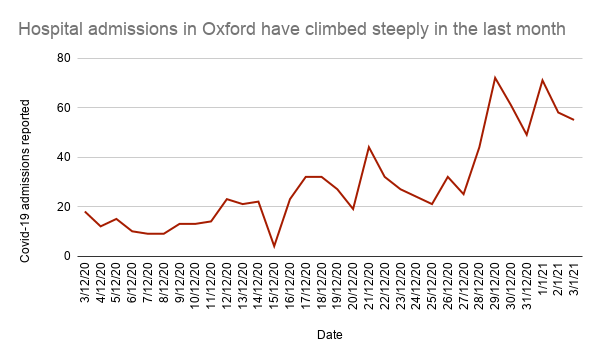
Hospital admissions to Oxford University Hospitals have increased steeply over the last month, with 275 beds occupied as of the 5th of January, and 410 patients admitted with Covid-19 between the 28th of December to the 3rd of January. As of the 3rd of January, 29 patients required intensive care on ventilators. 

Sam Foster, Chief Nursing Officer at Oxford University Hospitals NHS Foundation Trust, said: “As people will be aware, the NHS is currently experiencing huge challenges in our hospitals as we see increasing numbers of patients with COVID-19.”

“Our hospitals are fuller than they were in March and April last year.  We are doing all that we can to care for our patients with COVID but, if people do not stick to the national lockdown rules, we are likely to see cases rise even more and the pressure on our hospitals and our staff will increase further.”

A member of staff at the Oxford University Hospitals NHS Foundation Trust spoke to Cherwell about their experiences of working over the holidays: 

“I was moved to the John Radcliffe ICU for the day from a different hospital due to them being understaffed. Although I was only there for the day, I could tell that the staff were having to work very hard due to a lack of staff and a large amount of extremely ill patients who require careful monitoring.”

“I have a great amount of respect for the staff and could tell how tired they must be after months of enduring the heavy PPE, high workload and stressful environment.”

Image credit: ceridwen / The John Radcliffe Hospital / CC BY-SA 2.0

Extinction Rebellion parade a white elephant through the city to protest HS2

0

Members of the environmental group Extinction Rebellion dressed up as a white elephant and walked through the city centre in protest of HS2. 

HS2 is a high speed railway project linking up London to the Midlands, the North, and Scotland. A white elephant has, in modern usage, become synonymous with a building project or scheme that is considered expensive without adding use or value to society.

The protest against HS2 is being led by Chris Packham, TV naturalist and presenter. Members of Extinction Rebellion Oxford have been some of the most active protesters in campaigning against HS2, which they describe as “the most environmentally-damaging development currently occurring.”

Michael Taylor of Extinction Rebellion Oxford told Cherwell:  “HS2 claims to expand capacity on the rail network but it does this in the most expensive, least useful, least effective, most destructive way. It is a classic white elephant.”

“It is not going to have a significant effect in taking drivers out of their cars or freight off the roads, it is simply a faster way of train travel for people who would already travel by train.”

Jessica Upton of Extinction Rebellion Oxford said: “I’m very pleased to hear Chris Packham announce a petition to get HS2 stopped. The money being squandered on the white elephant that is HS2 should be used for reopening disused lines (eg from Oxford to Witney) and the full electrification of the rail system.”

“Public transport use is very low at present and the Government needs to be putting in place better public transport options for after the covid crisis. It should not be funnelling the funds into environmentally destructive high speed train lines. Our Oxfordshire community has very limited use for HS2 yet our taxes are paying a heavy price towards it. Estimates of eventual cost suggest that HS2 could cost over £100bn or over £300 million per mile of track.”

Image Credit: Feng Ho.

University funds hip hop classes for teens

0

Oxford University and the dance company Body Politic have partnered to provide free dance classes for 11 to 16 year olds in the city. 

The university’s aim is to explore the effects of the arts and physical exercise on wellbeing and is being funded by The Oxford Research Centre in the Humanities. The findings will form part of a study being conducted by the Social Body Lab. 

The lead researcher heading the project, Dr Bahar Tuncgenc, said: “Arts and physical activity can be very beneficial for improving social connectedness, reliance and self-esteem. 

“We want to find out whether engaging in our creative dance programme would promote young people’s wellbeing during these much-needed times, in the midst of the Covid-19 crisis.” 

The classes will take place over five weeks and will explore all aspects of dance, from performance to improvisation and choreography. The programme will be led by the artistic director of Body Politic, Emma-Jane Greig. 

The company was founded in Oxford in 2012 and aims to promote diverse communities by addressing the lack of representation of artists from Black and Asian backgrounds. It works to provide opportunities for young people from vulnerable and marginalised communities and to remove barriers to the arts sector. 

Body Politics’ mission is built around outreach, artist development and producing theatre. Through dance, the group tries to help to improve the skills, confidence and employability of young people, while also producing “authentic, relevant and essential work”. In 2019 the company became the first female led independent hip hop group to tour outside of London. 

Oxford’s Social Body Lab, which is heading the research project, is part of the Institute of Cognitive and Evolutionary Anthropology at the university. It was set up to explore links between social connection, group activity and health in relation to both everyday behaviour and culture. Research is conducted by academics and postgraduate students studying for an MSC degree in cognitive and evolutionary anthropology at the university and involves fieldwork as well as laboratory experiments. 

The work of the group tries to connect evolutionary, psychological and behavioural sciences. Researchers are aiming to try and use their findings to improve wellbeing, health and life outcomes across a wide range of settings globally. 

The hope is that the hip-hop classes will help to support young people in Oxford who are currently out of the classroom and are “experiencing challenging times”.

Healthy heart may help prevent dementia, Oxford study claims

0

A new study published by the University of Oxford suggests that the key to avoiding dementia may be a healthy heart. 

A joint investigation by Oxford University and University College London examined links between aortic stiffening and cognitive health. It concluded that faster stiffening of the aorta (the main artery carrying blood away from the heart) was linked to a lower blood supply to the brain, weaker connectivity between the regions of the brain, and memory loss. 

The study involved 542 participants, whose aortic stiffness was measured at both 64 and 68 years of age. This was then compared to the results of MRI scans and cognitive tests. The researchers not only concluded that there was a link between the two, but also that making changes earlier in an individual’s life could help delay the effects of aortic stiffening, and so reduce the risk of diseases such as dementia later in life. 

Dr Sana Suri, the University of Oxford’s Alzheimers Society Research Fellow in the Department of Psychiatry, said “Our study links heart health with brain health, and gives us insights into the potential of reducing aortic stiffening to help maintain brain health in older ages. Reduced connectivity between different brain regions is an early marker of neurodegenerative diseases such as Alzheimer’s disease, and preventing these changes by reducing or slowing down the stiffening of our body’s large blood vessels may be one way to maintain brain health and memory as we grow older.” 

Individuals with pre-existing medical conditions such as heart disease, diabetes and high blood pressure are particularly vulnerable to aortic stiffening. However, lifestyle factors such as smoking can also play a role. The risks associated with stiffening arteries can be mitigated by a healthy diet and increased levels of exercise, as well as by medical treatments.   

Dr Scott Chiesa, Research Associate at the UCL Institute of Cardiovascular Science, agreed with Dr Suri. 

“With no cure for dementia, there is an increased focus on understanding how to prevent or delay its onset. Importantly, our study helps us understand when in the lifespan it will be best to target and improve cardiovascular health to benefit the brain.” 

The study was funded by the Alzheimer’s Society. Its head of research, Dr Richard Oakley, said “Dementia devastates lives, and with the number of people with dementia set to rise to 1 million by 2025 and more families affected than ever before, reducing our risk has never been more important. This Alzheimer’s Society funded study didn’t look for a link between heart health and dementia directly, but it has shed important light on a connection between the health of our blood vessels and changes in the brain that indicate brain health. 

“We know that what’s good for your heart is good for your head, and it’s exciting to see research that explores this link in more detail. But we need even more research to understand the impact of heart health on brain health as we age, and how that affects our own dementia risk. Alzheimer’s Society is committed to funding research into dementia prevention as well as research into a cure. But coronavirus has hit us hard, so it’s vital the Government honours its commitment to double dementia research spending to continue research like this.”

Image: sbtlneet / pixabay.com

Oxford school becomes first vaccination centre in the city

0

The first vaccinations in the Oxford community have been given to elderly and vulnerable residents in the gym of a local school. 

The Cherwell School, a secondary school in North Oxford, has become the first vaccination centre in the city. Patients at Banbury Road Medical Centre, Summertown Health Centre and 19 Beaumont Street Surgery are all set to receive their jabs at the site. Over the weekend healthcare professionals planned to deliver over 1,000 vaccines to the most vulnerable Oxford residents. 

Dr Monarch, the co-clinical director of the primary care network which incorporates all three surgeries, thanked the school for “bending over backwards” to accommodate the medical staff. 

He also noted that other venues in Oxford had been keen to allow healthcare staff to use their own spaces as temporary vaccination clinics in order to speed up the rollout of the vaccine. The gym was deemed a suitable site for vaccinations given its high roof and ample space for social distancing.  

Initially the Pfizer vaccine has been rolled out to patients in the community. However, the surgeries plan to begin to use the Oxford-AstraZeneca vaccine in care homes across the city this week. 

Meanwhile, a local landlord has offered his pubs as vaccination sites, even if it means losing out on more than £250,000 in business grants from the government. 

Dermot King, the chief executive of Oakman Inns, said “The only route to any normality is through mass vaccination and for that the NHS needs to be able to work at scale. The entire hospitality industry is desperate to re-open as quickly as possible before we have huge scale redundancies across the sector. 

Mr King, who manages pubs in areas around Oxford, such as Abingdon and Witney, believes it will be more beneficial to both the economy and society in the long run to ensure everyone is vaccinated as quickly as possible. 

“Our pubs have large indoor spaces and in some cases large car parks and accommodation, which could accommodate large numbers of people around the clock. Clearly, the money offered by the Chancellor yesterday would help us in the short-term, but realistically the only way all of us can get back to normal is to get the country vaccinated. We would rather let the Government keep their hand-out to invest it in using hospitality venues as vaccination centres for the greater good of all. 

“The hospitality sector has the venues, it has the infrastructure, the venues are sitting empty, and our offer even includes a contribution towards the cost of the scheme. We want to help the Government and the people of the UK beat COVID-19 because the quicker we’re vaccinated, the more lives we save, the more jobs we save, the more businesses we save, and we’re prepared to do whatever it takes to see that happen.” 

Image: Labpluto123 / Wikimedia Commons.

COVID vaccine can adapt to combat new mutations, says Oxford professor

0

Covid-19 vaccines will be able to be adapted to offer effective protection against future coronavirus mutations, an Oxford University professor has claimed. 

Sir John Bell, Regius Professor of Medicine at Oxford University, told CNBC that he was confident that the vaccine can be updated to protect against future mutations, and it is likely both the Oxford-AstraZeneca and Pfizer vaccines already provide protection against the new variant circulating in the UK – B117. 

Whilst preliminary research by scientists in the US has found that current vaccines appear to work against B117, more uncertainty surrounds the new South African variant. Dr Simon Clarke, an expert in cell microbiology at the University of Reading, has warned that: “the South African variant has a number of additional mutations, including changes to some of the virus’ spike protein.”

The spike protein is what vaccines are designed around, and the extensive alteration caused by a mutation in the South African variant may make it less susceptible to the immune response triggered by the vaccine. The mutations found in B117 do not appear to alter the spike protein of the virus, meaning that the current vaccines are highly likely to remain effective. 

While Bell told CNBC that the South African variant may be “slightly more worrying” he expressed confidence that vaccines could be easily adapted to handle any virus mutations, saying: “if we have to make new vaccines, we can make them now we’ve done the initial work.”

Brendan Wren, professor of vaccinology at the London School of Hygiene and Tropical medicine, said modifying the vaccines would be relatively easy. It would involve making small changes to the genetic material they contain and would only take a matter of days to incorporate. 

Bell also noted that it is likely development processes to update vaccines not would require the same large-scale clinical trials held in 2020, with only immunogenicity studies required, to ensure that any updates would provoke an immune response. Danny Altmann, professor of immunology at Imperial College London said that this news should comfort those who were worried that these newly emerging, more transmissible variants would be resistant to vaccines. 

Image: Ri-Ya via Wikimedia Commons.