


Saturday 2nd May 2026
Blog Page 793

Conceptual art is a bubble

I meet Julian Spalding in the Ashmolean cafe, on a sunny Friday morning. He was in the Union the night before, debating about Art. “It’s a strange place,” he says. “Straight out of the 1840s.”

Spalding is a writer and art critic, and a former curator. With tortoise-shell glasses and an open-neck blue shirt, he speaks quickly and clearly. It’s soon obvious from Spalding’s references to meetings with David Hockney or Anthony Blunt that he’s been on the art scene for a very long time.

In 1989, he was appointed as Director of Glasgow Museums. There were protests on the streets at his appointment – he was the first Englishman ever to be appointed. Spalding persisted and proved his critics wrong. Spalding established the Glasgow Gallery of Modern Art in 1996 before leaving the city in 1999, the same year he won the Lord Provost’s Prize for Services to the Visual Arts.

He then went to the National Museum of Denmark for a year. I mention the ‘Trundholm Sun Chariot’, a Nordic Bronze Age artefact, and Spalding leans forward, his eyes lighting up. “It’s amazing, isn’t it?” “Denmark is mostly bogland, and people used to sacrifice people and things into the bog, which were preserved well.” It’s a reminder that art isn’t just western paintings of flowers and the Virgin Mary.

Since 2001, Spalding has focused on writing about art and history, as well as travelling: “I saw all the sites around the world I’d wanted to see but never had” he says. “It struck me that there was a history of seeing. I realised that realisation and the way we see things had a history.”

In 2015, Spalding published the book Realisation: From Seeing to Understanding, which argued that art emerged from the ways our ancestors tried to understand the world. Spalding argued that the pyramids, with their tremendous physical weight, were an attempt to establish permanence, and to hold down the flat earth against the skies which revolve around their polar axis. It’s a truly fascinating idea.

We go on to to discuss the Parthenon, with the ring of mountains which surrounds it and it’s view to the sea: “The sun would shine in through the main door and illuminate the statue of Athena,” he says, “which is similar to Newgrange, in Ireland and Jain Temples in Southern India.”

But Spalding is perhaps best known for his withering attacks on contemporary, conceptual art. “When conceptual art first appeared, I started to say, ‘what is this? It isn’t very interesting.’” Ever since Damien Hirst first came onto the British art scene, Spalding’s been arguing that the conceptual pieces people like Hirst make are fundamentally valueless. “It’s not creative visually.” he said, and in a 2012 article for The Independent, he wrote “Damien Hirst’s ‘works’ are only of value if they’re works of art. They’re not.”

In 2012, the Tate Modern ran an exhibition of Damien Hirst’s works, starting with ‘The Physical Impossibility of Death in the Mind of Someone Living’, the famous formaldehyde shark, and going right through to Hirst’s later spot paintings, which Spalding dismisses as “wallpaper”. Spalding tried to publish a book about Hirst: 12,000 words, entitled Con Art – Why you ought to sell your Damien Hirsts while you can. His publisher rejected it. Spalding published the book online. It attracted an enormous amount of media attention, and Spalding was interviewed by news sources from across Britain and Europe, including the BBC. But the Tate banned him from the exhibition, and he was left to talk to the cameras outside. “To treat me like that is just ridiculous” he says. “I was a major figure – a curator and an art writer. I wasn’t nobody.” Spalding challenged Nicholas Serota, the Tate’s director at the time, to debate the issue publicly. Serota said no. “Conceptual art is a bubble”, he says. It’s hard to disagree when one Damien Hirst show, Beautiful inside my head forever, sold for £111 million at auction.

Spalding is certainly isolated in making the argument against conceptual art, but he isn’t alone. The art critic Robert Hughes said in 2005 that ‘The Physical Impossibility of Death in the Mind of Someone Living’ was a “cultural obscenity”. So why do Hirst’s works keep popping up in serious, high-brow galleries?

Dealers, Spalding says. For the art market, the museum is the gold standard, and dealers tell potential buyers that if Hirst works are good enough for museums, they’re good enough for you. “Galleries are funded by dealers. The Turner Prize is decided by dealers,” Spalding says. “Curators are losing their independence.” Combined with the corporatism of the influential Saatchi brothers – a pair of advertising moguls who funded Hirst at the beginning of his career – it isn’t hard to argue that money has corrupted the art world.

When one Da Vinci, the ‘Salvator Mundi’, sells to a Saudi-Arabian prince at auction for $400m, it’s hard not to wonder whether any single object is worth that much. For Spalding, art’s been commodified: “if you can get a Da Vinci, you’re guaranteed investment”, he says. During his time as a museum curator in the Thatcher years he’d ask for funds, only to be told that “if you want more money, just sell what you’ve got in store.” For Spalding, art work in museums is publicly owned; it loses all monetary value it might have had when it can be seen for free.

Thatcher’s message to curators commodified public art by implying it could and should be bought and sold. $400 million Da Vincis commodify art in a similar way. It’s often argued that the process of artistic commodification started with Duchamp’s ‘Fountain’. His urinal was exhibited in the Society for Independent Artists, supposedly to mock the art world by showing that they accept anything. If he said it was art, it was. That was the intention, at least.

But Spalding tells me that it was misattributed. The world of modern, conceptual art, he tells me, was built on a lie: “It all comes from Duchamp – the idea that anything can be an artwork if you say it is. But Duchamp didn’t do the urinal.” The urinal, Spalding says, was made by Elsa von Freytag- Loringhoven, a German dadaist and poet, and it was intended as a work of sculpture protesting America’s declaration of war on her homeland.

“She regarded America as a gentleman’s club, so she was telling America not to piss on her homeland. ‘R Mutt’ scrawled onto the mass-produced porcelain is both a pun on ‘Mutter’, the German word for mother, and the English word ‘Mutt’ – she was punning in German and English”, Spalding explains. He’s working off research done by Dr Glyn Thompson, an art historian working at the University of Leeds, who found, as definitive evidence, a letter in which Duchamp – who “appropriated it very early but never claimed it was his” – said “one of my female friends under a masculine pseudonym, Richard Mutt, sent in a porcelain urinal as a sculpture.” The evidence seems definitive.

“Modern art had a founding mother, not a founding father”, Spalding says, and it’s convincing. The idea that the urinal was a work of thoughtful and serious sculpture, not a middle finger at our conceptions of artistic composition changes the history of Modern Art.

Spalding promoted work in his galleries that was popular (Beryl Cook and LS Lowry, for example), and what frustrates him most about conceptual work is that millions of pounds of taxpayer money goes towards art that isn’t. For Spalding, art should be something which anyone and everyone can enjoy. So I ask him what he thinks the most accessible art museum in Britain is. He isn’t sure. “You need to see a few things, to look at what you like. And then go back”.

Response to access report intensifies as open letter receives over 1,000 signatures

0

Oxford’s response to the last week’s undergraduate admissions report intensified over the weekend, with an open letter reassuring potential applicants of inclusivity receiving over 1,000 signatures.

The letter, which its organisers say aims to “reassure potential students from disadvantaged backgrounds that we are committed to providing a welcoming environment and to combatting any discrimination we see at the University,” states that “tackling [the access problem] is a challenge that none of us can shirk from.”

The news comes in advance of a Solidarity Rally at the Clarendon Building tomorrow evening in response to last week’s report, supported by groups including Oxford SU Class Act Campaign and Common Ground.

Ben Fernando, who worked with Holly Unwin on the letter to change the narrative that “Oxford wasn’t for non-whites, those from the north, or those from working-class backgrounds,” told Cherwell that they hope “those in positions of influence (such as David Lammy) [can] help us [to] solve these issues rather than perhaps unintentionally further dissuading applications from the students we most want to apply.”

The letter reads: “We wholeheartedly encourage all young people (no matter their background) to apply, and trust that they will find a community ready to welcome and support them, as we have. We will continue to invest significant effort in increasing diversity at the University and ensuring that disadvantaged groups are better represented.

“All we ask is that those who have shone a spotlight on these issues will now help us to solve them, else we fear that all this data release will have achieved is dissuading applications from those we most want to apply.”

Analysis of the University data has shown that of every 100 white applicants who applied between 2015 and 2017, over a quarter –  27% –  were given offers. White British applicants were twice as likely to gain admission as their black British peers.

Just 16% of black or black British (African) and 20% of black or black British (Caribbean) students who applied at the same time were given offers. The total black minority ethnic (BME) offer rate for the 2015-17 period was 18%.

Fernando highlighted that the University must adapt its access policies to ensure that it remains globally competitive. “Access is hugely important – if Oxford is going to maintain its world-leading position, it must be representative of the population from which it draws its students. Times are changing, and the University must change with them.”

On the event page of this evening’s protest, entitled ‘Solidarity Rally: Respond to the Oxford Access Report’, campaigners have written: “To ensure that potential applicants to Oxford hear our voices and see that we are trying to change the institution from the inside, it is vital that we come together in a show of solidarity:

“We need to show the world that, by taking up space, #thereisaplaceforyouhere at Oxford.”

They also wrote: “This is not about denying the problem, but showing that Oxford students do not stand by the University’s defence of its whiteness and elitism.”

Common Ground, the Oxford SU Class Act Campaign, Oxford First Generation Students, and the Oxford Students’ Disability Community will all take part.

The rally is due to begin opposite the Weston Library on Wednesday evening.

This article was amended at 16.52pm on Tuesday 29 May as today’s Solidarity Rally has now been postponed until tomorrow.

We should not be afraid to celebrate the St. George’s flag

0

Christ Church’s JCR recently passed a motion to fly the St George’s flag on campus during the upcoming World Cup, a move which was met with some criticism regarding the flag’s unfortunate ties to the EDL. With more abstentions than objections, this motion probably isn’t the major controversy that some might make it out to be. It does, however, raise interesting questions about how we as a country treat our national flag, particularly in the wake of recent comments by the national lead of football policing.

Deputy Chief Constable Roberts described the flying of the English flag after matches abroad as “almost imperialistic”, urging supporters to refrain from waving it or even taking the flag with them. It’s hard to deny that we all need to be on our guard against rabid nationalism, particularly in the current geopolitical climate, but is this not a step too far?

It isn’t a sin to be proud of your country. National pride and extreme nationalism are not synonymous, and despite our chequered history, England has plenty to be proud of. We should be proud of the NHS, and its hardworking staff. Over the centuries we’ve made, and are still making, amazing contributions to the sciences and the arts.

We established one of earliest and longest-lasting parliamentary democracies in the world. Our educational institutes are top notch, and our queuing is second to none. It would be childishly ignorant to close our eyes to the mistakes (and yes, deliberate atrocities) that our past holds; it’s equally immature to act as though the skeletons in our closet make our country incapable of ever doing right again, or invalidate all our accomplishments. Of course we should never forget that we built on the backs of others.

However, if we’re honest, imperialism isn’t actually the reason why we’re being told not to fly the St George’s Cross. Even the briefest read of the Deputy Chief’s comments will reveal that the aim is really to prevent antagonism between football fans following the fights at Marseilles two years ago. His main concern is avoiding harm to British citizens: unless Christ Church is planning a massive Anglo-Russian brawl that they’ve not told us about, they’re probably safe from the Deputy Chief’s ire.

Further, his comments were largely centred around showing respect for other countries when visiting, and avoiding behaviour “that might not be well-received locally and provoke a hostile response”. It’s a perfectly reasonable request, but it’s only relevant under a very specific set of circumstances. Provided that we’re not headed for a hard Oxit in the near future, Christ Church is and will remain an English college on English soil. What’s imperialistic about letting them show their support for the country’s football team?

Imperialism aside, Christ Church students also jokingly raised concerns at the meeting that flying the St George’s flag could come across as “a little bit EDL-y”. These concerns aren’t unfounded – back in 2012, the think tank British Future found that nearly a quarter of England’s people associated the flag with racism. The rampant nationalism and bigotry of factions like the EDL is slowly turning the flag into a symbol for their ignorance, and it’s hard to ignore those associations once made. It’s in the past – but the fight for St George’s Cross isn’t over yet. They can’t take the flag unless we let them.

We should fly the flag over what we really have to be proud of – show the world that the EDL doesn’t represent what we as a nation stand for. The flag is ours, not the EDL’s, and we can’t just roll over and let them drape their hatred in it. It’s perfectly possible to be patriotic without swearing blind, bloody-minded and bigoted devotion to your country: let’s not stand in the way of people proving that. Let the St George’s Cross fly over an atmosphere of friendly competition and national pride again.

Good for you, Christ Church – and God save Gareth Southgate.

Oxford beaten by Cambridge again in latest Guardian rankings

0

Oxford remains in second place in the Guardian’s 2019 university league tables as Cambridge clinched the top spot.

It is the third consecutive year that Oxford, Cambridge, and St Andrews have occupied the top three positions in the table.

The yearly ranking system scores colleges out of 100 based on courses, satisfaction, funding per student, teaching quality, and student-staff ratio among other measures.

Oxford’s overall score out of 100 fell by 0.7 from 98.1 in 2018.

The list also ranks colleges for their performance in subjects. Oxford rose to the top spot in Anthropology this year, beating out London School of Economics from last year.

The University remained the best in the country for Business, Chemistry, Music, Geography, and Maths, among others.

King’s College London suffered the biggest drop, falling 19 places to 58 from 39 last year.

Trinity St David’s and Westminster were the biggest risers, as both climbed 27 places. Trinity St David’s shot up from 112 to 85, while Westminster rose from 108 to 81.

Science is not just for boys

Under 30% of Maths freshers at Oxford are female. When I was the only girl in my Further Maths class at school, naïvely, it never crossed my mind that it would be the same here. It’s not just maths – women are disproportionately represented in many Stem (Science, Technology, Engineering and Mathematics) degrees. But where does this problem start? How serious is it? And what – if anything – should Oxford be doing about it?

“Good tactical move picking a subject with lots of boys – plenty of choice for a boyfriend,” a family friend joked when I told them I’d chosen to study Maths at university. I laughed, and brushed off the comment.

She was right about Maths being dominated by “lots of boys”, but, clearly, this isn’t appealing enough to get more young women into Stem degrees. Statistics from A-Level students in Summer 2017 show that women are actually 36% more likely to carry on to higher education than their male counterparts. Women are well-represented in higher education as a whole, and this representation is even evident in Oxford: there were 27 male and 30 female applicants per 10,000 population in 2017.

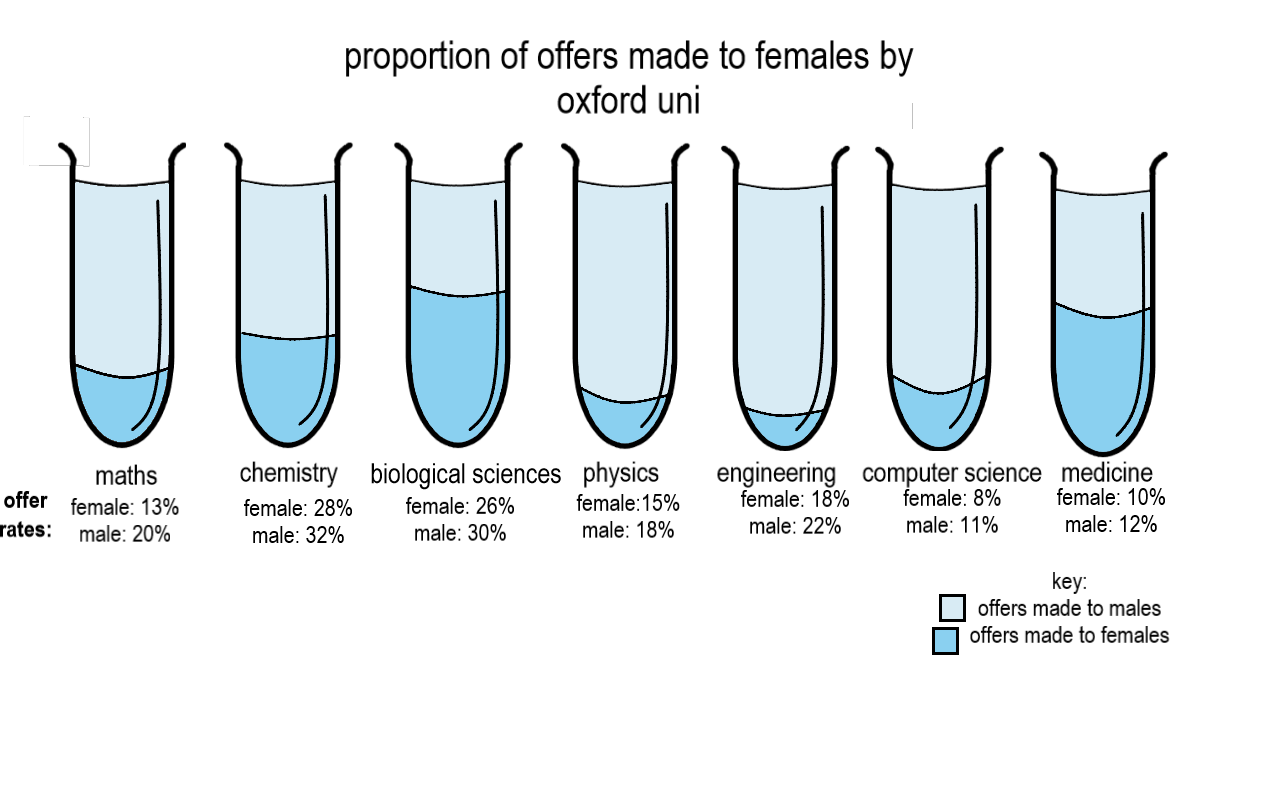
Oxford is closer to gender equity in some Stem subjects than universities nationally. At Oxford, as an average from 2014-16, Biology and Medicine made a slightly higher proportions of undergraduate offers to female than to male applicants (58% and 53% respectively).

National figures illustrate 60% of graduates in Biology and 81% in Medicine were female in the UK in 2016-17, showing them to be, on average, much more female-dominated subjects. Oxford’s equality doesn’t, however, seem to stretch to the traditionally male-dominated subjects. In Maths, 27% of offers were made to women by Oxford University (2014-16), 20% for Physics and 14% for Computer Science. Compared to the number of female graduates in these subjects nationally, it seems that Oxford is considerably worse than other universities at recruiting women in Stem subjects.

Proportion of offers made to women by Oxford University

In the UK in 2016-17, Maths, Physics, and Computer Science had 39%, 41%, and 15% female graduates respectively. In light of the massive underrepresentation of females in these Stem subjects, any efforts by Oxford toward achieving the previously mentioned equality for Biology and Medicine seem slightly misguided. It’s hard not to question why one of the world’s leading institutions makes an effort to close the gender gap in subjects where men are generally worse represented but seems to ignore the shocking disparity in most other Stem subjects.

Seven-year-old Maya’s response to the prompt, “Draw a scientist”

So, why aren’t there more women studying Maths and other Stem subjects at Oxford? In fact, the gender gap in admissions is more pronounced in Oxford across all stem subjects. In Biochemistry, for example, the admissions rates are 16% for female applicants compared to 27% for male applicants.

For many subjects, the difference is only by a couple of percentage points, but this is seen consistently across all Stem subjects, even for those where fewer women apply. Admissions tutors aren’t discriminating against female applicants as such, but the lack of any positive discrimination in preference of women is indicative of little awareness of how marked the gender imbalance is. This may not be an intentional bias, but as MP and former Higher Education Minister David Lammy suggested in his most recent critique of Oxbridge admissions, interviewers are thought to subconsciously recruit their own image, and science tutors are overwhelmingly male. For Mathematical, Physical, and Life Sciences (MPLS), just 6.5% of professors and 12.5% of associate professors are women. The result is that most Stem interviews are conducted by men – I was the only woman in the room for all ve of my interviews, even though there were two interviewers in each. Looking at these proportions of male staff, this must have been the case for many other applicants.

Nationally, Stem degrees tend to be less appealing to women than men, made clear by the previous statistics on graduates. But does this gap between Oxford and national averages mean that Oxford Stem courses are especially unappealing?

It may be that many young women don’t think they are good enough to be studying at Oxford, especially not a Stem subject. Computer Science, Maths, Biomedical Sciences and Medicine are all in the top ten most competitive Oxford courses in terms of offer rates, which could be deterring women from applying.

A study conducted in 2003 by David Dunning and Joyce Ehrlinger is just one of many that examines relationship between female confidence and competence, showing that women tend to be less con dent than men, and that the lack of this self-assurance can obstruct their personal progress. Similarly, a review of personnel records at Hewlett-Packard found that women working there only applied for a promotion when they felt they met 100% of listed job requirements, in comparison to men who were happy to apply when they thought they met 60% of these.

Applying to Oxford could be seen as somewhat comparable – women are less confident in their own abilities and so are less likely to apply. This seems to resonate with our student population. Jess, a Maths student at Somerville, said that she receives feedback from her tutors to “be more con dent in [her] work” and believes that this lack of confidence results from being in a minority of women on her course. This is especially noteworthy in light of the fact these are the women that have applied successfully for a Stem degree.

They have not been dissuaded by perceived male dominance, but are still aware of a contrast in self-belief. One can only imagine how endemic the problem must be if even the women who are successfully studying Maths at Oxford still find themselves lacking confidence in comparison to their male peers. Beth, a Maths student at Balliol, agrees: “the girls I know are very modest about their maths ability and most are surprised to have [been offered] places”.

The lack of female professors within the MPLS departments here at Oxford may be discouraging female applicants, who face a stark lack of inspiring female academics to model themselves on. With far more women now in a position where they have the opportunity to conduct scientific research compared to several hundred years ago, female scientists are only just coming to the forefront of scientific discovery. Yet there is a need to better recognise the achievements of both historic and contemporary female scientists in the syllabus at degree level. Ella, a Biology student at St Catherine’s, says that of the scientists that learn about behind key discoveries, “there’s very few females, maybe one in ten.”

A ‘Feminist Philosophy’ module has recently been added to the first-year Philosophy course as part of an attempt to tackle the gender imbalance (PPE is a subject with below 30% female undergraduates). The hope is that this will increase the popularity of the course with girls, and a similar approach should be taken within the sciences. Gender equality cannot be achieved without recognising female achievement in such a male-dominated eld in a concrete manner.

The gap is, however, clearly already evident before university entry, and so whilst they have an important role to play, the problem is too complex to be the sole responsibility of higher education institutions. So where do these differences first become evident?

Looking at girls’ achievement in science GCSEs (which are generally compulsory), they appear to perform very similarly to, if not better than their male counterparts in terms of proportion receiving A-A* grades. These higher achievements do not translate into girls choosing the subjects for A-level, however.In Physics, the proportion achieving A-A* was 42% for both male and female students, but a mere 21% of those sitting Physics A-level in summer 2017 were female.

Interestingly, Computer Science is the only Stem subject that already has a noticeable gap as early as GCSEs. The subject is also the only optional one at GCSE level, making it clear that the issue isn’t that female students are less intelligent than their male counterparts, but that something is putting them off these subjects to such an extent that the gender gap emerges as soon as an element of choice is involved.

Around 13,200 female and 53,500 male students took Computer Science GCSE. This makes it less surprising that the gap in terms of numbers of students taking the subject remains at A-level; in 2017 only 9% of those sitting Computer Science A-level were female.

Despite female students’ achievement at GCSE, they are not then choosing Stem related subjects at A-level. Whilst taking a subject at A-level doesn’t necessarily mean you go on to study it in higher education, a lot of Stem degrees do require Science A-levels, so by not choosing the subjects at this stage, the option for these studies in higher education is removed. Hence, once this difference in academic choices is established, it’s almost inevitable that this translates to degree level. Girls in single-sex schools are known to do better in GCSEs but according to Alice Sullivan, director of the Centre for Longitudinal Studies, at the UCL Institute of Education, they are also “more likely to take male-dominated subjects such as Maths and Science at school.” This strongly suggests that having boys within your learning environment has a negative impact on whether girls choose Stem subjects. Perhaps, girls are discouraged from studying subjects when they know they’ll be surrounded by boys in their classes or that at mixed schools the efforts of getting pupils into these subjects is focused on boys.

Proportion of girls taking Stem subjects at A-Level

It is important to highlight that many boys only select Physics and Maths-related subjects. Gender inequality is not simply an issue of an absence of girls in Stem, but also the lack of boys in the more traditionally ‘female’ A- levels too. For example, just 27% of students sitting English A-level in 2017 were male. The problem of a lack of girls in Stem-related subjects cannot be expected to be solved without promoting a more diverse range of subjects to anyone regardless of gender.

According to a paper published by Psychology professors Gijsbert Stoet and David Geary, girls did as well as or outperformed boys in science tests they conducted in a number of countries.

In relative terms, boys were strongest in maths and girls were strongest in reading, which could underpin subject choices for some girls in higher education. Proportion- ately, Science was their best subject for 24% of girls, for 25% it was Maths, and for 51% read- ing, whilst 38% of boys achieved their highest scores in Science, 42% in Maths, and just 20% for reading.

This study perhaps helps explain why girls aren’t going on to pick science-related A- levels – they are outperforming boys in other subjects too, and are choosing to go into these areas instead. This also indicates why there is a large concentration of boys in the sciences – they are simply performing slightly better in these subjects on an individual level.

Whilst this perhaps help us better understand the gender differences in subject choice at A-level, I’m not convinced this means it has to be the case. What this mostly implies is that girls are as capable as their male counterparts of study- ing Science or Maths A-levels but are not do- ing so, and are consequently unable to take these options later.

Where girls are clearly academically capable of Science A-levels, it would be great to see schools encouraging them more. When I told the career guidance counsellor I wanted to study Structural Engineering, she told me she’d never met a girl interested in it, and questioned whether I wanted to study such a male-dominated subject. I changed my mind about my degree further down the line, but at the time, as a 15-year-old who lacked self-confidence, her uncertainty massively affected me and I doubted whether I was actually interested in or going to enjoy a degree “for boys”.

There is already evidence of Oxford University making a clear effort to encourage women into Stem. Many colleges, including Trinity, Jesus and St Catz, held ‘Women in Science’ open days in February for those studying science at A-level. The days included talks from top academics, and aimed to encourage girls into choosing a Stem degree. Although the feedback for the days was overwhelmingly positive, it did primarily attract those who already knew they wanted to do a science- related degree.

To ensure efforts like these aren’t being made too late, it would be positive to see these open days supplemented by one earlier on during compulsory education, considering that the data suggests the gender gap can be as early as GCSE, where Stem subjects are optional. Open days like these can change people’s minds – Beth found meeting like- minded girls at the ‘It All Adds Up’ Oxford Maths open day aimed at girls “helped change [her] view that Maths at uni was a male-only subject”.

Students in the Mirzakhani Society, which promotes the welfare of women studying Maths at Oxford, will be handing out flyers at the upcoming Maths open days, with the aim to encourage women to apply. The flyers will include comments from current female Maths undergrads. I found the Maths open day at Oxford incredibly intimidating – confident boys were eager to ask and answer questions during the talks, and it left me doubting that I was good enough to apply. Something like these leaflets, showcasing the valuable experiences of women currently studying at Oxford, might have made a difference to how I felt.

A better gender balance in Science departments will take time, and until all the obstacles that currently prevent women from applying and gaining places on Stem courses here are eradicated, Oxford will not be selecting the best students possible. The steps they are taking currently are promising for the future of girls in Stem, but action needs to be taken earlier in girls’ school careers, and therefore more school involvement is pivotal.

The future is perhaps looking more positive – in analysis by David Miller of results of ‘Draw-a-scientist’ studies which prompt children to draw a scientist, the proportion drawing a woman has increased from 1% in the 1960s and 1970s, to 28% today.

Author note: Oxford University’s data currently only categorises students as ‘male’ or ‘female’.

Oxford academic forced to leave after Home Office dispute

0

One of Oxford University’s “brightest” new recruits was forced to leave her post and return to China, after the Home Office declined a visa for her 22-month-old baby.

Fengying Liu, a postdoctoral researcher in pathology, was recruited to Oxford’s Sir William Dunn School of Pathology in October last year after completing her PhD in Germany, where she lived with her husband and child.

On being offered the Oxford position, she moved to the UK without her husband and daughter, having made the decision to apply for their visas separately to make the costs more manageable.

However, a technicality in UK immigration law that requires parents to seek visas together with their children meant that the separate application for Dr Liu’s baby was refused.

“The reason my daughter got rejected is because we did not apply as a family,” Dr Liu told Times Higher Education. “I did not understand this at the time. It was also too expensive – about €1,400 [£1,226] per person for the visa application alone.”

Employer-sponsored UK visas cost up to £3,220 including an immigration health surcharge of £400 per year. However, family members require their own visas too, meaning the cost of moving to the UK even for a short period of time can increase rapidly.

While Oxford was able to reimburse Dr Liu’s own visa costs, it is not the University’s policy to extend this to dependents.

Her departure has raised further concerns over Oxford’s ability to recruit talented academics from around the world after Brexit, with several academics expressing their failed attempt to recruit suitably qualified staff.

Ulrike Gruneberg, the principal investigator of the laboratory that recruited Dr Liu, said that she already faced “extreme problems” hiring suitable candidates, which she attributed in part to the “complicated and flawed” nature of the UK immigration system.

She added: “[We] don’t get any applications from the EU now and there are hardly any qualified British candidates for postdoc positions, so it becomes much more important for us to be able to employ people from outside the EU.

“My concern is that British science is just going to collapse.”

Professor Gruneberg told Cherwell: “Clearly the underlying law is the problem, but from my (very limited) experience the immigration team at the University could have definitely been more helpful.

“I don’t think Dr Liu was made aware of possible problems with bringing her family when she accepted the job in my lab, and as scientists we rely on the University to take care of these aspects of hiring.”

Oxford vice chancellor, Louise Richardson, said earlier this month that British institutions like Oxford could struggle attract talent once the UK leaves the EU.

Richardson said: “Personally, I think we are all in trouble in England, Ireland and the rest of the EU over Brexit. We know [our elite status] rests on the excellence of research from people who [come] from abroad… It is painful for many of us as committed internationalists, citizens of the world, to find our country turning inward.”

Had Eno-ugh of revision? Give ‘Ascent’ a listen

0

t’s never easy when it comes to choosing a revision playlist. Depending on how far away your exams are, some songs may be entirely useless.

If you play Sigur Ros too early into the process, you’ll be lulled into a sense of false calm and relaxation. If you play Dragonforce’s ‘Through the Fire and Flames’ too late, then you won’t get the exhilarating push you need just before you move into the final ambient tunes. However, there are some songs that stand alone: the ones that you can play over and over again and never lose your appreciation, the ones where you can focus on your revision and rarely get distracted. These tunes stand in the pantheon of greatness, unrivaled by their inferiors. Brian Eno’s ‘Ascent’ is one of these tracks.

Having listened to this song, and this song only, several thousand times during my A-level revision, I can confirm that it’s a fine piece of music that won’t wear thin with repeated listenings. One of its key advantages is the complete absence of lyrics. You don’t need to get distracted working out any abstract meanings or symbolism. All you need to do is let Eno’s synth chords wash over you.

Despite a lack of dramatic progression, change in structure or even a conventionally repetitive melody, ‘Ascent’ still manages the difficult balancing act of engaging the listener while also allowing them to hold a clear focus on other activities. Eno’s frequent use of dissolves allow each chord to flow into the next one, creating an other-worldly sound that’s ideal for the stressed student.

It allows you to lift off into a different atmosphere. The song was originally composed for the 1989 NASA documentary For All Mankind, so it’s not surprising that Eno strives to evoke such a moving, ethereal awe in every chord. ‘Ascent’ has also been used in Steven Soderbergh’s Traffic and Danny Boyle’s 28 Days Later to create similar atmospheres of calm and relief. It forms a universal connection with listeners because of its transcendent synth tones, and Eno’s DX-7 synthesiser feels like the perfect instrument to create the mesmeric beauty of space, time and existence.

So whether you’re trying to absorb a lengthy quote from James Joyce’s Ulysses for English,
revise some inscrutable logic for Philosophy, or craft an exemplary piece for Fine Art, there’s no doubt that ‘Ascent’ will help you break through barriers and realise your full potential.

New colleges would not improve Oxford’s access

2

The Higher Eduation Policy Institute’s suggestion of creating new colleges for under-represented groups is well-intentioned, but it misses the real root of Oxford’s access problem, and would only perpetuate socio-economic segregation. The misguided proposal implies that students from under-privileged backgrounds should be shunted off into separate spaces, whilst existing colleges continue to be woefully inadequate in their diversification and access programmes.

Oxbridge’s imbalanced intake is almost certainly not a result of insufficient spaces, but rather that they aren’t fairly used. Around 41% of Oxbridge’s intake is privately educated, and over 80% come from the top two social classes. 48% of offers go to students in the South East and London, and between 2010 and 2015, 13 Oxford colleges did not admit a single black student. The idea that simply providing a greater number of spaces through the establishment of new colleges would solve this verges on the nonsensical: this is more than evident in the admissions statistics. There are plenty of privileged applicants who currently miss out on Oxbridge places. What’s to say new colleges wouldn’t simply provide more places for them, rather than boosting student representation?

The alternative would be the somewhat disturbing possibility of these proposed new colleges being targeted solely at disadvantaged demographics. Placing these students apart from their more socially privileged peers, in colleges which would likely be less wealthy and more geographically distant than existing ones, is more grudging tokenism than real inclusion. If access solutions can be offered, they must not be limited to a few colleges, but put into place across the whole university.

This isn’t even an ‘if’ question: it has been done. Around 15 years ago, my own college, Mansfield, set out to improve its diversity and it has succeeded – over 90% of my year are state-educated, and this percentage is set to increase further. Financially, we are very much one of the least wealthy undergraduate colleges: the excuse that other colleges are too strapped for cash and resources to do anything doesn’t cut it. Mansfield is, as yet, an anomaly in the Oxbridge establishment, but the success of its access initiative proves similar progress can and must be made by other colleges.

Recipe Corner: Asian-style Pesto Soba

I like to think of this dish as the summery lovechild of Itsu and pesto pasta.

It consists of a soba noodle base dressed in a zesty homemade pesto that only resembles the half-eaten contents of the trusty jar residing in your fridge door in name.

This dish works well served either hot or as a cold salad.

If you fancy the crisp freshness of the latter, just give the noodles a quick wash with cold water once they are cooked and drained, before mixing in the pesto.

This tangy take on a well-loved student staple will make your friends think twice before doubting your culinary prowess.

Don’t just throw together an- other depressing pasta and sauce combo.

Whip up an exciting new take on the age old favourite, and revolutionise your next batch of pesto pasta/pasta pesto.

Ingredients:

For the Asian Pesto:

  • A handful of coriander
  • A handful of parsley
  • A handful of mint
  • 1/2 of a red chilli
  • A thumb of fresh root ginger, grated
  • 1 garlic clove, finely chopped
  • 1 tbsp toasted sesame oil
  • 1 tbsp lime juice
  • 1 tbsp agave syrup

Everything else:

  • 320g Drived buckwheat (soba) noodles
  • 2 ripe avocados
  • Sesame seeds
  • Pine nuts

Method: 

Blend together all of the pesto ingredients using a blender.

Do this until you achieve aconsistency thats a bit leafier andchunkier than a standard Tesco or supermarket-bought pesto.

Cook the noodles in a saucepan of boiling water for around six minutes (or according to packet instructions).

Drain the noodles once they are cooked.

Remember to give them a cold wash if you want a salad-type dish. Then mix in the pesto, using as much as you would like.To serve, top with chopped avocado and sprinkle with sesame seeds and pine nuts.

Blind Date: “I had to reclaim my seat from a toddler having a tantrum.”

0

Emily Westlake First Year, PPE, Keble

Finding Elliot was easy – I just had to look out for the other solo per- son awkwardly loitering, and fol- low the Life editor’s non-specific descriptors such as ‘relatively tall’. Finding a table however was slightly more challenging – brave to choose Turf as a meeting point on such a warm summers evening – but a small table shared at close quarters with two strangers adds a certain comfort to plunging into one on one conversation with a totally new person. Conversation flowed easily – admittedly, as two PPEists, we had common ground in talking about politics. I never like to judge a book by its cover, nor do I like to jump to any conclusions, but I remember thinking he was a little bit older, so it came as a sur- prise that he’s a second year, and actually younger than me (cougar alert)!

First impressions? 

I remember thinking he was a bit older.

Quality of the chat?

Political. With a few awkward silences.

Most awkward moment?

An unexpected third party (a baby).

Kiss or miss?

We parted with a friendly hug.

Elliot Gulliver-Needham, Second Year, PPE, Corpus Christi

I was waiting outside Turf Tavern, anxiously scanning every person who walked past, when Emily showed up. When we walked in to get a drink, I was surprised by how not-awkward it was, even when a toddler tried to steal my spot at the table we were sitting on. After finally getting the toddler to leave, we ended up chatting mostly about politics (both of us are PPE students). But I won’t say who was (or seemed) more informed. As the date went on and the pints flowed, I ended up spilling embarrassing secrets about my Tumblr past, as well as talk- ing about how much the 2015 election hurt me personally (it was the night I found out I was allergic to cats). I was particularly jealous of her stories of working on the American election. After a few hours and many Peronis, we parted ways and I went and got an Ahmed’s (on my own). A good ending to a good date.

First impressions?

She was down to earth and laid back.

Quality of the chat?

Surprisingly high.

Most awkward moment?

Trying to reclaim my seat from a toddler having a tantrum.

Kiss or miss?

Kiss.