Thursday 30th April 2026
Blog Page 804

Revealed: Oxford Councillor’s controversial social media posts

2

Campaigners against anti-semitism have called for the immediate suspension of an Oxford Labour councillor following revelations that he compared Israel to Nazi Germany.

He has also praised Gaddafi, alluded to same sex marriages as “perversion”, and spread a conspiracy theory that cancer does not exist, Cherwell can exclusively reveal.

Ben Lloyd-Shogbesan, councillor for Lye Valley ward since 2010, has now been referred by Oxford Labour to the national party.

In a statement he apologised for any offence caused by the articles and videos shared by him, and for his implicit endorsement of them. He stressed that he no longer holds such views.

Councillor Lloyd-Shogbesan shared a graphic on his now deleted personal Facebook page in 2014 that directly equated the actions of German and Israeli soldiers. Such comparisons are considered antisemitic under the International Holocaust Remembrance Alliance definition, adopted by the UK government in 2016.

The Labour councillor shared a photo comparing Israel to Nazi Germany.

Euan Philipps, spokesperson for Labour Against Antisemitism, described the image as “apparently antisemitic” and “extremely offensive”. He told Cherwell that it ought to have led to Lloyd-Shogbesan’s “immediate suspension and ultimate expulsion”.

“Instead he continued to serve a four-year term as a Labour councillor on Oxford City Council. It is profoundly distressing content like this that we witness and report to the Labour Party every single day.”

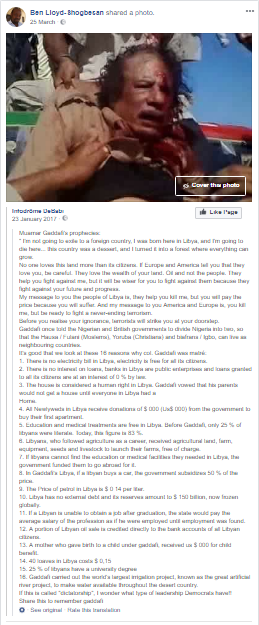
In March of this year, Lloyd-Shogbesan shared a photo of Muammar Gaddafi’s execution with a caption setting out the Libyan dictator’s “prophecies” for the future of Libya following his death.

This included the message that once Gaddafi was dead the Libyan people “will pay the price because you will suffer”.

The post then lists 16 positive aspects of Gaddafi’s rule. The final lines read: “If this is called “dictatorship”, I wonder what type of leadership Democrats have!! Share this to remember gaddafi.”

Nowhere are Gaddafi’s human rights abuses or financing of international terror mentioned.

When asked in a comment whether Gaddafi was a socialist, Lloyd-Shogbesan replied: “Even the socialists didn’t do as much as Gaddafi did for Libya. The West wanted him out of the way so they can get at the oil.”

A post praising Libyan despot Muammar Gaddafi, which Lloyd-Shogbesan shared.

In a March 2016 status, Lloyd-Shogbesan related an “interesting prayer”. The post opens with the words “SAME SEX MARRIAGE”, and later includes the lines “We have endorsed perversion and called it alternative lifestyle”, and “We have killed the unborn and called it choice”. It ends with a plea that the prayer “sweep over our nation and WHOLEHEARTEDLY become our desire”.

Also in 2016, he said: “cancer is not a disease but business.” The post continued “cancer consists of only a deficiency of vitamin B17. It is nothing else. Avoid chemotherapy, surgery, or taking medicines with strong side effects”.

Lloyd-Shogbesan said: “I am committed to fighting all forms of racism and discrimination including anti-semitism and homophobia.

“And I will use the opportunity given to me by my re-election last week to the Oxford City Council to do so and help create a society where we can discuss strongly held views in a tolerant and mutually respectful way.”

The revelations will raise questions about how Lloyd-Shogbesan could have remained an elected representative of the Labour Party for so long despite openly professing antisemitic and conspiratorial views.

Councillor Susan Brown, leader of the Labour Group on Oxford City Council, told Cherwell: “This matter came to my attention late last week. These posts are extremely disappointing and I asked Cllr Lloyd-Shogbesan to remove them immediately from his social media account. He has done so and he has apologized for his actions.

“As Labour Councillors, we came into politics to tackle prejudice, injustice and to celebrate diversity so we take these issues extremely seriously.

“Anti-Semitism or any form of discrimination has absolutely no place in the Party, and we are committed to challenging and campaigning against it all its forms.”

Why the media is fixated with student life

0

Oxford has enjoyed yet another week of national media attention. It started with a shooting, continued with a portrait, and ended with a proposal for new colleges. The right-wing media has again shown its fixation with the intricacies of student life. Both my co-editor, Matt, and I were on talk radio shows this week getting called up for students’ so-called ‘snowflake’ attitudes by oddly obsessed, past-it presenters like Julia Hartley-Brewer and Nick Ferrari.

There is a group in the media who seem to think that every student protest is a catastrophic event with an impact that could change the world we live in. The removal of one portrait from the wall of one department in one university is equated to an apocalyptic event. When I talk to freelance journalist and Guardian writer, Dawn Foster, about the event she explains this constant focus. “It’s very easy to mock. It involves younger people, so it is a lot easier to complain about students and paint them as overly-sensitive than it is to dismiss people with equally legitimate grievances but who are older and might be potential voters. It’s a lot easier to depict student politics as very ephemeral and as if it doesn’t have any impact on the real world when it does.”

But, as she points out, the focus on student politics itself indicates that it has some importance. “At the same time, it seems like a double standard where everyone says that student politics has no effect on the real world and at the same time the fact that someone isn’t going to be invited to a talk that is run by a student society is seen as the worst thing possible. A lot of these people can’t have it both ways. Either student protest is stupid and you should ignore it or it is important and you should support it and critique it. At the moment, they try to have their cake and eat it.”

Foster, who started as a comment moderator for the journalist straight out of university, says that the media profession needs to look at its own problems with censorship before it starts criticising others. “I find it really weird, because I work in media, and there is a huge amount of censorship going on in the media. There are a lot of people I know who do struggle to get their voices heard.”

She is right when she says that the reason for the faux outrage is that “a lot of the media come from Oxford and Cambridge and therefore feel they have a connection to it.” Hartley-Brewer, for instance, went to Magdalen College in the ‘80s and was recently criticised for claming that “I didn’t go to Oxford because I was privileged. I went to Oxford because I was clever.” This group of commentators have felt a loss of control over their old insitutions, and have taken to mocking and ridiculing student protest because they know that if they took them seriously, they would lose the argument.

I ask Foster about the event that has caused so much national uproar in the past few days: the removal of Theresa May’s portrait from the walls of the geography department after student and academic protest. Foster claims that she knew about the controversy long before students became involved in the protest. “This was an important protest,” she says. “I came about it because some of the academics involved spoke to me about it. This was before the student protests really began. I knew that, from speaking to the academics, a lot of them – even before the portrait went up – had lodged a complaint and were very unhappy about it.

https://twitter.com/DawnHFoster/status/993889782777434112

“They thought it set a bad precedent. I completely agreed with what they said: the issue isn’t that they were honouring a PM. It is more that they were honouring a PM who is in office when, as academics obviously, a lot of their work will involve critiquing the government so if you’re then sanctifying them. That does have worrying implications.”
Ultimately, the removal of the portrait is far less significant than everyone has made out. It may return, it may not, but, for sections of the media, the whole protest has already done its job. They don’t care about the outcome of the story, but just want to present an idea of Oxford students as weak, wimpy, and pathetic. They don’t care that this is a completely inaccurate representation and that many students didn’t so much as bat an eyelid because of the removal of the portrait.

This was not because they support censorship or the start of the formation of an Orwellian super-state, but because they have better things to do with their time. Right-wing media are bored and they are losing power, and that is why they latch onto the small issues and expand them to seismic proportions.

This was not the first time in recent weeks that Oxford has been at the centre of controversy because of student protest. The May ‘scandal’ comes only weeks after students protested against a group who they said had transphobic views. I ask Foster about why transphobia has become so common, especially within universities, and why there are so many who wish to subjugate the trans community.

“I think the issue with transphobic groups is in particular is that they are very small and very loud. Universities are often the only places, apart from the mainstream media, where they are given a voice. So if they can come out and try and claim that they are being silenced purely because are protesting while they are speaking, then it gives them more of a platform to try and amplify their voice beyond that one small thing.”

She says that transphobes have again created the idea that they are being silenced, while receiving disproportionate media attention. “I think people who are trying to push back against this will always try to claim that they are being silenced. Purely to try and get their voices amplified but everyone who I have heard claim that they are being silenced is either on mainstream media outlets or is constantly on my television. So I don’t think it holds any truck.”

As far as Foster is concerned, we will look back at transphobic people as being on the wrong side of history. “I think that in many ways, we will end up looking back at the row over trans rights in the same way that we do on Section 28 and race now. Obviously in the 80s, you had some members of the Conservative Party who wore hang Nelson Mandela t-shirts, and who are really anti-apartheid, and members of the Conservative Party who were against gay rights.

“I think it will be the same sort of thing. People protested against homophobia in the 90s, and they protested against racial subjugation in the 80s, and we still have to do that now. But now, the battle ground has moved predominantly towards trans rights.”

She says that although there is some overlap between transphobic groups and earlier social conservatives, the picture is more complicated. “Some of the people who used to in the past push against gay rights and black and minority rights, some of them are the same people. A lot of them are the same people, some of them are radical feminists who have moved in that direction. It is more a Venn diagram than entirely the same people.
She adds that the opposition to transphobia is more united. “Equally a good number of people in the Conservative party and the majority of people in the Labour party have no truck with this transphobic movement. Justine Greening, and lots of others in the tory party, have come out saying that they find lots of the transphobic acts that are going on now really abhorrent. So I think it is really clear to a lot of these people that they are losing the argument and that is why they are acting out so much.”

Foster is an outlier in the left-wing media. She is a Roman Catholic, and often tweets about her beliefs. I ask whether these two aspects ever come into conflict. “I mean, especially with the Irish referendum coming up at the moment, those things can come into contrast. I think it easier to be a right-wing journalist and be religious simply because people don’t question it so much.

https://twitter.com/DawnHFoster/status/993593026613252097

“Because of the way society works, the right-wing religious people tend to be more predominant. A lot of my friends are left-wing and Christian and talk about politics and explain that politics comes down a lot more to your social background than your beliefs.”
She says that the Catholic teachings are similar to the aims of the left. “A lot of teaching, especially Catholic social teaching, is about combating poverty and helping people so it doesn’t have too much of a disconnect.”

Foster is part of a generation of journalists who have gained huge followings on Twitter although they may not be that well-known to the individual person interested in journalism.
She now has over 55,000 followers and her tweets regularly spread all over the Twittersphere. I ask her whether that sphere has created a media bubble and whether journalists are doing enough to combat that.

“Yeah I think so,” Foster says. She adds that although Twitter is certainly useful for breaking down the bubble, it is more traditional forms of journalism that are more effective. “I think that there is a weird sort of fetishisation of people following other people on Twitter who they disagree with. I tend to find that that is the worst way to find out what the other side think. So I predominantly use Twitter to see what is going on in the news today and to talk to people about politics.

https://twitter.com/DawnHFoster/status/993612380763541505

“I find it helpful to tease out things from the other side but if I want to know what my political enemies are thinking I will read a newspaper rather than following them on twitter. Twitter can be handy for point-scoring, but I don’t think it does a huge amount in bursting bubbles that people complain exist. I think that actually reading a newspaper and watching a more right-wing television programme will be a lot more helpful than me following someone on twitter and seeing who they complain about on that day.”

Twitter has transformed journalism and commentary has become instant and constant. As I come to finish my interview with her, I notice from Foster’s profile that she has recently tweeted about the recommendations for Oxford to establish another college to help with access. She shared the story and simply commented: “oh fuck off”. I ask her about the issue and whether it presents a possible solution. She says “I think this is absolutely the stupidest way to go about it.

https://twitter.com/DawnHFoster/status/994485147146899456

“It allows Oxford to carry on behaving as it likes in its admission process and then you have one college where it can put working-class people and black people. But at the same time not to anything to change their admissions policies whatsoever.”
She is right in that the idea of additional colleges allows Oxford to escape from having to act to change its admission process. She mentions a case at UCL where the English department were forced to take admissions away from the departmental structure because tutors couldn’t be trusted with them. She says that Oxford may be approaching a similar point.

“It seems Oxford can’t be trusted to accept the fact that there are plenty of people who are working-class and who are black who could easily go to Oxford and would obviously get good grades. So I think that if Oxford can’t do that, they shouldn’t be trusted, and I think that having a get away with it college is the stupidest way possible of dealing with it.”

As we come to the end of the interview, I begin to realise that Foster is an antidote to the poison spread by the likes of Hartley-Brewer. She is interested, open to debate, and seems to genuinely care about the views and actions of others. With her voice being shared ever more widely, it seems that Foster is becoming an even more prominent commentator on the left. In light of the recent spotlight on the frankly insignificant problems at this university, this can only be a good thing for journalists, students, and the wider population alike.


Nigerian lawyer sues University over dictionary definition

6

Activist Ogedi Ogu has asked a Nigerian high court to direct Oxford University Press to pay N10m (£20,500) in damages for allegedly defining a word incorrectly.

Ogu represents claimant Emmanuel Ofoegbu, who is bringing a case to the Lagos High Court Igosere against the University of Oxford and Oxford University Press (OUP).

On behalf of the claimant, Ogu ordered the court to direct OUP to ensure that every dictionary they publish includes the phrase: “The dictionaries are made available as a reference tool only, and that anyone who relies on definition of words in their dictionary as an alternative to seeking independent legal or financial advice, does so at his own risk.”

Ofoegbu, for whom English is a second language, said that the University of Oxford is reputed as the world authority for the English language and that many people rely on its definition of English words.

The claimant allegedly purchased two dictionaries published by the OUP, the Oxford Mini Reference Dictionary and the Oxford English Mini Dictionary, in 2005 and 2006 respectively.

Ofoegbu alleged that the dictionaries defined the word “mortgagee” as the borrower in a mortgage transaction, and the work “mortgagor” as the lender. He said he relied on these definitions while providing legal advice to a professional colleague.

He then alleged that the colleague corrected his definition by directing him to other dictionaries, not published by OUP, that define the mortgagee as the lender and the mortgagor as the borrower.

Ofoegbu claims this incident led his colleagues to stop asking his opinion or advice on legal issues, causing him embarrassment and a loss of professional esteem. Ofoegbu said that on 4th November 2016, he directed his lawyers to notify the defendants of his intention to press charges for their wrong definition.

The defendants allegedly replied to his letter on 30th November 2016, admitting to the supposed wrong definition but refusing to accept liability.

The defendants added: “Our dictionaries are made available as a reference tool only; they are never held out by OUP as being an alternative to seeking independent legal or financial advice, and we cannot take responsibility for an individual’s decision to use them as such.”

An OUP spokesperson told Cherwell that the publishing company was aware of the intended action, having received papers from Source Chambers. Cherwell has contacted the University for comment.

Police to crack down on Oxford’s drug dealers

0

Thames Valley Police and Oxford City Council have introduced new measures to tackle Oxford’s drug problems.
Improved CCTV, lighting, and security features will be funded by a £40,000 budget. The City Council will spend a further £70,000 on recruiting two new Police Support Community Officers, while the Oxford Community Safety Partnership has offered £45,000 towards a problem solving position.

A post on the Thames Valley Police Facebook page announced the task force on 26th March, saying: “Both Oxford City Council and Thames Valley Police have seen increasing concerns about drug dealing and use over recent months, with the number of discarded needles found in public places increasing, and both local dealers and organised crime groups from other cities operating in Oxford.”

Superintendent Joe Kidman, Local Police Area Commander for Oxford, said: “Drug dealers prey on and exploit some of the most vulnerable in our community; we do not want these people in our city. It is clear that, despite considerable efforts, enforcement alone will not work.

“I welcome the commitment of Oxford City Council and other partners to work together through the taskforce. This is a significant step forward in our on-going efforts to tackle drug dealing and misuse and will play a vital role in safeguarding vulnerable people, disrupting criminality and bringing offenders to justice.”

A Thames Valley Police spokesperson told Cherwell: “Thames Valley Police is working in partnership with Oxford City Council to create a joint taskforce to tackle open drug markets.

“Dealing and using controlled drugs on the streets is the manifestation of organised crime and has a significant impact on the quality of life for local communities.

“The taskforce will take a problem solving approach to target key locations and arrest and disrupt offenders.
“They will also draw on the resource and expertise of Oxfordshire County Council, Oxfordshire Clinical Commissioning Group and Turning point to reduce the harm and exploitation associated with drug markets.”

Chief Inspector Marc Tarbit, the deputy LPA commander for Oxford City said: “Buying drugs on the street puts money into the pockets of criminals, erodes communities and is often linked to violence and knife crime.

“The impact of organised crime seeps across all aspects of society and we must work together to prevent it.”
The University declined to comment on the developments.

Oxford SU to financially support students voting in Irish referendum

1

Oxford SU has passed a motion to subsidise Irish students’ travel home to the Republic of Ireland to vote in the upcoming abortion referendum.

The referendum, which is taking place on 25th May, will decide whether or not the government should repeal the 8th Amendment to the country’s constitution, which effectively bans abortion.

Oxford SU will allocate £500 from its discretionary funds to assist students in covering the cost of their travel home to the Republic of Ireland to vote in the referendum.

They will offer a maximum of £55 to individual students, which will then be matched by the NUS bursary.

The motion was passed unanimously, after three amendments were proposed and two were accepted.

The passed amendments mandated Oxford SU to ensure that anyone can access the funding regardless of which way they are voting, and to publish the funding information on the Oxford SU website. The third amendment, to publish anti-abortion information from campaigns such as ‘Save the Eighth’, was voted down 85% to 15%.

Oxford SU VP Women, Katy Haigh, told Cherwell: “Oxford SU has policy which mandates us to oppose any measures which make it more difficult for our student members to choose either to terminate a pregnancy or to carry it to term and to work to ensure that no additional restrictions are imposed at any level.

“I am very happy to have been able to support Irish students to exercise their right to vote in the upcoming Irish referendum by proposing this motion to council: the motion will provide up to £55 (which will be matched by the NUS travel subsidy scheme) to students who are eligible to vote but unable to finance their travel home to do so.

“Of course, as a pro-choice organisation, this motion came from the perspective of facilitating pro-choice allies to vote accordingly, but this funding would be available to all to facilitate the rights of our students to vote, regardless of the way in which they choose to do so.

“The bursary system, as per the amendment proposed in council, will operate without prejudice as to how students will vote in the referendum.

“However, I would encourage our student members to consider what council’s beliefs are about abortion rights and reflect upon their motivations before applying to this funding: the intention behind which is to fund travel for students with limited finances, and the values behind which are distinctly pro-choice.”

When asked for comment, WomCam’s cochairs and Irish activist Muireann Meehan Speed told Cherwell: “In two weeks times, Ireland will have a historic referendum on the 8th Amendment. For a long time, Ireland’s determination to deny women and people basic bodily autonomy, to subject us to cruel, inhumane, and degrading treatment, was our dirty little secret. However, due to the tireless work of activists both North and South, Ireland’s draconian abortion laws are on the agenda everywhere.

“The Oxford SU, by standing in solidarity with Irish students wishing to travel home to vote, is also standing shoulder to shoulder with the 170,000 Irish women and people who have been forced to travel to the UK since 1980, and also with the countless others who’ve been forced to break the law by taking the abortion pill at home, risking 14 years in prison by doing so.

“We are immensely proud of our SU for supporting this motion and moreover our endeavours to get Irish Students home to vote. Whether we are eligible to vote or not, the proposers of the motion are most certainly together for Yes. We have all been harmed by 8th, and we cannot accept another fifty years of the denial of choice. That is why we hope that the 8th amendment will be repealed – for care, compassion, and choice.”

The 8th Amendment, which was passed in 1983, “acknowledges the right to life of the unborn and, with due regard to the equal right to life of the mother, guarantees in its laws to respect, and as far as practicable, by its laws to defend and vindicate that right.”

The maximum funding per student was decided due to Irish Electoral Law, which dictates that £110 is the maximum amount of money an individual can accept as a political donation without being registered as a third party.

The University declined to comment on the passing of the motion, and the ‘Repeal the Eighth’ and ‘Save the Eighth’ movements did not reply to Cherwell’s requests for comment.

Oxford vice chancellor slams Brexit research funding proposals

0

Oxford vice chancellor Louise Richardson has condemned current government Brexit proposals, warning that the UK is set to miss out on billions of EU research funding.

Richardson said the “pay-as-you-go” proposals risk an “enormous loss” to research, and warned that the UK could lose its reputation in the scientific community if it cut ties with the EU.

Speaking to the British Irish Chamber of Commerce conference, Richardson said: “The reality is that between 2007 and 2013 the UK contributed £5.4bn to the EU to support research, development and innovation while over the same period we received £8.8bn under the EU research framework programme budget.

“So post-Brexit the pay-as-you-go system as has been proposed – a system where the UK gets out only as much as it puts in to research funding – represents an enormous loss to us.”

Richardson told the conference that swathes of UK research, from cancer vaccines to sports science, would suffer.

“I would call on the UK government to make it a priority in the Brexit negotiations that our universities continue to have the strongest possible relationship with the EU.”

Richardson argued that with finance, agriculture and other sectors likely to suffer as a result of Brexit, research and innovation would become more critical to the British economy.

“I think we are all in trouble as a result of the referendum. We know how much our reputation depends upon our research partnerships and collaborations, in everything from artificial intelligence to zoology.

“Many of these partnerships, which are supported through EU research programmes, are threatened by Brexit.”

Last term, Cherwell revealed that the EU provides over half of the external research funding for several Oxford departments.

The data also showed that EU funding to University departments in 2016/17 had increased by more than 8% over two years.

Tariq Ramadan loses bid for early release

0

Oxford University professor Tariq Ramadan – who has been in custody in France since early February – has lost a bid for early release ahead of his trial, according to his lawyers.

Ramadan’s lawyer, Emmanel Marsigny, called the decision “incredible” and told the AFP: “We were informed of the decision today and I immediately lodged an appeal.”

Ramadan was also denied bail on health grounds last month, despite a bid by his lawyers claiming that the 55-year-old’s health had deteriorated since being brought into custody, and that his condition was “not compatible” with imprisonment. French authorities have judged him a flight risk.

A medical report ordered by the French court in February confirmed that Ramadan suffers from multiple sclerosis. However, it concluded that Ramadan’s state of health was compatible with his continued detention, provided he received adequate medical treatment behind bars.

Ramadan is currently detained in Fleury-Mérogis prison in Essonne on multiple accusations of rape. He has been on leave from the University, where he is a professor Islamic studies, since allegations surfaced in November.

Ramadan has denied all allegations against him.

At the same time that news of his health condition emerged, a video was released in which Ramadan’s wife, Iman Ramadan, claimed that her husband “had full confidence in justice and unfortunately [had] justice wronged him.”

She said: “I’m not sure right now that he’s receiving a fair and just treatment.”

History through the lens of film: memory, culture and politics

1

“If one controls people’s memories, one controls their dynamism. And one also controls their experience, their knowledge of previous struggles.” Michel Foucault captured this rather obvious sentiment in 1975, but it bears much relevance today.

Film among other visual arts, has been used to create a sense of common identity, a ‘patrimoine’, in today’s age is often manipulated by political narratives. However, film has also framed cultural memory for productive purposes; as a medium against the current homogenisation of national identities.

As such, reactions to ‘Volhynia’ (2016), a film depicting the 1943 massacre of nearly 100,000 Poles by the Ukrainian Insurgent Army allied with Axis powers, have re-defined national memory, worsening international relations between the countries. The film’s plot follows a forbidden love story between a Polish girl named Zosia, and her Ukrainian partner Petro, their marriage is interrupted by the outbreak of the War, and Zosia’s father’s disapproval. Their story develops against the background of increasing tensions between the two communities, culminating in a gruesome portrayal of a night of the massacre. Zosia seeking rescue with her son, finds temporary shelter with her sister Helena who is married to a Ukrainian. Both Helena and her husband Vasyl are killed by Poles, Vasyl for being Ukrainian and Helena for her ‘betrayal’ and Zosia is forced to escape to the woods with her child. Ultimately, the film entertains complex characters from both sides of the historical conflict, however, public debate surrounding the film has inflamed old ethnic tensions. Many Polish and Ukrainian politicians view this as counter-productive to decades of reconciliation efforts. The resurfacing of traumatic memories of this 70-year-old conflict, has produced a toxic political and cultural debate, characterised by a limited acknowledgement of Polish violence, taking the lives of an estimated 10,000-30,000 Ukrainians during the retaliation.

Poland and Ukraine share a particularly tumultuous history, and the implications of ‘Volhynia’ have implicitly enabled the vilification of Ukrainians living in Poland by ultra-nationalists today. The film has also attracted national and international attention for its ties to the right-wing Law and Justice government in Poland, specifically the government-owned TVP station responsible for funding the film. Incidents of ethnically-charged hate crime have risen since Law and Justice’s ascendancy to power in 2015. Anti-Ukrainian graffiti often targets Ukrainians as ‘Banderites’, reflecting the ultra-nationalist views of Stepan Bandera, responsible for the massacres in 1943; while calls for the repatriation of Ukrainians that have moved to Poland since the 2014 Crimean Crisis, are also common. However, since the films official release in 2016, former Presidents Lech Walesa and Bronislaw Komorowski have issued an official apology letter for Polish violence, as a response to the apologies of Ukrainian Presidents Leonid Kravchuk and Viktor Yushchenko.

Inez Hedges – a professor of cultures, societies and global studies – investigates how ‘traumatic memory’ in films such as ‘Volhynia’ effects those who did not experience the trauma. Hedges’ emphasises the use of film as the primary influence on cultural memory since WW2. While she is more optimistic about film as an accessible and productive medium that serves the purpose of reclaiming cultural memory, others such as Foucault, share profound concerns about the manipulation of film to inspire false memory. In the case of ‘Volhynia’ the jury is still out as to whether we can attribute the film with blame for rising incidents of hate-crime. However, debate surrounding the film has been contaminated by ethnically charged right-wing narratives that reflect the current government’s nativist agenda in shaping collective memory.

An illustrative example of film used for more productive ends, include the efforts of Japanese filmmakers such as Shohei Imamura and Kiju Yoshida who have sought to oppose the ‘amnesiac’ approach to Hiroshima victims. In many ways the advent of nuclear weapons transformed our idea of humanity, our ability to obliterate the entire world to this day haunt international politics with North Korea or Iran.

In 1945 over 150,000 people died from the impact of the bomb and radiation in Hiroshima, a further 80,000 in Nagasaki. The survivors became the hibakusha, a term that was also given to those suffering from radiation exposure after the US 1954 nuclear test on the Bikini Islands. Fears of radiation sickness were implicit in the way the hibakusha were increasingly discriminated against in the public eye, with a lack of job and marriage prospects, they were defined often by their keloid scars. Until 1952 US soldiers occupied parts of Japan and public discussions of the bombings as well as the surrender were forbidden. It was only a decade later that the Japanese Council against Atomic and Hydrogen Bombs was formed, and organisations began to call for compensation and medical treatment. But social attitudes and memory of the bombings demonised survivors. Hedges explores the relation of film to cultural memory and the shifts in Japanese society towards the hibakusha.

Portrayal of the immediate effects of the bomb remain inadequate and perhaps impossible to recreate given survivor’s eyewitness reports. The psychological dimensions of the atrocity are given little attention until films such as ‘Black Rain’ (1989) by Shohei Imamura, and Kiju Yoshida’s ‘Women of the Mirror’ (2002), addressed the breakdown of individual identities and fears of social alienation. Yoshida’s film poignantly explores how the ‘amnesiac’ approach to the hibakusha has affected three generations of women in their experiences of the bombing and the way in which memory suppression impacts survivors as much as wider society.

Women of the Mirror’ focuses on the lives of Ai Kawase, a woman who had survived Hiroshima at the age of 17 pregnant with her daughter Miwa, who runs away from home at the age of 20. Miwa gives birth to a daughter, Natsuki, four years after her initial disappearance. She abandons her child who grows up with her grandmother Mrs. Kawase. Natsuki and Mrs. Kwase come across a woman named Masako Onoue, finding she possesses some of Miwa’s personal documents, and a broken mirror fractured in a similar way to that in Mrs. Kwase’s house at the time when Miwa first disappeared. The broken mirror becomes a crucial symbol throughout the rest of the film for the women’s broken identities and are featured often with all three women reflected. In hopes of returning Masako’s/Miwa’s memory they visit Hiroshima where her amnesia only intensifies as if she were actively refusing the idea that she may be a hibakusha. This was commonly observed reaction of survivors who declined medical assistance to escape association with Hiroshima and Nagasaki. Hedges emphasises the cinematography and craft of Yoshida’s film, and draws attention to painful exploration of traumatic memory which ends with a lack of closure, as neither of the women agree to conduct a DNA test in fear that it will prove Masako is not Miwa. Natsuki represents the third-generation of ‘victims’ in that the legacy of Hiroshima persists in her own struggles to connect to her possible mother and define her identity.

Fundamentally, the openness of the film allows the audience to project their own ideas of hope or pessimism at the ability of society to deal with the psychological impacts of traumatic memories. Hedges ends this chapter by echoing a statement from ‘The Nuclear Century’ (1997), a book published by the Japan Peace Museum and the Japan confederation of A- and H-Bomb Sufferers stating: “We are all hibakusha today.”.
Looking at history and memory through film directs a debate towards an inevitable discussion of free speech and censorship. Portraying historical events is undoubtedly challenging, especially when memories of these events are contested and emotionally charged; nevertheless, filmmakers should not shy away from these projects, since more often than not, the accessibility of cinema today has influenced progress in social attitudes on taboo subjects.

However, across the globe nations are struggling to come to terms with their past, after all, it was only in 2017 that Marine Le Pen denied the role of the collaborationist Vichy government in the Vel d’Hiv, a roundup of over 13,000 Jews in July 1942. And few months ago, the Polish government passed a controversial Holocaust bill, an attempt to criminalise the association of Polish collaboration with wartime crimes against the Jews. Yet, stifling the debate about the actions of our ancestors goes beyond the Second World War. The atrocities of imperial rule of European powers in the 19th century are to this day vindicated by school curricula, for example by a 2005 French law that called for the teaching of the ‘positive values’ of colonialism in schools. And most recently, criticism of the Cambridge Conservative Association for its organisation of a ‘Rhodesian Reception’ with Denis Walker, a former Rhodesian cabinet minister removed from the Conservative Party for his views on race.

Film as a medium has been used to document repression, persecution and the struggle for justice. Traumatic memory affects more than those having experienced a tragedy or disaster; and film is a potent medium by which cultural memory continues to change as we acknowledge the legacies of struggle and trauma.

No Market For Old Men review – ‘an hour of fast-paced sketch comedy’

If you ever wished an alarm went off around toxic masculinity, or wondered what it would be like to have someone like Mrs Weasley as your crime-scene getaway driver, then get down to the Burton Taylor studio before No Market for Old Men inevitably sells out. From blockchain bros to hipster avocado farms and meditation tapes, no current trend escaped scrutiny last night in the Oxford Revue’s new show at the Burton Taylor Studio, No Market for Old Men. Excellent performances deliver an hour of fast-paced sketch comedy that is guaranteed to make audiences laugh—though the jokes are likely to fare better with younger audiences than your neighborhood mansplainer.

It took me a few minutes to warm up to the premise of the show, worrying it would devolve into a regurgitation of clichés and outdated gender tropes: a loud American female millennial with a technology addiction is sent away by her father to learn a lesson about community, much to her dismay. She awkwardly befriends two old but classically likeable pup-dwelling blokes, who tell their story to the young woman through a series of flashbacks.

However, the classic tropes about this scenario are quickly and completely reversed, partly because of the clever choice in casting: all three characters involved are portrayed by women. The three performers embody their recognisable ‘stock’ characters with such accuracy, morphing the sketches into a commentary on the tropes involved. At one point, one of the old men extols the virtues of times gone by, reminiscing about the glory days before women could vote. The fact that these lines are delivered by female actors gives an instant irony to jokes which, in a different time or context, would have just been straightforward misogyny. Instead, clever casting and excellent delivery lead to a reversal of the original intent of gender-based comedy, giving a subtle and nuanced social commentary that also made audiences crack up in the first few minutes of the show.

No Market for Old Men is destined to please any audience member, partly due to the variance in the sketches. The flashbacks as a plot mechanism allow for a variety of scenes with ranging complexity. If you are a fan of well-crafted topical jokes, there is plenty of material to work with, ranging from a gender-reveal- party-gone to the drama of court battles in little league baseball. You can watch Santa Clause give negative feedback to a naïve elf in an Oxford-style supervision. If you are more interested in absurd humour with wacky premises, you will enjoy a creatively staged dating show, the best stand-up that artificial intelligence has to offer, a surreal among many. Perhaps the best aspect of the performance is how it reminds us that even the simplest detail or premise can be funny; a sketch featuring a birthday party might have only contained a handful of words, but the repetition of a line caused a burst of laughter that resonated throughout the blackout.

In terms of production, the show shares in the minimalism of its genre, but the actors need hardly any props to bring the scenarios to life. In fact, the minimalism of the set is incorporated into a joke, in one of many perfectly executed metatheatrical moments by Alison Middleton. The transitions between sketches are a tad long, but are often filled by residual laughter from the audience coupled with the occasional Cardi-B single or throwback cheesy tunes. Evelyn Elgart injected energy into each scene, even as the show moved between an array of sketches, in which Madi Warner impressed the audiences with her range and comedic nuance as she moved flawlessly between characters. No Market for Old Men ultimately strikes a perfect balance between simplicity and complexity which other comedies strive to achieve: simple premises with a dose of subtle social commentary, all carried along by strong performers.

University dismisses calls for new colleges to improve access

1

Oxford University have said they have no intention to open new colleges to boost student diversity, after a new paper highlighted the need to help those from under-represented groups get into higher education.

The document, published by the Higher Education Policy Institute (Hepi), proposes that both Oxford and Cambridge should introduce new colleges designed specifically to boost the numbers of students from under-represented groups.

However, the University has dismissed the plans as unrealistic. A spokesperson told Cherwell: “There are no plans to expand overall undergraduate numbers or create new colleges. Neither would be a straightforward process: Oxford is made up of around 40 colleges and permanent private halls which already face major accommodation and other resource challenges.

“There are already many other college and University initiatives which are expanding the number of students from under-represented backgrounds.”

As well as advocating for new Oxbridge colleges, the paper also includes nationwide proposals to appoint a commissioner for student mental health, and to change the timing of university applications so they take place after A-level results have been published.

In December, the Sutton Trust released a report calling on universities to embrace Post Qualification Admissions (PQA), citing evidence that 1,000 disadvantaged, high-achieving students have their grades underpredicted each year.

A former director of research at the Sutton Trust, Conor Ryan, said that “poor but bright students consistently have their grades underestimated”, and so would benefit from post-qualification admissions.

A University spokesperson told Cherwell at the time of the report: “Oxford is very concerned about fairness and does not believe in a system that inadvertently excludes bright disadvantaged candidates.

“The limitations of a pre-qualifications admissions system are well known, and moving to a post-qualifications system would have an impact on students and schools as well as universities and would need to be considered carefully.”

Oxford already uses a system of contextual data in shortlisting candidates, and takes contextual information into account when making selection decisions.