

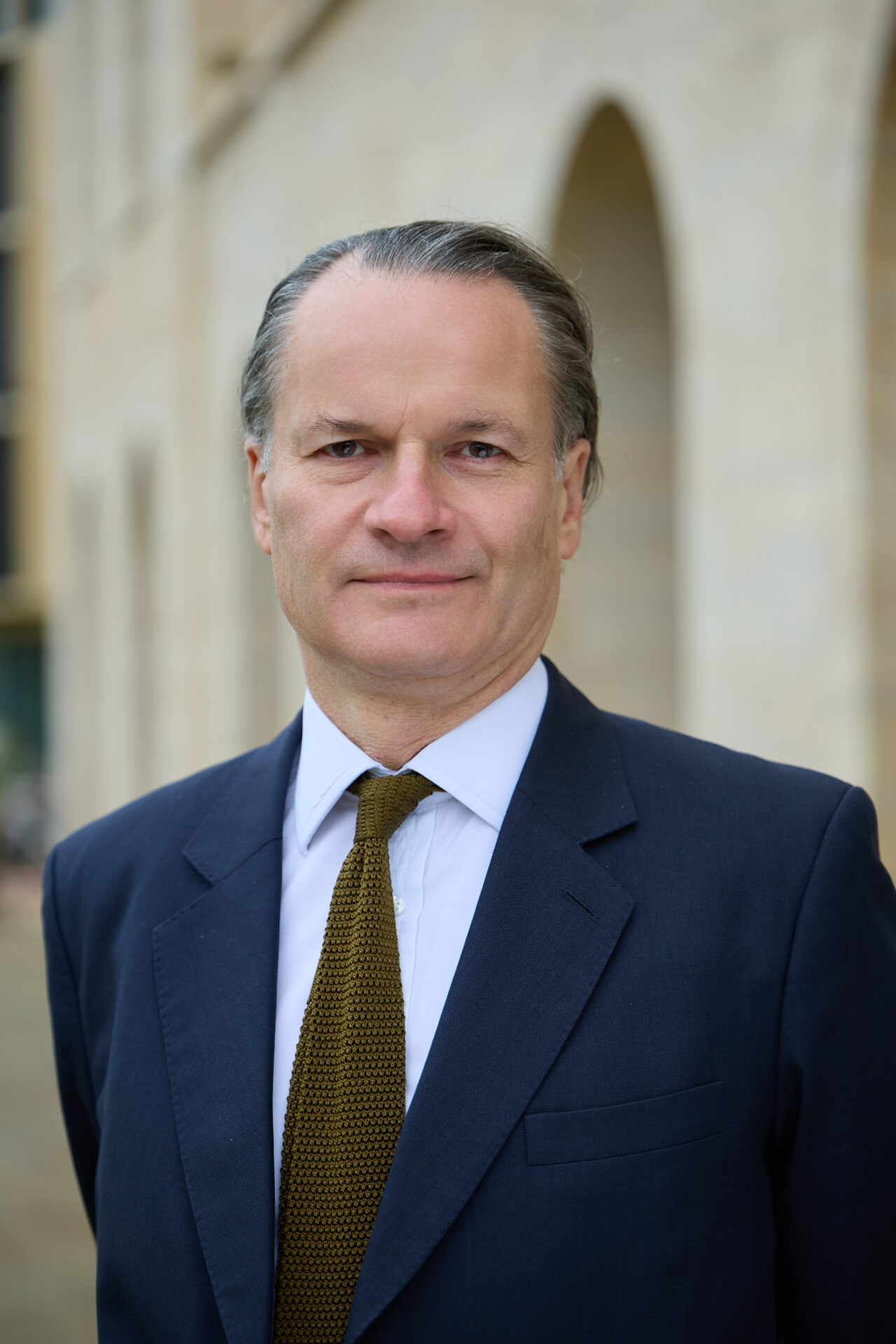
Barely 30 seconds into my conversation with Edward Harcourt, I have egg on my face. In my preamble to the first question, I somehow ended up questioning the importance of “academic philosophy”. The academic philosopher shot me a stern look.
It is an ironic error. The real-world relevance of philosophy was exactly why I wanted to talk to Harcourt, the director of the University of Oxford’s Institute for AI Ethics. The institute itself is a product of philosophy’s importance in the age of AI, and was founded in 2021 thanks to a donation from Stephen A Schwarzman. It aims to offer “independent, informed perspectives on AI – spanning multiple disciplines but anchored in philosophy and humane learning”.
I had witnessed this in action days earlier at the institute’s summit on Human Rights and AI. The summit, with its focus on the importance of applying human rights frameworks to artificial intelligence, showed the value of the “open-ended inquiry” Harcourt says the institute promotes.
Harcourt is not a “specialist” in AI. Rather, he is an expert in the philosophical questions AI poses. It has provided a focus for “questions [that] have been on my mind for a long time”. Questions like: “what’s special about human beings?” or “why is the mind not a mechanical thing?” Public discourse on AI “seems to bring all these questions alive”.
These are problems the AI companies are aware of themselves. Arguably, there has never been a better time to study philosophy. AI labs are hiring philosophers en masse, and recent American statistics show that philosophy graduates are more likely to be employed than their computer science peers.
Harcourt, however, offers a very different approach to ethical AI than the frontier labs. He criticiіes the “constitutional” model applied by Anthropic, the company behind the AI chatbot Claude.
Anthropic’s approach to ethical AI centres on training. Their constitution encourages Claude to engage in its own philosophy: “We encourage Claude to approach its own existence with curiosity and openness.” Harcourt argues: “It is a mistake to think that AI ethics and ethical AI is all about what you train models on.”
It assumes a “consensus” that is almost impossible to reach in practice. “Just casting your net very, very wide and thinking, ‘well, what do all humans agree on?’” might not produce anything. It also neglects the importance of “reasonable dissent” in reaching ethical goods. An AI model like Claude is, self-evidently, unable to argue with itself.
Anthropic’s constitution also misunderstands human values. “There’s a lot of pious talk about training models to share our values. Well, it’s true that Saint Francis and Mother Teresa are fondly remembered, but another surefire way for human beings to get themselves immortalised is either to amass huge piles of money or to conquer huge swathes of other people’s territory… So when they say, ‘Oh, we want Claude to share our values, they mean some and not all’”.
Harcourt’s approach is about “the way in which humans and AI inhabit an ecosystem together”, not just the values AI is trained on.
I understand the true significance of this approach better when we discuss the possibility of AI being conscious later. He tells me we need to move away from the vexing question: “I think it misplaces the question because almost nobody doubts that dead human beings are non-conscious. Yet dead human beings are extremely special, whereas dead computers are rubbish.”
AI ethics, then, is not just about filing the rougher edges of AI adoption. Rather, it is about recognising what is special about humans as we adapt to an “ecosystem” where machines are more capable than we are in many fields.
Establishing philosophy’s importance is one thing; achieving impact is another. Harcourt thinks that setting his institute’s targets on big tech is ambitious, and while a conversation is necessary, he recognises that they “can buy their own philosophy if they want philosophy”.
Individual AI adopters are “the real soft spot”. In industries like banking, insurance, management consultancy, education, and many more, market pressure means “people are adopting at a faster rate than they can quite keep up with themselves, so they are very keen on understanding what they’re letting themselves in for”. He tells me about a survey released just that morning saying 46% of financial firms only “partially understood” the AI they had adopted.
What would his advice be? “Make sure there are adequate human controls”. This differs from just having a human in the chain of command: “It is no longer adequate to keep a human in the loop”.
Doing so ignores the risks of “epistemic deference” to AI models. This, he explains, is akin to being a 7-year-old going on an outing with your 16-year-old brother. “You’re going to do everything he says, right? Even if he asks you to do stupid stuff. Your decision isn’t worth much because you’re not the authority in the pair.”
Cognitive atrophy, the decline in human critical thinking skills, is an even bigger risk, especially for the generation of Oxford students getting to grips with AI for the first time. It also has scary implications. If AI leads to a decline in human intelligence, we will have the most control over the technology in the current moment. As Harcourt puts it: “the more the world contains a preponderance of AI natives, the less there will be that kind of critical intelligence or scepticism around.” “AI adopters,” he says, “need to think carefully about how they grow their next generation of leaders.”
In the context of how my generation can guard against these threats, I put to Harcourt my concern about students’ reactions to AI. Look at the comments of any Cherwell article about AI, and you see a dogmatically negative response from a student population increasingly reliant on that same technology.
Harcourt agrees with this disconnect: “I think it is proper to be critical of the big companies. I don’t think that’s misplaced… they get away with a lot.” However, he adds: “They [young people] should be more self-critical in terms of their own reliance on AI. Once upon a time there was no such thing as print… what an amazing difference that must have made, and yet we integrated it into our lives, we’re not looking back and thinking, ‘well I wish there was no such thing as printing’ so my guess is that there is some reasonable accommodation to be made in AI.”
What is needed, he said, is “some pretty tough education”.
Here Harcourt brings to bear his own fascination with chatbots. He has a longstanding interest in the philosophy of psychotherapy. It was the tragic stories of chatbot-induced suicides that were his “philosophical inroad into AI”.
He thinks students should consider in school: “What is really going on when you talk to a chatbot? Do you think it really understands you? Your friend is going to be sick of you talking about yourself non-stop for 45 minutes. The chatbot won’t. Do you think that’s because the chatbot is a much better person?”
This discussion reveals the misaligned incentives between big AI companies and consumers. While it may help AI producers have people see the model as a fellow human, it is not self-evident or even rational that ChatGPT or Claude should use the first person. Harcourt later speaks positively of Chinese regulation that limits chatbots’ use of the first person.
This practical succession runs contrary to much contemporary AI discourse, which tends to fluctuate wildly between terrifying tales of human extinction and dreams of a cashless, workless age of abundance. With some reserve, I put these competing visions to him.
He remains sceptical about existential risk: “It distracts us from nearer-term potential harms caused by AI, including environmental harms but including also the cognitive atrophy [sic].” It also helps the “frontier labs to magnify the importance of their own product.”
While he recognises how the Hugging Face incident, where a band of rogue AI agents hacked an AI training company and secretly communicated over message boards undetected for months, has heightened focus on existential risk, the unease remains.
“If we want to talk about existential risk, let’s think through carefully what the mechanisms are for humans becoming extinct thanks to AI going rogue. I could think of lots of terrible things that might happen if AI went rogue… It could crash the NHS. Lots of people would be harmed, but crashing the NHS is not the same as the human species becoming extinct.”
Existential risk scenarios, he argues, are too casual with the role of human error. He uses the metaphor of COVID-19 escaping from a lab: “Whether that’s true or not, I’ve got no idea. But did COVID jailbreak the lab and pick the locks, or was it some human who didn’t do what they were supposed to be doing? So, I suspect that quite a lot of human error is surreptitiously built into the existential risk scenario.”
Whether the main risk is existential or merely near-term disruption, Harcourt’s job is to demonstrate why we should listen to philosophers to solve them. This brings us back to the question of humanity’s purpose.
“If you think we don’t need philosophy in thinking through how humans are going to cohabit the Earth with AI, reflect on the fact that the frontier labs are drawing on 350 years’ worth of philosophy for nothing.” More precisely, they are drawing on the vein of philosophical thought Harcourt most opposes. The idea “that human beings are a kind of machine” is a vein of thought that can be traced from Hobbes’ labelling of humans as clocks.
He notes the look of puzzlement on my face. Why does all of this matter with AI? “If we are just machines, and if human mental life is just about calculation, it looks like we’ve invented some other machines that replicate that. If somebody comes along and says, ‘Well, you know, is it better that there should be a million machines in existence or a million human beings?’” Saying that the humans are better seems like ‘prejudice.’
“So, there’s a lot of philosophy unspoken, and unspoken because it’s been so profoundly internalised, not only in the thinking of the frontier labs themselves but in the readiness with which our civilisation accepts the idea that AI is an artificial duplicate of us.”
Countering this is no small task. “Getting people to think again about the nature of humanity, getting people to adopt a new model of what we are like, which will make them think, why would anybody be so stupid as to think artificial intelligence was the moral equivalent of us? That’s like saying, ‘Well, folks, let’s sit down in a philosophy seminar room and reverse 350 years of history.’”
Earlier, I questioned how philosophy could impact AI. Leaving the interview, I wanted to know how we could halt the impact Harcourt showed me it had already had.