
The growing rejection of anything not deemed purely Hindu is a deep affliction within contemporary Indian society, not least because such furore is directly motivated by Islamophobia. Anything which does not seem to fit an increasingly uniform party narrative is often subjected to violent criticism. In recent memory, who can forget the outrage caused by jewellery company Tanishq’s advertisement, which so brazenly depicted the marriage of a Hindu woman to a Muslim man, despite a well-established precedent of such interfaith marriages in a country with such a history of religious diversity? Who can forget when, last year, Indian clothing company Fabindia had the audacity to release a clothes collection called Jashn-e-Riwaj (Festival of Tradition) around the time of Diwali? This was naturally decried by many, among them an MP from my home state, who wrote, “Deepavali [a synonym of Diwali, commonly used in South India] is not Jash-e-Riwaaz” (typos and all), before going on to complain about the lack of “traditional Hindu attire” in the ad, seemingly having overlooked the multiple saris on show. So why did the name cause such controversy?
The issue at hand was the name of the collection (not a renaming of the festival of Diwali, despite this being the name-plate of many a fervently-constructed straw man), which is written in Urdu – evidenced by the izafat (the possessive connective ‘e’, found in Persian and Urdu but not common practice in Hindi) – as well as the choice of words, which derive from Persian and Arabic respectively, as opposed to the possible Sanskrit equivalents. It would be another article entirely to analyse the extent of nationalistic fragility that might evoke such a response to three Urdu words, but today’s quiver contains only the arrow of language, so let us focus on that. Before looking at the language in depth, it is worth defining a few key terms: Sanskrit is an extremely ancient standardised Indo-European language, a direct ancestor of Hindustani, and the language of the Hindu religious and literary canon. In contrast, Persian and Arabic are not languages native to the Indian subcontinent (although Old Persian, Avestan, and Sanskrit share close linguistic links), with Persian generally spoken in modern-day Iran, Afghanistan, and Tajikistan (while Arabic stems from a different language family altogether – the Afro-Asiatic languages).
Language and history are, of course, connected. That is quite the understatement. Language is often personified as a living, breathing entity, which develops into the future based on its markings from the past. Hindi and Urdu, which will henceforth be referred to as Hindustani, are not exempt from this process. Hindustani is an Indian language, and therefore derives the majority of its vocabulary and syntax from Prakrits, descendants of Sanskrit that were spoken in India from approximately 300BC to 700 CE. After this, the language underwent several stages of development across the Indian subcontinent, yielding varieties such as Dakhani, spoken in the Deccan region, which was strongly influenced by Muslim rulers, as well as varieties around Delhi, which had less influence.
During the Delhi Sultanate and Mughal Period a process of Persianisation took place, whereby Hindustani retained much of its Prakrit core vocabulary, but absorbed huge amounts of Persian, Arabic, and Turkic loanwords. As the Mughal empire spread, so too did Hindustani, benefiting from Hindu-Muslim contact. This coexistence was so harmonious in places that it gave rise to the development of the Ganga-Jamuni-Tehzeeb1, a synretic cultural fusion of Hindu and Muslim culture and religion. At this stage, historical linguists point out that Hindustani was so diverse as a language that it was referred to as Rekhta, ‘mixed.’ Hindustani has survived with these various influences throughout the extended period of British Colonialism, and is still often used as a term to describe the language in Bollywood, which enjoys popularity in both India and Pakistan and cannot be described as belonging to one or the other.
It is, of course, impossible to speak Hindustani without subconsciously accepting, with almost every sentence, the role that Persian and Arabic culture has played in the formation of the country and its eponymous language2 (Hindustan is a synonym for India). We could, for example, look at an excerpt from speeches made by India’s PM, Narendra Modi. In a speech made in March 2022, at the India-Australia summit, he talks about the ‘creation of structural mechanisms of regular review of our relationship,’ using the word taiyar, standard Hindustani for ‘ready,’ a perfectly normal word, which came into Hindi from Arabic, via Persian. Such is the case for countless other Hindustani words and phrases which have been integral to a rich literary tradition for centuries. They are found in poetry, prose, ghazals (amatory poems with an origin in Arabic poetry) and many other forms of art enjoyed by innumerable proud Indians, myself among them.
If the extreme right-wing are to kick up such a fuss about collection names such as Jashn-e-Riwaj, then it would be quite hypocritical to use any vocabulary with a similar origin. Let us say goodbye to any words with the suffix -dar, as they are borrowings from Persian, and bid farewell to words such as intazar, mohabbat, duniya, zindagi (expectation, love, world, life), mainstays of not only poetry but everyday language, too. Following this reductive logic, only obscure words with a purely Sanskrit origin should be used (often lovely words too, it must be pointed out), before speech would inevitably judder to a halt. Let this blindfolded right-wing pause for thought when trying to express words for beginning or finish, (shuru, khatam, – both from Arabic via Persian), or even trying to eat their favourite foods, such as paneer. Let them find a new name for their very identity and religion – the very word Hindu is directly from Persian, deriving from an ancient Indo-Iranian root likely referring to the river Indus.
There is, then, a truly outrageous hypocrisy in criticising companies for choosing Urdu names and in the same breath making daily use of Arabic and Persian vocabulary loaned into Hindustani. This intentional linguistic and historical myopia, if it can be termed such, is one that transcends the boundaries of ignorant comedy, and has the capacity to yield horrendous consequences, particularly in a country as animated, energetic, and fervent as India. It is indicative of an attitude of historical revisionism, which seeks to ignore the role that Muslim influence has played on the very formation of the country.3 Is it really the case that the right-wing can enjoy the Taj Mahal as a symbol of India, a wonder of the world, without noting its origin and name, both from a Persian-speaking Muslim dynasty? (Taj – crown in Persian, Mahal – place in Persian, reanalysed as palace in Hindustani) It must surely be the case that even this group, which better resembles a kindergarten than a political faction, must eventually grow up and realise the inherent hypocrisy of such ways – one can only hope that such a realisation occurs before it is too late.
I should like to conclude this article with a couple of lines from an Urdu ghazal, written by poet Syed Khwaja Mir Dard, a poet from the Delhi school, which seem particularly relevant to this discussion of identity. It is below in the Perso-Arabic and Devanagari scripts, alongside a transliteration and meagre translation attempt:
دوستو دیکھا تماشا یہاں کا بس
تم رہو اب ہم تو اپنے گھر چلے
दोस्तो देखा तमाशा यहां का बस
तुम रहो अब हम तो अपने घर चले
dosto dekhā tamāśhā yaāhaN kā bas.
tum raho ab hum to apne ghar chale
friends, I’ve seen the spectacle here – that’s enough
you stay here, I’m heading back home
Make of that word, ghar – home, what you will.
Footnotes:
1A term which means Ganges-Yamuna culture in Hinudstani, named for the two rivers around which this syncretic Hindu-Muslim culture thrived. Elegantly, it just so happens that the term itself is a combination of both Sanskrit and Persian terms…
2For the sake of balance, it is important to point out that Persian and Arabic also contain several loanwords from Sanskrit, although these are far fewer (for obvious historical reasons) than the number of loanwords into Hindustani. Nevertheless, they include the word nârang, orange, from Sanskrit nāraṅga, from which most European terms for this fruit derive, too, as well as Persian/Arabic shatranj, deriving from Sanskrit caturaṅga (an army of four parts – elephants, chariots, cavalry, and infantry) – The name of the board game this may have spawned escapes me…
3Yes, a great deal of Persian influence originally spawns from Zoroastrianism, but the impact of Persian on Indian languages is directly traceable to Muslim rule which used Persian as the language of the court.
Stolen Focus is one of the few books I would label ‘life-changing’. Sure, I’ve read many memorable books – it would be hard not to, studying an English Literature degree – but rarely have I finished a book and felt as though my entire life perspective has drastically shifted.
To summarise crudely the recently published book, Hari examines the widespread degradation of our ability to focus and the environmental factors contributing to this collective crisis of attention. Though he primarily scrutinises the impact of technology like our phones, laptops, and the internet, he also delves into how changes in our diet, sleeping habits, and cultural attitudes regarding productivity have drastically altered our ability to concentrate each day.
Hari, who attracted attention with allegations of plagiarism and poor journalistic practice a few years ago, choses an engaging and personable style of writing in his book. He shares his own experience of poor focus and his addiction to technology with honesty and frankness, describing how, when his phone was taken away, he “felt like a large part of the world had vanished […] its absence flooded me with an angry panic”. Unusually for a book exposing some depressing statistics, he voices rallying optimism for our ability, as a society, to challenge the systems that are profiting from diverting and transfixing our attention on online content.
This is what resounds most strongly in Stolen Focus, the fact that our inability to focus is not the result of individual weakness. On one level, this message reassured me. We should not feel guilty or frustrated at ourselves for wasting hours on social media unintentionally. Powerful corporations have manipulated our attention to suck us into the virtual world of Instagram, Facebook, and YouTube, Hari states. Quoting Professor Joel Nigg, an American psychologist, Hari argues they are fostering “an attentional pathogenic culture” For social media sites, success is measured by engagement – the more time we spend staring at our screens, the more adverts we are exposed to, and this in turn generates revenue. Features like ‘infinite scroll’ – the web design mechanism that automatically and infinitely loads new content without the user needing to click for more – make it extremely difficult for us to peel our gaze away from our screens. This is why, on another level, this book terrified me.
I am yet to watch the Netflix documentary, The Social Dilemma, but friends tell me that the programme similarly examines social media’s ability to condition our minds into craving the frequent and immediate dopamine rewards that ‘likes’ and ‘follows’ deliver. Stolen Focus argues that we were vulnerable to manipulation even before social media was introduced, due to an array of social factors, such as high levels of stress.
What interested me more, however, was Hari’s consideration of less studied factors, such as the decreased amount of time our minds spend wandering. Growing up, we are taught that ‘daydreaming’ is detrimental to our ability to learn in the classroom. Our culture constantly demands our attention, be that the boldly coloured advertising billboards, the constant whirr of traffic, or the buzz of text and email notifications in our coat pockets. Seldom do we find time to digest any of this noise. Our minds exist in a state of turbo-charge, frantically flitting between different sources, engaging with each at only surface-level. By depriving ourselves of time to let our minds wander, Hari argues, we make ourselves more vulnerable to distraction.
After finishing this book, I went on an aimless walk. `I did not bring an audio-book, podcast, or music. It was remarkable how relaxed I felt. I couldn’t remember the last time I did something without a specific purpose. Oxford’s intense eight-week terms reinforce the constant pressure to be doing something ‘worthwhile’ or ‘productive,’ be it academic study, rehearsals, or sports training. Taking time off to rest our minds, however, enables us to attend our activities with focus and clarity.
Hari offers a few helpful tips for improving sustained attention, like finding an activity that is meaningful to you and will fully absorb your attention – a ‘flow state’. However, if you’re looking for a self-help book providing simple steps to solve attention deficit, then this is not your book. Hari continually emphasises that individual lifestyle changes can only get you so far. To truly regain our ability to focus, we need systematic change that will address the larger forces assaulting our attention. This, he convincingly argues, comes down to ordinary individuals like you and me grouping together to protest, because – let’s face it – companies and governments won’t change a system that is immensely profitable unless we demand it.
Stolen Focus is a simultaneously immobilising and empowering book. By addressing the root problems, it demonstrates that individuals are not responsible for their own inability to focus. Yes, it has an element of journalistic sensationalism, with its heavy reliance on shocking statistics such as how the average American in 2017 spent 5.4 hours per day on their phone (that’s 85 days each year), but these are not intended to debilitate us. Rather, Hari manages to weave studies, interviews, and personal insight into a narrative that ultimately strives to enlighten and alert its readers to the importance of focus. Our culture has taught us to undervalue this state of mind, but Stolen Focus reminds us that it is worthy of nurture and protection.
Since finishing this book, I’ve been more mindful when using my phone, monitoring my screen time and actively making an effort to distance myself from social media. I won’t lie, it’s been difficult, and I still catch myself scrolling through the Instagram ‘explore’ page late at night instead of sleeping. But Hari’s book was the impetus I needed for reassessing my relationship with technology, and I now actively pursue other activities over using social media. Each time you pick up your phone, ask yourself, “Do I really need to use this? How will it make me feel?” Nine times out of ten, I put the phone back down.
If Thomas Hardy had blessed his female characters with more than an “ephemeral precious essence of youth,” perhaps he would have produced something along the lines of Dorothy McDowell’s Casterbridge, an adaptation of Hardy’s 1886 novel The Mayor of Casterbridge. Performed at The Space in London, Casterbridge reacts against its male-dominated Victorian source in creating a wholly unique re-telling, set in London’s fast-paced financial district between the 1980s and 2000s. Expecting a feminist re-telling of a classic favourite, I was curious to see how McDowell would re-fashion the original novel with a contemporary, progressive ethos. The ingenuity of a 2000s setting came as a pleasant surprise, for what else could capture the competitive, dramatic tensions between an 1840s Henchard and Farfrae quite like a hedge fund run by a ruthless girlboss?
A stage composed of cardboard boxes and suitcases creates a charmingly rustic yet rootless vibe which, for those familiar with Hardy’s original, refers to the pastoral nature of Casterbridge, a comment on the continuous battle for self-interest, whether it be the provincial politics of a Victorian town or contemporary financial affairs.
This female-centric adaptation is grounded by the charmingly awkward Eddie Henchard (Lara Deering), perhaps the most constant character throughout the play and providing a good dose of comic relief in his veneration of Farfrae. I admired the choice to pass Elizabeth-Jane’s feminine passivity onto a male equivalent, with Eddie being the perfect juxtaposition to the ruthless hostility between Farfrae and Henchard. Eddie’s quiet power not only serves to prevent these two businesswomen from overpowering the stage, but also extends the defiance of gender stereotypes by representing a sensitive young man who is not possessed by the impulsive arrogance of the male protagonists in Hardy’s work.
Then there is Luke Le Sueuer, played by Leah O’Grady. McDowell’s male version of Lucetta maintains the sly characteristics of a desperate woman, yet the moment O’Grady saunters onstage, the ingenuity of McDowell’s experiment with character is just as authentic when originally female characters are transferred to male counterparts. Likewise, Gilfillan’s portrayal of Mary Henchard is incredibly profound, as we see her shift from angry drunk to cocksure CEO.
All these gradations are articulated to the audience by Farfrae (Lorelei Piper) herself. With insight into the story that Henchard does not have, Piper’s performance effectively ties together the dramatic events of the story for viewers unfamiliar with Hardy’s novel. Strutting around the stage in a flashy pink suit, she encapsulates the novelty and innovation which is so threatening to Mary.
I found Mary Henchard’s will particularly potent, as it is taken directly from Michael Henchard’s own will in Hardy’s novel. The play’s final line, “to this I put my name,” delivered profoundly and succinctly by Gilfillan, illuminates the versatility of language; the theme of remorse is relevant regardless of time, place, or gender. The originality of McDowell’s adaptation lies in the detailed artistic choices rather than in sweeping maxims: replacing a town fair with a bar, an arrogant, afflicted man with an ambitious girl boss, a skimmity ride for leaked photos. Topped off with catchy noughties hits, Casterbridge appeals to book lovers and theatre-goers alike.
The time has come for Oxford United. The men’s side are in a nail-biting fight for a playoff place with nine games remaining and the women have just three games left to play – all away from home. So, what’s left in store for the U’s?
It is the women’s side who have the fewest games left to make a difference to the table, but in an odd quirk due to various postponements, they will enjoy a few weeks off before their next match against Ipswich on 24thApril.
That trip to Bridgewater will be crucial and undoubtedly season-defining. The FA Women’s National League, the third tier of the game in England, offers up just one chance of promotion for each region. Even then, the title winners must face off against each other to go up. As it stands, the Yellows are sitting third in the table and four points behind leaders Ipswich, whom they face next. An emphatic 9-0 win over Keynsham Ladies in their last home game of the season last time out not only ensured that they stayed unbeaten at home all season but might also be vital in the race for goal difference come the end of the season.
After travelling to the league leaders, Oxford have yet another crunch game against the side sat second, Southampton. They are just three points ahead so if the U’s can win their next two games then they will be in with a real chance of the title come their final day trip to Gillingham. It won’t be easy, but it is still all to play for and drama is guaranteed.
On the men’s side of things, a recent drop in form has left the team in a tight battle for the play-off places despite having looked comfortable just a couple of weeks ago. Two defeats in the last week to rivals Plymouth and a struggling Morecambe side have seen Oxford drop to eighth in League One. They are three points behind the teams currently occupying fifth and sixth, Sheffield Wednesday and Wycombe Wanderers, and much like the women face a potentially season-defining test next time out.
Sunderland are seventh in the table and within touching distance. They make the journey to the Kassam on Saturday in what is set up to be a blockbuster of a clash. Looking further ahead, United have a tough run-in with tests against high-flying MK Dons and Rotherham. The final day sees them host Doncaster Rovers in what will surely be an amazing spectacle.
So, that’s how it is all looking heading into the final month of the season at Oxford United. Can the men push for a play-off place and extend their season all the way to Wembley? Can the women’s side achieve a historic promotion? Only time will tell…
Oxford-based refugee charity Asylum Welcome is preparing to help the local groups, organisations, and individuals who are about to host Ukrainian refugees.
More than 20,000 applications have been received under the Homes for Ukraine scheme since it opened on the 18th of March, according to Richard Harrington, the minister for refugees. The scheme was designed to allow Ukrainian refugees with no family links to be hosted by members of the public in Britain, who will be paid £350 per month.
The government has not created a formal process for matching sponsors and Ukrainian guests. This will be carried out by community groups, faith groups, and NGOs. Security checks including Police National Computer checks, criminal records and Warning Index checks are made by the Home Office on every potential sponsor, as well as other adults in their household and the potential guest.
Asylum Welcome said in a press release: “Despite the organisation’s concerns around the scheme’s design, Asylum Welcome is heartened by the extraordinary expression of generosity from the public in response to the scheme, and is determined to help make it work.”
According to its website, Asylum Welcome’s mission is to offer “information, advice and practical support to asylum seekers, refugees and vulnerable migrants living in Oxfordshire”. Founded in 1991, it has since worked with refugees, asylum seekers, and immigration detainees in the area. It is a volunteer-based organisation that is backed by the Office of the Immigration Services Commissioner with over 100 active volunteers. In response to the ‘Homes for Ukraine’ programme, they have offered support and guidance for hosts in Oxfordshire.
Asylum Welcome is also working with councils and experts to design a more comprehensive programme of support for refugees. In the past weeks, it has recruited more staff to focus on supporting Ukrainian refugees, as well as organising a meeting attended by councils and local organisations to discuss how the ‘Homes for Ukraine’ scheme will work in Oxfordshire and what support could be valued.
Mark Goldring, the director of Asylum Welcome, said: “I want to say thank you to the thousands of people across the county who have expressed their wish to support people fleeing the war in Ukraine. It shows the generosity of the British public. The government needs to ensure the access routes for Ukrainians and indeed all others fleeing violence are made simpler, to ensure that those driven out by conflict are able to benefit from the generosity and kindness being shown by our communities. Asylum Welcome are determined to play our part in supporting the generous hosts and the new arrivals.”
Asylum Welcome is currently appealing for donations to fund its Ukraine service without restricting its work with refugees from many other less-publicised wars, conflicts, and crises. They welcome offers of support from anyone with relevant language skills. Donations can be made at www.asylum-welcome.org, and people can email [email protected] to offer support.
In 1890s Paris, Swiss-French artist Félix Vallotton’s striking, monochrome woodcut series known as Intimités captured all the illicit affairs and longing glances of his aristocratic belle époque subjects. Put simply, his work explored the ways in which they related to one another, and the nature of intimacy itself. Ever ambitious in its approach to what art and theatre can be, Oxford production company Paper Moon aims with its new exhibition Intimacies, after Vallotton not only to apply Vallotton’s vision to a contemporary Black British setting, but also to combine innovatively Paul Majek’s Vallotton-inspired artworks with a series of piercing duologues by student playwright Sam Spencer.
Spencer’s writing, which one can listen to at the Old Fire Station exhibition either by scanning QR codes or with a traditional audioguide, is remarkable in its ability to cut to the heart of what makes the relationship between two people unique, without ever being unsubtle or overly literal. Against the backdrop of Majek’s enigmatic blue-toned figures, Spencer, with the help of a multi-roling, all-Black voice cast playing a broad spectrum of characters, reveals tantalising glimpses of these figures’ lives. Among them, a woman and her girlfriend both give individual testimonies of a relationship on the brink; in the light of cultural and career tensions, two nannies discuss bemusedly their wealthy charges; a pair of exes veer towards closure.
Both the audio and visual aspects of the exhibition are rich with ambiguity. Spencer’s use of subtle verbal cues and meaningful pauses, combined with the disembodied effect of an audio recording, sometimes conceal from the listener quite what’s going on until halfway through. Similarly, Majek’s paintings, made up of rapid streaks of paint upon a rough wooden canvas such that the figure appears ‘barely there’ and can sometimes only be seen from certain angles, have a similarly fragmentary effect.
The viewer thus feels like an observer and an intruder, invited into personal, private interactions which we don’t fully grasp. These interactions strike a tough balance, feeling simultaneously so specific to an individual that an outside observer cannot understand them in their full context, yet so universal in their view of human relationships that one is left with further questions rather than shame at the intrusion. The connections between the art and the writing are also pleasingly non-literal — rather than simply depicting whoever happens to be speaking in the audio, Majek seems with his ghost-like figures to be creating certain archetypes, a visual aid to the observations Spencer makes about the human condition.
Situated in the grey area between the theatre, the radio, and the art gallery, Intimacies is inherently interactive, and creates a (fittingly) intimate connection between art and viewer, as one can choose which work they listen to, which artwork they observe, and where in the gallery they stand. There is no set order in which the viewer must listen to the duologues as they move around the gallery; this has the effect of a tapestry being gradually revealed, as one hears Spencer returning to imagery familiar from an earlier piece, and wonders if the duologues are at all connected (is the couple on the brink of divorce in one piece the same couple experiencing the first signs of tension in another?). In some ways, however, this effect is undermined if one listens on the audioguide rather than on a smartphone, since this will in fact play the duologues in a set order, making them feel more ‘fixed’ and less ambiguous in their relationship to one another.
Intimacies raises more questions than it answers: about the ways in which we communicate, about how an outside observer can understand them, how theatre and visual art can enhance one another, and how a work can be rooted in historical inspirations like Vallotton while also building upon them. The show demonstrates great promise in Majek and Spencer, and also is a welcome sign of innovative, unconventional approaches to theatre being taken by student companies like Paper Moon.
Not the Way Forward Productions’ original play Casterbridge, a female-led retelling of Thomas Hardy’s classic novel, sees its London debut at The Space this week. We spoke to writer-director Dorothy McDowell, producer Ana Pagu, and actor Leah O’Grady about the process behind Casterbridge ahead of its five-day run.
What made you decide to adapt Hardy’s The Mayor of Casterbridge?
Dorothy McDowell: It’s a book I’ve really liked for a very long time – I first read it when I was a teenager, and it was the first proper ‘grown-up’ book I remember really enjoying. Then, by coincidence, I did it for A-level, many, many years ago now. I remember, when I was meant to be doing my notes on it for revision, I was sitting there thinking, ‘if this were a film, this is what it would look like’. When I was graduating from Oxford, I was looking for a play to put on. If you skim down The Mayor of Casterbridge, it’s really about two people, Henchard and Farfrae, and about their rivalry and their relationship with each other. Once you get something that has that core, that two-person dynamic, it gets much easier to cut it down to an hour, to something four actors can do.
How has it been adapting the novel to a more modern setting?
Dorothy: I’ve enjoyed it. It’s a bit like writing fanfic – you get to play with characters that you really like. It’s a bit terrifying, because the nature of novels is that everyone who reads it has a vision of it in their head. This is how I see The Mayor of Casterbridge. Every single decision you make when adapting it, you know you’re going to horrendously disappoint someone who likes the book. It’s quite fun because you get to do exactly what you want to do and you have to learn not to worry about what anyone else is going to think of it. But this is a 200-year-old classic and I’ve changed bits of the plot, I’ve taken out a character…Thomas Hardy would be turning in his grave, which is a slightly horrifying thing for a good English literature graduate, as I am, to think. Grown-up fanfic, shall we say. Fun.
If you’ve been involved with any Oxford drama, how has your experience putting on a play in London compared to doing so in Oxford?
Ana Pagu: I’ve produced shows in Oxford a fair bit in the past three years, with a two-year hiatus like the rest of us. I think the main difference has been figuring out how to market to a London audience. There are so many people in London and a lot of them go to the theatre, but it’s really hard to tell them that this is a show that is happening among the other 300-odd shows that are happening today, and that it is good and that you must come and see it. We’re going to find out next week [as to the success of the marketing]. But there is not the [Oxford] culture of ‘there’s a show on’, and the whole student community floods the BT. It’s fantastic to see, but it’s not the same in London.
Dorothy: Ana and I were prolific student drama people at Oxford. I think I did around 15 student shows. The thing I found weird was that it was quite like doing an Oxford show, because all my actors are people I had either met in Oxford or had directed when I was a student. But this is a bit more serious, and there’s a lot less support. The only thing stopping this from falling through is me, me and Ana sitting there trying to hold up the sky, trying to make something go ahead whenever there isn’t the infrastructure in place.
Leah O’Grady: The version of Casterbridge which was done over the summer last year was my first show and then I did Songs of the Silenced at the BT in Michaelmas which was great fun, very different to this. I’m directing something of my own at the moment, and [Casterbridge] has made me very grateful for the infrastructure the university provides, because watching you guys do it is quite scary. But like Dorothy said, it’s amazing to work with people trying to do this professionally, and a lot of the rest of the cast are auditioning for drama schools. It’s a privilege to be able to work with such amazing women who are aiming for the stars.
How has the rehearsal process been? Have rehearsals been happening in Oxford or in London?
Dorothy: In London, mostly. That’s actually a big difference – at uni you can get a space to rehearse in for free. We have the shed at the bottom of my garden, which has been getting far more use than I wanted it to be getting. Massive shoutout to New Diorama Theatre Broadgate, which is a theatre in London which has a two-storey building that they let anyone rehearse in for free. It’s really saved my neck a couple times.
Leah: We blocked out all the scenes, and in the last week or so we’ve been running them. It’s been a lot of fun. Me and one of the other actors [sic], Lara [Deering], have seen the show develop from its infancy in June of last year. I’m multi-roling, as is Lara, [which involves] playing around with the characters. One day Dorothy will tell me to ‘do this like you’re so disgusted with her [that] you can’t even look at her’, and‘do this like you’re really pissed off’, or ‘do this like you’re really stressed, like you’re hysterical’. It’s a bit of a mad play, and a lot of quite mad things happen, because that’s what happens when you translate Victorian characters into the modern era. It’s been a lot of fun and a lot of jokes.
Have you had any memorable moments during rehearsals?
Dorothy: We had an actor who was missing for a bit of rehearsals today and we needed to redo a scene, so I filled in for them. When I was in first and second year of uni I did quite a bit of acting, and I haven’t done any since. But I got weirdly into it, and forgot Leah wasn’t just a prop. And I sort of whacked into Leah. I don’t know what came over me!
Leah: I’d say another memorable moment was an actor getting COVID, and then her understudy getting COVID, and us bringing in the legend that is Maya [McQueen].
Ana: And it wasn’t even 24 hours apart, so the understudy didn’t even get a chance to be an understudy.
Dorothy: Maya, who’s our understudy 2.0, learned of our existence at 9am one morning and was in rehearsals by 2 that afternoon.
Leah: [Another memorable moment was] trying to be a sexy man. There’d be lots of character workshops where people, mostly me, have been trying to get into our two or three characters. We’ve been trying to solve these characters for about nine months now, and one of them is a sexy man.
Dorothy: I spent about 20 minutes one time trying to force Leah to do an impression of Joey from Friends, going ‘How you doin’?’.
Do you have a favourite line from the play?
Leah: I like “Where is she? Where’s that witch?” Also, “Mary, you’re drunk, sit down and shut up.” Oh and also – I’m getting carried away here – when [Mary] says “I mean it!” and [the male character] replies, “You look insane, sit down.” They’re just people being angry at Mary.
Dorothy: I really love the book, and there are lots of beautiful lines in [it], and I had to get rid of all of them. My favourite line is “It doesn’t matter why things happen, the most important thing is that they do”.
Ana: I like the line we’ve put on our advertising – “I don’t see why people who have got husbands and wives shouldn’t sell them to those in need of such articles.”
In three words, why should Cherwell readers go and see Casterbridge?
Leah: Am I allowed to say girlboss, gaslight, gatekeep? That’s what everyone says whenever they hear about the show.
Dorothy: Support Oxford students. I remember when I was in third year I was wondering how to put on a show in London, whether it was possible, how people do it. We know the answer to these questions now!
Ana: Come and ask us questions if you would like to do this – we can help!
My answer is a whole paragraph, but I’ll try to distill it into three words. The show is incredibly random. If I told you that we’ve got a show with a set made out of cardboard, reinterpreting a Hardy tragic novel, with noughties pop hits and an all-female cast, you’d just go, what the hell? But all those random things somehow work together really well. I don’t understand how, and I guess it’s credit to Dorothy and her writing, and Hardy, but it works!
Three words? Cardboard…pop…finance? As you can see, the show is next week and we’re all going a little mad!
Casterbridge runs at The Space in London from 5 – 9 April. Tickets are available here. The play will also be livestreamed 7 April and on-demand streaming will be available for two weeks here.
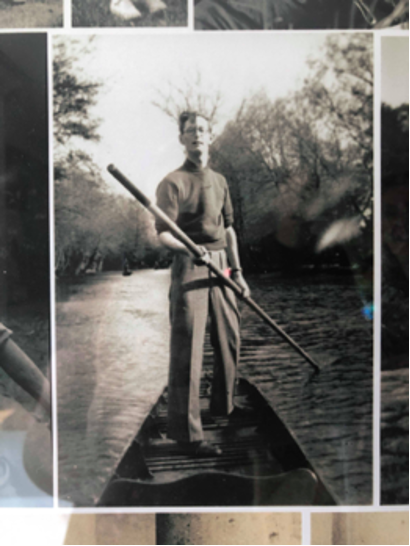
Image Description: A river with trees behind, in Port Meadow.
A few months ago, I somehow ended up in an Improv class whilst on a football training camp. No doubt this is common knowledge to a seasoned thespian, but we were taught that one of the cardinal rules of Improv was never to say ‘No’ in a scene, as it would be unhelpful to the plot and character development. How strange it would be, I thought, to have to agree to everything like that in real life. It was not long afterwards that my wonderful roommate suggested this title for my next article. Despite the panic that flooded my stomach at the thought of this challenge, I agreed, and sent out a message to friends and family asking for the most wild and adventurous requests they could think of, all of which I would have to say ‘Yes’ to. Here is what happened next…
Watching my first ever football match: I was invited to go and watch the England international women’s team play in Wolverhampton with the newly-crowned cuppers champions, the Catz women’s football team. The two-and-a-half hour drive turned out to be more than worth the wait, as we watched England defeat Germany to win the 2022 Arnold Clark Cup! While I have always quite enjoyed watching football matches on television, people have always told me that being in a stadium and feeling the ‘atmosphere’ is a different story altogether – and it really was. I was completely starstruck too and could hardly resist jumping up and down in glee when I saw so many of the England players I had been so in awe of during the World Cup in 2019, playing barely 200 metres away from us. The roar of the crowd after every tackle, free kick and goal was sensational. It reminded me of what I love most about sport – its power to inspire and impress people from such diverse backgrounds.
The verdict: 100/10 – Hands-down one of the coolest experiences of not just my Yes-challenge, but of my life! Thank you to the Catz football team for a truly wonderful day! This will definitely be my first football match of many.
How strange it would be, I thought, to have to agree to everything like that in real life.
Wild water swimming: I was dreading this one the most. Taking a dip in the river in Trinity Term when the Sun is beaming down and you are feeling nice and warm after the glass(es) of Pimm’s you have been drinking all afternoon is one thing. For some reason, the currents of the river Isis just do not seem quite so appealing in late February. After a lucky escape on my first attempt, (I honestly was just about to follow a couple of seasoned wild-swimming-friends into the icy-cold river at Christchurch Meadows when we were stopped by a park ranger – how sad) I finally took the plunge on a breezy afternoon as the Sun was setting over the banks of Port Meadow. There was very little actual swimming involved. At the behest of my friends, I took a perfunctory stroke of something that vaguely resembled a front crawl and then pleaded, my teeth chattering, ‘Could I please get out now?’. Against all expectations, I loved it. It was invigorating, yet relaxing and the perfect way to de-stress during term-time as the water temperature leaves room for absolutely nothing else in your mind.
The verdict: 9/10 – it might have been great, but it was still very cold.
The Weetabix and Parma Violet milkshake: There was always going to be at least one request for me to eat/drink something weird. As someone who is guilty of always ordering the same thing from a lot of restaurants, it was liberating to allow someone else to control my culinary experience for once. I would like to think that I will be at least a little more adventurous going forward. Still, not sure I will ever be having anything containing Weetabix or Parma Violets anytime soon.
The verdict: 0/10 – no, thank you.
Going vegan for a week: I tried. I really did. As someone who struggles to even make it through Meat-Free Mondays, this was always going to be a challenge. I lasted two full days and two half days (the lack of vegan options at the England match and the Weetabix milkshake proved to be unconquerable obstacles). On the fifth day, my stint as a vegan ended once and for all when, after an exhausting day of rowing and dance training sessions, I finally caved and ordered a large meat pizza from Domino’s. If that was not bad enough, I added stuffed crust too.
The verdict: 3/10 – I might have failed, but I have come to realise that being able to sustain such a diet requires impressive forethought and organisation. I had not comprehended just how difficult it is to find vegan-friendly food while out and about. While it is very doubtful that I will be doing this one again, in a surprising turn of events, oat milk has become a staple in my diet!
A date with myself: Not your traditional dinner or drinks, I took myself out on my idea of a perfect date. I donned a summer dress and spent the afternoon wandering up and down the Thames, stopping to gaze poignantly out from Tower Bridge and sip an awfully indulgent milkshake upon a bench outside the Globe Theatre. Although I have lived in London my whole life and have walked up Southbank and across London Bridge more times than I can remember, I have never done so by myself.
The verdict: 10/10 – the company was excellent.
Playing as a shooter in a netball match: I had to repeatedly check with the rest of Wadham netball that they were 100% sure they wanted to effectively forfeit our matches this week, especially after this one was requested by multiple people. When I went on as GA, the only goal I had in mind was staying out of the way of our seasoned GS. Somehow, the game turned out to be a resounding success: all I can say is that our other shooter is really good, and I managed to make a couple of fortuitous lobs that somehow tumbled through the net. At the risk of sounding terribly pretentious, maybe netball is a lot like life: sometimes, we have to put ourselves in positions we do not want to be in; sometimes, even when the odds seem completely out of our favour, the best thing we can do is to just shoot our shot. You never know what goals you might achieve.
The verdict: 8/10 – thoroughly enjoyable, not sure we will be making this a regular position though.
Spending one-on-one time with someone new: I went for lunch with a course mate whom I have somehow never spent one-on-one time with, despite having shared numerous classes and group pub trips! It cemented a friendship that should have been built so much sooner, and has inspired me to ‘go for coffee’ with so many more of the people in my life. As a finalist, it is easy to think that meeting new people in Oxford this year will be both impossible, due to the term time workload, and a little redundant, given the limited time we have left at university. Yet I have found the opposite. Building new connections has been the highlight of this term, much-needed after a year limited by lockdowns.
The verdict: 10/10 – We never know how long friendships are going to last when we make them. No matter what year or stage of life we are in, new connections are always worth exploring!
Trying a Salsa class: I was fatally complacent about this one. Having danced from a very young age, I assumed I would cruise through the class, being able to show off a wonderful repertoire of fancy footwork and pick up the choreography at first glance. Oh, how wrong I was. Dancing by yourself is one thing – what I had not considered was the completely unnerving experience of dancing with complete strangers for the first time. The constant rotation of partners was even more jarring – I found myself transported back to freshers’ week as I introduced myself dozens of times and found that the names and faces of my dance partners began to blur in my mind, already reeling from the salsa choreography!
The verdict: 7/10 – a refreshing experience, but evidently I am not ready for Strictly Come Dancing just yet.
…sometimes, even when the odds seem completely out of our favour, the best thing we can do is to just shoot our shot. You never know what goals you might achieve.
Mending a broken friendship: I went for a walk with an old friend and realised it is never too late to reconnect with people you were once close with. When I was young, I used to think that every friendship I made would last forever. Growing up, I have come to realise that friendships change and grow throughout our lives just as much as we do. Misunderstandings happen; sometimes you lose touch; sometimes life takes you in different directions. But sometimes, all it takes is a coffee and a walk to remind you that even the oldest friendships can have new beginnings.
The verdict: 10/10 – being able to reflect upon past mistakes and recognise your own growth is surprisingly rewarding.
A new Oxford library: I settled upon the Weston library, which I have never been to despite the fact that it is not even a 2-minute walk away from the room where I live in Wadham. The Weston is unique for its stipulation that you are not allowed to take bags, coats or pens into the library. Leaving my belongings in the lockers at the entrance was a strange experience in itself; the library seemed more precious somehow. I worked on the topmost floor on a desk by the window, surrounded by what looked like extremely ancient books and some startlingly loud electric pencil sharpeners.
The verdict: 9/10 – working in a completely new place turned out to be brilliantly productive and I ended up writing most of my dissertation here!
I went into this challenge thinking that my time saying ‘Yes’ would be the perfect demonstration as to why it is so important to say ‘No’ to certain things. The pressure not to disappoint people’s expectations and the urge to take on more than we can handle can feel overwhelming, particularly in a university scene where the possibilities for involvement and immersion are endless. I thought saying ‘Yes’ would just prove exhausting: instead, it has been distinctly exhilarating. When my roommate asked me a few days ago what my reflections were upon my ‘Yes-challenge’, I told her honestly that saying ‘Yes’ had led to one of the happiest and most enjoyable periods of time during my years in Oxford so far. I am not suggesting that we go around blindly saying ‘Yes’ to every single thing that is asked of us – it is important to recognise the difference between those things that are beyond our limits for good reason and those things that will productively challenge us. It turns out, the things people wanted me to say ‘Yes’ to have ended up enriching my life in unforeseeable ways. All the things I was asked to do had one thing in common: they forced me outside of my comfort zone in one way or another. Just as in Improv, good plot development and character-building in our everyday lives requires us to say ‘Yes’, to open ourselves up to the possibility of experiencing something entirely new. If you are reading this, I challenge you to say ‘Yes’ to something you might otherwise never have agreed to. Maybe it will end up being awful. But maybe, just maybe, it will end up being the best decision you ever made. Take that risk. Go where you have never been before. Dare to know. After all, in the words of Lewis Carroll, a man who once walked the streets of Oxford himself: ‘In the end, we only regret the chances we didn’t take!’
A 12-foot (3.5 meter) tall sculpture on Broad Street was unveiled at midday on March 30 and will be displayed there for the next four weeks. Designed by Witney-based artist Dan Barton, the installation shows a Ukrainian soldier holding a gun and a baby and helping a woman and child reach safety.
Barton characterized the intent behind the monument as to show support for Ukraine amidst Russia’s ongoing invasion of the country. “Its purpose is to honour those who fight for freedom and to show our unwavering solidarity to people suffering in Ukraine,” he said in an interview with BBC News.
The Broad Street sculpture was produced in collaboration with artist Peter Naylor and laser cut out of 15 mm sheet steel, weighing in at seven tonnes. From the idea’s first conception to the reveal of the final product, the process took 12 days. The project was spearheaded by Standing with Giants, a voluntary community group and not-for-profit organisation dedicated to honouring those who have lost their lives during conflict by creating large-scale art installations.
“Historically, monuments, tributes and sculptures come after the event,” Barton said. “However, for Ukraine, we wanted to act now.”
Barton said that the sculpture had already prompted messages from people in Ukraine “thanking us that we haven’t forgotten them.” He also noted that the design of the Broad Street sculpture was meant to be shared, and that he hoped other cities might follow suit.
Previous displays created by Standing with Giants include life-size cut-outs of 300 NHS workers in South Park, Oxford dedicated to their contributions during the COVID-19 pandemic, and hundreds of soldier silhouettes and poppy cut-outs placed at a number of locations as a remembrance tribute. Standing with Giants also raises money on behalf of other charities.
The Broad Street installation was made possible by funding from private supporters, volunteers, and sponsors, according to the Standing with Giants website. Oxford City and County councils also worked closely with the organization in order to provide the space in which to display it. Oxfordshire County Council Chairman John Howson attended the unveiling of the sculpture on March 30.
Since Russia first commenced military operations in Ukraine on Feb. 24, hundreds of people from across Oxford have turned out to protest against the invasion, and the Oxford City Council has temporarily cut ties with the Russian city of Perm, with which Oxford had previously been twinned since 1995.
This investigation was made possible by all those who provided information to Cherwell. Special mentions must be attributed to our excellent news editors Charlie Hancock and Pieter Garicano, as well as our marvellous legal adviser Petra Stojnic.
Oxford University opened the Blavatnik School of Government (BSG) in 2010, a new landmark institution named after a benefactor whose fortune was largely built in Russia. In the same year, the Oxford Saïd Business School was entering another year of a partnership with the recently sanction-hit Russian bank Alfa Bank owned by oligarch Mikhail Fridman, a partnership which ended in 2011.
Speaking to Cherwell, Vladimir Milov, Alexei Navalny’s chief economic adviser and a former Russian deputy energy minister, named the three individuals, responsible for the BSG’s opening and the Saïd Business School’s partnership with Alfa Bank.
He told Cherwell: “I can tell you that I think by any reasonable standards, Oxford did not do a proper due diligence on Fridman, Aven, or Blavatnik.”
Mikhail Fridman and Pyotr Aven are the founders of Alfa Bank, the largest private bank in Russia. Both oligarchs have been sanctioned by the U.K. Oxford’s Saïd Business School partnered with Alfa Bank to create an annual “Award for Excellence in Foreign Investment in Russia”.
Leonard Blavatnik is a Ukrainian-born billionaire who has shared close business links to sanctioned Russian oligarchs. A citizen of the UK and USA, he owns major Western companies, such as Warner Music Group and DAZN.
Following Cherwell’sdiscovery of Russian oligarch Vladimir Potanin’s £3 million donation to Teddy Hall and $150,000 to the Saïd Business School, Cherwell has traced the origins of Oxford University’s ties to Mikhail Fridman, Pyotr Aven, and Leonard Blavatnik.
Thisinvestigation into the foundation of the Blavatnik School of Government and the Saïd Business School’s partnership with Alfa Bank reveals:
The full story of how Blavatnik’s multi-million pound donations were accepted
A former BSG professor, who resigned in 2017, criticises Blavatnik
The BSG invited a controversial former minister in Putin’s government for a “special masterclass”
How a critic of the BSG was silenced on multiple occasions
Fresh condemnation by ex-Oxford academics and key opponents to Putin’s government
Oxford representatives attending ceremonies at a Russian government palace
Sir Leonard Blavatnik: the ‘non-oligarch’ who made billions in deals with Russian oligarchs
“He made his money [in Russia].”
Viktor Vekselberg
Leonard Blavatnik grew up in the Ukrainian city of Odesa, then a part of the USSR. Blavatnik briefly studied at the Moscow State University of Railway Engineering, before emigrating to the US in 1978 with his family. There, he studied at Columbia and Harvard Business School.
Blavatnik’s fortunes multiplied after his holding company, Access Industries, teamed up with Viktor Vekselberg’s holding company, Renova Group. Viktor Vekselberg was recently sanctioned by the UK government.
Blavatnik and Vekselberg’s company Sual Partners, which Blavatnik still “jointly controlled” up until at least 2019, held a 26.5% stake in Rusal, the world’s second largest aluminium company, based in Russia. Blavatnik was also on the Rusal board up until 2016. Rusal’s founder is Oleg Deripaska, who has also been sanctioned by the UK.
Today, Blavatnik holds an indirect stake of approximately 8% in Rusal. Blavatnik’s spokesperson told Cherwell that he has been “actively engaged” in trying to dispose of this stake, but he has been prevented by other stakeholders. He left the aluminium company’s board in 2016. Blavatnik’s spokesperson informed Cherwell that he has had “no active, managerial, or operational decision-making role in the company since 2007”, and that he has “proactively stepped back from his role within the company”.
In 1997, Blavatnik and Vekselberg added a member to their partnership, teaming up with Mikhail Fridman to buy a joint 40% stake in TNK, an oil company which had been owned by the Russian state. Fridman, who is another UK-sanctioned oligarch, completed the trio consortium, the AAR (Alfa Group, Access Industries, Renova Group), who would go on to accumulate billions together.
The AAR partnered with BP in 2003 to create TNK-BP. However, after harassment forced CEO Robert Dudley out of Russia in 2008, TNK-BP was sold to Russian state-owned oil company Rosneft in 2012. BP were partly paid through shares, which they are to “offload” due to Russia’s invasion of Ukraine.
AAR was paid in cash. Blavatnik, Vekselberg, and Fridman received over $27 billion. Reuters reported that Putin “blessed the deal”. Milov told Cherwell that this value was “an extreme excess of 40-60% above the market price”. He said he has never been able to understand the reason why Igor Sechin, the sanctioned CEO of Rosneft, paid this “premium” price.
Despite the web of business connections between sanctioned oligarchs and Blavatnik, Blavatnik’s PR team insist that Blavatnik is not an oligarch. His representatives emphasise he has no personal, political or commercial ties whatsoever to Putin, or Putin’s government. Blavatnik is not a Russian citizen, but is a US and UK citizen. His spokesperson emphasised that “less than 1%” of his holding company’s investments are “Russian-related”.
In reaction to Vladimir Milov’s comments, the spokesperson pointed to Alexei Navalny’s own comments provided to the FT: “As far as Russia and I are concerned, he’s [Blavatnik] not a political oligarch. He isn’t buying newspapers here, he isn’t intimidating journalists, he basically isn’t involved with Putin.”
Over the last decade, Len Blavatnik has integrated himself into the West, presenting himself as a modern investor and dedicated philanthropist. The Blavatnik Family Foundation has made sizable investments into Harvard University, the New York Academy of Sciences, Oxford University, and other institutions, totalling around $900 million.
In 2010, the Blavatnik School of Government formally opened. Len Blavatnik was knighted in 2017 by the Queen for his philanthropy.
The Blavatnik School of Government, located just round the corner from Somerville College. Image Credit: Martin Cooper/CC BY 2.0 via WikiMedia Commons
Some controversies surround Sir Leonard Blavatnik today. He is listed as one of the producers of a Russian war film, T-34, which the Ukrainian embassy in the US urged cinemas not to screen. Panama Papers also show a possible indirect link between former Russian minister Alexander Makhonov, who was forced to resign in 2017, and Blavatnik’s giant Russian streaming platform Amediateka.
In 2017, it surfaced that Blavatnik made a $1 million donation to Donald Trump’s inauguration committee after Trump had been elected.
Professor Bo Rothstein resigned from the Blavatnik School of Government after finding this out, saying at the time that “Donald Trump’s policies are antithetical to the goal of the Blavatnik School of Government, which aims to improve the quality of government and public policy-making”. Ngaire Woods, the Dean of the Blavatnik School of Government, responded in an official statement: “Mr Blavatnik is entitled to make donations and give support to whichever politician he chooses”.
Blavatnik’s spokesperson told Cherwell: “Sir Leonard Blavatnik has made donations to both Democrats and Republicans. The Trump campaign never received any financial support from this donation.”
In light of Russia’s invasion of Ukraine, Rothstein told Cherwell: “Since Mr Blavatnik is from Ukraine, I find it a bit strange that I have not been able to find any support for Ukraine or any statement against the invasion from him. If I would still have been at the Blavatnik School, I would have worried that this is because Mr Blavatnik has some connections to the Putin regime that he does not want to put at risk.”
Rothstein added: “Given his enormous wealth, one would have expected a large donation to help the Ukrainian people in this very horrible situation.”
Sir Leonard Blavatnik’s spokesperson emphatically stated that Rothstein’s claim linking Putin to Blavatnik was “false and unfounded”. The spokesperson also said that the Blavatnik Family Foundation has donated “millions of dollars” to charitable organisations working to “assist Ukrainian refugees”, such as Save the Children, the International Red Cross Committee, and Doctors without Borders.
“Sir Leonard believes that what is happening in Ukraine is absolutely unimaginable and, along with all fellow Americans and British nationals, hopes and prays that the conflict ends quickly and that all Ukrainian citizens are once again able to live their lives in peace and freedom.
A University spokesperson told Cherwell: “The unprovoked invasion of Ukraine by Russia is causing a humanitarian catastrophe to unfold in Europe. The University will support and comply with all sanctions introduced in the current crisis. We have not received any donations from sanctioned individuals or organisations.
“Sir Leonard Blavatnik is the founding donor of the Blavatnik School of Government and without his generosity, the creation of the School would not have been possible. He has always respected the academic independence of the School and never attempted to direct its activities. The School will continue to be named after him.”
Sir Leonard Blavatnik declined Cherwell’s request for an interview.
Who carried out due diligence on Mr Blavatnik?
“There is no point in disclosing the names of the CRD since they did not conduct the due diligence.”
Internal Oxford email
For Oxford University to accept a donation, the Development Office, with advice from the Legal Services Office, must create a due diligence report for the Committee to Review Donations (CRD) to either approve or reject.
The University’s freedom of information responses state that the jobs of “relatively junior staff” in the Development Office are of a “lower level of responsibility”, meaning that they are not able to publicly release details of individuals who conduct due diligence reports.
However, the guidelines for the Committee to Review Donations are publicly available. Yet it seems that the University dramatically changed the CRD guidelines in 2015, following an earlier change in late 2008 or early 2009.
The previous CRD guidelines, from 2009-2015, explicitly state that “donations will not be accepted… not because there is a concern about the source of the funds, but because this could create a conflict of interest”.
The committee is made up of external appointed persons and “members of the Congregation who shall represent the divisions”.
Two CRD meetings were held to review proposed donations by Len Blavatnik.
Retired academic and Oxford alumnus Martin Dewhirst submitted various FOI requests between August 2015 and September 2016 for full information regarding due diligence into Mr Blavatnik’s donations.
The names of the individuals within the Development Office who initially submitted a report of due diligence to CRD could not be revealed under section 40(2) of the Freedom of Information Act. An internal email reasons that relevant individuals are “relatively junior staff”. However, Cherwell can reveal the names of those who sat on CRD in 2008 and 2010, the two years where Blavatnik’s donations were reviewed by the committee.
In a response to Dewhirst’s first FOI request in August 2015, it was stated that Professor Irene Tracey and Baroness Pauline Neville-Jones “sent their apologies for the 2010 meeting”. Cherwell was informed that at least two members did not attend meetings discussing Blavatnik’s donations to the University.
The response to Dewhirst’s FOI request also revealed that there had been internal discussions via email about whether CRD member names should have been revealed or not.
One email outlines that, of the nine CRD members, excluding Dr John Hood and Dr Jon Dellandrea, “who considered the donation”, six did not object to the inclusion of their name, one did not respond, and two objected “strongly”.
One of those who objected said they were “not happy at all” as it would be “misleading” to say that the CRD carried out due diligence on Blavatnik’s donations.
The other individual who objected stated that they “don’t consent” to their name being released as they “did not evaluate the due diligence into the legality of the source of Mr Blavatnik’s funds”. They added that the responsibility of due diligence belonged to the Legal Services Office.
Ilya Zaslavskiy, an anti-corruption campaigner and Oxford alumnus, noted that there were no Russian speakers on the committee. The University also confirmed in an FOI response that CEO Robert Dudley or any former TNK-BP employees were not “asked for views” on Blavatnik’s donations, and no “experts on the recent and contemporary history of Russia” sat on any committee.
Peter Oppenheimer, formerly a fellow at Christ Church College, echoed Vladimir Milov’s criticism of Oxford University’s due diligence on Len Blavatnik’s donations.
He told Cherwell: “Oxford’s purported mechanism for verifying the ethical acceptability of money that it receives is clearly deficient, if it indeed works at all. There is clearly a case [for renaming the BSG], and therefore this is a case which should be answered.”
Oppenheimer also questioned the academic advantages of the School: “The main thing to be condemned is that if you will be taking money from someone like Blavatnik, it should be taken for something which is an academic priority, not for objects which serve as some kind of prestige booster for the self-interested executive of the University. The fact that the DPIR said ‘we don’t want this’ was simply ignored.”
Cherwell has sent an FOI request to the University to further understand the Department of Politics and International Relations’ (DPIR) position on the Blavatnik School of Government in 2008-09.
A University of Oxford spokesperson stated: “The University of Oxford’s core objectives of teaching and research are supported to a significant extent by donations and research funding. The funds we raise help discover cures for debilitating disease, offer solutions to the world’s most pressing problems and assist worthy students, from diverse backgrounds, to obtain an Oxford education. Our donors have no say in setting the research and teaching programmes of the posts or infrastructure they fund, nor do they have any access to the results of research, other than publicly available material.”
They added: “Decisions about significant donations are made by the University’s Committee to Review Donations and Research Funding, which includes independent, external representatives, who consider the reputational risks based on the source of the funding and its intended use in the University. We have robust and rigorous guidelines regarding the acceptance of donations and research funding.”
Cherwell has contacted all CRD members for comment.
Silencing the critics: Blavatnik and Oxford’s PR battalions
“These people have now proven that they will go to lengths to censor me.”
Ilya Zaslavskiy
In anFT profile on Blavatnik, Fox and Seddon wrote that Blavatnik’s “head of press relations asks reporters to confirm that Blavatnik will not be referred to as an oligarch in any article before agreeing to arrange potential interviews”. Connie Bruck of The New Yorker too was unable to secure an interview with Blavatnik, and afterwards referred to Blavatnik as an “oligarch” in her article.
When Prince William opened the Magdalen Longwall Library at the BSG, former Oxford student Martin Dewhirst told The Oxford Student:“A photographer from Cherwell was told in no uncertain terms not to photograph me and my placard in front of the BSG, even from the opposite side of the street.” Martin Dewhirst and Cherwell’s photographer were told that if pictures were taken, the photographer’s name would have been “taken by an employee”.
Beyond Blavatnik, reporters and other researchers have encountered various stumbling blocks when confronting Oxford University administrators.
In November 2010, Ilya Zaslavskiy met with Ngaire Woods. He told Cherwell that he was dismissed, and was told by Woods that “Blavatnik is not an angel but at least he is not as bad as his partner oligarchs”. Zaslavskiy commented: “That is her standard of global governance.”
A spokesperson for Blavatnik stressed: “Sir Leonard’s personal and commercial activities are not involved with Putin, the Kremlin, Russian politics or the Russian government.”
In April 2012, Zaslavskiy set up a meeting with Chancellor Chris Patten and Michael Cunningham, Executive Director of Oxford’s North American Office. The meeting took place in a luxury hotel, where Zaslavskiy handed Patten and Cunningham a copy of a leaflet on Blavatnik and Alfa Bank.
Zaslavskiy recalls: “They patronised me. Both of them essentially recommended that I keep quiet. Both promised to come back with follow up on my facts and due diligence, and never did.”
Zaslavskiy said he was also censored from commenting on the Oxford North American Office’s Facebook account. This occurred after he commented on a question “about due diligence and Blavatnik” under a photo of Blavatnik and Patten posted by the Oxford North American Office on Facebook. Zaslavskiy sent an email complaining about this “case of censorship”.
In 2016, Ilya was thrown out of an Oxford alumni fundraiser in Washington DC. He recalls how Cunningham rushed to him and grabbed him by the elbow and dragged him out. Both Chancellor Patten and Vice Chancellor Louise Richardson were present, as well as hundreds of other attendants.
Speakers, including VC Louise Richardson, gather for Oxford North America alumni event. Image Credit: Ilya Zaslavskiy
Prior to the meeting, Zaslavskiy submitted a public letter to VC Louise Richardson. In it, he says: “Vested interests within Oxford’s administration evidently believe they can easily sell University’s reputation in exchange for money and higher public and academic status.”
University officials were evidently worried about Zaslavskiy’s presence at the event. A journalist, John Keenan, sent an FOI request regarding discussions about Ilya Zaslavskiy’s open letter to VC Louise Richardson.
One unnamed individual stated: “We do not want the Washington DC programme to be soured by the campaigners’ intervention.”
John Keenan told Cherwell: “Oxford University has to recognise that decisions on donations sends a message about its value. Is it happy that values are reflected in donations from oligarchs, and what that says now about the situation in Ukraine? They have to answer that themselves.”
Cherwell approached Lord Chris Patten, Michael Cunningham, and Professor Ngaire Woods for an interview. Patten, Woods, and Cunningham declined the offer.
Oxford in Moscow: Partnering with oligarchs
“It is not out of the ordinary to build links with corporate organisations in countries that are of research interest to the School.”
Oxford University in 2015.
Perhaps the murkiest partnership Oxford University has held is with Alfa Bank, belonging principally to Mikhail Fridman and Pyotr Aven. Oxford’s Saïd Business School and Alfa Bank jointly awarded a prize to a “foreign investor in Russia” who has a “significant positive impact on the community, demonstrated by the size of the investment”.
The award was first recorded in 2003, and the winner that year was Procter & Gamble. Other winners included Nestle, Intel, and McDonalds. Unilever was its last winner in 2011. A University spokesperson states that the Saïd Business School was not involved in a partnership in 2003. As recorded on the Alfa Bank website, the earliest year of the Oxford Saïd Business School’s involvement is 2007.
There is no information about the prize on the Saïd Business School website. A FOI response from the University to Ilya Zaslavskiy from October 2015 stated: “It would not be sufficiently relevant to mention on the School’s website. We have no website content about the award, and there is nothing that has been erased.”
Links to the award continue to exist on Alfa Bank’s website.
The 2011 awards ceremony took place at a Russian government palace, the Reception House of the Ministry of Foreign Affairs. Ceremonies in other years also took place at this Russian palace.
Cherwell has seen one image which shows an Oxford University official, Dr Dana Brown, alongside oligarchs Pyotr Aven and Mikhail Fridman, standing in front of a billboard showing the Oxford University crest alongside the logo for Alfa Bank. Cherwell is unable to confirm what year this image dates from.
Speakers to have attended the prize event include former PM John Major (2005) and controversial attorney to Donald Trump, Rudolph Giuliani (2008).
In the FOI response to Zaslavskiy, the University claimed they have “no available record of who carried out due diligence on Alfa Bank” or any “record of the reason” for the award to have ended in 2011.
The exact terms of this deal between the Saïd Business School and Alfa Bank are inextricably unclear. The University told Zaslavskiy: “This award did not involve relationships with individuals or a legal partnership with Alfa Bank, but was about participation in an award scheme to recognise Excellence in Foreign Investment in Russia.”
Zaslavskiy told Cherwell: “Not only [Oxford] provides reputation laundering to kleptocrats and Putin’s cash handlers, but it gives them access and ability to penetrate the political establishment, co-opt high level administrators, officials and former politicians.”
A University spokesperson told Cherwell: “Alfa Bank is not a donor to Oxford University. The connection Saïd Business School had with Alfa Bank was over a decade ago, when a former Associate Fellow sat on Alfa Bank’s award selection committee for 3 years. This involvement ended in 2011. The School did not commit nor receive any money as part of that involvement. The only exception was payment for travel expenses to the Moscow awards ceremonies.”
Alfa Bank was contacted for comment.
This article was updated at 15:00 on Tuesday 5 April to correct that Ngaire Woods declined an interview and to correct that Oxford’s partnership with Alfa Bank did not last 9 years.
The article was updated at 19:25 on Wednesday 6 April to add in extend Navalny’s comments and edit 3 phrases relating to Len Blavatnik.