

I can still remember the first time I got drunk. I was around 13 years old. A friend had stolen some of his dad’s whisky, and we got through half a bottle together. The experience wasn’t particularly extraordinary, apart from one thing: even then I was astonished, terrified, by just how much I enjoyed being drunk. The rush, the feeling of the alcohol coursing through my veins, the way it made my worries and anxieties dissipate for a few blissful hours. I subconsciously realised something that, years later, I would spend countless hours grappling with; whatever joys I could experience sober, they would be even better with a bottle in hand.
The next few years went by relatively normally. The lack of independence borne from still living at home meant my alcohol use was kept in check. All that happened was that every week or two when me and my friends were out drinking, I’d always end up getting absolutely shitfaced – far more than anyone else.
Then I arrived at Oxford University. It only took a few weeks for my alcohol use to absolutely soar. I was 18 at this point, and without my parents breathing down my back, I was free to drink as much as I pleased. In the Michaelmas and Hilary just gone, I drank an average of around 100 to 150 units a week. I drank virtually every day – and I mean drank, enough that almost every night ended with me stumbling up the stairs to my accommodation and collapsing in bed, drunk out of my mind. I spent well over a thousand pounds on alcohol, leaving less than half of my money for other expenses.
There are probably very few environments worse for would-be alcoholics than Oxford University. The atmosphere of constant stress, the omnipresent ‘work hard, play hard’ undertone, the fact that almost every society runs countless boozy events, combined with virtually every college having a cheap and accessible bar, meant that I stood little chance. It’s true that, regardless of where I went, alcohol problems would have probably arisen. Of the three factors often leading to alcoholism – a family history of alcohol abuse, beginning drinking at a young age, and past mental health problems – I tick every one.
But Oxford undoubtedly exacerbated my issues. It doesn’t have much of a drug culture (in my experience, at least), but it has one hell of a drinking culture. Very few people seemed to notice how out of hand my drinking was getting. In a society where getting drunk regularly is a common occurrence, it’s hard to differentiate between someone who likes to drink and someone who needs to drink. When I finally began the long and painful process of seeking sobriety, the lack of support provided by the university was shocking. My addiction advisor suggested I seek out alcoholic support groups within the University. As far as I can tell, no such group presently exists.
The solution isn’t, however, some sort of puritanical clamp down on drinking among students. The vast majority of you reading this article will be perfectly capable of drinking healthily and in moderation – and I am deeply envious of you. College bars and drinking events provide most with a hugely enjoyable social space. Some alcohol free alternatives would be nice, but that’s all. Instead, the University needs to do more to assist those students who are struggling; and we all need to be more ready to look out for the warning signs of alcohol dependency. There’s nothing wrong with wanting to drink; but when we start noticing that ourselves, or others, need to drink, alarm bells should be raised.
The writing of this article marks the two month anniversary of my sobriety. These past few weeks have been tough, much tougher than I could have ever expected. But they’ve also been incredibly rewarding. Getting over an addiction requires a complete life reset; it requires reconnecting with the friends and passions that you lost to booze. The constant urge to drink still hasn’t left me, if it ever will. Knowing that you can’t under any circumstances do the thing you want to do more than anything else is torture. But finally, for the first time in many months, I’m able to appreciate the beauty of our world, the simple joys of friendship, without the distorting lens of the bottle – and that makes it all worth it.
But if there’s one piece of advice I want anyone who relates to this article to take to heart, it’s this: don’t go cold turkey. Alcohol is one of the few drugs whose withdrawal can be fatal. For me, it was so bad that I was rushed to the John Radcliffe emergency unit, suffering from delirium tremens – a condition arising from alcohol withdrawal with symptoms like tremors, delirium, hallucinations, and even seizures which could potentially lead to death. Talk to your doctor, or any other NHS resources, so you can withdraw with the help of medications to protect you.
Drinking in moderation can be great fun, but if you notice yourself or anyone else unable to put down the bottle, becoming dependent on alcohol to get through the day, it’s time to take a break. And if that’s too hard, speak to a pastoral adviser or counsellor. Alcohol nearly ruined my life. For many years to come, I think, I’ll still be grappling with its consequences. I don’t want it to ruin yours.

During exams, my friends and I formed a study group. While it took us three years to realise that studying might be important even for a History degree, the dread for our upcoming exams eventually sunk in. Amidst the panicked conversations about misogynistic late-Roman chroniclers (looking at you, Procopius) were the study breaks at some point in the day to visit a café. A European-style working day with a long lunch break was essential to feeling like a real humanities student, and spending on coffee or cake proved to be an excellent means of coping with exam stress.
Now that exams are long gone, I have found time to consider what I could write about that would allow me to reflect on my experience of Oxford as a city, and I was torn between pubs and cafés. However, having been teetotal for the first year of my degree, in lockdown for the second and a finalist for my third, my pubbing credentials are well below par. Being a sugar-addict, however, my café CV is brimming with relevant experience, and I felt the need to pay some kind of tribute to the coffee shop scene here.
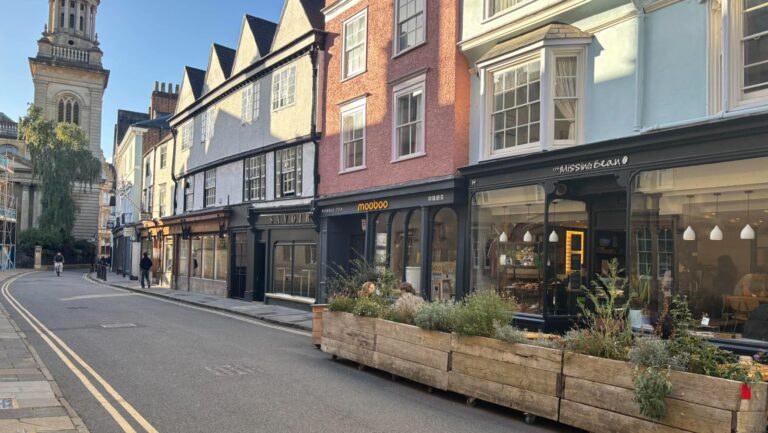
Bored witless by the Law Library, I applied for a loyalty card at the adjacent coffee shop, Missing Bean, and I also occasionally resorted to the suspiciously cheap coffee in college, where the exciting catch is that the oat milk is off and the coffee tastes burnt. As Exeter’s Cohen Quad is in Jericho, Tree Artisan, located on Little Clarendon Street, became our most-visited café. To find out what coffee shop life is like in Oxford from the point of view of the owners, I decided to interview Tree Artisan’s founder and owner, Graziella Ascensao.
Tree Artisan Café now feels like a fixture of the Oxford coffee scene, but it faced challenges from the very start. Graziella moved to Oxford from Brazil at 18, and later worked in the service sector, as both a barista and a waitress, and began to save up until she could afford to open her own café. It seemed as if fate had conspired against her when the COVID-19 pandemic hit as soon as she had secured the lease for the premises.
However, consistent with the rest of her attitude connected to her work, Graziella approached the challenge with a positive mindset and turned it into an opportunity. ‘At that time, I saw it was the time to open,’ she says. ‘When people were in front of their computer all day, they wanted to pick up a coffee and go to the park’. While, due to COVID-19 restrictions, she found it harder to cultivate the atmosphere she wanted within the physical space, she managed to generate a small community of regular customers who appreciated the friendliness and good coffee on offer. ‘I found positivity in that. I am always trying to be a warm person’.
This attitude is Graziella’s main take on the difference between the culture of chain cafés and that of independent ones. She takes pride in buying everything from independent suppliers, from bread to coffee beans, not wanting to compromise the culture of a small local enterprise. ‘There is more love, more passion. With chains, whoever you are, you are a number. The staff are a number, the customers are a number, everybody is a number. It is completely different to when you have a focus on the people’.
This focus is arguably what makes Tree Artisan Café unique. After exams, my friend and I worked there one afternoon, while the café was quiet. As we worked, we noticed that the staff recognised and talked to almost every customer who walked through the door. For a generation that appreciates the personal experience afforded by food vendors, this kind of human interaction sets Tree Artisan Café apart from chain cafés, where the staff often seem stressed and keen to hurry along to the next customer. The feeling that you’re part of a community is a huge appeal, and one that makes sitting in Tree Artisan much more appealing than, for example, sitting in Café Nero.
While the independent café market in Oxford is crowded and competitive, Graziella does not feel this is a hostile environment, and rather sees a market where independent outlets do not have to try and beat each other down to stay in business. ‘Honestly, I respect all of them, because I believe in this world there is space for all of them. Tree Artisan has my biometric, it is different from all the others. It is my personal imprint on them. It is like my baby. I am not comparing to others; I love it because it is mine’.
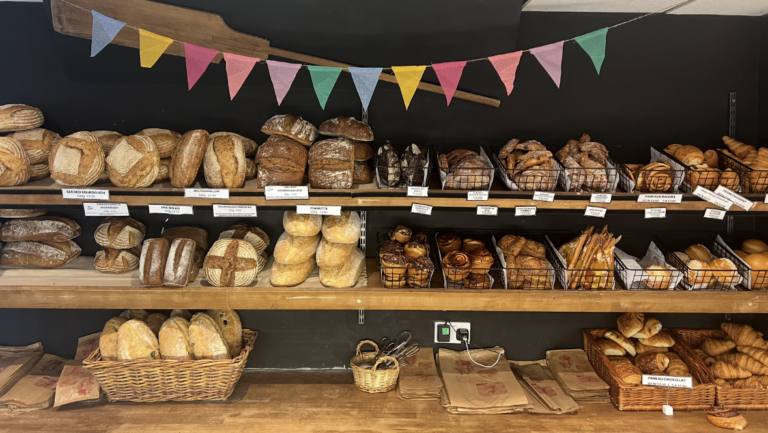
This ‘personal imprint’ is a huge part of independent coffee outlets in Oxford, and Graziella’s experiences definitely shape how Tree Artisan operates. Having been vegan for three years, she ensures there are multiple dairy-free, gluten-free and vegan options on the menu. As a lifelong member of the allergy club myself, it is welcome to have actual choices, especially when they’re genuinely delicious and likely to even be bought by someone who isn’t allergic to the other options. The menu is also rotated regularly, according to which options prove most popular, which allows Tree Artisan to be customer-driven, rather than constantly supplying the same, bulk-bought generic options available at a chain.
Graziella’s enthusiasm talking about running her own café is infectious. ‘It is hard work,’ she tells me at the end of our interview. ‘I’m here at 4:30 in the morning every day, and I have gratitude to be here. It is my passion, I am happy to be here’. It is this highly personal desire to create a positive experience for every customer that sets Oxford’s independent outlets apart from their corporate competition, and Tree Artisan Café is the perfect example of this alternative, people-focused approach to growing as a café in Oxford.
Friday 2nd September is creeping ever closer and with a government that seems to be set on inaction until then in the midst of the biggest cost of living crisis in decades, for millions it can’t come soon enough. Before then though, 0.3% of the population will decide who the next Prime Minister is and all signs now seem to suggest that that person will be Liz Truss.
Personally, I see it as a tragedy on several levels but, above all, I cannot cease to be totally baffled by the polls that show Truss will win by such a landslide. Not only is it now with seeming daily regularity that a new independent report, financial expert, or ‘Tory grandee’ points out her economic plans are both unfundable and inadequate. More than anything, the Conservative Party Members seem set to condemn themselves to losing the next election by electing a leader and resulting cabinet that is beyond impalpable for the general population.
I suppose the first step in trying to get inside the mind of Tory members is understanding who they really are, something that is notoriously difficult and explains why opinion polls in leadership contests vary so much in comparison with those of general elections. Although the information is not officially published, Tim Bale, professor of politics at Queen Mary University, concluded nearly ten years of study on this and told the FT last month that “There hasn’t been much change in the demographics of the Tory grassroots since we began our research on party members back in 2013.” The research found that, rather unsurprisingly, that members are disproportionately older men. 63% were male (compared to roughly half of the UK population), their median age is 57 (the national average is 40), and 80% fall in the so-called ABC1 category of the most highly-paid demographic group (this makes up 53% of the country). They also match the classic stereotype of being white and right-leaning on issues, with 76% voting for Brexit and 95% identifying as White British in a country where that makes up just 83% of the population. Now, that is a lot of numbers, but the fact that those voting on our next leader come from such a small and narrow segment of society is not only plainly a crazy and scarcely believable part of our democratic system but goes some way to explaining how and why they have leaned so heavily on Truss over Sunak. They have rewarded her ludicrous attempts to evoke Thatcherite policies which don’t fit the current economic climate and, much like the Foreign Secretary’s desperate efforts to emulate Thatcher’s personality and dress sense, are outdated.
Despite this, in fact for this very reason, one would think that the constant comments from some of the Tory party’s oldest, most successful, and most well-respected names, about just how baseless much of Truss’ economic policies are, would have swayed more of the base towards Sunak. Kenneth Clark has described her approach as “nonsense and simplistic” and related it to techniques that might be used by a Venezuelan government. Former leaders Michael Howard and William Hague, as well as well-respected current MPs such as Dominic Raab, Jeremy Hunt, and Michael Gove, have all taken to the airwaves and newspapers in the past few days to speak against the idea that tax cuts can resolve the crisis. Even Lord Lamont, Treasurer in the Thatcher government remembered so fondly by much of the conservative party base, has publicly backed Sunak over the holes in Truss’ plans. It isn’t only individuals who think that her plans are misguided either: the IFS joined countless other economists last week in pointing out that her current ideas are simply unfundable unless they are accompanied by spending cuts.
What makes all of this even more crazy and difficult for me to get my head around is that the members seem blissfully unaware of just how unelectable Truss is for the electorate as a whole. With a general election looming in 2024 you would think that there would be an appetite for a relatively inoffensive leader who appeals to as broad a base as possible. Whereas Sunak has at least shown his ability to appeal to a large spectrum in the past, earning himself the nickname ‘Dishy Rishi’ during his Eat Out to Help Out glory days, Truss has never shied away from bulldozing ahead with unpopular policies and divisive comments. Whether that is upsetting Scots by saying that the best way to deal with their democratically elected leader is “to ignore her” or regular workers by telling them to put in some more “graft”, Truss trails Keir Starmer and rival Sunak in every poll of the general population. And if recent leaks of her planned cabinet are to be believed, placing Jacob Rees-Mogg as Levelling-up Secretary, she hardly appears to be planning a change of course on this front.
So – why? What is it that appeals? It might well be a case of Johnson continuity – indeed in surveys, many have said that they feel Sunak betrayed their leader by resigning and becoming one of the major catalysts for the Prime Minister’s downfall. In reality though, I think it is more of a case of the members being genuinely detached from the real world themselves. For whatever reason they don’t seem able to see their impending decision risks disaster for millions of people across the country by worsening current financial pressures as well as putting them in a catastrophic position ahead of the next general election. Two years is a long time in politics, but right now I struggle to see why on earth the turkeys are voting for Christmas.
CW : mention of disordered eating, fat phobia, body dysmorphia
Have you ever wept in a toilet stall—maybe during a particularly rough school day, maybe during a night out that went wrong—thinking that you were completely insulated from the world outside, only to realise that there’s a giant gap in the door – so whoever is walking past can definitely see you, all puffy-faced? Grace Olusola’s Vessel spoke directly to my teenage self and my current self alike, as I found myself in that exact situation after the show: watching the play felt like having my private, internal feelings about my body and food externalised and projected onto the stage at the Old Fire Station this Trinity. I felt seen.
Last summer I vented my frustrations at feeling like the only fat person at Oxford on Twitter, and my notifications pinged more than normal for a little while. Initially, I worried that a play seeking to address themes of bodies and food in the Oxford community would centre the experiences of people who are afraid of looking like me. While I do not seek to invalidate the experience of people who are insecure and conventionally attractive, there’s a difference between being insecure about having rolls when you slouch and, as the Comedienne comments, “the world decid[ing] whether you’re ugly or not for you”.
Yet Olusola and her team of six other directors have taken the wide-ranging diversity of such relationships with body image into close consideration. Vessel is made up of twelve discrete episodes, each drawing inspiration from student survey responses on questions around bodies and food. The episodes differed significantly in tone, managing to tackle these issues with sensitivity and humour, and reminded me of scrolling through TikTok: we see a spoof of 2000s fatphobic TV shows, titled ‘Formerly Grotesque Fat People Bake On Blind Dates While We Watch’, and a monologue on different kinds of Reese’s peanut butter cups, among others. In ‘Not Like other Girls’we even see a girl sniffling in the school toilets, not unlike me after the show.
The episodic structure and use of several directors is certainly a strength of the show, reflecting how our relationships with food and our bodies has as much to do with class, race, gender and sexuality as with what we see when we look in the mirror. I particularly enjoyed how the show played around with form and structure to reflect this: in ‘Femi’, Tariro Tinwaro sings of a best friend with an eating disorder “outrunning bodies like mine”, while in ‘The Comedienne’ we see Chloe Ralph hilariously enact the awkwardness of mediocre standup about her friend group and conclude “with friends this fucked up, this may be one of the few situations in life where being the fat one is actually the best status in the group.”
Olusola cites her experience as a welfare officer at St. Catherine’s College, as well as her own body image struggles, as a catalyst for Vessel: this certainly shows throughout the production, albeit not in a way that feels patronising, didactic or reductive. At the beginning we hear a voiceover announce the show’s trigger warnings, and that if at any point an audience member needs to leave and take a break, they are welcome to do so. Likewise, at the end the crew offered pens and index cards to audience members as a chance to reflect on what they had just seen.
While I did sometimes find myself wishing for more cohesion between the writing of the episodes, I enjoyed the way that each episode was announced by the pinning of a poster or a graphic with its title to a board at the back of the stage, creating a sense of collaginess and accumulation. This imagery of food wrappers and containers was neatly alluded to in ‘Motherhood’, an episode where a woman tidying the house for a date discovers her daughter’s binge-eating stash concealed between stage blocks. During the interval, a friend remarked that the episodic nature reminded her of opening a door at a house party and accidentally walking in on a conversation between strangers that you were not meant to overhear, as alluded to perfectly in a scene where we watch the awkward reconnecting between old friends gradually tip over into a painful conservation about responsibility when one is mentally ill. Olusola’s skilful writing shines through in lines like “I had a brain that betrayed me–you were the collateral”, and “sorry, force of habit, when you’re at death’s door [so often] you start leaving a key under the doormat.”
The presence of fat actors and explicitly working-class characters, albeit only a handful, on a student stage was particularly refreshing to see, although I did find myself wishing for more than a few of the twelve episodes in a show about bodies to centre their experiences.
Overall, Vessel’s careful balancing of sensitivity and humour in its treatment of the subject matter of body image and food made it an important and worthwhile watch; I can only hope that we see more stories and actors with these experiences on the Oxford student stage in the future.
Where do we go from here? Reflections on a day of unprecedented chaos in Downing Street…
The past few years in British politics have repeatedly defied belief but Thursday 7th July will go down in history as the most chaotic, bizarre, and extraordinary day that our country has seen in decades. This morning, it was barely possible to make a cup of tea before returning to the television to learn of another ministerial resignation or letter from newly appointed cabinet ministers calling for the Prime Minister to go. Chris Mason taking the phone call from Downing Street to confirm Boris Johnson’s resignation live on BBC Radio 4’s Today programme perhaps perfectly summed up the incredulous nature of the morning’s proceedings. The big question now though is what on earth happens next? Where do the Conservative party and the country go from here? As it stands, the PM insists that he will stay on until a new leader is announced, but is that really feasible? Who is best positioned to succeed him? One thing is certain, the turmoil is far from over…
Who Next? The Runners and the Riders
The main reason why Johnson has survived in post for so long in spite of countless scandals that would’ve buried leaders of the past has been the lack of an apparent successor. Now the Conservative party is facing a leadership election with contenders from across the political spectrum, as it tries to decide its future.
Liz Truss
Bookies odds – 7/1
Long-time favourite of old-time party members but counting many enemies among fellow MPs, the outspoken Truss has never been afraid to make her leadership ambitions clear. Much like Johnson, she has been happy to bend her political beliefs to fit with her rise to power after backing remain in 2016 only to become one of the biggest supporters for a hard Brexit in recent years. Brash and brazen with political stances branded by many as ‘Thatcherism on steroids’, she certainly wouldn’t offer the dramatic change in tone and direction needed if her party is to stand any chance of rescuing themselves at any approaching election. She may also struggle in early stages of the leadership race, with several MPs declaring privately that they wouldn’t back her.
Nadim Zahawi
Bookies odds – 8/1
Zahawi was centre stage in the political chaos of the last 48 hours after being appointed Chancellor of the Exchequer on Tuesday night, doing the media rounds defending the Prime Minister on Wednesday morning, and then calling for his resignation on Thursday. His political stock rose substantially as vaccines minister during the pandemic and, popular amongst his colleagues, he now appears to be one of the favourites to succeed Johnson. The only thing standing against him may turn out to be his relative inexperience in government.
Rishi Sunak
Bookies odds – 4/1
There are few men in history who have had such a dramatic rise to fame and fall from grace as Rishi Sunak. An unknown among the public when appointed as Chancellor he attracted fans throughout the pandemic with generous furlough and ‘Eat Out to Help Out’ schemes before becoming embroiled in the Partygate scandal and brought down by questions over his wife’s non-dom tax status. There’s a chance that his shock resignation on Tuesday night might just have saved his chances and he is sure to be a front runner if he can convince MPs of his credentials. Equally, his resignation letter suggested that his could be ‘his last ministerial job’ and a return to pre-political life could certainly prove to be an attractive proposition for the former banker.
Sajid Javid
Bookies odds – 7/1
Having already failed twice in leadership elections could it be third time lucky for the man who initiated the final chapter of Johnson’s prime ministerial career? Although his dramatic move and speech after PMQ’s will appeal to some, few can really doubt his own personal motivations for moving against the PM when he did and that kind of ‘snakery’ as Number 10 likes to call it has been enough to see others named Michal Gove get the sack. Javid would offer something different in terms of a political direction and would appeal as a more stable set of hands but his flip-flopping hasn’t won him many fans amongst MPs and party members.
Penny Mourdant
Bookies odds – 5/1
Who? I hear you ask. The bookmakers’ favourite that’s who! Mourdant finds herself in the bizzare position where not having any experience working in recent cabinets will be seen as one of her biggest strengths. If you are in search of a metaphor for the dire state of the Tory party then this is it. Being a long-time Brexit backer makes her palpable to the right of the party and the ERG but her membership of the liberal Conservative ‘One Nation’ caucus means that she has a fairly wide reach. She has perhaps the fewest enemies of any of the obvious contenders. Then again that is inevitable when you consider that she has never held a post of significance within government.
Tom Tugenhadt
Bookies odds – 14/1
‘The rebels’ choice’, Tugenhadt is one of the few likely runners who has spoken out against Johnson from the start. The Chair of the Foreign Affairs Select Committee slammed him for his performance as Foreign Secretary and has remained critical ever since. His rhetoric always focuses on a renewal of traditional conservative values, the meaningful substance of that rhetoric unsurprisingly remains in the dark.
Jeremy Hunt
Bookies odds – 11/1
Hunt will undoubtedly frame himself as the man who stood up to ‘Johnson the bully’ and never served in his cabinet. In reality, insiders suggest that his close relationship with Theresa May meant that he was never invited to – a quite extraordinary thing when you consider the amount of ministers Johnson went through. Hardly a superstar as health secretary Hunt would represent a return to the more traditional style of government of Theresa May and although that be unexciting to some MPs, large swathes of party members could be convinced by a reassuring return to relative normality.
Ben Wallace
Bookies odds – 5/1
The defence secretary never resigned from the cabinet but did just about manage to squeeze in a letter calling for Johnson to go before the final decision was announced. The former soldier is broadly seen as reliable and undramatic, both potentially very attractive characteristics at the moment. He has won international acclaim for his dealing with the Ukraine crisis and the general public would be sure to back him on that but he is notable for his lack of experience in all other areas of government. Despite his popularity, he has also previously stated his desire to take on the role of UN Secretary-General in the future and that may yet prove to be his next step.
So, in conclusion, the race remains very much open. Dozens are sure to declare their leadership bids over the coming days and countless campaign websites will no doubt be launched within hours but the stark reality is that none of the options are pretty for the Conservatives. The party is in a mess, politics is in a mess. Opposition parties insist that Johnson cannot remain PM whilst the process continues and any caretaker would get the chance to audition their potential on the biggest stage. It still remains to be seen how long the elected leader will stay in post. Can any of those listed above really stake a claim to Johnson’s record-breaking mandate from 2019? A general election may very well be on the cards and, if that is the case, then the calculations change all over again for the MPs with the fate of the nation in their hands…
Your Thoughts
We asked you to sum up your thoughts about our departing Prime Minister’s time in office and departure itself – it’s safe to safe that the responses were mixed and I am happy to report that you didn’t hold back!
Charlie Aslet on the nature of Johnson’s departure:
“Boris Johnson’s resignation had as much dignity as a streaker at a football game. He clung to power until even his unkempt reflection was telling him it was time to pack it in. Some people would have thought it honourable to jump before being pushed. Not Boris. He was beaten up by all his closest friends and colleagues, his trousers hoisted around his ankles and then given a mighty boot up the buttocks before stumbling over the cliff. His only consolation as he tumbled down that rockface was that he managed to give Michael Gove a final slap in the face before he fell, giving him the sack when everyone else was resigning. In a way, I feel a bit sorry for Boris. His resignation was like the assassination of Julius Caesar, except this time it felt like he also managed to stab himself a few times before he died. But, then again, the man seems incapable of telling the truth. Even when he says he’s leaving it’s difficult to believe it will actually happen. When he says he’s actually staying, that’s when I’ll be ready to believe he’s really going for good.”
We then asked you for reflections on Johnson’s premiership:
“Good riddance babes”
“One word – joke”
And your predictions for the future:
“Same circus different clown”
“There is an unfortunate possibility that the Tories may be redeemed in the public eye”
“No chance anyone else will have anywhere near the decision-making prowess of Boris – prepare yourselves for an era of catastrophic indecision”
“I’m just sad for the people of Ukraine. Their future is now in doubt more than ever.”
“Someone equally bad or worse will become Prime Minister, there is no winning!”
UPDATE: On the 29th June, The UK Government announced a new round of sanctions on several high profile Russian figures including Potanin, with the aim of “hitting Putin’s inner circle”. A government statement read: “Potanin continues to amass wealth as he supports Putin’s regime, acquiring Rosbank, and shares in Tinkoff Bank in the period since Russia’s invasion of Ukraine.”
As the Western world moves to sanction overseas Russian money, Cherwell has found that St Edmund Hall and the Saïd Business School accepted donations from Vladimir Potanin, the oligarch and metals tycoon who is the second richest man in Russia.
Potanin, 61, has a net worth of $27 billion, as estimated by Forbes. In 2020, he was included on the US Treasury’s list of 210 Russian oligarchs, businessmen and politicians under considerations for sanctions, dubbed ‘Putin’s List’. He is widely known for regularly playing ice hockey with Putin. Potanin’s fortune fell by $3 billion on the day that Russia invaded Ukraine. Potanin also served as the Deputy Prime Minister for 7 months between 1996 and 1997.
In 1999, Potanin founded the Vladimir Potanin Foundation to “implement large-scale humanitarian programs” in the fields of “culture, higher education, social sport and philanthropy development”. The foundation donated £3 million to St Edmund Hall in 2018 to endow a research fund for Earth Sciences, and to jointly establish the Vladimir Potanin Associate Professor and Tutorial Fellow in Earth Sciences with the University of Oxford. The endowment also funded the three-year Vladimir Potanin Tutorial Fellow of Russian Literature and Modern Languages.
The foundation also granted $150,000 to the Saïd Business School in 2017 for a fellowship scheme for the Oxford Social Finance Programme. The school selected 15 Russian charity workers to attend this programme between 2017 and 2019.
The collapse of the Soviet Union in the 1990s allowed well-connected individuals to profit from the bloc’s transition to a market economy by gaining control over newly privatized state assets. Many of these deals were done privately, without competition. While in office, Potanin proposed the controversial ‘loans for shares’ scheme, which is seen as having furthered the rise of the oligarch class. This scheme effectively caused the consolidation of oligarchs’ control over the Russian economy. ‘Loans for shares’ encouraged wealthy businessmen to loan money to the Yeltsin government in exchange for state-owned shares in companies, many of which extracted and processed Russia’s abundant natural resources.
Of the programme, he told The Financial Times: “It is the biggest PR tragedy of my career. Of course, the privatisation process has to be transparent. And in our case it was not. My plan was different. I wanted to privatise the companies with banks and qualified people, raise their value, and then sell them.”
Through this scheme, Potanin and his long-term business partner Mikhail Prokhorov acquired a 54% share in Norilsk Nickel (Nornickel). The two businessmen separated their assets in 2007, leaving Potanin with 34.6% of the shares in Norilsk Nickel. The company’s total assets amounted to $20.7 billion in 2020.
On top of being the world’s largest producer of nickel, Norilsk Nickel is one of the world’s largest industrial polluters. In 2020, the company produced 1.9% of total global sulphur dioxide emissions. The company has announced that it intends to reduce suphur dioxides from its plants in the heavily polluted Norilsk region by 90% by 2025 from a 2015 baseline.
Potanin is the only Russian to have signed The Giving Pledge, in which the super-rich pledge to give a majority of their wealth to philanthropic causes. Other signatories include Elon Musk, Mark Zuckerber, and George Lucas. He said his decision was motivated by a belief that “wealth should work for public good”, and as a way to “protect [his] children from the burden of extreme wealth”.
A spokesperson for St Edmund Hall told Cherwell that the gift was accepted “in good faith and at a time when relations with Russia were in a substantially better place. This was a one-off donation and the College does not anticipate any further funding from The Potanin Foundation.
“The College is deeply concerned at the events happening in Ukraine and sincerely hopes that a peaceful outcome will soon be reached,” they added.
The Saïd Business School told Cherwell: “The grant went through the University’s robust approval process and the partnership ended in 2019. The focus of the programme is to improve the social impact and philanthropic work of charities and non-government organisations (NGOs) across the world. As a global business school with students and alumni from across the world, we have been deeply saddened at events happening in the Ukraine and hope a peaceful outcome is soon reached.”
The University of Oxford, Interros, and The Vladimir Potanin Foundation were approached for comment.
A couple of hours before watching Track 2, I saw a friend’s Instagram story pointing out the comments on a post from the official 10 Downing Street account. The post celebrated the ‘extraordinary contribution of LGBT’ people to Britain, but the comments were full of the kind of vitriolic homophobia that it’s hard to believe still exists in public spaces. It is this kind of hate, as well as the prevalence of outright racism, especially in online spheres, that makes projects like the Black Lives Playlist essential.
Track 2 is, primarily, a monologue about the experience of being Black and gay. It centres around The Speaker’s complex inner turmoil between shame and pride in his sexuality. Whilst we may now fortunately live in a world where homosexuality is far more accepted, this play serves as an important reminder that prejudice still very much exists in our society,and that microagressions can have serious consequences especially where marginalised identities intersect.
In spite of this, Track 2 never feels like a PSA about homophobia or racism. Instead, its character-driven nature is relatable to anyone who has ever felt out of place at a family party; anyone who’s questioned what they really want from life; anyone who’s kissed someone they didn’t really like and regretted it; anyone who’s looked at themself in the mirror mid-breakdown and thought, actually, they look kind of hot. This is the play’s greatest strength: writer Sam Spencer manages to both convey a very specific life experience and connect with universal feelings of anxiety and difference.
The Speaker tells us about a day spent visiting his sister’s boyfriend’s family for the first time – an experience that sparks complex emotions and difficult memories. This central narrative introduces us to the story of his ex-boyfriend, and a rendez-vous with a man from the gay hook-up app Grindr who asks The Speaker some difficult questions. Each of these narrative strands ties together cohesively. Credit must go to Spencer for creating a plot that plays out in such a satisfying manner, and to director James Newbery and assistant-director Grace Olusola for translating it onto the stage so effortlessly.
The different visions of the show’s team work flawlessly together. With one-person shows, especially those performed and directed by different people, it’s easy for conflicting creative visions to come across in the finished product, but no such issue exists here. The use of music adds to the piece brilliantly, and the colourful lighting accentuates the vivid narrative, although the lighting could perhaps have been used to accentuate key moments to a greater extent, and mark transitions between time periods more clearly. Yet, the collaborative nature of the project translates into a show that knows what it wants to be, and executes this vision immaculately.
The greatest strength of the direction is its simplicity: the story is allowed to speak for itself, which is essential to its success. Spencer’s script never tries to be overly clever or conceptual, instead relying on its innately heartfelt character development and engaging humour. He has a talent for visceral description, making both messy hookups and family dinners crystal clear in audiences’ minds, despite the minimalist staging: The Speaker remains sat alone in a dark space throughout. The script is structured very cleverly, with the hook-up acting as a frame that gains new meaning at the end, and the sister’s boyfriend storyline leading us craftily to an emotional climax. In addition to this, Spencer’s mixing of personal anecdotes with general thoughts on the likes of Stonewall statistics and making out with girls helps the writing sit so perfectly on the line between specific and universal. If I were to be especially fussy, it could be said that the script becomes slightly repetitive at times. Some elements, such as the use of the Grindr sound effect, could do with verbal clarification for audiences less familiar with the app, and the ideas around religion could have been fleshed out further. It remains, however, a remarkable piece of writing.
Spencer also performs his writing with a real honesty, transitioning smoothly between a public-facing cheekiness and moments of serious emotional depth – there are points where we feel genuine concern for him. The only things subtracting from the performance are some issues with awkward cuts and poor sound quality – the choppy switches between cuts takes us out of a few important moments, and dialogue with the off-screen voice in the first scene is at times hard to make out. These flaws can be easily forgiven, though; the show would work seamlessly in person, but we are unfortunately still gradually exiting the age of online theatre.
Like every other theatre fan, I’ve watched a lot of filmed monologues over the last year and a half. The influence of the likes of Fleabag can be felt within this piece (what would a review of a monologue be without a reference to Phoebe Waller-Bridge or Michaela Coel?), but it’s clear that the team have taken into consideration the limits and possibilities of the form and made it work for them. With its cohesive structure, engaging character and unfaltering honesty, Track 2 takes its place as one of the best examples of what has become an era-defining genre.
As the editors of Russell Group student newspapers, we are writing collectively to request a reversal of the Russell Group’s statement, 7 January 2020, ‘on ensuring fair assessment and protecting the integrity of degrees.’
As editors, not only are we students or recent students ourselves but we are also in constant contact with the students at our respective universities, as part of the function of our extracurricular roles. Apart from sharing in their collective experiences, we have a unique insight into their attitudes, viewpoints and beliefs. We speak and listen to them every day – and every day since the beginning of this academic year, we have heard students calling for more understanding, cooperation and empathy from university management.
The statement shared by the Russell Group on 7 January showed the inconsistencies between what they and we understand to be adequate teaching. Whilst we enormously appreciate the hard work of teaching staff under these challenging circumstances and understand the complications ‘blended learning’ has presented, students have repeatedly said they have not been adequately supported throughout this pandemic. This is by no means to disregard the tremendous efforts of university staff, but it is simply a consequence of the realities of a year like none other in living memory.
The lack of a ‘no detriment’ or ‘safety net’ policy has been a miscalculation by the Russell Group. Students across the UK have been left feeling abandoned by both the government, devolved administrations and universities themselves.
As the editors of 28 student papers, we pick up and record the views of our students on a regular basis. What many are telling us, as a result of personal and shared difficulties, is that they do require the support a clearer ‘no detriment’ policy would deliver.
We object to the assumption made by the Russell Group that ‘emergency measures’ are no longer ‘necessary’ or ‘appropriate’. We are living through what are undeniably unprecedented times – this is a global emergency. The Prime Minister has labelled these weeks of the third lockdown as the critical point in the UK’s fight against the pandemic – death tolls are high, hospitals have reached capacity, we are still just in the early days of administering vaccines. Students, locked down in various levels of economic and social stability across the nation, are facing some of the most important exams we have sat in our lives to date – under some of the most difficult circumstances many will have faced. International students, too, have been working all term from various time zones around the globe, detached from the support of their student communities.
If anything, this point in the pandemic is perhaps the most urgent. We are now facing a mental health crisis amongst young people. Figures by WONKHE and Trendence have shown that more students feel lonely and isolated on a daily basis as a result of the pandemic. Additionally, surveys of undergraduates by various higher education policy advisers have found that over 50 per cent of students say their mental health has significantly deteriorated during the course of the pandemic.
Students are attempting to sit assessments with a lack of resources, varying internet connections and mixed home environments. There are students without desks, who share bedrooms with siblings, who have caring responsibilities when they’re at home. Across the country, there are students from wide and varied backgrounds who are struggling to study for their final year assessments, many also affected by illness and bereavement owing to COVID-19. Students from lower income families as well as estranged students are disproportionately affected in their learning experiences this year and less able to receive the traditional means of support. They do not deserve to be dismissed.
Yet, no one from the Russell Group denied the emergency of the situation when metal fences were erected around halls at Manchester. Universities even went as far as to declare their own local emergencies by locking down individual residences during outbreaks amongst first years. There was no denial of ‘emergency’ when students were being blamed in the media for spikes in national COVID-19 cases.
A-level and GCSE exams have been adjusted to as if this were an emergency – so why aren’t the Russell Group responding in the same way for university students?
It should also be noted the UK government have voided themselves of much of the responsibility for the problems students face. On January 15, the Minister of State for Universities Michelle Donelan tweeted that ‘if universities want to continue charging full fees, they are expected to maintain the quality, quantity and accessibility of tuition’. A government who demands this from its universities should put support systems in place to enable it.
You have explained to our respective Student Unions that it is more appropriate for universities to provide ‘a range of policies and tools’ to ensure fair assessment for students. Whilst we agree some universities will need to adapt their policy on an individual basis, the Russell Group’s collective position against ‘no detriment’ or ‘safety net’ policy does not match the reality of what many students have faced, and are continuing to face, this year.
In principle, a ‘no detriment’ or ‘safety net’ policy should ensure a student’s grade is not worsened as a result of the pandemic. Currently, many of your universities’ mitigatory policies amount to simply offering more time for assessments. Frankly, a matter of extra days or a week is not sufficient for the challenges that we have outlined above, which students are facing in real time.
We understand that an algorithmic approach is not entirely viable due to the lack of benchmark data for many students at this stage of the 2020/21 academic year – that’s a mathematical given. But it is by no means impossible to support an alternative ‘no detriment’ policy built for the circumstances. The University of York, for instance, is implementing a comprehensive policy, attempting to take into account the unique challenges posed by this pandemic, as opposed to reshuffling and extending existing policies.
By readjusting the weightings of each year towards a student’s overall degree and choosing the better of the two for penultimate- and final-year undergraduates, as well as allowing first-years to re-sit up to 90 failed credits in exams, the University of York have worked to try and introduce an appropriate and fair policy. Postgraduates, who should not be forgotten in any such policy, have also been offered an assured ‘safety net’. Overall, it is certainly not perfect but it at least strives to fulfill on the principle of ‘no detriment’, allowing students to simply focus on their studies, with some confidence they will not be impacted by COVID-19, whilst preserving the value of their degrees to employers.
We urge all Russell Group universities to introduce similarly comprehensive policies.
Whilst we understand that every subject, university and student is different, showing the understanding and empathy to their students embodied in York’s approach should be a basic requirement.
Presently, there are a small number of universities, such as Cardiff, that have recently implemented similar policies. Yet their commitment to this editorial is on the basis that students from all Russell Group universities should have the same level of assurance.
Overall, many students will of course respect and largely agree with your desire to maintain degree standards comparative to other years and to ensure, as you say, that they still ‘command the confidence of employers and professional bodies’. However, where other aspects of society have shifted or seen unprecedented measures introduced over the course of the last year, we believe a reweighting or rescaling of degrees is certainly possible. The students we write for and hear from daily are not asking for a policy that allows them to stop working or learning, but one that simply acknowledges the reality of the pandemic and its wide-ranging impact.
Ultimately, you claim you want to uphold the integrity of our degrees. Yet a university’s first responsibility is to its students and acting with integrity ought to mean upholding this responsibility. Many students across the country have not received the ‘blended’ or ‘hybrid’ learning experience they were promised; many are now separated from their campuses, with its facilities and libraries, due to a third national lockdown brought about largely by an unforeseen variant; many are facing personal, long-term hardship as a result of the virus, and/or extreme difficulties at home.
The integrity of a degree, too – students would hope – should encompass a focus on the opportunity to learn and study as well as a focus on rankings and outcomes. The integrity of university institutions should entail safeguarding the mental wellbeing of its students. Under the current plans laid out by most Russell Group universities, students are reporting to us loudly that neither of these are currently in line.
Students have not been quiet about their concerns. With exams fast approaching, and some already underway, now is the time for Russell Groups universities to act compassionately and responsibly.
It is an understatement to say that we are living in extraordinary times. Last March, the UK, along with the rest of the world, came to a grinding halt at the onset of the COVID-19 pandemic as we tried to cope with a crisis that was entirely without precedent. The Prime Minister told us then that “things are going to get worse before they get better” – but the reality of this warning has only now been fully realised.
Ten months later, the UK has entered the worst stage of its crisis so far: tragically, cases and deaths have soared and, once again, students have been asked to study from home with Hilary term teaching moved online. However, many are highly concerned about the limited and restrained adjustments recently made by the University of Oxford to account for the deterioration of the coronavirus crisis and its impact on the upcoming term and students’ education as a whole.
It is not unreasonable to expect that students should not be disadvantaged by circumstances wholly beyond their control. That is why the editorial boards of The Oxford Blue, The Oxford Student and Cherwell are calling on the University of Oxford to introduce a fair ‘no-detriment’ policy for finalists.
While the scale of this tragedy has been devastating in terms of loss of life, the quality of students’ education has also suffered enormously. Students have raised serious concerns in recent days and weeks about issues at home: different time zones to Oxford in their home location; a lack of space; noise; and an absence of essential work tools including a desk, books, a computer and a stable, high-speed internet connection. Furthermore, international students are faced with additional (and unpredictable) challenges, such as having to make travel plans, negotiating complex and changeable immigration policies, undergoing mandatory periods of quarantine (either in private accomodation or specialist facilities) and/or firewalled internet access. Students who are materially more privileged than others in these areas are thus at a significant advantage compared to their peers.
Many students have also felt lonely, confused and anxious throughout the pandemic. Like the rest of the population, students have had to contend with self-isolation and the emotional impact of being unable to socialise normally with friends, family and partners. Some students have been ill with COVID-19 themselves or had to care for sick household members and loved ones whilst keeping up with the famously rigorous, unrelenting pace of an Oxford degree. The pandemic’s asymmetric demands on students means that a one-size-fits-all approach cannot be feasible and a ‘no-detriment’ policy is crucial for student success.
In such extraordinary circumstances – and ten months into the UK’s COVID-19 crisis – students deserve better than inflexibility and an insistence that it is possible to study as normal in such tough conditions. It is crucial to recognise the circumstances that led to the establishment of the ‘no-detriment policy’ last spring have only been prolonged and exacerbated over the course of recent months. If students are to pay full tuition fees for a severely diminished university education, it is right that the University at least intervenes to accommodate the impact of COVID-19 on our learning experience and academic attainment.
Last year, in light of the rapid spread and impact of COVID-19, the University listened to student feedback and implemented what they called a no-detriment policy, designed to ensure that finalists did not suffer from the consequences of a global issue outside of their control. Whilst by no means perfect, this policy was executed well in many respects. The optionality from last year should be continued further given the nature of the ongoing crisis. Imposing any one formula on the entire student body will unfairly disadvantage a significant number of its members. If we prioritise simplicity, we may unintentionally neglect the nuances of the situation which we face. Decentralising choice to students means that assessment will consider principles of fairness and equity, and ensure that each student can face the challenges we all find ourselves facing on their own terms, in a way that is right for them. That is what a no-detriment policy must guarantee.
There is undoubtedly a shared interest amongst the entire staff-student body in not wanting the value of an Oxford degree to be diluted, and everyone understands the importance of ‘academic rigour’; it is why many students apply to study here. However, it is unavoidable that students will be affected to varying degrees by the pandemic. Some will feel unable to be examined at the end of this calendar year if, for example, they or a close family member fall ill and/or they have been struggling with mental health issues. Others may be able to undertake exams, but will have to do so in extremely difficult conditions. More still will need to fulfil academic conditions to begin postgraduate courses but may or may not be able to be assessed next term. It suffices to say that no one solution can accommodate all students in a satisfactory manner and, therefore, a solution similar to last year must be implemented.
Yesterday’s email from the University, however, is not only a disappointment but an insult to the entire student body. By refusing to implement a clear ‘safety net’ policy, the University is downplaying the real-world impact that the pandemic has had on students’ learning – both in terms of access to teaching and resources, and of the effect of this crisis on students’ mental health. Some individual departments have also introduced policies that represent a ‘business as usual’ approach to exams and assessments, despite students’ loss of library access, resources and study spaces. A reliance on examiners’ personal acknowledgement of the past year’s unique circumstances cannot replace a formal framework that can evaluate and mitigate inequalities in learning and attainment.
The University has said that it will announce “additional measures” to ensure fair degree outcomes in “the middle of Hilary term”. The only way to ensure fairness is for the University – in conjunction with departments and faculties – to commit, as soon as possible, to a no-detriment policy for all those taking exams and submitting other assessments, Such measures can ensure that no individual Oxford student is unjustly disadvantaged by the effect of the pandemic on their learning in the last year and during the next.
Oxford’s Student Union, which serves as a voice for a student body of over 22,000, has said that the University should “recognise the academic challenges by reassessing workloads and assessment practices”, calling for a “fair outcome policy” defined as “a system of policies put in place to mitigate the detrimental effects of the pandemic on students with exams and coursework this year”. This will involve the re-scaling and re-weighting of exams and coursework to reflect the impact of the pandemic on the whole cohort. At an individual level, the Student Union has called for students to be able to file for mitigating circumstances and deadline extensions – without needing to prove that the pandemic has affected their studies – and to access better financial, academic and mental health support. We wholeheartedly endorse these demands and encourage students to find out more about the Student Union’s campaign and services and attend the online workshop taking place this evening (13 January), which will address these issues.
Other universities in the Russell Group, such the University of York, have also started to implement similar ‘safety net’ policies, and the Universities of Leeds, Lancaster and Bristol are considering similar approaches. A petition by Oxford students to the Vice Chancellor to implement “fair safety nets” has already attracted almost 800 signatures at the time of writing.
On Tuesday, the University ruled out the possibility of a ‘blanket safety net’, but given the disruption caused to the last two terms – which will likely endure even beyond Hilary term – it must now act to introduce a fair no-detriment policy which will also reflect the impact of the pandemic on assessments, just as last year’s safety net did. To fail to do so will present an entirely unfair disadvantage to Oxford students, directly undermining the University’s commitment to student welfare and academic success.
The effects of the COVID-19 pandemic on a whole generation of students can not even begin to be graphed on a curve. This crisis is, as we are so often reminded, ‘unprecedented’ – but extraordinary times surely call for equally extraordinary measures.
A fair, robust no-detriment policy is one of those measures – and it must be implemented now.
Editors-in-Chief and Managing Director, Cherwell, The Oxford Blue, and The Oxford Student
Come Christmas, what’s on your table? Are there bowls overflowing with cranberry sauce? Plates filled with pigs in blankets? A prize bird gleaming on its platter? Traditions differ, but some dishes find their feature every year.
For most, the star of the Christmas feast is the turkey: the plump, golden-skinned bird that takes pride of place. But different birds have had their place; peacocks, pheasants and ducks all had their time on the table and before Victorian times, a goose was the typical centrepiece of the Christmas meal.
Henry VIII, a man then synonymous with decadence, may have been the first in England to try a turkey, but it did not come into fashion until Charles Dickens chose to emphasise the immense philanthropy of Scrooge’s gift to the Cratchits by swapping their traditional goose for turkey. No expense would be spared, and thus the Christmas turkey fell into vogue. Isabella Beeton, author of Mrs Beeton’s Book of Household Management, and the Victorian authority on all things to do with housekeeping, bolstered this new trend by proclaiming that Christmas for the middle class “would scarcely be a Christmas dinner without its turkey”.
Two of the more controversial members of a Christmas dinner, Yorkshire puddings and Bread Sauce, both find their origins in leftovers. Although many would argue Yorkshire puddings should only be eaten with roast beef, they actually originated from the drippings of fat off mutton as it roasted. As dripping fell into a pan filled with a batter, a Yorkshire pudding – enormous by today’s standards – would grow. Anyone with a food-strict upbringing similar to my own would never imagine a Yorkshire pudding on their plate come Christmas, yet this favourite continues to divide the country. It takes just a quick google search to discover the years of articles that have piled up from yuletides arguing pro-YP or against!
Yorkshire puddings’ more traditional, but stranger cousin is bread sauce. The beige, lumpy, liquid-like substance is not much more than gloop to those who haven’t been brought up with it. But to a fan, it’s a haven of stodgy delight. Bread sauce also originates from leftovers. In the Medieval period, soups were thickened with leftover bread, rather than flour as used today. These soups were prepared for Christmas feasts and evolved into the bay/nutmeg/clove flavoured slop (can you tell I wasn’t raised on it?) that so many will douse their turkey with this week.
As with anything that has its roots in the dinners of yore, the veg on our plates at Christmas have been shaped simply by whatever our ancestors managed to grow. Brussel sprouts found their way to the UK from Belgium, being the only cold-hardy green around. Parsnips, the preferred partner to sprouts, are harvested in the winter. Their first frost causes sugars to be released from their starch stores, giving them their characteristic sweetness (you won’t find that fun fact in your cracker).
Christmas desserts may be the most reliably underwhelming part of the day. Dessert has the opportunity to hold such creativity and glee, and yet the dry, misshapen lumps turned out year after year hold nothing but an unbelievable amount of fruit. They also hold a considerable serving of history.
The myth of each of the thirteen fillings of Christmas cake representing the 12 apostles and Jesus is a fun tale, but the most interesting story is with mince pies. First, let’s clear it up – yes, mincemeat did once contain real meat. Dating back to the crusades when meat/spiced/fruit pies found their way back to Europe, mince pies evolved from rectangular “coffins” to round Christmas Pyes that were often found at bountiful Christmas feasts. They were famously held in disdain by Cromwell’s Puritan government because of the ‘more-gluttony-less-Jesus’ they seemed to represent. By the Victorian period, mincemeat was being prepared and jarred earlier and earlier in the year to allow flavours to mature, and hence, meat was left at the wayside – thankfully for us.
These Victorian mince pies largely look like those we have today – buttery pastry, spiced fruit (and suet) filling, decoration with festive designs on top. Though their status as a delicious treat may be divisive, mince pies, with their undeniably Christmassy aroma, remind you it’s a special time of the year, and for that they fulfil their role as a Christmas food tradition.
Whether you guzzle gravy or put away potatoes, your food has been through a lot to make it onto your table – so forget the Queen’s speech and tune into your food come Friday.
Some colleges are reducing the availability of residence for students over the Michaelmas vacation. Oxford SU is lobbying to ensure international students are guaranteed accommodation for those who wish to remain, and has criticised the impact on care leavers, estranged students, and independent students.
Oxford SU passed a motion in 3rd week resolving to ask the University to guarantee all international student residence in Oxford over the vacation. The SU also resolves to push for vacation residence to be offered at 15% of usual vacation rent.
College policies do not currently fulfil Oxford SU’s requests. St John’s College has said that their vacation residence and grant scheme “will not operate as usual” during this vacation. All students have to leave, except international students whose home borders are closed and students with extended terms for their subjects.
St John’s told students that this was to ensure staff get a break from a difficult term, and students get a break to spend some time in a “different environment” before next year.
Queen’s College emailed students saying they “strongly urge” and “expect” all UK-domiciled students to return, noting that for students with welfare concerns, the welfare services would be closed for a period over the vacation.
They also told international students that the requirement to quarantine in their home country and in the UK is “unlikely” to be a “compelling reason” to be granted vacation residence. Queen’s said that, if borders for students’ home countries are closed, students should consider asking friends to stay at their homes. Queen’s reminded students that “there is no automatic right to stay in College”.
Oxford SU Class Act Campaign told Cherwell: “This is an issue not only for international students, but also for care leavers, estranged students, and independent students. Colleges consistently fail to provide these students with security, instead leaving individuals to negotiate with them for the right to have somewhere to stay. This is a difficult situation for everyone, but many students call Oxford their home, and must not be forgotten in this pandemic.”
One anonymous student told Cherwell: “The vacation residence policy email I received from my college was a disappointing read that placed unnecessary anxiety upon estranged students. For some of us, home life is not safe: it does not matter if this has always been the case, or if this is recent. Trinity Term lockdown was hard enough to suffer because students from other colleges were able to return – hopefully we can stay this time.
“I, like many other students, am incredibly grateful for my time at Oxford because of the freedom it gives me. It is also one of the reasons students take advantage of the vacation residence system: escape. To put it plainly, studying in college is better than working at home. We already try so hard to learn to live independently, study efficiently and strike that balance needed to be happy that if we are forced back into our older unhealthy environments no good will come of it.”
Oxford SU will further ask the University to ensure students who are required to quarantine upon return to Oxford get free accommodation, and receive food at the average price of their college’s home food.
Students who were required to quarantine upon arrival at the beginning of Michaelmas faced very varied college policies. Oxford SU’s motion stated that students were “in some cases charged extortionate rates for their accommodation”. Cherwell reported at the beginning of the term that Oriel College charged self-isolating international students over £700, including a nearly £30 per day food bill. Some colleges, including Hertford, Magdalen, Queen’s, and Worcester College, made accommodation free.
Freedom of Information requests submitted by Cherwell have revealed that Oxford University accepted at least £726,706 from the Atomic Weapons Establishment (AWE), the designer and producer of the UK’s nuclear warheads, during the years 2017-19 alone.
The majority of this money was awarded to the Oxford Centre for High Energy Density Science (OxCHEDS), which advertises AWE as one of its “national partners” on its website.
AWE’s funding is mostly used by OxCHEDS to fund individual research projects and studentships, with a substantial portion (£82,863 in 2019) funding the department’s William Penney Fellowship, named after the head of the British delegation for the Manhattan Project and ‘father of the British atomic bomb’. According to the AWE website, William Penney Fellows “act as ambassadors for AWE in the scientific and technical communities in which they operate”.
This fellowship is currently shared by two professors, Justin Wark and Peter Norreys, both of whom collaborate closely with US state laboratories that develop nuclear weapons, the Lawrence Livermore National Laboratory and the Los Alamos National Laboratory.
AWE donations have also funded projects at the University’s Departments of Chemistry, Engineering, and Physics, a number of which are directly linked to the design of nuclear weapons. One AWE-funded paper, published in 2019, investigated fusion yield production, a vital way of testing the destructive power of a warhead prior to manufacturing, whilst another project researched methods used by nuclear weapons designers for simulating the interior of a detonating warhead.
This research also has civilian applications, and does not in itself point towards the development of nuclear weapons. A spokesperson from Oxford University stated: “Oxford University research is academically driven, with the ultimate aim of enhancing openly available scholarship and knowledge. All research projects with defence sector funding advance general scientific understanding, with a wide range of subsequent civilian applications, as well as potential application by the sector.”
However, AWE is not a civilian organisation. As Andrew Smith of Campaign Against the Arms Trade told Cherwell, “the AWE exists to promote the deadliest weaponry possible. It is not funding these projects because it cares about education, but because it wants to benefit from the research and association that goes with it”. Mr. Smith concluded: “Oxford University should be leading by example, not providing research and cheap labour for the arms industry”.
Responding to Cherwell’s findings, Dr Stuart Parkinson, Director of Scientists for Global Responsibility, described Oxford University’s ties with AWE as “shocking” and called for the work to be “terminated immediately”. He said that the findings “point very clearly to Oxford University researchers being involved in the development of weapons of mass destruction”.
In the face of this criticism, the University spokesperson claimed: “All research funders must first pass ethical scrutiny and be approved by the University’s Committee to Review Donations and Research Funding. This is a robust, independent system, which takes legal, ethical and reputational issues into consideration.”
However, there are growing concerns over the ethics and efficacy of this process, which has seen controversial donations from the Sackler family, Wafic Saïd, and Stephen Schwarzman given the green light despite internal and public protests. The committee’s deliberations are frequently subject to Non-Disclosure Agreements, meaning that they are not accountable to members of the University and to the wider public. Moreover, Freedom of Information requests submitted earlier this year revealed that the committee accepts over 95% of the funding it considers, with congregation members describing the committee as a “smokescreen” and a “fig leaf”.
In recent years, the University has faced increased opposition from student groups such as the Oxford Climate Justice Campaign and Oxford Against Schwarzman over the companies Oxford chooses to affiliate itself with through investments and donations. From this term onwards, a newly formed student group, Disarm Oxford, will be campaigning against the University’s numerous ties with the arms industry. Oxford Amnesty International is working with Disarm Oxford on the global Campaign to Stop Killer Robots, and to strive for the disarmament of the University more broadly.
Dr Rowan Williams, the former Archbishop of Canterbury and Chair of the Trustees of the Council for the Defence of British Universities, told Cherwell: “The recent publicity around university divestment from fossil fuels has highlighted the need for university bodies to be transparent about the ethical standards they apply to their funding, and it is encouraging to see this crucial question being raised also in the context of armaments-related funds and research.”
The combination of Brexit and the coronavirus pandemic has created a particularly difficult time for university research finances. In a marketised higher education system, seeking and welcoming money from industry partnerships seems like an inevitability. However, while some industries rely on academic research to save lives, others are predicated on taking them. With the UK confirmed this year as the world’s second biggest exporter of arms, the University’s significant ties to the development of weaponry has an alarming global significance which is now beginning to be called into question.
A trial led by Oxford University has discovered that
dexamethasone, a cheap steroid, can help reduce deaths in seriously ill COVID-19
patients.
The drug reduced the risk of death by one-third for patients
on ventilators and by one-fifth for patients on oxygen.
Oxford University says: “Based on these results, 1 death would be prevented by treatment of around 8 ventilated patients or around 25 patients requiring oxygen alone.”
Chief Medical Officer Professor Chris Whitty has described it as “the most important trial result for COVID-19 so far”.
The British government has immediately authorised use of the drug in the NHS, saying “thousands of lives will be saved”. The government has secured supplies of dexamethasone in the UK, meaning there is already treatment for over 200,000 people.
Prime Minister Boris Johnson has said this is “a remarkable British scientific achievement” and that the government “have taken steps to ensure we have enough supplies, even in the event of a second peak”.
It was discovered as part of the RECOVERY trial, the Randomised Evaluation of COVID-19 Therapy, which has involved over 11,500 patients at over 175 NHS hospitals in the UK.
About 2000 hospital patients were given 6mg of dexamethasone
per day and compared with more than 4,000 who were not.
For patients on ventilators, it cut the risk of death from 41%
to 28%. For patients needing oxygen, it cut the risk of death from 25% to 20%.
The drug costs £5.40 per day and treatment takes up to 10 days. Professor Martin Landray, one of the Chief Investigators, has said: “So essentially it costs £35 to save a life.”
Chief investigator Peter Horby has said: “This is
the only drug so far that has been shown to reduce mortality – and it reduces
it significantly. It’s a major breakthrough.”
The UK Government’s Chief Scientific Adviser, Sir Patrick Vallance, said:“This is tremendous news today from the RECOVERY trial showing that dexamethasone is the first drug to reduce mortality from COVID-19. It is particularly exciting as this is an inexpensive widely available medicine. This is a ground-breaking development in our fight against the disease, and the speed at which researchers have progressed finding an effective treatment is truly remarkable. It shows the importance of doing high quality clinical trials and basing decisions on the results of those trials.”
Peter Horby, Professor of Emerging Infectious Diseases
in the Nuffield Department of Medicine and one of the Chief Investigators for
the trial, said: “Dexamethasone is the first drug to be shown to improve survival
in COVID-19. This is an extremely welcome result. The survival benefit is
clear and large in those patients who are sick enough to require oxygen
treatment, so dexamethasone should now become standard of care in these
patients. Dexamethasone is inexpensive, on the shelf, and can be used
immediately to save lives worldwide.”
Martin Landray, Professor of Medicine and Epidemiology at the Nuffield Department of Population Health, University of Oxford, one of the Chief Investigators, said: “Since the appearance of COVID-19 six months ago, the search has been on for treatments that can improve survival, particularly in the sickest patients. These preliminary results from the RECOVERY trial are very clear – dexamethasone reduces the risk of death among patients with severe respiratory complications. COVID-19 is a global disease – it is fantastic that the first treatment demonstrated to reduce mortality is one that is instantly available and affordable worldwide.”
Public Health England (PHE) has confirmed that a student at the University of Oxford has tested positive for coronavirus (Covid-19) after returning home from a specified country.
The university has said that “Our immediate concerns are for the affected student and their family, along with the health and wellbeing of our university staff, students and visitors. The student is being offered all necessary support.”
The university has established that the affected student did not attend any university or college events after they felt ill, when they subsequently self-isolated.
PHE has advised that the risk to other students and staff is very low and that university and college activities can continue as normal. They have also advised that the university and colleges do not need to take any additional public health actions in the light of this specific case.
A university spokesperson has said “We have worked with PHE to make sure that anyone who was in contact with the student after they fell ill have been notified and that they are able to access support and information as needed. PHE do not consider individuals infectious until they develop symptoms.”
The university is providing support for students, staff, and the wider community.
Oxford University has announced that more than 69% of undergraduate offers have been made to students attending state schools. The increase of 4.6% is the “best percentage increase the University has ever seen.”
30.9% of offers were made to students from independent schools; this is over 12% higher than the 18% of students who attend independent sixth forms, according to the Sutton Trust (2018), and dramatically higher than the 7% of all UK students attending independent schools.
78% of offers were made to UK applicants, 7% to EU applicants and 15% to Overseas applicants. The University specifies that ‘UK applicants are more likely to receive an offer.’
The University was unable to provide a breakdown of the split between Grammar, Comprehensive, Academy and other forms of state schools as they do not currently collect that data. The data on the inter-state school split is not published in the University’s annual data report either, however the May 2019 access report published by the University highlighted that ‘In 2018, 11.3% of UK students admitted to Oxford came from the two most socioeconomically disadvantaged groups (ACORN categories 4 and 56).’
Oxford’s successful UNIQ programme has led to 250 students being made offers this year. The offer rate to students who attended UNIQ programmes is 33.6%, in contrast to the offer rate of 21.5% across UK applicants. The increase in offers to UNIQ participants comes after the expansion of the scheme last year, which saw more than 1,350 pupils take part in the programme – an increase of 50%. This is the largest number of UNIQ participants to receive offers in the programme’s history, thanks to the dramatic development in 2019.
This year, Students from POLAR4 quintile 1 accounted for 6.4% of UK offers – up by 1.4%. These students represent the areas with the lowest progression to higher education.
Dr Samina Khan, Director of Undergraduate Admissions and Outreach at Oxford, said: “We are delighted by this record number of offers to state school students, and to students from under-represented backgrounds. This creates a strong foundation for what we aim to achieve. We know that students from some backgrounds are not as well-represented at Oxford as they should be, and we are determined that this should change. Having taught in state schools during my career, I know the wealth of talent that lies there. We wish the students every success in their studies, and hope they flourish at Oxford.”
The number of offers made to young people from areas with the lowest progression rates to higher education have increased. Students from POLAR4 quintile 1 accounted for 6.4% of UK offers – up by 1.4% from 2019 offers.
In 2015 the University made 56.7% of their offers to students from state schools. Across the past five years, there has been an increase of 12.4% in state school offers. This comes after pioneering Oxford schemes have taken place, from the UNIQ programmes to Lady Margaret Hall’s Foundation Year and University College’s bridging scheme. It also coincides with the University’s formation of the Foundation Oxford and Opportunity Oxford schemes.
Opportunity Oxford launched at the end of the previous academic year, and this week more than 100 candidates from under-represented backgrounds received offers to study as a part of the scheme. Dr Andrew Bell, Coordinator of Oppertunity Oxford and University College Senior Tutor, has stated:
“Opportunity Oxford is a major new initiative to increase the number of offers made to UK students from under-represented backgrounds, and to provide academic support to those students to ensure that they have the best possible start to their university careers. This year, more than 100 offers have been made under the scheme across 28 colleges. We anticipate making 200 offers per year under the scheme from 2022 onwards. We’re really excited to have launched Opportunity Oxford, and we very much look forward to welcoming our first cohort to Oxford later this year.”
This article was updated at 20:02 15.1.20 to clarify POLAR.
Further clarification was made at 00:11, 16.1.19 concerning Opportunity Oxford.
White curtains quiver in the non-existent breeze that haunts
the clinical interior of the Hayward gallery. With that slight movement, too,
the image projected onto the curtain sways – Victoria Sin’s wide eyes flicker
involuntarily as the camera slowly zooms into their face. In sparkling lingerie and full drag inspired
by Cantonese opera, the model, laid out demurely across
a satin curtain, stares back at the starers; sometimes sultry, sometimes vulnerable,
always, somehow, piercing.
“Look. Look. Look – At her.”
Victoria Sin’s A View from Elsewhere, Act 1, and She Postures in Context, three film-art pieces projected onto a curtain-enclosure, embody the spirit of the Hayward’s latest exhibition Kiss My Genders. The exhibition, made up of over a hundred artworks by thirty different international artists, centres around gender identity and fluidity. Physically enclosing their viewers in the wavering medium of cloth and projection, Sin appears to comment on the insubstantiality of gender boundaries, but in subverting perspective and viewing experience, also draws attention to the role of performance, presentation and spectatorship in all elements of identity. Hayward claims the exhibition focuses on “content and forms that challenge accepted or stable definitions of gender.” Paintings of hunter-gatherer tribes with drag elements question the West’s suppression of third-gender narratives, while sculptures made of artificial oestrogen and testosterone break down, biologically, what it means to be “male” or “female”.
But more than just gender identity, the exhibits are an expression of the individuality and the internal or cultural conflicts of the artists. Amrou Al-Kadhi teams up with Holly Falconer to explore what he describes as the “disorienting” experience of being drag as a person of Muslim heritage by modelling as drag persona Glamrou wrapped in a Persian carpet. Cloned in different poses through triple exposure to express the incongruence of these disparate cultures, Al-Kadhi demonstrates their successful unification in the persona of Glamrou. Meanwhile Juliana Huxtable’s photographic self-portraits deflect identity-labels entirely; using makeup, costumes and fantasy backgrounds, she deflects the reductive categorizations ascribed to her as a “black intersex artist” by creating personalized embodiments of mythology, sci-fi and super-heroes. Kiss My Genders thereby becomes an exploration not only of the boundaries perceived in gender – but of individuals’ cultural identity experiences.
With this exhibition, an art assistant explains, the Hayward is attempting to break the mould of LGBTQ+ and gender-related exhibitions, which often focus on the violence and oppression experienced by these communities. Instead they want to celebrate different identities. Nonetheless, the exhibition is palpably political: Zanele Muholi explores black lesbian and transgender experiences in South Africa through photography – and acts of violence are still an all too present component of that. In her series Crime Scenes she stages the aftermath of brutal murders, photographing the upturned feet of model corpses buried in sheets of plastic and litter. Paintings like YESSIR! Back off! Tell me who I am, again? combine illustration and collage to satirize the way gender transition is spoken about. The artist, Flo Brooks, depicts a fictional cleaning company scrubbing away at a therapist’s room, reflecting his experience of the “hygienic spaces” he experienced while transitioning; “spaces designed to clean, conceal and correct” things socially considered “dirty, abnormal or other” – but also addresses the way transgender issues are generalised and “sterilized” through neat clinical terms. Artists in Kiss My Genders marry the intensely personal with the social, emotional with the playful, and at the same time evoke all the contrasting feelings of pride, comfort, fear, frustration, belonging and exclusion.
The exhibition succeeds in its “celebration” and “expression” of identities – but the presentation, at times, is confusing. The works of some artists are split across multiple floors, the labelling unclear, and it is generally worth asking the art assistants to talk you through the rooms – difficult, when the gallery is at its busiest and a shame for an exhibition set on “opening doors.” Perhaps this is all the more noticeable as the exhibition appears to be catered towards an audience that identifies with binary genders – many of the artworks require the context of the theme or artist in order to be appreciated. Often, however, this is used in a positive way; many of the exhibits are truly thought provoking.
Most strikingly, Something for the Boys takes us through a spiral of ruched curtains in metallic pink – as if we are walking into a private adult show, yet at the same time, as if we were walking onto a stage. In the centre of the spiral we find ourselves in a circular womb-like room with a screen. Cutting between various LGBTQ+ spaces in Blackpool, the projected film shows an increasing disconnect between sound and image; a drag queen mouthing to “I am who I am” off-sync, interjected with a club-dance choreography, stills of gay clubs, the camera panning over pornographic videos and fetish-wear, and back to the drag queen – except this time she just mouths, and all we can hear is industrial sounds – once again connecting gender-identity and sexuality to cultural identity as a whole. But there is also something intimately performative about the display – the gesticulations and dances, unhinged from their appropriate music, seem to point to a theme of performance and spectatorship at large. And suddenly, that circular room no longer feels like a private theatre. It starts to feel like a stage, and the question crosses our minds – who is really the performer here, the drag act, or us, playing up to our female/male expectations? Just as Victoria Sin’s insistent murmurs, Kiss My Genders seduces its audience into truly looking – and becoming aware of the instability of their perspective in the process.
The National Union of Student’s annual conference took place between Tuesday and Friday of this week. Five of Oxford’s seven elected delegates were present and voting in Glasgow, with two not voting on any motions.
The voting records of all delegates are available for viewing online, whilst a list of the motions discussed over the three day event can be found here.
This conference saw the election of Zamzam Ibrahim as NUS President. Ibrahim, the former president of the Salford University students’ union, vowed in her manifesto to hold a National Student Strike, calling for free education, an improved student maintenance allowance and the return of the post-study work visa for overseas students.
Among the motions discussed, Oxford SU delegates voted to support the Mental Health Charter. This would seek to improve standards of mental health provision and funding across universities, acknowledging alarming rates of student suicide and the ongoing “mental health crisis”.
All Oxford delegates voted against the motion to revoke gender quotas within the SU. The proposer highlighted the now-increased presence of women in the organisation, since the rule’s creation in 2014, as well as the potential harm to non- binary individuals that a 50% female quota poses. The last 5 NUS presidents have identified as female, with racial discrimination featuring more often than gender inequality in this year’s manifestoes.
The conference itself was marked from the outset by sitting president Shakira Martin’s admission of the NUS’s financial trouble. Telling the conference that “we should have run out of cash”, Martin stated: “We are having problems that we need to sort out”.
This follows the November announcement that the NUS was unable to pay off a £3m deficit, cutting half of its jobs as a result. However, all Oxford delegates voted against a review of the NUS’s finances.
Closer to home, Oxford SU is continuing the hunt
for a VP for Charities and Community, a position unfilled by Hilary term’s
election. President Joe Inwood also penned a letter this month, calling for the
university to revoke the honorary degree given to the Sultan of Brunei.
Oxford SU has been contacted for comment on the proceedings.
It is a Sunday and some weeks since Tracey Emin’s latest London solo show at White Cube Bermondsey first opened to the public. Yet the people of south-east London have emerged in droves, so that at lunchtime the gallery is still milling with visitors – the fullest I have ever seen it. It is testament to the magnetism and celebrity of an artist like Emin that people continue to flock so dutifully to the austere, white-lit and grey-walled gallery to see a show entitled A Fortnight of Tears, when outside it is one of the sunniest days of the year so far. Outside, the faint hum of pop music floats down from the nearby park, while a yellow Labrador lolls out into the sunshine on the corner opposite. The scenes inside Emin’s exhibition, however, tell a starkly different story.
Emin’s show is a broadly autobiographical survey of love and loss. It is a tour de force in sculpture, neon, painting, film, photography, and drawing. The artist’s uncanny ability to stage life’s ordinary tragedies, and to be entirely candid about the experience of female pain, is on display as masterfully as ever in the demanding spaces of the White Cube. Decades of dirty laundry are paraded through the gallery; the horrors of a 1990 botched abortion, rape, and the death of her mother are the dominant topics of expression. Though much of the language and subject matter has been a constant throughout her career, it is evident that Emin has come some way from her days as a party-girl enfant terrible of contemporary British art. There is a discernible grown-upness about this exhibition; familiar, ugly subjects are returned to with a new seriousness and sensitivity, though the bite is doubtless still there.
The South Gallery I houses ‘Insomnia Room Installation’. Huge Gilcée print iPhone selfies of the artist reveal a tormented Emin in various states of physical and mental injury over four years of sleepless nights. The pictures are double hung almost up to the ceiling in a manner that falls somewhere between a teenage girl’s bedroom and a French salon. Unframed and pinned in each corner, they lift off the wall slightly, a pencil signature just visible on each bottom-right corner. We are invited to share the unhappy bed. As the first room of the show this sets the tone for the rest: sad, intimate, and earnest.
Alongside the ‘finished’ works further on in the gallery, four cases containing sketches and writings on paper, maquettes, and memorabilia are exhibited from the artist’s archive. These sketches – some on notepad pages branded with the names of hotels – are reminiscent of those doodles we draw out on paper absent-mindedly, while taking a phone call or sitting in a lecture. They have a day-to-day feel about them. The cabinets are organised thematically under the topics of love, sex, death, and fear. Indeed, these are the subjects to which the artist returns obsessively, and which percolate through every room of the gallery, bleeding into each other at the edges.
Paintings around the cabinets line the wall like the Stations of the Cross. But Emin’s protagonist keeps falling down, stumbling with her proverbial cross with little sense of any eventual redemption. We are inclined to believe that these are self-portraits, though the women’s faces are almost always obscured. Emin’s girls have soft, protruding (pregnant?) bellies, clubbed feet and hands, blurry faces, and masses of dark pubic hair. The viewer is struck by the way that the swollen nipples, breasts, and genitals always seem to be most in focus.
‘I Watched You Disappear. Pink Ghost’ is the first picture in a brilliant triptych of portraits in the Ashes Room. Blurred as if captured through tears, steam, or the fogging lens of memory, a soft rosy body floats behind the canvas, which itself perhaps imitates a shower curtain. To the right a painting about the death of Emin’s mother, ‘I Was Too Young to be Carrying Your Ashes’ ruptures any impression of shy, warm womanhood that might have been offered by that tipsy pink. Thick red paint then erupts through the curtain-canvas; with a sudden and regrettable violence, this is the moment the Hitchcockian knife wielder plunges his weapon. The picture is an open wound, a bloody, weeping sore. ‘You Were Still There’ then resuscitates a dissected body. The womb is darkened with movement like the impact of a punch. The colours shift throughout from the pink-red blushes of the Madonna to the grey blackish-blue bruised body of Christ. A punishing and merciless life-cycle is acted out.
Emin proves herself here as a painter and a sculptor of bodies, rather than figures; her subjects are not idealised forms that exist outside of the self, but those that are an extension of it. In the best of these works, the intimate understanding of the body and of a personal psychology comes out beautifully raw. They are positioned firmly within the artist’s own identity, and in the bodily violence that is the source of so much of her trauma. The bodies that Emin paints are much better than the large sculptures that dominate the space because they still feel alive – trapped between soft and hard lines, pushed and pulled and beaten out on canvas and paper. Corporeal suffering is not only acted onto the body, but oozes out from within it into art.
Love, desire, and violence are intimately linked in Emin’s world. The interactions between bodies in the paintings are like the kiss in Giotto’s frescoes, where two faces collide into one, eyes open; somehow unromantic, while still wholly passionate. The word ‘longing’ seems to have come up in titles and prose again and again throughout the exhibition. In her 1996 film How It Feels – a fitting endnote to the show – Emin comments on her abortion: “I will never really get over it”. This sits at the core of all the artwork – the wanting, the not getting, and the not getting over.
“What this whole show is about is releasing myself from shame. I’ve killed my shame, I’ve hung it on the walls,” Emin claims. Women wracked with grief and desire, aching and desperate, contort themselves with it, she seems to be saying. Everything is deeply felt and then neatly hung up. The exhibition is entitled A Fortnight of Tears because, Emin claims, that is the longest she has ever cried. For all its wailing and thrashing, this grieving process has produced an exhibition of staggering emotional complexity.
An Oxford University professor has come under public scrutiny after contributing to a front page story in the Times criticising the use of hormone blockers on young people as “an unregulated live experiment on children.”
Professor Carl Heneghan, a fellow at Kellogg College and the director of the Centre of Evidence-Based Medicine, provided a comment piece to the newspaper as a supplement to an investigation into the Gender Identity Development Service Clinic, which the Times described as “the only NHS gender clinic for children”.
Professor Heneghan’s appeal was made on the basis of medical skepticism over the practice, writing that: “the majority of drugs in use are frequently supported by low-quality evidence about their use beyond the usual age for puberty, or in many cases no evidence at all”.
The piece to which Professor Heneghan contributed sparked a significant outrage, with prominent figures criticising the Times for its coverage. MP for Cardiff South Stephen Doughty tweeted: “It’s not just the shocking 1980s style headline – @thetimes @TimesLucy have given us a bumper edition of prejudice against the #Trans community today. Do they have *any* idea or even care about the harm this risks causing?”.
Speaking to Cherwell, Professor Heneghan stood by his comments, saying: “the development of these interventions should occur in the context of research. Treatments for under 18 gender dysphoric children and adolescents remain largely experimental.
“There are a large number of unanswered questions that include the age at start, reversibility; adverse events, long term effects on mental health, quality of life, bone mineral density, osteoporosis in later life and cognition.”
Responding to the issue for Cherwell, transgender campaigner Fox Fisher wrote: “The University of Oxford has a responsibility to make sure all students feel safe to attend the school – behaviour of this sort should never be tolerated and jeopardises the well-being of students and the integrity of the institution.
“Look at any modern research in anthropology, sociology, biology, psychology or psychiatry – all indicates that trans children benefit massively from being allowed to express themselves.”
In a public statement regarding the article, the Oxford Student Union LGBTQ+ Campaign condemned the article and urged both members of the LGBTQ+ Community and its allies to launch official complaints to the Independent Press Standards Organisation (ISPO).
The statement read: “Transphobic, fear-mongering articles being given priority in national news is unacceptable. Although the article includes information and statements from the Gender Identity Development Service (GIDS) that refutes its own main line of argument, emphasis is still placed upon unsupported and dangerous viewpoints.
“The prominence of this article within the issue of The Times clearly means to stir up misinformation which will exacerbate the difficulties transgender and gender nonconforming children and teenagers face in the UK.
“The article additionally relies on a statement from Carl Heneghan, who is a senior tutor at Kellogg College. His words attempt to give credibility to a transphobic rhetoric which is harmful to transgender people both within and outside of the University. It is deeply concerning that Dr Heneghan’s attempt to sow confusion about the treatment of trans children by conflating different treatment methods and rejecting information from the GIDS itself is being legitimised by the name of the University in this way.
“Conspicuously absent from both pieces are the voices of transgender people who have used the services provided by GIDS. Ignoring the perspective of the people who matter most in this issue, transgender children, is entirely unbalanced reporting.
“As such, both pieces fail to contribute to any kind of representative discussion on gender dysphoria, perpetuating only a transphobic editorial line.”
This article will be updated as we receive more information.
On a sunny but very windy afternoon on Sunday 10th March, the Women’s Football Blues faced Cambridge in their annual Varsity match at the Hive Stadium in Barnet. The stakes were high – with their BUCS season drawing to a close, this game was the climax the team had been preparing for all season. Perhaps the fact that Oxford had already faced Cambridge twice in their BUCS run this season made the competition even fiercer; a 0-0 draw between the two sides in late January demonstrated that Varsity was either team’s for the taking.
Both teams got out of the
blocks fast at the start of the game, making for an exciting first half.
Although Cambridge did seem threatening at times and were putting Oxford under
a lot of pressure by playing a particularly high line, the Dark Blues were able
to keep them at bay and captain Lucy Harper led her defence well to snuff out any
hope of glory for the Cambridge attack.
Oxford were equally keen
to apply the pressure in the Cambridge half and wingers Erin Robinson and Katie
Plummer made some great runs down the pitch which were difficult for the Light
Blues cut out. However, with the Oxford forwards often being found offside, it
was hard for them to break the deadlock and consequently the teams went into
halftime with the score still at 0-0.
However, early in the second half, Cambridge were able to break Oxford’s resolve, and after a fumble in the box the ball came out to the edge of the area for Cambridge’s Ashcroft to propel a shot into the top right of the goal and put the Light Blues ahead. Two minutes later, the Tabs extended their lead after a corner that was not cleared up by the Oxford defence.
Despite this, Oxford did
not let their heads go down and the next ten minutes of the game were extremely
tense, with the Dark Blues desperately trying to close the gap between the two
teams. Eventually, first-year duo Taiye Lawal and Rani Wermes were able to link
up in Cambridge’s box, before Wermes went down from a foul and earned Oxford a
penalty. Substitute Monique Pedroza stood up to the plate and smashed the ball
high into the net to put Oxford level, much to the delight of the Dark Blue
crowd.
Unfortunately for the Oxford
team, as the match drew on they were unable to find any more luck in the
Cambridge half, and at the other end of the pitch, Cambridge were awarded a
penalty from a rather dubious handball and were able to make it 3-1,
effectively sealing the deal and winning the game.
As the final whistle blew, Oxford were clearly filled with despair over their loss. However, such a valiant performance gave them much to be proud of, and the Dark Blues will be hoping to work harder than ever next season to claim back the trophy.
Despite this loss, the
Women’s Reserves (the Furies) were able to find success against Cambridge
Reserves (the Eagles) on home turf at Iffley on Saturday of 7th Week.
The Furies found themselves 1-0 up after a through ball from Jasmine Savage
reached the feet of captain Rebecca North who slotted the ball firmly in the
back of the Cambridge net. However shortly after, Cambridge managed to breach
Oxford’s defence, and after a two on one situation with Oxford’s last woman,
were able to equalise with a short range shot on goal.
Going into the break the
score remained 1-1, but neither team had any luck in the second half either,
meaning at the end of the 90 minutes, the game went straight to penalties. The
tension in the stadium was riding high, but Oxford kept their cool. After four
goals from four Furies and three goals and a miss from Cambridge, the final Eagles
penalty taker was hoping to keep her team in the game. However it was not to
be, and an admittedly easy save from goalkeeper Emmie Halfpenny saw the Furies
win Varsity for the second time in a row.
As the whole of the Oxford team sprinted from halfway to celebrate with their keeper, it was easy to see just how much this Varsity win meant for the Furies, who had worked so hard throughout the season for this moment.
With one cup spending a year at The Other Place, and the other cup held firmly in Oxford’s hands, all we can do now is wait until next year to see if OUWAFC are able to do the double over Cambridge.
The
co-chairs of Oxford University Labour Club have issued a statement to committee
members demanding that all contact with the student press be approved by the
executive, Cherwell can reveal.
Aiming to centralise the executive’s control over the club’s relationship with student media, the co-chairs recently claimed that committee members were constitutionally required to consult the co-chairs on statements to the press.
In a
message sent to members of the club’s committee, co-chair Grace Davies said: “If
any of you guys are approached by OxStu or Cherwell please please [sic] let us
know.
“We’re
keen to have a say in all communication going to the media and the constitution
says that you should consult the co-chairs – I’ll be quite sad if I see peoples
quotes in papers and me and Arya didn’t know about it first.”
Despite Davies’ claims that it is a constitutional requirement for members to consult the co-chairs before approaching the press, Cherwell could find no evidence of such a rule in the club’s constitution.
The club’s co-chairs responded to a request for comment by claiming “The comment regarding consulting co-chairs was intended to extend to, but only to, members of the club speaking on behalf of the club. The position of co-chair is the only position which has the mandate and official capacity to speak on behalf of the club.
“There was no intention to limit comments to press when speaking on individuals’ own behalf and in a personal capacity, and the intention was instead that any comments made officially by the club were decided by the entire committee, with both co-chairs being able to gauge the position of the entire club.
“Individual members of the OULC executive making comments on behalf of the club, does not follow the convention of the Labour Club, and can lead to confusion about the official position of the club.”
“We’re upset that a member of the club felt it was an attempt to censor their personal expressions of their views and would reassure them that this in no way our intention.”
“The publicity officer is elected to manage media and communications, and as such their role is to oversee comments made to the press, working alongside the co-chairs.
“This is a well established convention. Whenever possible, we try to reach agreement about statements to the press within the OULC committee so that the entire committee has a say in our official position, rather than individuals who do not have the mandate to decide OULC’s official position to the press.
“The established interpretation of the constitution and other documents referred to in the constitution, is that only co-chairs can be ultimately responsible for any pronouncements made on behalf of the club.”
Despite this claim, no mention is made of members speaking on the club’s behalf in the original message.
One OULC member, speaking anonymously, told Cherwell that: “Though of course I understand why the Labour chairs want to centralise a lot of communication to the press, to act as though it is a formal rule is misleading and unfair.
“Moreover,
on certain issues the ability to voice dissent via the press is valuable, and
the Labour club will ultimately be weaker for the absence of honest
disagreement with the party line.”
Oxford University Boat Club (OUBC) and Women’s Boat Club (OUWBC) this morning confirmed their crews at the City Hall, London for next month’s Boat Races.
The Men’s boat is
identical to the crew that was named for last weekend’s fixture against Oxford
Brookes, a race that was postponed due to high winds.
The crew weighs in at 719.6kg, 19.6 kilos lighter than the 2018 crew but nonetheless a shade heavier than their Cambridge counterparts, who weighed in at 718.3kg.
OUWBC will head into
the race with 2 returning members of last year’s defeated crew, naming both
Beth Bridgman of St Hugh’s and Keble’s Renée Koolschijn, although both have
shifted position in the boat, with Bridgman moving from Stroke to position 6,
and Koolschijn from Bow to position 3.
The situation is
mirrored in the Men’s boat as OUBC president Felix Drinkall and Christ Church
student Benedict Aldous – who last year replaced Joshua Bugajski at the
eleventh hour in a decision shrouded by illness – are the only survivors in a
youthful-looking crew.
The average age of the
Oxford Men’s boat is 21.8 years-old, a historically low figure accentuated by the
presence of four undergraduate scientists in the aforementioned duo of Drinkall
and Aldous, as well as Charlie Pearson and Tobias Schroder.
This is in stark contrast with the CUBC crew, who sport an average age of 26.3, after the decision to include two-time Olympic gold medallist James Cracknell in the boat. Cracknell qualifies for selection as he is studying for an MPhil in Human Evolutionary Studies at Peterhouse College, floating the idea on Twitter as early as July 2018 alongside the hashtag “#NeverTooOld”.
The OUWBC crew have an
average age of 23.9 years-old, slightly younger than the 24.3 years-old of the
Cambridge Women’s crew.
The Light Blues
comprehensively swept all 4 races last year, including a first victory in eight
years for the Cambridge reserve boat Goldie over Isis, a dominance hitherto
unseen since the move to stage each race on the same tideway in 2015.
Cambridge now lead the
standings in the Men’s race 83-80, whilst they boast a greater advantage in the
Women’s race, notching 43 to Oxford’s 30.
This year’s Boat Races take place on Sunday 7th April, with the Women’s race commencing at 2:15pm, followed by the Men’s race an hour later at 3:15pm.
The bookmaker William Hill has priced up the Men’s Race on their website, rating it a closely-fought affair, going 8/11 about Oxford and evens for Cambridge, with the possibility of a dead heat rated a 50/1 chance.
Corpus Christi College’s JCR Executive Committee has sent an open letter to the Vice-Chancellor objecting to the proposals for a new postgraduate college. The letter argued the University had failed to engage sufficiently with University members regarding the proposals, and suggested that “this college has no goal other than increasing student numbers.”
Parks College, a new postgraduate college proposed by the
University to begin accepting undergraduates in 2020, aims to “draw together
researchers from different disciplines to explore some of the big scientific
questions of our time.”
The new college will use the Radcliffe Science Library site as part of the library’s redevelopment. The college will also aim to provide accommodation elsewhere. The Corpus Christi Executive Committee believe that “The “co-location” of Parks College and the Radcliffe Science Library will undermine both. Every space is temporary: a room will one day be a library, the next, a seminar room, the day after, a public exhibition.
“How can academia flourish without a permanent space? The students and fellows of Parks College will instead remain confined to their respective Departments, defeating the ideal of interdisciplinary studies.”
Students also
raised concerns about their opportunities to engage with the University on the
Parks College proposals. During a JCR meeting about the letter, its author, Ed
Hart, said: “I think it’s important to push against the lack of communication. It
is a huge project and was pushed through within three months.”
In the letter, the committee wrote: “The proposal has been made with little to no attempt to engage with University members. The proposal was first mooted in August, in the provisional 2018–23 strategic plan, and it was presumed the creation of any college would be closer to 2023 than today.
“The plan was confirmed after the end of Michaelmas term 2018, after the publication of the final Gazette of the year, preventing serious discussion of it.
“Now, it is to be rushed through Congregation, with plans to hire fellows in just three months’ time. Meanwhile, student and faculty publications fume incredulously and faculties have been left expressing surprise that an important laboratory may become a dining hall.
“We find it concerning that such a monumental decision has been made without adequate consultation of the students you claim to represent.”
The committee also raised concerns about the purpose of the college, since it does not have an overtly outreach focus.
They said: “The proposed college fails to embrace Oxford’s long history of founding colleges to include those from marginalised backgrounds and to improve the lives of those outside the College system. Consider the foundation of the women’s colleges, the foundation of Mansfield College for non-conformist Christians and the foundation of St Catherine’s and St Cross for those without college affiliation.
“Parks College fails on both counts, its website paying lip service to “[embracing] internationalism and diversity” and the benefits of college life.”
“120 years ago, Ruskin College, Oxford, was founded to expand education access to adults with few or no qualifications. It embodies many of the qualities admired in the University’s own colleges. Parks College has none of them.
“The University offers nothing – a half-hearted college, cynically preying on outsiders’ unfamiliarity with Oxford – in return for self-aggrandisement and tuition fees. This proposal demeans the University and the Colleges. It must be reconsidered.”
Responding to the letter, Professor Lionel Tarassenko, Senior Responsible Owner for the Parks College Project, said: “Parks College addresses one of the key education priorities in the University’s Strategic Plan, which is to increase the intake of graduate students across all four divisions by up to 850 a year by 2023, while maintaining quality.
“It will enable the University to grow the number of graduate students, but without upsetting the balance between undergraduate and postgraduate student numbers in mixed colleges or imposing unrealistic targets for growth in the existing graduate colleges.
“The proposed new graduate college will actively promote interdisciplinary exchanges between researchers from across the four academic divisions. It will offer graduate students a rich and stimulating intellectual and social experience, on a par with that at the other graduate colleges.
“And, as with other graduate colleges at Oxford, it will have an outward-looking and inclusive ethos, which embraces internationalism and diversity. As with St Cross College when it was founded, the Fellows of the college will be University professors and researchers who do not currently have a college affiliation.
“Far from leading to a loss of library facilities, the Parks College project presents an exciting opportunity to redevelop the science library and its services to align more closely with the needs of scientists in the 21st century – students, researchers and other academics.
“The proposals for the new college have been discussed with graduate student representatives, the staff of the Radcliffe Science Library, and at meetings of numerous University committees, including the Curators of the University Libraries, Education Committee, Conference of Colleges Graduate Committee, Conference of Colleges, Finance Committee, Personnel Committee and Council. Throughout this consultation process, the plans have been gradually evolving to take on new ideas and to ensure that concerns raised are understood and addressed.
“The
plans for the new college and the allocation of space were approved by Council
on 11 March, and will now be put before Congregation in early Trinity term. The
OUSU VP for Graduates is a member of the Programme Board which is responsible
for the development of the plans.
“We are actively encouraging students
to participate in the planning for the new college. We have been running
Q&A events for students in partnership with OUSU, and we are inviting
students to help shape the academic blueprint of the college at a series of
focus groups, which will take place in late April and early May.”
In the motion for the JCR Committee to sign the letter, the Corpus JCR President Rhiannon Ogden-Jones was also mandated to discuss the issue with other JCR presidents and the Corpus MCR to seek their support. The motion was passed with 13 votes for and 2 against.
Cherwell can reveal that Nigel Farage is expected to speak at the Oxford Union on Thursday’s eighth week debate on Brexit.
The announcement of Farage’s appearance had not yet been made by the Oxford Union, but instead was pre-empted by Labour peer and People’s Vote supporter Andrew Adonis, who this morning tweeted: “I’m debating Nigel Farage at the Oxford Union on Friday. Can’t wait”. Given that Oxford Union debates are, under normal circumstances, held every Thursday of term, and that the Union’s term card places the Brexit debate on Thursday 7th March, it is not known whether the date announced by Lord Adonis is correct.
The specific motion that will be debated at the upcoming Brexit debate and which speakers would be attending has been kept a secret from the Union’s members throughout the term. The Oxford Union’s website has for weeks read “speakers to be announced”.
Cherwell has contacted representatives of Nigel Farage, Andrew Adonis, and the Oxford Union for comment.
It is not yet known which other speakers from the student body or elsewhere have been confirmed to speak at the event.
Along with the Union debate, Adonis also announced on Twitter he would be speaking at Leeds, Eddisbury, Oxford, Llanelli, Swansea, and Wrexham in the upcoming week.
The Oxford Union organised a now-famous debate on Britain’s membership of a European community in 1975, two days before the referendum which saw Britain’s voters consent to membership of the EEC. Speakers in proposition included Edward Heath and Jeremy Thorpe, while Barbara Castle and Peter Shaw spoke in opposition.
There has been significant disagreement between staff at Queen’s College over the decision of the college to fly an LGBTQ+ rainbow flag in recognition of LGBTQ+ History Month, after the college Provost, Professor Paul Madden, opposed the move.
In a meeting on the 13th February, which was attended by representatives from the JCR and MCR and a number of college fellows, the Governing Body passed the unreserved motion to raise the flag for the remainder of the month with a vote of 18-3.
The vote came after the Provost had excused himself from debate on the matter.
However, Cherwell understands from sources present at the meeting that, following the vote, the Provost ruled against the majority, instructing that the flag not be raised for more than the originally planned one week.
No statement has yet been given to explain this decision.
Upon the Provost’s overruling of the vote, Cherwell understands that a fellow left the session in protest at the decision, not returning for the duration of the meeting.
A few days later, an email was sent to the JCR President and Vice President by the Dean, informing them of a change of college policy, stating that the flag would fly for the month as a whole.
When contacted for comment, the Provost did not offer any explanation of his decision. Both the Senior Tutor and Dean also declined to comment personally.
Speaking to Cherwell, a spokesperson for the college said: “As has been customary for a number of years, instruction was given by the Provost to fly the rainbow Flag in the first week of February.
“After it was taken down, the Provost received representations that, in view of the observation that it had become customary among the colleges for the flag to be flown throughout February, the College’s position seemed anomalous.
“He therefore reviewed the decision and gave the instruction that the flag should fly for the whole month and it was remounted on the morning of Thursday 14th February.”
The decision stands in the context of the fact that all other colleges on the high street have flown the rainbow flag for at least a week in February, with many flying it for the whole month.
The disagreement comes just a couple of weeks after Cherwell’s revelation that more than 100 serving Oxford clergy have signed a petition opposing a call by local bishops for “an attitude of inclusion and respect for LGBTQ+ people,” with staff from two Oxford colleges among the signatories.
Responding to the issue, Queen’s JCR President Ebrubaoghene Abel-Unokan said: “The original decision not to fly the LGBTQ+ flag for the entirety of LGBTQ+ history month was, in my opinion, an oversight by the College. It was an anachronism from the College’s past that does not reflect our varied and inclusive community of students and staff or acknowledge and value the contributions they make to the life of the College.
“It is a de facto tradition for the LGBTQ+ rep of our JCR to request that the College fly the flag for the entire month, and I’m incredibly pleased to see that this year Florence Darwen was successful in lobbying the College to change its policy.
“I’d also to thank the Senior Tutor, Nicholas Owen, and the Dean, Chris O’Callaghan for the roles they played in securing the change.
“The JCR has always championed progressive political beliefs, and I would like to think that this is but one step in the consolidation of those views into the College’s practices.
“I have little doubt that this will continue as Queen’s welcomes Dr Claire Craig CBE later this year, who will be the first woman in the College’s history to hold the position of Provost.”
Oxford University LGBTQ+ Society told Cherwell: “While we haven’t been contacted directly by Queen’s students regarding this issue, and are therefore uncertain about the nuances of this particular situation, we as a Society strongly encourage colleges to fly the LGBTQ+ Flag for the duration of pride month.
“It is an important symbol of tolerance and acceptance, which promotes the wellbeing of LGBTQ+ students.
“It is extremely disappointing when college officials do not understand the value of celebrating their LGBTQ+ students and sending a welcoming message to potential applicants.
“We run a campaign service to help students enact change in their colleges, and would strongly encourage Queen’s students to get in touch with us, with the aim of improving provisions for LGBTQ+ students by rectifying this issue.”
Brendan McGrath will be Union President next Michaelmas after receiving 84 more first preferences than rival James Lamming.
Candidates on McGrath’s ‘Together’ slate also secured the positions of Librarian-Elect (Mahi Joshi), Treasurer-Elect (Shining Zhao), and Secretary (Amelia Harvey).
Three out of the four Standing Committee candidates nominated by the ‘Together’ slate also won election, compared to two of Lamming’s six candidates for the ‘Engage’ slate.
Two independents, Mo Iman and ex-Logistics Officer Nikhil Shah, complete the seven-member standing committee.
However, ‘Engage’ had some success in the election, as the most popular candidates in both the Standing Committee election (Spencer Cohen) and Secretary’s Committee election (Chengkai Xie) were from the slate.
Speaking to Cherwell about the result, James Lamming said: “Whilst this obviously was not the result the Engage team had hoped for, I can without any doubt say that Brendan will put together a fantastic term card, as one of the most diligent and dedicated members of Union committee I have ever worked with during my time at Oxford.
“I am immensely proud of the team myself and my officers put together.”
The election of Brendan McGrath as president of the Oxford Union comes after a turbulent term for the current Librarian, after members saw a motion for impeachment being filed against him, and his first candidate for Treasurer, Lee Chin Wee, being disqualified from running for the position.
McGrath declined to comment to Cherwellon the election result.
Those members elected will be expected to follow through with the pledges made in their manifestos. The ‘Together’ slate claimed that it would introduce member-speaker roundtable events, make the Union’s financial accounts transparent by publishing a fully audited account online, and implement a strict ‘zero tolerance’ policy on bullying. The ‘Engage’ slate’s pledges included a bar happy hour with pints costing £1, livestreaming events on the Oxford Union app, and holding more female-led debate events.
McGrath, Joshi and Zhao will serve their terms as officers in Michaelmas Term 2019, while Secretary-elect Amelia Harvey will assume her post next term in Trinity.
New data shows that 8.7% of female postgraduates suspended their studies in 2016/17, one-third higher than the rate for men (6.5%). The gender discrepancy was mirrored in withdrawal rates, which were 1.37% for men compared to 1.64% for women.
The data, obtained from the University by Cherwell, reveals a consistent gender disparity in suspension and withdrawal rates over the previous 8 years.
Suspensions are when a single student pauses their study during a given year, with one student potentially accruing multiple suspension ‘counts’, in the rare event that they do so more than once.
Withdrawals are when a student completely withdraws from their programme of study. This does not include those that have been transferred to a different programme of study.
A spokesperson for the University told Cherwell: “These numbers are relatively low so we should be careful about drawing conclusions from them without understanding the context. We offer high levels of academic and pastoral support to our graduate students through their departments, colleges and central University services.
“There are many reasons why a student’s status might be suspended, including health, maternity or paternity, personal circumstances, academic difficulties and disciplinary matters. Suspension is often a voluntary decision by a student, and in most cases students return from periods of suspension to successfully complete their course.”
A History Masters student at St Catherine’s, Hannah Grange-Sales, told Cherwell: “Women are conditioned to believe they are less intelligent than men, therefore there is both a real and imagined need to work harder to be considered men’s intellectual equals.
“Girls and women are also taught from an early age to internalise ‘unbecoming’ emotions, such as anger, frustration and hopelessness.
“Considering the historic argument against women’s right to education that they do not hold the mental rigour to undertake study, there is a double pressure to overcome this stigma and maintain a facade of capability when, for a variety of personal reasons not linked to their intellect, this may not be the case.
“The increased pressure for women to prove themselves intellectually coupled with the internalisation of emotion can surely be considered a factor in the higher rate of mental health issues amongst female students.”
The overall suspension rate for all postgraduate students has also increased year on year from 2013/14 to 2016/17 from 5.98% to 7.93%, although there was a slight decrease last year to 7.5%.
The withdrawal rate has remained consistent at about 1.5%, peaking in 2013/14 at 1.82%.
There was also a marked contrast between those on research and taught postgraduate degrees, with the former having consistently higher levels of suspension and withdrawal. In 2016/17 just under 10% of research graduates suspended their studies compared to 6% of taught graduates. This figure decreased slightly to 9% last year.
Cherwell understands that the disparity in the figures could be due to the length of postgraduate research degree, which are typically three years. Taught degrees can be as short as 9 months, meaning that there is less opportunity for students to suspend or withdraw from their studies. Just under 52% of enrolments in 2017/18 were in taught degrees.
Oxford SU VP for Graduates, Alison D’Ambrosia told Cherwell: “It is a ticking time bomb the issue of graduate student welfare. With a huge increase in graduate numbers over the past several years, we have seen minimal investment in their welfare provision and support.
“From a counselling service that is only open during term time to students been pushed from college to department to seek help, more needs to be done to properly support the graduate student body. It seems that the first call of action is for students to suspend rather than tackle the causes of suspension and offer proper support for students.”
According to the SU’s recently published counselling report, postgraduate students were proportionally less likely to seek help than undergraduates, with 10.8% of postgraduate researchers and 9.2% of taught students receiving counselling to 12.3% of undergraduates.
The report added that the lower take up of provision could be due to cultural differences. In 2016/17, 64% of graduates were non-UK students.
The University has released advice for EU staff and students
in preparation for a no deal Brexit.
The new website explains that the University is now “making
preparations” for the possibility that Britain leaves the EU without a deal,
which will go ahead if no withdrawal agreement is in place by March 29th.
A no deal Brexit would be likely to include EU citizens
entering the UK being treated as third country nationals, no longer subject to
EEA immigration rules and requirements. This would mean EU students would pay
higher tuition fees than they do now and may need new visas to conform with new
immigration laws.
Research staff may lose the opportuning to access EU
research funding, which totalled £78 million in the academic year 2017/18. The University
may also lose the opportunity to participate in pan-European collaborations.
Given the growing uncertainty, the University is now advising
EU students to ensure they have all relevant paperwork up to date.
The University stresses that EU citizens will still be able
to apply to study at Oxford, and that “all Oxford University staff from the EU
will have the same right to work in the UK whether a withdrawal deal is agreed
or not.”
A spokesperson for the University said to Cherwell: “Given the ongoing uncertainty
about the implications of the UK leaving the EU, the University is working hard
to understand and manage the impact on our staff and students.
“Dedicated web pages with the latest information about the
implications of Brexit have been set up for staff and students and these will
be updated regularly. The pages consider all possible outcomes of the current
negotiations, including the possibility of the UK leaving without a deal.
‘Whatever the outcome of current negotiations, the
University of Oxford is, and intends to remain, a thriving, cosmopolitan
community of scholars and students united in our commitment to education and
research.
“The departure from the EU will not change this; our staff
and students from all across the world are as warmly welcome as ever.”
The Students’ Union reaffirmed the need for advice, stating:
“Students need guidance as soon as possible. If a no deal Brexit does happen,
students want the University to quickly provide information about the impact
it’s going to have on them.
“Graduate students from the EU could face serious
disruption, particularly those studying for 1-year masters programmes. There
are major issues outstanding, especially around the future of the Erasmus
programme and future prospects for research students. The only way to avoid
this mess is a People’s Vote with the option to remain.”
With just over six weeks left until the Brexit deadline, the
University will continue to update their page with more information as it is
available, and individual colleges may be providing specific information
directly to students before the end of Hilary Term.
For more information, or to keep up to date on the
University’s advice, visit the University’s Brexit advice page for students
and for staff.
Brendan McGrath, against whom a motion for impeachment was filed on Thursday 7th, has won his vote not to be impeached by 400 votes to 189.
A notice has been pinned on the Oxford Union noticeboard that reads “The Librarian remains in office. The Motion of Impeachment is unsuccessful”.
The 68% vote in favour of McGrath comes after the 12 hours of deliberation that an impeachment motion in the Oxford Union entails. On the day of the vote supporters and allies of McGrath mobilised a “Vote No” campaign on Facebook, posting social statuses that presented McGrath’s potential impeachment as symptomatic of ‘toxic politics’.
A greater proportion of women and those from BME backgrounds hold fixed-term contracts at the University.
In 2018, the proportion of women in fixed-term contracts was consistently higher across the academic divisions, with the sharpest disparities in the Social Sciences where 56% of women were in fixed-term contracts compared with just 45% of men.
In the Medical Sciences Division, 85% of those from BME backgrounds were found to hold fixed-term contracts in 2018 in comparison to just 68% of those who identify as white.
For Social Sciences the respective figures were 66% to 45%, and in the Maths, Physical, and Life Sciences, the figures were 74% to 43%.
Overall, the proportion of all those of fixed-term contracts has increased significantly from 2008 across all divisions apart from Medical, with the Humanities Division seeing the biggest increase in the use of fixed-term contracts, from 23% to 32%.
In 2018, just under 50% of staff from the Maths, Physical, and Life Sciences, Social Sciences, Medical, and Humanities divisions, were on fixed-term contracts.
The University’s policy on ending fixed-term contracts requires dismissal to be “fair and transparent.”
Employees are informed three months before the end of their contract is “at risk”. When it is not possible to extend or renew the contract, an employee will be informed of the fact a month before its termination.
A University spokesman told Cherwell: “Oxford is the UK’s most successful University in attracting external funding to support our world-leading research. The funding packages support jobs for researchers at every career stage, including fixed-term posts. The larger number of fixed-term contracts results from this increased funding success, opening more opportunities for the next generations of world-class researchers. We have had particular success in attracting talented women to progress their careers with us, including those areas of the sciences where they have been traditionally under-represented.
“We do recognise that fixed-term work can create uncertainties and practical difficulties. We make extensive efforts to support staff on these contracts, including through personal and career development opportunities.
“All staff at Oxford, whether on permanent, open-ended or fixed-term contracts, benefit from our generous employment packages and support for future development. We are also working hard on moving staff onto open-ended and permanent contracts wherever possible. A growing proportion of these contracts are held by women, while the proportion of all staff on open-ended contracts in the sciences is now growing faster than those in fixed-term posts.”
The University’s policy is to ensure departments are “keeping contracts under active review and transferring staff to permanent or open-ended contracts wherever funding permits.”
The proportion of staff working on open-ended contracts in the sciences is now growing faster than those on fixed-term contracts. For example, in 2008, 75% of staff in Medical Sciences were on fixed-term contracts and 4% on open-ended contracts; By 2018, fixed-term contracts had fallen to 72% and open-ended contracts risen to 8%.
The proportions of women in permanent and open-ended positions has increased in some sectors. In Medical Sciences in 2008, 45% of permanent contracts and 53% of open-ended contracts were held by women. By 2018, women held 52% of permanent and 57% of open-ended contracts.
However, in a 2016 report the UCU also included open-ended contracts within their definition of insecure contracts, because their “employment is dependent on short-term funding.”
Their report read: “Employers like to emphasise the degree of choice and agency available to workers on casual or as they like to call them ‘flexible’ contracts, but it is obvious that your enjoyment of choice and flexibility will be shaped by which category you are in.
“It’s simply impossible to imagine that a workforce of this magnitude is comprised entirely, or even largely of the people who conform to the employers’ caricature of the jobbing professional who relishes the flexibility.”
Oxford UCU representative Patricia Thornton told Cherwell: ”Regardless of whether the University wishes to accept the UCU’s calculation of the HESA data on precarious contracts or not, it’s clear that in many divisions, the numbers of staff on casualised contracts have been rising.
“It’s important to note here that “open-ended externally funded contract” staff, whilst sometimes not counted as casualised, effectively face the same level insecurity: their employment is terminated if and when the external source of the funding is withdrawn. The key difference here is that, whereas a fixed-term contract employee is given an end date at the point of hire, the staff member on an open-ended externally funded contract is not; which is arguably even less secure for the member of staff, whose employment can come to an end suddenly and without sufficient warning if the funding is withdrawn.”
Just under 5% of staff in the Medical, Maths, Physical and Life Sciences, Social Sciences, and Humanities cumulatively are in open-ended or externally funded contracts in 2018. The figure was just 2.3% in 2008.
Thornton continued: “Casualised contracts not only create a two-tier workforce within the university, with casualised members of staff effectively carrying out many, if not all, of the same duties as their permanent counterparts on a day-to-day basis, paid lower salaries and afforded a greatly reduced level of protection (and fewer benefits), but they also magnify pre-existing inequalities within the workforce, like the gender pay gap and the persistent underpayment of minority ethnic staff.
“There is a significantly higher proportions of women than men in fixed-term contracts across the divisions, and, disappointingly, that proportion has actually increased marginally since 2008 in the Social Science and MPLS Divisions, and increased significantly in the Humanities Division.
“Equally disturbing is that, despite Oxford UCU’s persistently raising this issue with the administration, and despite various commitments that have been verbalised across the university, the percentages of staff on fixed term term contracts have instead risen since 2008.”
One representative of the ‘Academic Precariat’ group, pointed out that these figures fail to account for those that have already left the sector due to casualisation.
They told Cherwell: “There are plenty of us around, but very little data or interest in us. I left the sector for a range of reasons, but most of them related directly to insecure employment and its consequences: a two-tier system in which casual teaching and research staff undertake work that mainly just enables senior academics to bring in big money projects, lack of respect for intellectual ownership of teaching/research materials produced on these contracts, feeling and being utterly disposable, lack of investment and interest in supporting career progression (why should they, when to offer us more secure employment would be to remove the props fora system which values REF and big grant money above all else?).
“Another big factor in my decision to leave after my short-term postdoc was the minimal prospect of ever being able to secure a contract long enough to actually qualify for maternity pay in the near future.”
Sarah Outen was seventeen when curious seals surfaced beside her kayak off the coast of Scotland: “I remember very clearly having seals follow the boat and try and nibble at the toggles on the boat, and I just love that interaction,” she says. “It was as close to the water as you’re going to be. You’re never going to be off the water, but it was a way to be in that world.”
The desire to immerse herself in the natural world without trying to conquer it has shaped almost every chapter of her life. Outen is one of Britain’s most accomplished endurance adventurers: the youngest person and first woman to row solo across the Indian Ocean, later the first woman to row solo across the Pacific from Japan to Alaska, before completing a 20,000-mile, mostly human-powered journey around the world by rowing boat, bicycle, and kayak. The expeditions earned her an MBE, a Fellowship of the Royal Geographical Society and several Guinness World Records, yet when she talks about adventure, records barely feature. Instead, she returns to the sea itself: its unpredictability, its wildlife, and the quiet relationship it demands.
“I was very active, doing lots of sports at school,” she says. “I was very lucky. I had lots of opportunities through school for different sports and the Duke of Edinburgh’s Award, and then through a local kayaking club.” She first learnt to kayak at around eleven or twelve, before discovering Ellen MacArthur’s account of sailing solo around the world as a teenager. “These different things kind of just led me to a sense that one day I would like to do a big journey somewhere, somehow, but I didn’t know what it would be.”
At home, “there was a lot of encouragement for trying new things. I don’t feel there was ever anything that we were told: we don’t want you to do that, don’t have a go.” The greater influence, however, came from watching her father live with rheumatoid arthritis: “I saw him not be able to do lots of things that he used to love doing. I saw him not be able to walk as much and become wheelchair bound.”
For years, she interpreted that experience in the only way she knew how. “I’ve got to go and make the most of it, and at all costs will push through,” she says. Looking back, she sees something more complicated: “I’ve got one go in this body, and I need to really honour it, value it. Yes, push myself, and do things that I want to do, but I’ve got to really look after it. Because actually, I’ve experienced a lot of health challenges, in part driven by how I’ve pushed myself in the past, and sort of just ignored all the signals from my body.”
The University of Oxford arrived almost by accident. She had applied to Worcester College without really understanding the admissions process and instead received an offer from St Hugh’s. This became one of the happier accidents of her life: “Just the idea of not being able to walk on the grass felt really formal,” she says of Worcester. St Hugh’s, by contrast, felt immediately welcoming: “There was something really relaxed about the atmosphere… it’s got these lovely big gardens that you can walk all over.” She still describes ending up there as “a total gift.”
But Oxford was also harder than she had anticipated. During her gap year, she had been diagnosed with hypothyroidism. Only in retrospect did she realise how much it shaped her experience: “Some patterns that were playing out whilst I was at Oxford, they actually just weren’t being managed properly.”
What kept her grounded was the water: “I loved being a part of the boat club, especially, and the fact that that, for me, was a way to get out and about pretty much every day of the week on the water.” She still laughs about one race against the men’s crew. “We won, we beat the boys… One of our crew members made us some T-shirts afterwards, saying: ‘Making boys cry since 2006′, because it was alleged that there were some tears in the boys’ crew.”
However, a ruptured cruciate ligament during her first term ended previous hopes of an army scholarship: “I couldn’t do that anymore and I didn’t really have a plan at that stage. So I thought in my head, oh, okay, I’m going to row across an ocean.” Then, during her second year, the idea began to crystallise. An email advertising an Atlantic rowing race arrived just as Ben Fogle and James Cracknell’s crossing was being shown on television: “I was just blown away by the idea of it. I thought, wow, this is a really cool equation. I love oceans and I love rowing. Put these together.”
Just before her second-year exams, her father died suddenly: “It was a real shock, and very quickly again, I knew that I still wanted to go and row across an ocean, but that actually I did want to do it solo,” she says. “Nobody knew my dad. Like, as in the people that I was chatting to that might become the team, didn’t know him. It felt like a very personal mission. The ocean was this big, unknown, sometimes scary place that I had to cross. And grief was also this big, unknown, sometimes scary place that I needed to find a way through and to sort of live with.”
Turning that decision into reality took another three years: “To graduate, fundraise, build a boat, learn what to do with the boat, get sponsors, raise money, train, figure it out.” She describes it as solving a giant jigsaw puzzle: “Starting out with a mind map… okay, I’m here, I need to get to here, what are these different bits that I’m going to need?” What made it feel achievable was its ordinariness: “I had a real sense in that first journey that this isn’t rocket science. Other people have done it, so therefore I’ve got a good chance of doing it.”
She puts a lot of emphasis on the beginning: “We all have things we would like to do. And also, we can sometimes get a bit caught up in all the reasons why we can’t, why we shouldn’t. So, often, I think even just getting to the start of any project, be it an ocean or a degree or whatever it might be, it’s a big deal.”
Training for the row was surprisingly simple compared with organising it: “I focused on building an endurance base, so I borrowed a rowing machine and put it in my mum’s greenhouse, and I would go and row for a few hours at a time,” she says. First aid, radios, navigation, “how to fix bits of the boat,” took priority, on the theory that fitness would build itself at sea. What she hadn’t anticipated was the relentless mental load of being entirely responsible for herself: “The boat’s moving in some way, all of the time… you always need to be switched on, because you need to make sure you’ve closed the door so that if you were to capsize, suddenly you’re not flooded with water. It was a big adjustment, and I think that took me by surprise a little bit, was just how much of an adjustment that was.”
To survive months alone at sea, she learnt not to think in terms of the ocean: “I was reminding myself that I was as prepared as possible, and just taking it a little bit at a time, cutting down the overall journey… What about the next couple of days? What about the next hour? Sometimes, just what about the next minute?” It is a philosophy that now extends far beyond her expeditions: “We can get really overwhelmed when we look at everything that we’re trying to manage. There’s something going: okay, what can we control? I can’t control the weather. But I can control the thoughts that I’m having, or how I’m relating to those thoughts. I can control how I’m looking after my body, what I’m eating, and when I am sleeping. Bit by bit, then we can find a way through the stormiest of times, or the biggest of obstacles, when we kind of break it down into little bits.”
The ocean tested that outlook almost immediately. Her first attempt lasted just eleven days before deteriorating weather forced her back. “I looked at it as a warm-up lap,” she says. “Yes, I had failed. I had not made it across the ocean, but I was looking at it as: great, I’ve just survived eleven days at sea. I looked after myself. I still want to go back and have another go.”
The second crossing took 130 days. It made her the first woman to row solo across the Indian Ocean and only the fourth person ever to do so, although she dismisses the records almost as quickly as they’re mentioned. “It was more about what the journey meant to me than it did about any statistic or record,” she says. “For me, it’s more about the experiences… certainly with that first journey, it was about honouring my dad and honouring my grief and my healing, really.” Her emphasis is on sincere gratitude: “I just feel extraordinarily privileged and lucky, fortunate to have had the support of so many people… whether it’s a big sponsor putting in money, or Joe Bloggs at the end of the road encouraging me.”
She expected to miss the water when she landed, yet “about a month before I was due to land, I didn’t want to go back to land,” she says. “I was so comfortable in my boat world that I was a bit scared about what it would be like to transition back to being on land.” The landing itself, in Mauritius, was dangerous. “I ended up crashing onto a coral reef, essentially,” she says. Once she was safe, the adjustment turned out to be its own ordeal. “It was quite mind-boggling. It was quite stressful to try and keep tabs on things,” she says, remembering watching other people move her belongings around.
“At sea, I had very limited battery supplies that were charged by the sun. It was a real matter of life and death that I managed that battery supply… whereas on land, I had people who haven’t had those experiences, and they are leaving lights on, they’re wasting some food.” Confronted by a supermarket shelf of ten kinds of orange juice, she says it “was really stressful in new ways”. Alongside all that, there was real pleasure too. “It’s lovely to see friends and family. It was great to be able to walk on land and appreciate all the different foods… It was great to get a massage, my muscles were happy. I got to see my mum’s dog again.”
That heightened sensitivity has never quite left. On her later round-the-world journey, she watched wind patterns shift: “seeing disruption to that, which was having a direct impact on what I was doing and plastic pollution, which was really worrying”. What troubles her most is the distance most people keep from it: “There’s still quite a lot of blind spots for a lot of people. It feels like there’s this kind of ‘Oh, it’s out there somewhere, my activities don’t matter, or it’s not impacting me yet.’ That feels bothersome and is really worrying to me.”
The pace of human-powered travel transformed the way she experienced the world: “You feel a mountain range very differently when you’re chugging up it slowly on a bike… you would have felt the changing of the seasons, the changing of the landscapes.” The bicycle, she discovered, was also a universal conversation starter: “Even if I didn’t have the same language, we would see bikes, and there would be this sort of shared sense of ‘Hi, yeah, we’re on this thing together.’”
Image credit: Sarah Outen, with permission.
The biggest challenge came in the North Pacific: a typhoon, subsided to a tropical storm by the time it reached her, which she chose to ride out: “Knowing what I know now, in that wonderful thing of hindsight, I wouldn’t have stayed. But that was who I was at that time. I kind of looked through all the information that we had, and I thought that we had a good chance of getting through it.”
What followed was chaos: “It was so violent and so chaotic and so frightening to be a part of that.” Three days strapped into her bunk in a racing harness, watching through the cabin door: “All of these waves, these huge waves, topping out at fifteen metres, just looked like the Alps. Everything was white, and there was spray going everywhere, and I saw an albatross just soaring over the top of it. And I just thought, wow, I wish I were the albatross. I have never been so frightened in my life, certainly not for a sustained period. It was horrible and very uncomfortable.”
The Japan Coast Guard rescued her, but her boat, Gulliver, could not be brought with her and was cast adrift. “To me, it felt like I had sort of let my boat down somehow,” she says. “When you’re solo with a boat, you’re a little team, you look after each other.”
The sheer weight of emotional aftermath came after: “My way of coping was to sort of almost get on with it, and kind of put it to one side, what had happened, and just focus on moving forward, because I wanted to go back to sea.” Months later, the reckoning was almost forced: “I was having nightmares, I was crying all the time. I was scared all the time. I was really struggling.” When Gulliver herself turned up years later in the Philippines, during the making of a documentary about the journey, it started again. “Lots was being stirred up, and around that time, Gulliver turned up in the Philippines, which brought up lots of memories and emotions. It was like, okay, there’s another layer of healing to do here. We need to deal with this in a more proactive way.”
By the time she finally came home for good, something had to change: “So much of the journey had been about pushing forwards, going, keeping moving, going, getting to the next bit, going,” she says. “And actually, what I came to understand with hindsight, a few years later, was that it took quite a few years to process, to settle, to unwind some of the energy that was in my body from those journeys… now I needed to learn this whole new way of being that was more about softness and yielding and gentleness.”
She laughs gently at who she used to be: “I laugh at my younger self that she was so audacious to put together something as complex as that and as massive. I definitely didn’t fully comprehend just what it would take, emotionally, physically, financially, logistically, energetically.” Asked what she would tell her eighteen-year-old self, she says: “I wish I had known more about the impact of stress and food on my health, and on my autoimmunity and had more softness, and that I paid more attention to things like stretching.” Then she lets herself off the hook: “Some things you have to go through stuff to learn the lessons, I think. You’re not ready to know them until the point at which you’ve learnt them for yourself.”
That difficult year, 2018, is also what led her to psychotherapy. She had been advised, coming off the journey, to take her time before deciding what came next. Working with a couple of different therapists, one of them an equine therapist, something became clear: “I thought, I want to be alongside people as they explore their worlds.” Indeed, the parallel with her old life feels obvious to her now: “It does feel like it’s an adventure to sit alongside somebody exploring their world. We don’t know what’s going to come next. We don’t know what’s going to happen. I feel similar senses of awe at the tenacity of the human spirit. What humans can navigate, and how we can find meaning and healing out of some of the darkest times, blows my mind.” Some of her sessions happen outdoors now: “I love that nature becomes my teammate, and the donkeys are my teammates.”
Listening to Outen now, it’s striking that the oceans themselves almost fade into the background. The crossings were extraordinary, but they were never really the destination. They became the landscape through which she learnt to live with grief, embrace uncertainty and, eventually, exchange relentless endurance for the courage to meet both the world and herself with softness.
King Charles III officially opened the Schwarzman Centre for the Humanities and unveiled a plaque to commemorate his visit. His Majesty was greeted by the University of Oxford’s Chancellor, Lord William Hague, Vice-Chancellor, Professor Irene Tracey, and Stephen Schwarzman, whose donations funded the £185m building.
During the visit, the King spoke with individuals involved in the building’s construction, academics from the humanities faculties, and community organisations which use the site. He met representatives from the Centre’s Cultural Programme and the Leys Festival, an ongoing collaboration between residents and the Centre to celebrate creativity. A choir of secondary school children from across Oxford performed during the visit.
His visit also included a showcase of historic musical instruments from the University’s Bate Collection, selected by representatives from the Faculty of Music, and a rare Bach manuscript from the Bodleian Library.
In a short speech, the King said it gave him “great pleasure” to celebrate the opening of the building, which brings together the University’s humanities departments under one roof.
Stephen Schwarzman, the philanthropist and businessman after whom the building is named, said: “ Throughout decades of public service, His Majesty King Charles III has been a thoughtful and prescient voice on many of the defining questions of our time, all the while championing dialogue across disciplines, cultures, and generations. It is my hope that the Schwarzman Centre will contribute to this dialogue by advancing scholarship that addresses humanity’s most pressing challenges and fostering global collaboration here in the heart of Oxford.”
Lord Hague said: “It was a privilege to welcome His Majesty The King to mark the opening of the Stephen A. Schwarzman Centre for the Humanities, a moment that celebrates both an extraordinary new addition to Oxford and the enduring importance of the humanities.
“At a time when the world is changing with extraordinary speed, the study of history, languages, philosophy, literature, music and the arts helps us understand who we are, how we have arrived here, and how we might shape the future. This remarkable centre is a powerful statement of confidence in the ability of the humanities to illuminate public life, enrich our culture and equip future generations with the judgement and imagination every society needs.”
The Royal Visit included receptions at Oriel College, which is celebrating its 700th anniversary, and University College.
The Schwarzman was closed for two days as a security measure agreed with Thames Valley Police and the Proctors’ Office. Faculties informed students of the building’s closure to minimise disruption. In an email sent on 25th June, students in all faculties located in the building were told that the Centre would be closed to all staff, students, and the general public for a “VIP Visitor”.
Performance spaces at the Schwarzman Centre have been open since April 2026 for the Cultural Programme, which “aims to welcome audiences and communities into the heart of the research process at Oxford University through public engagement.” The Centre is also home to the Bodleian Humanities Library, as well as seven humanities faculties and research institutes.
Funded through £185 million in donations from Stephen Schwarzman, the Schwarzman Centre is the largest building project the University has undertaken “since the Renaissance”.
Since its announcement, the Centre has been subject to debate about the role of billionaire benefactors within the University. Schwarzman, an American billionaire, is the founder, chairman, and chief executive of Blackstone, an investment firm best known for its private equity business. His connections to Republican politicians, including financial support for President Donald Trump’s presidential campaigns, provoked the formation of the campaign Oxford Against Schwarzman. At the time of his initial donation, an open letter signed by 27 Oxford academics opposed the University’s decision to accept Schwarzman’s philanthropy. Citing a UN report which singled out Blackstone for its contribution to the global housing crisis, the letter stated that the Schwarzman Centre “will be built with the proceeds of the exploitation and disenfranchisement of vulnerable people across the world”.
At the Centre’s opening in 2025, a University spokesperson told Cherwell: “Oxford University has robust and rigorous guidelines regarding the acceptance of donations and research funding … All significant new funders or new gifts or grants from existing funders are reviewed by the Committee to Review Donations and Research Funding (CRDRF) … Those donating money or sponsoring programmes at the University have no influence over how academics carry out their research or what conclusions they reach.”
Somewhere around the fifth week of Michaelmas, it starts. Not with a formal announcement, not with any kind of pastoral guidance — just a creeping anxiety that spreads through staircase WhatsApp groups and over hall dinners, usually introduced by someone who heard from someone in second year that if you haven’t found a house by Christmas, you’re finished.
This is Oxford’s least-discussed rite of passage: the second-year housing scramble. Everybody goes through it. Nobody really prepares you for it. And in the last few years, it has gotten considerably worse.
The queue
In November 2025, students had queued outside a Finders Keepers letting agency for over 48 hours to secure properties for the following academic year. More than a hundred students. Tents. Winter coats at 5am. Forty properties released at 9am on a Tuesday, gone within hours.
It sounds absurd. It isn’t. The queue has become a fixture, notorious enough that the BBC covered it the previous year, when a first-year Brookes student waited 24 hours for a lease. In 2025, the wait had doubled.
According to one Oxford student, she and her prospective housemates had viewed ten properties through another agency the week before. All ten were snapped up before they could attend the viewings.
This is not a fringe experience. It is what finding a house in Oxford now looks like for the majority of students who leave college accommodation after first year.
What nobody tells you at the open day
The college system creates a comfortable illusion. You arrive in October, your room is ready, your battles are paid termly, the heating (mostly) works. For eight weeks you live in a building that has housed students for centuries, and the logistics of accommodation simply do not require your attention.
Then Michaelmas ends. And someone in your year group sends a message that a good house in Cowley Road just went under offer and maybe you should all have a serious conversation about who you want to live with next year.
The pressure this creates — to lock in friendships that are barely twelve weeks old, to commit to people you haven’t yet fallen out with or become inseparable from — is its own particular stress that sits alongside the academic one. “You feel like you’re making decisions about your entire social life for the next two years based on who you happened to sit next to in a freshers’ week dinner,” says Maya, a second-year reading History. “And then simultaneously you have to decide on a neighbourhood, a budget, whether you want to live with five people or three, all before Christmas collections.”
The market they step into
What Oxford students enter when they leave college is one of the most expensive private rental markets in England. According to the ONS Price Index of Private Rents, the average monthly private rent in Oxford reached £1,956 in April 2026 — the highest of any area outside London. In the same period, the weighted average college rent for undergraduates was around £950 per month.
That jump of more than 100% is not a London premium that students have been warned about and can plan around. It is a local market that has quietly become London-adjacent in price while remaining entirely un-London in terms of wages and support structures.
The agencies know this dynamic well. Finders Keepers, the letting agent at the centre of last year’s queue, operates a policy in which viewings are not conducted before leases are signed — at which point students must put down a holding deposit of a week’s rent. One medical student described it as: “effectively a viewing costs £700.” She added: “Just because we need houses as studentsand letting agencies know that, doesn’t mean they should be able to treat us like this.”
The friendship geometry problem
Underneath the financial pressure is something stranger and harder to articulate: the way the scramble reshapes social dynamics in a place where social dynamics are already unusually high-stakes.
Oxford friendships in first year exist in a bubble — the college bubble, specifically. Everyone is fifteen seconds away from everyone else. You eat together, you socialise in the same JCR, you walk past each other’s doors. The question of who you want to live with next year is therefore being answered before you’ve had the chance to experience what spending real, sustained time with these people actually looks like.
“I ended up in a house with people I chose in week six of first year,” says Tom, a third-year classicist. “By the end of second year I was barely speaking to two of them. But you’ve signed a twelve-month lease. So.” He trails off in a way that suggests the rest of that sentence is too long to complete over coffee.
The problem is structural. The scramble happens at exactly the moment when bonds are newest and the pressure to form them is highest. It accelerates decisions that, in any other context, people would take much longer to make. And unlike most decisions made at eighteen, it has a legally binding contract attached.
The medical student exception
A specific subset of Oxford students has it worse: medics in third year, transitioning to clinical placements at the John Radcliffe Hospital in Headington. College accommodation, for those who have it, is typically in central or north Oxford — geographically useless for early morning hospital starts. So clinical-year students enter the private market not by choice but by necessity, often at the precise moment their academic workload is at its highest.
“This is routinely the year that people find the most challenging, just because of how big of an adjustment it is to be in the hospital,” said one third-year medical student last year, standing in the queue outside Finders Keepers in November. “So, having this looming over my head plus this whole organisational crisis with trying to find a house is not great, and I know that there’s a lot of people in the same boat as well.”
It is hard to think of a worse moment to be spending your evenings on Rightmove.
The quiet divergence
What the scramble reveals, more than anything, is how differently Oxford students experience the same institution depending on a variable almost entirely outside their control: how much accommodation their college offers, and for how many years.
Some colleges guarantee rooms for all three years of an undergraduate degree. Others offer two. Some allocate on ballot; others on financial need. A student at one college may never touch the private market. Their friend at another college down the road may have been in it since second year, navigating twelve-month leases and absent landlords and the particular misery of discovering in October that your new house in East Oxford has no working boiler.
None of this is made legible to students before they choose a college — a choice that, for most undergraduates, happens at seventeen, on the basis of subject suitability and open day impressions. The financial consequences of that choice, compounded over three years in one of England’s most expensive rental markets, can be enormous.
The college system is Oxford’s great strength and, in this specific respect, its great inconsistency. The quality of someone’s housing experience should not be a lottery whose outcome is determined before they have even sat their A-levels. But right now, more often than not, it is.
For most undergraduate composers, a debut album remains a distant ambition. For Christopher Churcher, a music student and finalist at Lady Margaret Hall, it has already become a reality. His album Moonrise, a collection of choral works recorded with Somerville College Choir, has earned national attention, including being selected as BBC Radio 3’s Album of the Week.
The path to Moonrise began long before Oxford. Christopher started composing at the age of ten or eleven, shortly after beginning piano lessons. But rather than sitting down to compose, Christopher’s primary catalyst for writing music was a reluctance to practise scales. Instead of working through assigned exercises, he found himself improvising melodies and chord progressions at the piano. Eventually he began writing those ideas down.
Music entered his life through several different routes. Growing up in Birmingham, he joined Birmingham Cathedral Choir as a child chorister, learning to sight-read and performing music several times a week. Later, after his voice broke, he moved away from singing and towards orchestral performance, taking up the bassoon and playing with youth orchestras. When he arrived at Oxford, he expected his future to lie primarily in orchestral music. Instead, it was choral music that transformed his direction.
That redirection, sparked inside Somerville’s chapel, is the thread that runs in a more or less straight line to Moonrise. The turning point came towards the end of his first year. Christopher attended one of the college’s contemplations, reflective services that combine music, poetry, and readings. Listening to the Somerville College Choir perform, he experienced what he describes as an epiphany.
“I just had this sort of epiphany that I’d been missing choral music from my life for so long,” he recalls. “I realised that that was where I needed to be.” Although he had spent years pursuing orchestral performance, the artistic language that ultimately felt most natural was the one he thought he had left behind. Through Somerville College Choir and its director, Will Dawes, he rediscovered a musical tradition that had shaped him as a child.
That relationship would eventually become the foundation for Moonrise. The choir provided a collaborative environment in which Christopher’s compositional voice could develop, serving as his “most kind of significant collaborators to date” who have “have hugely inspired the way that [he] write[s]”. Looking back, he is clear that the album would never have existed without Oxford. “This album only happened because I was in the right place at the right time with the right choir and the right director”, he says.
Yet Oxford’s influence extends beyond performance opportunities. Christopher speaks of the university as a creative ecosystem whose value lies in its intellectual diversity. Although he studies music, much of the poetry featured on Moonrise came through conversations with friends studying English and modern languages. The degree itself, meanwhile, exposed him to ideas that challenged his assumptions about what composition could be.
While rooted in the choral tradition, Christopher’s music draws inspiration from far beyond the classical canon. He speaks enthusiastically about artists ranging from Joni Mitchell to contemporary popular musicians. Rather than treating classical music as a sealed cultural category, he approaches it as part of a wider musical landscape. Oxford, he says, “removed any sort of prejudices that [he] had internalised from studying GCSE music”.
But, of course, Oxford isn’t all positive for composition. Christopher is careful not to romanticise the experience. “Oxford really gets in the way of composing,” he says bluntly at one point. The Music degree (like any Oxford degree), he explains, leaves little uninterrupted time for sustained creative work. Unlike a conservatoire education, his course does not centre composition itself. Despite this, he views Oxford as a productive tension, rather than a mere obstacle. The demands of the degree may limit the time available for composition, but they also expose him to ideas, texts, and people that continually enrich his creative work. “Whilst sometimes I can feel like I’m fighting against the degree a bit to find time to write and compose”, he reflects, “it’s so great because the degree is so stimulating”. Oxford, in his view, has been a place where academic study and artistic practice constantly inform one another.
The result is a compositional style that balances sophistication with immediacy. His creative process is surprisingly architectural. Before writing notes, he sketches large visual timelines on sheets of A3 paper, mapping emotional trajectories, climaxes, textures, and harmonic developments. He compares the process to designing a building.
Describing his composition process, he says: “I’ll sit there and think, okay, I’ve got five minutes. Where do I want the high point of the piece to be? How can I create a sense of catharsis for the listener?” The language is telling. Even when discussing structure, Christopher returns repeatedly to emotional experience. Composition becomes a carefully planned emotional journey, which leads him to reject the idea that composition is inherently intellectual. Instead, his music is fundamentally personal and autobiographical. “I think actually that does make me quite different to some classical composers”, he says. While some composers prefer distance between their work and their personal lives, he actively embraces vulnerability. His music functions almost as a form of emotional testimony.Nowhere is that clearer than in the third Pride Motet. Christopher says, “I put my heartbreak and my love and my humanity into that piece”.
For Christopher, the goal when composing music is to create music that anyone, regardless of their background in classical music, can listen to and appreciate. Asked how he would describe Moonrise to someone without a classical background, he avoids technical language entirely. Instead, he speaks about emotion. The album, he says, is an attempt “to express human emotion” and to create atmospheres that listeners can inhabit regardless of their musical experience. The words he chooses to describe the music – “warm, comforting, atmospheric, emotional, sensitive” – reveal a composer less concerned with intellectual display than with human connection.
As he prepares for the next stage of his career, including a move to Germany and new commissions for choir and orchestra, that commitment remains unchanged. The success of Moonrise has given him confidence that audiences are responding to the values that matter most to him: emotional truth, accessibility, and connection.
Moonrise emerged from precisely that conviction. Beneath its carefully crafted choral textures and ambitious artistic vision lies a simple idea: that music is at its most powerful when it communicates something real. It is an idea Christopher has cemented in his professional repertoire because of Oxford – because of a choir he wasn’t looking for, a director who became a collaborator, and a degree that left him fighting for time even as it gave him plenty to write about. That belief, and that drive to make music accessible, seems likely to remain at the centre of whatever comes next.
Scenes with Girls deserves to be seen as one of Labyrinth Productions’ (Rosie Morgan-Males and Emily Cullinan) most impressive accolades. It displayed the tension inside a female friendship to such a believable extent that at points the audience were silenced entirely. It felt particularly relevant given this year’s right-wing coverage of an emerging “angry woman” who refuses to conform to established beauty ideals, creating the concern amongst men that she may, horror-of-horrors, renounce them entirely.
The play centres the friendship of flatmates Tosh (Juliet Taub) and Lou (Sanaa Pasha), and their ex-flatmate Fran (Georgina Cooper), and forces the audience to consider what it means to live as a feminist in today’s day and age. Each character symbolises a varying degree of conformity to the standard “narrative” – the conventional life path ascribed to women which lacks space for female platonic intimacy, and foregrounds the pursuit of heteronormative romantic relationships. Lou persistently seeks sex with men, but wishes she could leave her body as it happens, Tosh chooses not to associate with men at all, and Fran becomes the object of their ridicule as she, in their eyes, allows herself to be dominated by her boyfriend.
The play questions whether following the narratives we’re fed makes us flawed. Underlying the flatmates’ attempts to define a new feminist consciousness is a sense of sexual competitiveness written into their psyches since “girls’ school”, and ironically it is Tosh who chooses the “desire to be desired” over forging an alternative lifestyle with Lou, briefly doing a “really good impression of a girlfriend” before the two reunite. This production was remarkable for its ability to use laughter to make the audience think. Lines which were instantly funny, such as Taub begging her boyfriend to repeat himself and him saying “you’re so fit”, prompted reflection on the reality of women allowing men’s assessment of their physical appearance to dictate their happiness. Hearing conversations after the performance’s end made me certain that this production will have an enduring impact on viewers’ understanding of heterosexual romance.
The actors’ versatility prevented the physically intense emotional scenes from losing pace, and Rosie Morgan-Males’ stellar directing allowed the audience to observe when each friend was craving the other’s approval. In such an intimate relationship, tension was physical. Blocking made evident to everyone but Lou that Tosh wanted her undivided attention. Lou’s incessant mentions of sex made Tosh’s shoulders visibly slump, and her dissatisfied expression at times where Lou seemed more focused on her phone gave context to later anger. Later, having been persuaded that she ought to renounce men entirely, Lou is placed behind Tosh so that the audience can notice her hopeful looks as she asserts to Fran that she no longer wants to talk about boys: in a weak imitation of Tosh’s all out separatism, Lou murmurs that she now finds them “gross”.
Cooper as Fran was a comedic highlight, and Morgan-Males’ choice to push her over-enthusiastic reactions to extremity was well enacted. Cooper’s focus was commendable: the audience could see that while constantly smiling, Fran was also constantly listening, never looking away from the relationship between the two women. This made her later assertion that she “is not stupid” and sees herself worthy of pursuing their feminist lifestyle believable.
Pasha too is a fantastic emotional actor and it was in her character’s moments of defeat that she shone most. After Tosh confronts her and explains that she is obsessed by “the shit version of love they [men] give you”, her physicality destabilises and for much of the rest of the play she appears untethered, at one stage collapsing on the floor. The sense that she is struggling to avoid a total breakdown was impressively acted, her eyes glazing with tears as she tells Fran that she feels “mad”.
Taub was impossible not to watch, especially in moments of climactic anger. Her ability to move between a cynical “dead-inside” attitude and brutal anger was phenomenal. In particular, her dogged confrontation of Pasha had the audience visibly uncomfortable.
The embodiment of the joy as well as pain within Tosh and Lou’s platonic relationship was a highlight. No holds-barred descriptions of Tosh’s sex life, in which the men were always viscerally denounced – “the conversational equivalent of a nosebleed in a swimming pool” – were interspersed with tableaus that convincingly represented the pair as two friends placed firmly in our generation. Non-sensical jokes were thrown at each other while sat apart engrossed in their phone screens. In the parts of the script where their friendship was strongest they sprawled their limbs across each other. It was these unspoken moments that made their friendship seem most real: jokingly poking each other’s legs, or wrestling each other to the ground.
The actors’ boldness and commitment to every movement gave the play its glowing quality. Their hugs – most memorably after Tosh demands that Lou “dig into this” – successfully transferred an appearance of platonic passion. Alongside whole-hearted physical intimacy, the toilet at the back of the stage was an effective way to demonstrate the lack of boundaries between the characters. The lack of bodily privacy between the two was reflected in its openness to the audience, with some of the most compelling dialogue delivered by Tosh from the toilet seat. In an extremely powerful exchange taking advantage of this set-up, a visibly defeated Taub asked “am I mentally ill?”.
The “messiness” of the physical intimacy was well complimented by the set, with clothes strewn across the floor. It felt like an illusion to Tracey Emin’s My Bed in an era where women’s lack of total cleanliness is no longer seen as shocking. The simplicity of the costumes (relaxed tops and tracksuits, designed by Clara Woodhead and Mimi Finney) were another indicator of the friend’s closeness.
The script, like female friendships themselves, is complicated, but the actors tackled it with professional quality. It is rare that a student production is capable of making an audience both laugh out loud, and fall completely silent. To use a cliche, it was jaw-dropping.
William Hague, Chancellor of Oxford, conferred nine honorary degrees in today’s Encaenia ceremony. The recipients include former New Zealand Prime Minister Dame Jacinda Ardern; actress and theatre director Adjoa Andoh MBE; and literary critic and host of Finding Your Roots Henry Louis Gates Jr.
The other honorands are tennis player Billie Jean King; electronics engineer and inventor of blue LED Shuji Nakamura; Nobel Prize-winning economics professor Daron Acemoglu; Birmingham Royal Ballet director Carlos Acosta CBE; biochemist Katalin Karikó, whose mRNA research contributed to the COVID-19 vaccines; and former CEO of GSK Dame Emma Walmsley.
The procession of recipients and senior members of the University walked from Exeter College to the Sheldonian Theatre, where the ceremony took place, around 11.20am. Earlier this year, the Chancellor conferred eight honorary degrees in a Special Honorary Degree Ceremony intended to commemorate the beginning of his Chancellorship.
Image credits: Zoë McGuire for Cherwell.
Encaenia takes place on the Wednesday of ninth week of each Trinity term, and sees the conferral of honorary degrees on recipients selected by the Congregation, a body of over 5,000 staff and academics. The University website describes these awards as “the most prestigious awards the University can confer”. The ceremony is traditionally followed by a lunch, hosted by All Souls College for over 100 years, and a garden party. It has been a constant feature in the Oxford calendar since the 1470s.
Dame Jacinda Ardern GNZM is one of the most prominent honorands this year. As the Prime Minister of New Zealand from 2017 to 2023, she was praised by international media for her leadership during the COVID-19 pandemic. Last year, Ardern joined the Blavatnik School of Government as a member of the World Leaders Circle, alongside former Prime Minister Rishi Sunak.
Adjoa Andoh MBE is another recognisable face among the recipients. An actress from Bristol, she has performed with the National Theatre and the Royal Shakespeare Company, and is an honorary fellow of the Royal Society of Literature. In recent years, she has played Lady Danbury in both Bridgerton and Queen Charlotte: A Bridgerton Story, the latter of which included a wedding scene filmed in Merton College Chapel.
Dame Emma Walmsley DBE is the only recipient to also be an alumna of the University. She studied for an MA in Classics and Modern Languages at Christ Church, later working at L’Oréal. From 2016 to 2025, she was the CEO of GSK, one of the world’s largest pharmaceutical companies, and is the first woman to lead an international pharmaceutical company.
Professor Henry Louis Gates Jr. is one of the several Americans awarded today. An academic at Harvard University, he rediscovered the manuscripts of the earliest known African-American novels and is the director of the Hutchins Center for African and African American Research. Professor Gates has also built a successful television career as the host of Finding Your Roots, in which celebrities are presented with their ancestral histories.
Past notable honorands include Nelson Mandela (1996), Dame Judi Dench (2000), and Sir Tim Berners-Lee (2001).
Ask any final-year student leaving an exam hall in June where they’re headed next, and London was the obvious answer. Not anymore. More and more Oxford graduates are heading north, and one destination keeps appearing in conversation: Manchester.
The Lure of Manchester
In the capital, rent may eat through a graduate wage before the month is half over, and that is reason enough for plenty of finalists to look elsewhere. Some confess to perusing houses for sale Manchester between revision sessions, imagining a version of adult life where buying a property doesn’t feel like something to fret about a decade from now. There is something softly comforting about that.
Money explains some of the shift, but not all of it. Manchester has spent the last few years creating a reputation that has precious little to do with being “the cheaper option”. Whole areas that were warehouses and factories a generation ago are now filled with studios, independent cafés and small enterprises managed by people who wanted to be there.
And that difference matters. “Many Oxford graduates face a choice between two conflicting instincts: the safer, more prestigious path, or one that lets them build something at their own pace. More and more, Manchester seems to provide a chance to have both: ambition without the relentless financial squeeze.
That same logic extends right into the working world. And that’s where the real appeal begins to emerge.
More than Merely Low-Priced
In recent years, several large businesses in finance, media, and technology have been expanding their northern headquarters, drawn by lower operational costs and a steady supply of graduates from Manchester, Salford, and nearby universities. And for someone coming out of Oxford, it means actual chances, not a safety net.
Ask a graduate eight months into the move, however, and the conversation rarely remains on salary for long. It tends to stray towards the gig they went to last Friday, the five-a-side team they joined within weeks of arriving, and the speed at which the city stopped seeming strange. Manchester has a knack of making people feel at home quickly; its music scene, its football culture, and its directness with strangers all seem to help with that.
What’s striking is how rarely the move seems like settling. Most graduates say it’s quite the opposite: evidence that a strong career and a manageable, pleasurable life don’t have to be mutually exclusive.
That is not to say Oxford has lost its allure or that London is not a sensible option. What has changed is that graduates now have a real choice where career and quality of life are not at opposite ends of a trade-off. That’s just the kind of start that an increasing number of finalists are looking for, and Manchester is where more often than not they are choosing to get it.
I must admit I don’t have much love for musical theatre – not in a holier-than-thee (not thou) sort of way, as I assure you I have significantly less love for opera – but simply on the basis that I am a great lover of stories, and I find that songs are usually an obstacle to the momentum of an unfolding plot. So, when reading this review, bear in mind that as a story-loving, musical-hating, easily-bored theatre-goer, I am quite possibly the worst person in the world to review this play.
The Moro Affair is an original musical, whose script and songs were, to my great admiration, written entirely by Magdalen College’s Alex Rawnsley. When asked for a summary of the play’s plot, Rawnsley told me: “This play is based on a real event which happened in 1978 where the former Italian Prime Minister, who was the most powerful politician in Italy at the time, gets abducted in broad daylight, and the government just… does nothing. And so it’s a story about how all the different facets of Italian society reacted to that, how it progressed, and whether or not they were successful in rescuing him, basically. That is to give the quickest possible summary of what is quite a complicated plot.”
Rawnsley wrote the script and all the music for it, which I find very impressive. The play was clearly crafted with love, and it showed in how professional it felt. The acting was superb across the board, with Harriet Wilson’s Pope as a standout, and Rosie Sutton’s direction was flawless. Frankly, everything about the production was great, contributing to the aforementioned feeling of professionalism (excepting some dismal lighting in one scene). The songs were funny and well-written, and again very impressive given Alex is a mere student (and a medicine student at that), but admittedly not very catchy – though I may just be a simpleton for wanting them to be. I was impressed, through and through.
But to criticise the play a bit, as is my job, I’ll admit I found it a little boring. It didn’t feel much like a story, on account of the fact the characters kept changing: it was the same 6 actors throughout, but they rotated through an endless rota of NPCs to tell vignette-style anecdotes. And whilst they often returned to their ‘main’ characters, I found it difficult to tell, as nothing about their outfits or composure changed, and they were in any case more like dancing exposition machines than 3-dimensional people. Frankly, the play sometimes felt like a singing history textbook. There was a scene where Moro’s wife and daughter have an argument, which was written very well (and performed superbly by Sophia Lee and Emma Hamilton), but I struggled to feel engaged, as I had never seen these characters interact before in my life.
But whilst I may seem harsh in this criticism, I only do so because of how impressed I was by what I saw overall, and how optimistic I am that Rawnsley and this same team could, with a little extra polish, create something truly special – maybe even a musical classic which gay dramakids will be singing about for years to come. Like Wicked, but good. But then again, what do I know? I don’t like musicals.
A private members’ club audacious enough to promote itself as the “last bastion of free speech”, the Oxford Union is the embodiment of Oxford exclusivity and elitism. Founded by a group of young white men in 1823, the Union’s self-professed object is to encourage rigorous debate, often about some of the most controversial topics of the moment. It occupies a bizarre space between the University and the public, affiliated to neither and mediating between both.
Though times have changed since the founding of the Union, its atmosphere and attitude remain outdated. Yes, there have been recent statements of the Union’s commitment to inclusion – such as its 2022 Policy on Equality, Diversity, Accessibility and Inclusion, which outlines the Union’s aim “to be an open, diverse, accessible and inclusive society in which all who meet the criteria for membership feel welcome irrespective of their legally protected characteristics or socio-economic background”. But words on a page can only do so much to eradicate a culture which has been compounding itself for 200 years, what with its extensive list of alumni Prime Ministers, mostly men, mostly white. Whatever provisions may be in place, the fact of the matter is the reputation and culture that are recognised as part and parcel of the Union. The stereotypes do the work of keeping underprivileged and underrepresented students well away, and discounted lifetime membership is by no means a panacea to this issue.
The image persists of the card-carrying Union member as a rich, self-righteous white man, waving the flag of free speech with a hand adorned in signet rings. But, in fairness, as part of their accessibility plan, the Oxford Union Society’s discounted membership for those from underprivileged economic backgrounds does max out at £137 off the full-priced lifetime membership, which currently stands at a hefty £343. As an independent society that receives no University funding, it is understandable that membership fees play a necessary role in sustaining its buildings, events, and speaker programme. However, despite these initiatives, the price of membership at all begs the question: how far can anyone be said to represent the virtue of free speech if this “free” speech is locked behind a paywall? Especially given the funds the Union is consistently able to raise through private room hire, social events, and termly balls. The numbers don’t matter, it’s the principle. This pompous attitude of self-aggrandisement is what many of us see behind the slogans, hacks, and prestige.
Even the concept of lifetime membership alone is enough to deter some from feeling that they have a place at the Union. Who is a lifetime membership really for? Lowly undergraduates who will return to the site of the Union for the sheer love of debate? Or is it for those students who go on to be the Boris Johnsons, Tony Blairs, or even the W. H. Audens of the future? Policymakers, famous faces, the rich. People who the Union can thrust forward as part of their longstanding historical tradition of prestige. Or, perhaps it is for those residential members, a token gesture to people who actually live in Oxfordshire but aren’t Oxford University students. But don’t be fooled, this isn’t a heart-warming gesture of solidarity with the general public. In the Union’s words, “Any person resident in or near Oxford whose admission would, in the opinion of the Standing Committee, benefit the Society, shall be eligible for election as a Residential Member”. However, to put it more bluntly, these memberships have to be approved, candidates have to be interviewed, and the number of residential memberships is capped annually at 100.
I found all the information here whilst reading through the Union’s 228 page rule document. Some of my favourite rules include Rule 5 (b), which orders that “Membership Cards shall remain the property of the Society”, and “All Members shall carry the Society’s Membership Card or other approved proof of their membership on their person whilst in the Society’s Buildings”. Another is Standing Order E3 (e), which reads “No poster or notice which is not an official Union publication shall be affixed to any wall, window, door, or similar structure in the Society’s Buildings, except with express permission of the President”. Ah, free speech.
Whilst lingering on this topic of free speech, it might be worth considering who this free speech was originally for. The Oxford Union was founded in 1823, nine years before the 1832 Reform Act, which extended the British franchise to middle-class, propertied men. 1935 marked the year in which women obtained “Third Class membership” to the Oxford Union, allowing them the generous privilege of coming to the Union for tea if they so desired. It wouldn’t be until 1963 that there was a woman who was a full member of the Oxford Union, namely Judith Okely, who went on to become an anthropologist. However, there were notable examples of Union women who served careers in public office, such as former Union president Benazir Bhutto, who became Pakistan’s first female Prime Minister, and the Union’s first female Asian president. Recent presidents and officers have come from a broad range of backgrounds, including the current Oxford Union president, Arwa Elrayess, who has made history herself by being the first Palestinian, first Algerian, and first Arab woman to be president. While these are excellent, positive strides forward for the institution, they beg the question: why are such things still news in 2026? The Oxford Union itself was quite literally not built for most of us. And it seems to me that it is not for most of us still.
Whoever has been most unfortunate enough to encounter Union hacks barricading St Michael’s Street before elections will have surely noted both the demographic, and attitude, of the members representing the Union to University students. A friend of mine was passing down this street when one such member accosted her, questioning what she was even doing on St Michael’s if she wasn’t going to the Union. Still furthering this atmosphere of exclusivity and elitism is the sort of gated community the Oxford Union buildings themselves impress – with parties continuing well into the morning, blaring music, members making a raucous that can only be heard and not seen behind the tall barred gates. And so this idea persists, then, of the Oxford Union as loud, unabashed, and self-important, supposedly contained within its own four walls yet leaking out into Oxford society at large.
In quite stark contrast to this is the Oxford Students’ Union, an institution which is frequently misconceived as one and the same as The Oxford Union Society. One might be forgiven for this mistake, granted the national media coverage of the Oxford Union, or even the inclusion of ‘Union’ in its title. While the Oxford Union’s purpose is to provide a forum for debate and discussion rather than to act as a representative body for students, even official bodies like Wadham Student Union are quick to iron out the popular misconception between the two institutions in the first sentence of their ‘short guide’ to the University-wide SU. Likewise, at the top of the Oxford University Student Union Wikipedia page, in italics it reads “Not to be confused with Oxford Union”, with a link to the debating society’s own page. This begs the question: are we, as Oxford University students, united by the Oxford Union? It seems quite obvious that one of these Unions is not quite as interested in the University’s students as the other.
This contrast can be summed up quite neatly by comparing the opening sentences of each institution’s ‘About Us’ section of their website. The Students’ Union proposes a clear aim of working for and in the interests of Oxford University students: “We exist to represent students’ academic interests, not just for better outcomes, but for a better, more equitable University experience”. The Oxford Union, on the other hand, introduces itself as “the world’s most prestigious debating society with a tradition of hosting internationally prominent individuals across politics, academia, and popular culture”. Perhaps it would be more fitting for the Oxford Union Society to drop the ‘Union’ from its title. I think ‘The Oxford Society’ gives an accurate enough depiction – although only if we are understanding ‘society’ in the Edwardian sense.
A pompous culture rooted in a history of exclusivity, whiteness, maleness, and richness keeps many at arm’s length from the Oxford Union. Locked behind a membership, distinct from both the University and from the public, it begs the question: who is the Union for? The answer, for now, can only be: for itself.
The Aurora Orchestra, who are playing at Oxford’s Schwarzman Centre on the 19th June, are best known for performing their orchestral repertoire from memory. For anyone who’s familiar with classical concerts, this is a huge departure from the norm – orchestral players usually sit demurely in their seats, eyes flitting between their scores and the conductor. It is especially remarkable considering the difficulty of their repertoire, which consists of pieces such as Stravinsky’s Rite of Spring and Shostakovich’s Symphony No. 5. But, as Jane Mitchell, their principal flautist and artistic director, tells me, performing by heart actually affords a kind of security: “ninety people with that much knowledge in their heads is actually safer than ninety pieces of paper that might fall off the music stand.”
Learning the pieces by heart allows for a more instinctual, bodily knowledge of the music, “an intensity and an energy and this kind of ownership that the players feel… we know where the piece is coming from and where it’s going.” As an audience member once remarked, it is as if “there are no bar lines.” Their immersive performance style, where players can move around the stage, allows for relationships between players to be forged that might not have formed in a traditional orchestra setting: “one of the only jobs where you literally sit in the same chair for twenty years next to one person.”
Another way that Aurora departs from the norms of orchestral performance is in their collaborations with actors, using the medium of ‘Orchestral Theatre’ to tell stories about composers. Jane writes the scripts for these performances. She is conscious of the fact that Aurora are, in a way, “paying homage to the canon, and it’s all of those men who’ve been made statues of”. Music history is often constructed as a narrative following the lives and works of a series of ‘great men’. Nevertheless, Aurora has “a real desire to tell their stories in a new way which brings in other voices”, not being afraid to “look at sides of [the composers] that are a bit ridiculous.” Jane suggests that their presentation in fact brings the audience “closer to the composer” by emphasising the more human elements of them, like the grumpy and irrational side of Beethoven.
These ways in which the Aurora Orchestra tries to present classical music differently are part of their more general ethos: that classical music is for everyone. As Jane describes, the orchestra has come up against many practical barriers in doing this: most obviously, it can be really hard to draw in audiences when many people see classical music as being cordoned off for a cultural elite. Jane has also made huge efforts to introduce classical music into educational settings, which can also be made difficult by material barriers at every level – Jane tells me how even when Aurora has offered free tickets to a school, many can’t pay for the bus to get to the concert.
So why is it so important for music to have a role in education? As Jane says, music “can be everything” – it “can be about words, and writing, and counting,” and on a more fundamental level, it is about “understanding what being human is”. This is becoming increasingly more important amid “well-founded fears about effects of screen time” on young children. As such, Aurora play interactive concerts that are specifically aimed at introducing children to classical music, such as Mahler and the Mountain Adventure, and Beethoven and the Dinosaurs. Jane has also developed a free programme called Aurora Classroom, aiming to break down further barriers by adapting the ideas explored in their concerts to a classroom setting.
The Aurora Orchestra have made waves within classical music by presenting a familiar repertoire in a completely new way – more human, more mobile, more dramatic. They will be performing Mozart’s Jupiter Symphony by heart at 7pm on Friday the 19th June at the Sohmen Concert Hall at the Schwarzman Centre for Humanities. Last tickets can be found on the Schwarzman Centre website, with discounts for students. The orchestra will also be doing a free pop-up performance in the Atrium of the Schwarzman at 4:45 pm on the same day, which is worth coming along to if you don’t fancy paying for a ticket (and useful to be aware of if you’re going to be there revising).